ANCILLARY BOTANY
PLANT DIVERSITY
5-2
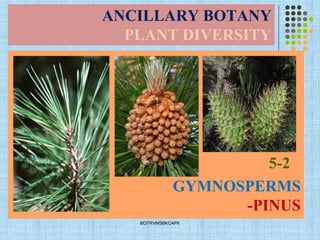
GYMNOSPERMS
-PINUS
BOTRVMSBKCAPK
GYMNOSPERMS -PINUS
POINTS TO REMEMBER
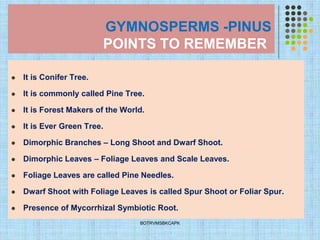
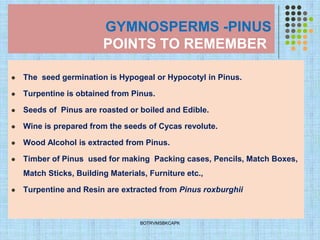
⚫ It is Conifer Tree.
⚫ It is commonly called Pine Tree.
⚫ It is Forest Makers of the World.
⚫ It is Ever Green Tree.
⚫ Dimorphic Branches – Long Shoot and Dwarf Shoot.
⚫ Dimorphic Leaves – Foliage Leaves and Scale Leaves.
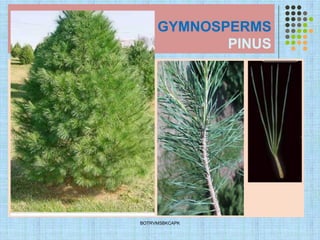
⚫ Foliage Leaves are called Pine Needles.
⚫ Dwarf Shoot with Foliage Leaves is called Spur Shoot or Foliar Spur.
⚫ Presence of Mycorrhizal Symbiotic Root.
BOTRVMSBKCAPK
GYMNOSPERMS -PINUS
POINTS TO REMEMBER
⚫ The seed germination is Hypogeal or Hypocotyl in Pinus.
⚫ Turpentine is obtained from Pinus.
⚫ Seeds of Pinus are roasted or boiled and Edible.
⚫ Wine is prepared from the seeds of Cycas revolute.
⚫ Wood Alcohol is extracted from Pinus.
⚫ Timber of Pinus used for making Packing cases, Pencils, Match Boxes,
Match Sticks, Building Materials, Furniture etc.,
⚫ Turpentine and Resin are extracted from Pinus roxburghii
BOTRVMSBKCAPK
GYMNOSPERMS
PINUS
BOTRVMSBKCAPK
GYMNOSPERMS
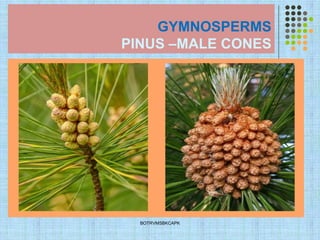
PINUS –MALE CONES
BOTRVMSBKCAPK
GYMNOSPERMS
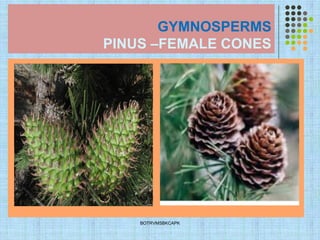
PINUS –FEMALE CONES
BOTRVMSBKCAPK
GYMNOSPERMS
PINUS
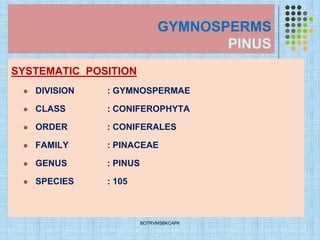
SYSTEMATIC POSITION
⚫ DIVISION : GYMNOSPERMAE
⚫ CLASS : CONIFEROPHYTA
⚫ ORDER : CONIFERALES
⚫ FAMILY : PINACEAE
⚫ GENUS : PINUS
⚫ SPECIES : 105
BOTRVMSBKCAPK
GYMNOSPERMS -PINUS
STRUCTURE OF PLANT BODY OF PINUS
STRUCTURE OF PLANT BODY OF PINUS (or)
STRUCTURE OF PINE TREE (or)
SPOROPHYTIC BODY OF PINUS
⚫ It is a Conical, Tall, and Evergreen Tree
⚫ The Plant Body is Diploid Sporophyte, consists of
▪ Root
▪ Stem and
▪ Leaves
BOTRVMSBKCAPK
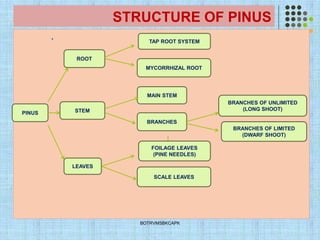
STRUCTURE OF PINUS
.
BOTRVMSBKCAPK
MAIN STEM
PINUS
ROOT
STEM
MYCORRHIZAL ROOT
LEAVES
TAP ROOT SYSTEM
BRANCHES
SCALE LEAVES
FOILAGE LEAVES
(PINE NEEDLES)
BRANCHES OF LIMITED
(DWARF SHOOT)
BRANCHES OF UNLIMITED
(LONG SHOOT)
GYMNOSPERMS -PINUS
STRUCTURE OF PLANT BODY OF PINUS
BOTRVMSBKCAPK
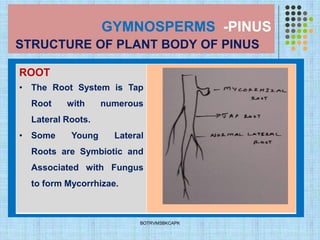
ROOT
• The Root System is Tap
Root with numerous
Lateral Roots.
• Some Young Lateral
Roots are Symbiotic and
Associated with Fungus
to form Mycorrhizae.
GYMNOSPERMS -PINUS
STRUCTURE OF PLANT BODY OF PINUS
STEM
⚫ The Stem consists of
▪ Main Stem and
▪ Branches.
⚫ The Growth of Main Stem is Continuous by Apical Bud and Produces
Branches in Whorls.
⚫ The Main Stem is covered by Scale Leaves.
⚫ The Lower Branches are Longer than Upper Branches in the Pine
Tree, this arrangement gives Conical Shape. So the Trees are called
Conifers.
⚫ The Branches are Dimorphic (Two Types) namely
▪ Long Shoots and
▪ Dwarf shoots
BOTRVMSBKCAPK
GYMNOSPERMS -PINUS
STRUCTURE OF PLANT BODY OF PINUS
BOTRVMSBKCAPK
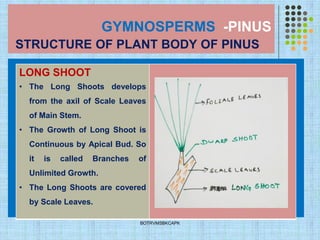
LONG SHOOT
• The Long Shoots develops
from the axil of Scale Leaves
of Main Stem.
• The Growth of Long Shoot is
Continuous by Apical Bud. So
it is called Branches of
Unlimited Growth.
• The Long Shoots are covered
by Scale Leaves.
GYMNOSPERMS -PINUS
STRUCTURE OF PLANT BODY OF PINUS
DWARF SHOOT or SPUR SHOOT
⚫ The Dwarf Shoots develops from the axil of Scale leaves of Long
Shoot.
⚫ The Growth of Dwarf Shoot is Restricted by the loss of Apical Bud.
So it is called Branches of Limited Growth
⚫ The Dwarf Shoots are covered by Scale Leaves and End with Foliage
Leaves or Pine Needles.
⚫ The Dwarf Shoot with many Pine Needles is called Spur Shoot or
Foliar Spur
BOTRVMSBKCAPK
GYMNOSPERMS -PINUS
STRUCTURE OF PLANT BODY OF PINUS
LEAVES
⚫ The Leaves are Dimorphic ie Two types namely
⚫ Foliage Leaves and
⚫ Scale Leaves
FOLIAGE LEAVES
⚫ Foliage Leaves are Green and Needle like.
⚫ Also called Pine Needle.
⚫ Involved in Photosynthesis.
SCALE LEAVES
⚫ Scale Leaves are Brown and Membranous.
⚫ Also called Cataphylls.
⚫ Gives Protection to Buds.
BOTRVMSBKCAPK
INTERNAL STRUCTURE
T.S OF PINUS NEEDLE
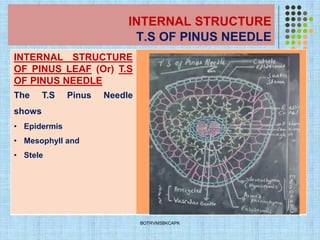
INTERNAL STRUCTURE
OF PINUS LEAF (Or) T.S
OF PINUS NEEDLE
The T.S Pinus Needle
shows
• Epidermis
• Mesophyll and
• Stele
BOTRVMSBKCAPK
INTERNAL STRUCTURE
T.S OF PINUS NEEDLE
EPIDERMIS
⚫ It is an outer most multicellular unilayer.
⚫ It is made up of thick walled Parenchyma
⚫ Presence of thick Cuticle
⚫ Stomata are Sunken
⚫ It gives protection to the internal tissue.
MESOPHYLL
⚫ It is a tissue present below the epidermis
⚫ It consists of
▪ Outer Hypodermis
▪ Middle Arm Parenchyma and
▪ Inner Endodermis
BOTRVMSBKCAPK
INTERNAL STRUCTURE
T.S OF PINUS NEEDLE
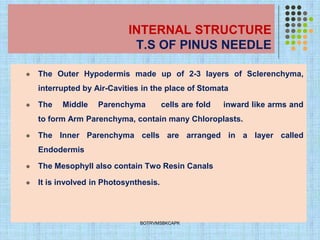
⚫ The Outer Hypodermis made up of 2-3 layers of Sclerenchyma,
interrupted by Air-Cavities in the place of Stomata
⚫ The Middle Parenchyma cells are fold inward like arms and
to form Arm Parenchyma, contain many Chloroplasts.
⚫ The Inner Parenchyma cells are arranged in a layer called
Endodermis
⚫ The Mesophyll also contain Two Resin Canals
⚫ It is involved in Photosynthesis.
BOTRVMSBKCAPK
INTERNAL STRUCTURE
T.S OF PINUS NEEDLE
STELE
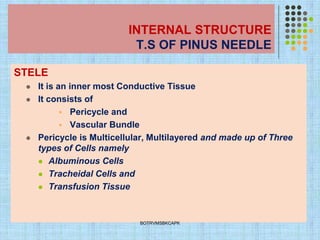
⚫ It is an inner most Conductive Tissue
⚫ It consists of
▪ Pericycle and
▪ Vascular Bundle
⚫ Pericycle is Multicellular, Multilayered and made up of Three
types of Cells namely
⚫ Albuminous Cells
⚫ Tracheidal Cells and
⚫ Transfusion Tissue
BOTRVMSBKCAPK
INTERNAL STRUCTURE OF PINUS
T.S OF PINUS NEEDLE
VASCULAR BUNDLE
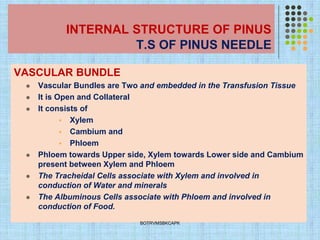
⚫ Vascular Bundles are Two and embedded in the Transfusion Tissue
⚫ It is Open and Collateral
⚫ It consists of
▪ Xylem
▪ Cambium and
▪ Phloem
⚫ Phloem towards Upper side, Xylem towards Lower side and Cambium
present between Xylem and Phloem
⚫ The Tracheidal Cells associate with Xylem and involved in
conduction of Water and minerals
⚫ The Albuminous Cells associate with Phloem and involved in
conduction of Food.
BOTRVMSBKCAPK
INTERNAL STRUCTURE
T.S OF YOUNG ROOT OF PINUS
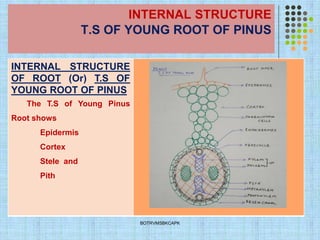
INTERNAL STRUCTURE
OF ROOT (Or) T.S OF
YOUNG ROOT OF PINUS
The T.S of Young Pinus
Root shows
Epidermis
Cortex
Stele and
Pith
BOTRVMSBKCAPK
INTERNAL STRUCTURE
T.S OF YOUNG ROOT OF PINUS
EPIDERMIS
⚫ It is an Outermost Multicellular Unilayer.
⚫ Some Epidermal cells Extent Outsides to form Unicellular Root Hairs
for Absorption.
⚫ It Gives Protection to the Internal Tissues.
CORTEX
⚫ It is a Tissue Present Below the Epidermis.
⚫ It is made up of Parenchyma Cells.
⚫ It is End with Single Layer called Endodermis.
⚫ It is Involved in Storage.
BOTRVMSBKCAPK
INTERNAL STRUCTURE
T.S OF YOUNG ROOT OF PINUS
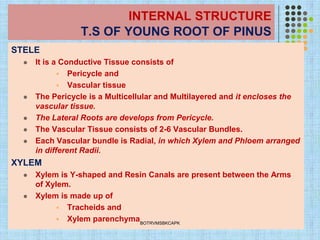
STELE
⚫ It is a Conductive Tissue consists of
▪ Pericycle and
▪ Vascular tissue
⚫ The Pericycle is a Multicellular and Multilayered and it encloses the
vascular tissue.
⚫ The Lateral Roots are develops from Pericycle.
⚫ The Vascular Tissue consists of 2-6 Vascular Bundles.
⚫ Each Vascular bundle is Radial, in which Xylem and Phloem arranged
in different Radii.
XYLEM
⚫ Xylem is Y-shaped and Resin Canals are present between the Arms
of Xylem.
⚫ Xylem is made up of
▪ Tracheids and
▪ Xylem parenchymaBOTRVMSBKCAPK
INTERNAL STRUCTURE
T.S OF YOUNG ROOT OF PINUS
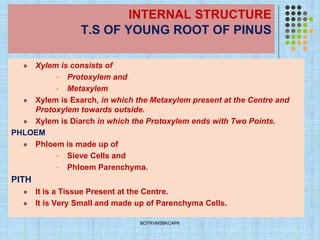
⚫ Xylem is consists of
▪ Protoxylem and
▪ Metaxylem
⚫ Xylem is Exarch, in which the Metaxylem present at the Centre and
Protoxylem towards outside.
⚫ Xylem is Diarch in which the Protoxylem ends with Two Points.
PHLOEM
⚫ Phloem is made up of
▪ Sieve Cells and
▪ Phloem Parenchyma.
PITH
⚫ It is a Tissue Present at the Centre.
⚫ It is Very Small and made up of Parenchyma Cells.
BOTRVMSBKCAPK
INTERNAL STRUCTURE
T.S OF OLD ROOT OF PINUS
BOTRVMSBKCAPK
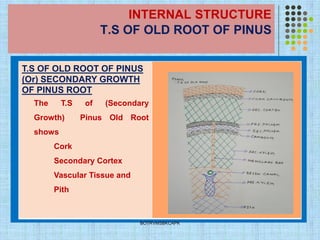
T.S OF OLD ROOT OF PINUS
(Or) SECONDARY GROWTH
OF PINUS ROOT
The T.S of (Secondary
Growth) Pinus Old Root
shows
Cork
Secondary Cortex
Vascular Tissue and
Pith
INTERNAL STRUCTURE
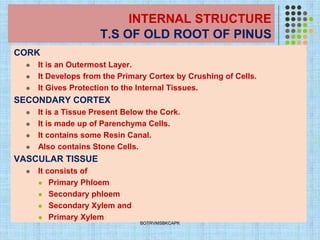
T.S OF OLD ROOT OF PINUS
CORK
⚫ It is an Outermost Layer.
⚫ It Develops from the Primary Cortex by Crushing of Cells.
⚫ It Gives Protection to the Internal Tissues.
SECONDARY CORTEX
⚫ It is a Tissue Present Below the Cork.
⚫ It is made up of Parenchyma Cells.
⚫ It contains some Resin Canal.
⚫ Also contains Stone Cells.
VASCULAR TISSUE
⚫ It consists of
⚫ Primary Phloem
⚫ Secondary phloem
⚫ Secondary Xylem and
⚫ Primary Xylem
BOTRVMSBKCAPK
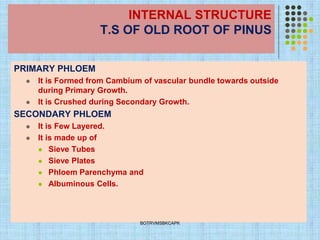
INTERNAL STRUCTURE
T.S OF OLD ROOT OF PINUS
PRIMARY PHLOEM
⚫ It is Formed from Cambium of vascular bundle towards outside
during Primary Growth.
⚫ It is Crushed during Secondary Growth.
SECONDARY PHLOEM
⚫ It is Few Layered.
⚫ It is made up of
⚫ Sieve Tubes
⚫ Sieve Plates
⚫ Phloem Parenchyma and
⚫ Albuminous Cells.
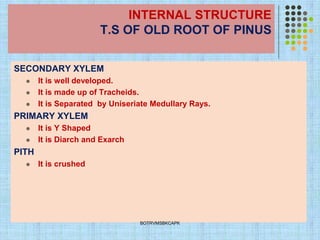
BOTRVMSBKCAPK
INTERNAL STRUCTURE
T.S OF OLD ROOT OF PINUS
SECONDARY XYLEM
⚫ It is well developed.
⚫ It is made up of Tracheids.
⚫ It is Separated by Uniseriate Medullary Rays.
PRIMARY XYLEM
⚫ It is Y Shaped
⚫ It is Diarch and Exarch
PITH
⚫ It is crushed
BOTRVMSBKCAPK
INTERNAL STRUCTURE
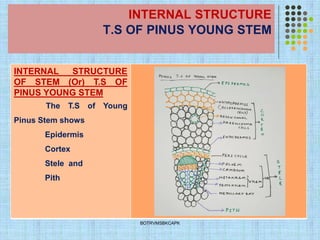
T.S OF PINUS YOUNG STEM
INTERNAL STRUCTURE
OF STEM (Or) T.S OF
PINUS YOUNG STEM
The T.S of Young
Pinus Stem shows
Epidermis
Cortex
Stele and
Pith
BOTRVMSBKCAPK
INTERNAL STRUCTURE
T.S OF PINUS YOUNG STEM
EPIDERMIS
⚫ It is an Outer Most Multicellular Unilayer.
⚫ It is an Irregular Outline due to the Presence of Scale Leaves.
⚫ Cuticle is Present.
⚫ It Gives Protection to the Internal Tissues.
CORTEX
⚫ It is a Tissue Present Below the Epidermis.
⚫ It is made up of
▪ Outer Hypodermis
▪ Middle Parenchyma and
▪ Inner Endodermis.
BOTRVMSBKCAPK
INTERNAL STRUCTURE
T.S OF PINUS YOUNG STEM
⚫ The Outer Hypodermis made up of 2-3 Layers of Sclerenchyma Cells
Gives Mechanical Support.
⚫ The Middle many Layers of Parenchyma Cells Involved in Storage
and also contains many Resin Canals.
⚫ Each Resin Canal is surrounded by a layer of Glandular Epithelial
Cells that Secrete Turpentine.
⚫ The Inner Parenchyma Cells arranged in Single Layer called
Endodermis.
STELE
⚫ It is a conductive tissue consists of
▪ Pericycle and
▪ Vascular Tissue.
BOTRVMSBKCAPK
INTERNAL STRUCTURE
T.S OF PINUS YOUNG STEM
⚫ The Pericycle is a Multicellular and Few Layered and it encloses the
vascular tissue.
⚫ The Vascular Tissue consists of 5-8 Vascular Bundles Separated by
Medullary Rays.
⚫ The Vascular Bundles are arranged in a Ring.
⚫ Each Vascular Bundle is Open in which the Cambium is Present
Between Xylem and Phloem.
⚫ Each Vascular Bundle is Collateral in which the Xylem and Phloem
arranged in Same Radius.
XYLEM
⚫ Xylem is made up of
▪ Tracheids and
▪ Xylem parenchyma
BOTRVMSBKCAPK
INTERNAL STRUCTURE
T.S OF PINUS YOUNG STEM
⚫ Xylem consists of
▪ Protoxylem and
▪ Metaxylem
⚫ Xylem is Endarch in which the metaxylem toward outside and the
protoxylem toward inside of Stem.
PHLOEM
⚫ Phloem is made up of
▪ Sieve Cells
▪ Sieve Plates and
▪ Phloem Parenchyma.
PITH
⚫ It is a Tissue Present at the Centre
⚫ It is made up of Parenchyma Cells connected with cortex by
Medullary Rays.
BOTRVMSBKCAPK
INTERNAL STRUCTURE
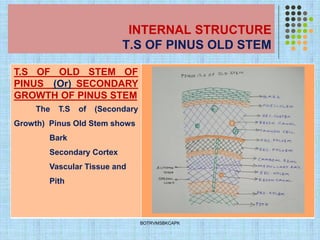
T.S OF PINUS OLD STEM
T.S OF OLD STEM OF
PINUS (Or) SECONDARY
GROWTH OF PINUS STEM
The T.S of (Secondary
Growth) Pinus Old Stem shows
Bark
Secondary Cortex
Vascular Tissue and
Pith
BOTRVMSBKCAPK
INTERNAL STRUCTURE
T.S OF PINUS OLD STEM
BARK
⚫ It is an Outer Most Dead Cork Tissue.
⚫ It is Formed from Cork Cambium or Phellogen Towards Outside.
⚫ Cork Cambium or Phellogen is a Lateral Meristematic Tissue formed
from the outer cells of Cortex during Secondary Growth.
SECONDARY CORTX
⚫ It is Present Below the Bark.
⚫ It is made up of Parenchyma Cells.
⚫ Some cells Filled with Tannin.
⚫ It also contains some Resin Canal.
⚫ It is Formed from Cork Cambium or Phellogen Towards Inside.
BOTRVMSBKCAPK
INTERNAL STRUCTURE
T.S OF PINUS OLD STEM
VASCULAR TISSUE
It consists of
▪ Primary Phloem
▪ Secondary Phloem
▪ Secondary Xylem and
▪ Primary Xylem
PRIMARY PHLOEM
⚫ It is Formed from Cambium of Vascular Bundle Towards Outside
during Primary Growth.
⚫ It is Crushed during Secondary Growth.
⚫ Cambium is a Lateral Meristematic Tissue present between Xylem
and Phloem of Vascular Bundle
BOTRVMSBKCAPK
INTERNAL STRUCTURE
T.S OF PINUS OLD STEM
SECONDARY PHLOEM
⚫ The Secondary Phloem formed from Cambial Ring towards outside
during Secondary Growth
⚫ It consists of
▪ Sieve Tubes and
▪ Phloem Parenchyma
⚫ The Cambial Ring is a Lateral Meristematic Tissue formed from the
extension of Intrafascicular Cambium of Vascular Bundles and joins
to form continuous Ring called Cambial during Secondary Growth
SECONDARY XYLEM
⚫ The Secondary Xylem is also called Wood
⚫ The Secondary Xylem formed from Cambial Ring towards inside
during Secondary Growth
BOTRVMSBKCAPK
INTERNAL STRUCTURE
T.S OF PINUS OLD STEM
⚫ It consists of
▪ Tracheids and
▪ Xylem Parenchyma
⚫ It is Transverse by Secondary Medullary Rays.
PRIMARY XYLEM
⚫ It is formed from cambium of vascular bundle during Primary Growth
⚫ It is Endarch
PITH
⚫ It is a Tissue present at the Centre.
⚫ It is Made up of small and Parenchymatous Cells.
⚫ Many cells filled with Tannin.
BOTRVMSBKCAPK
PINUS
REPRODUCTION
REPRODUCTION OF PINUS (or)
ASEXUAL REPRODUCTION OF PINUS (or)
REPRODUCTION OF SPOROPHYTIC BODY OF PINUS
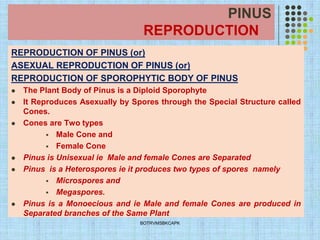
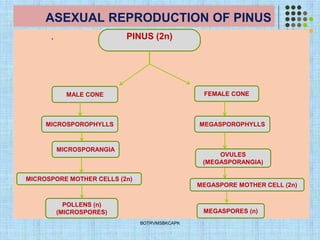
⚫ The Plant Body of Pinus is a Diploid Sporophyte
⚫ It Reproduces Asexually by Spores through the Special Structure called
Cones.
⚫ Cones are Two types
▪ Male Cone and
▪ Female Cone
⚫ Pinus is Unisexual ie Male and female Cones are Separated
⚫ Pinus is a Heterospores ie it produces two types of spores namely
▪ Microspores and
▪ Megaspores.
⚫ Pinus is a Monoecious and ie Male and female Cones are produced in
Separated branches of the Same Plant
BOTRVMSBKCAPK
ASEXUAL REPRODUCTION OF PINUS
.
BOTRVMSBKCAPK
PINUS (2n)
MALE CONE FEMALE CONE
POLLENS (n)
(MICROSPORES) MEGASPORES (n)
MICROSPOROPHYLLS MEGASPOROPHYLLS
MICROSPORANGIA
OVULES
(MEGASPORANGIA)
MICROSPORE MOTHER CELLS (2n)
MEGASPORE MOTHER CELL (2n)
PINUS
REPRODUCTION
MALE CONE
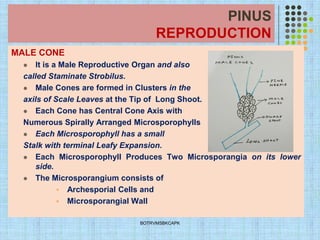
⚫ It is a Male Reproductive Organ and also
called Staminate Strobilus.
⚫ Male Cones are formed in Clusters in the
axils of Scale Leaves at the Tip of Long Shoot.
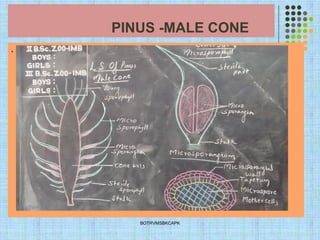
⚫ Each Cone has Central Cone Axis with
Numerous Spirally Arranged Microsporophylls
⚫ Each Microsporophyll has a small
Stalk with terminal Leafy Expansion.
⚫ Each Microsporophyll Produces Two Microsporangia on its lower
side.
⚫ The Microsporangium consists of
▪ Archesporial Cells and
▪ Microsporangial Wall
BOTRVMSBKCAPK
PINUS -MALE CONE
.
BOTRVMSBKCAPK
PINUS
REPRODUCTION
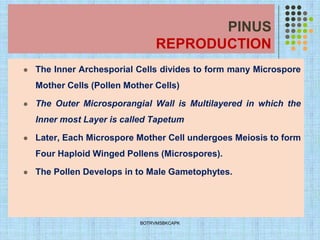
⚫ The Inner Archesporial Cells divides to form many Microspore
Mother Cells (Pollen Mother Cells)
⚫ The Outer Microsporangial Wall is Multilayered in which the
Inner most Layer is called Tapetum
⚫ Later, Each Microspore Mother Cell undergoes Meiosis to form
Four Haploid Winged Pollens (Microspores).
⚫ The Pollen Develops in to Male Gametophytes.
BOTRVMSBKCAPK
PINUS
REPRODUCTION
.
BOTRVMSBKCAPK
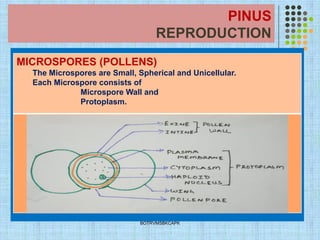
MICROSPORES (POLLENS)
The Microspores are Small, Spherical and Unicellular.
Each Microspore consists of
Microspore Wall and
Protoplasm.
PINUS
REPRODUCTION
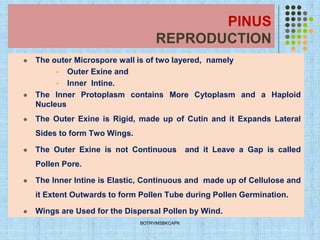
⚫ The outer Microspore wall is of two layered, namely
▪ Outer Exine and
▪ Inner Intine.
⚫ The Inner Protoplasm contains More Cytoplasm and a Haploid
Nucleus
⚫ The Outer Exine is Rigid, made up of Cutin and it Expands Lateral
Sides to form Two Wings.
⚫ The Outer Exine is not Continuous and it Leave a Gap is called
Pollen Pore.
⚫ The Inner Intine is Elastic, Continuous and made up of Cellulose and
it Extent Outwards to form Pollen Tube during Pollen Germination.
⚫ Wings are Used for the Dispersal Pollen by Wind.
BOTRVMSBKCAPK
PINUS
REPRODUCTION
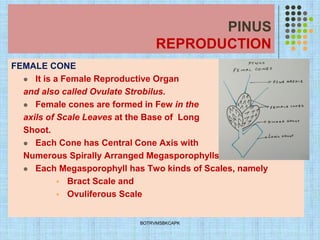
FEMALE CONE
⚫ It is a Female Reproductive Organ
and also called Ovulate Strobilus.
⚫ Female cones are formed in Few in the
axils of Scale Leaves at the Base of Long
Shoot.
⚫ Each Cone has Central Cone Axis with
Numerous Spirally Arranged Megasporophylls
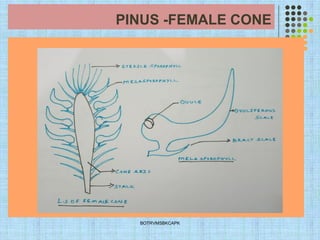
⚫ Each Megasporophyll has Two kinds of Scales, namely
▪ Bract Scale and
▪ Ovuliferous Scale
BOTRVMSBKCAPK
PINUS -FEMALE CONE
BOTRVMSBKCAPK
PINUS
REPRODUCTION
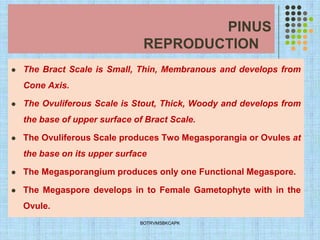
⚫ The Bract Scale is Small, Thin, Membranous and develops from
Cone Axis.
⚫ The Ovuliferous Scale is Stout, Thick, Woody and develops from
the base of upper surface of Bract Scale.
⚫ The Ovuliferous Scale produces Two Megasporangia or Ovules at
the base on its upper surface
⚫ The Megasporangium produces only one Functional Megaspore.
⚫ The Megaspore develops in to Female Gametophyte with in the
Ovule.
BOTRVMSBKCAPK
PINUS
STRCTURE OF OVULE
STRCTURE OF OVULE
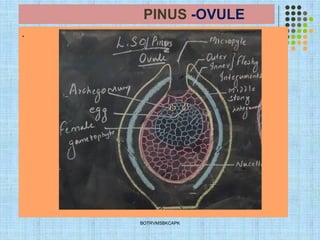
⚫ The Megasporangium or Ovule consists of
▪ Integument and
▪ Nucellus
⚫ The Outer Integument is made up of Three Layered, namely
▪ Outer Fleshy Layer
▪ Middle Stony Layer and
▪ Inner Fleshy Layer.
⚫ The Inner Nucellus is a Nutritive Tissue.
BOTRVMSBKCAPK
PINUS -OVULE
.
BOTRVMSBKCAPK
PINUS
STRCTURE OF OVULE
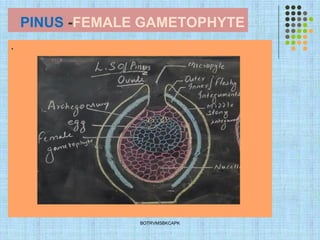
⚫ The Integument Leaves an Opening is called Micropyle
⚫ During the Development of Ovule, a cell in Nucellus near to
Micropyle is Differentiate and act as Megaspore Mother Cell
⚫ The Megaspore Mother Cell undergoes Meiosis to form Four Haploid
Megaspores in Linear Tetrads.
⚫ In which, Three Megaspores are Disintegrate towards Micropyle and
Remaining One is Functional.
⚫ The Functional Megaspore develops in to Female Gametophyte with
in the Ovule.
BOTRVMSBKCAPK
GAMETOPHYTIC BODY OF PINUS
STRUCTURE and REPRODUCTION
GAMETOPHYTIC BODY
⚫ The Gametophytic Body of Pinus is Small and Haploid
⚫ The Gametophytic Body of Pinus is Dioecious in which the Male and
Female Gametophytic Bodies are Separated.
REPRODUCTION OF GAMETOPHYTIC BODY
⚫ The Gametophytic Body Reproduces by Sexual Method.
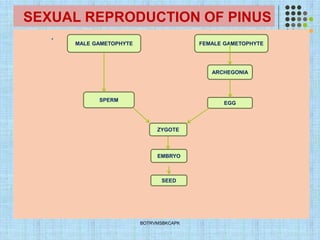
SEXUAL REPRODUCTION
⚫ Sexual Reproduction is Oogamous type.
BOTRVMSBKCAPK
SEXUAL REPRODUCTION OF PINUS
.
BOTRVMSBKCAPK
EMBRYO
MALE GAMETOPHYTE FEMALE GAMETOPHYTE
ARCHEGONIA
ZYGOTE
EGG
SPERM
SEED
GAMETOPHYTIC BODY
-SEXUAL REPRODUCTION OF PINUS
STRUCTURE OF MALE GAMETOPHYTE
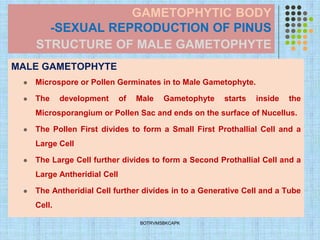
MALE GAMETOPHYTE
⚫ Microspore or Pollen Germinates in to Male Gametophyte.
⚫ The development of Male Gametophyte starts inside the
Microsporangium or Pollen Sac and ends on the surface of Nucellus.
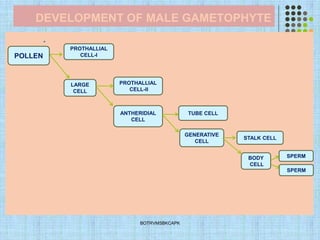
⚫ The Pollen First divides to form a Small First Prothallial Cell and a
Large Cell
⚫ The Large Cell further divides to form a Second Prothallial Cell and a
Large Antheridial Cell
⚫ The Antheridial Cell further divides in to a Generative Cell and a Tube
Cell.
BOTRVMSBKCAPK
DEVELOPMENT OF MALE GAMETOPHYTE
.
BOTRVMSBKCAPK
LARGE
CELL
PROTHALLIAL
CELL-II
GENERATIVE
CELL
TUBE CELL
ANTHERIDIAL
CELL
STALK CELL
PROTHALLIAL
CELL-I
POLLEN
BODY
CELL
SPERM
SPERM
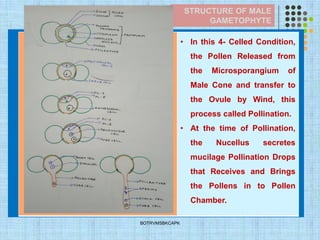
STRUCTURE OF MALE
GAMETOPHYTE
BOTRVMSBKCAPK
• In this 4- Celled Condition,
the Pollen Released from
the Microsporangium of
Male Cone and transfer to
the Ovule by Wind, this
process called Pollination.
• At the time of Pollination,
the Nucellus secretes
mucilage Pollination Drops
that Receives and Brings
the Pollens in to Pollen
Chamber.
GAMETOPHYTIC BODY
-SEXUAL REPRODUCTION OF PINUS
STRUCTURE OF MALE GAMETOPHYTE
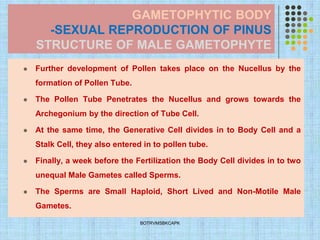
⚫ Further development of Pollen takes place on the Nucellus by the
formation of Pollen Tube.
⚫ The Pollen Tube Penetrates the Nucellus and grows towards the
Archegonium by the direction of Tube Cell.
⚫ At the same time, the Generative Cell divides in to Body Cell and a
Stalk Cell, they also entered in to pollen tube.
⚫ Finally, a week before the Fertilization the Body Cell divides in to two
unequal Male Gametes called Sperms.
⚫ The Sperms are Small Haploid, Short Lived and Non-Motile Male
Gametes.
BOTRVMSBKCAPK
GAMETOPHYTIC BODY
-SEXUAL REPRODUCTION OF PINUS
STRUCTURE OF FEMALE GAMETOPHYTE
FEMALE GAMETOPHYTE
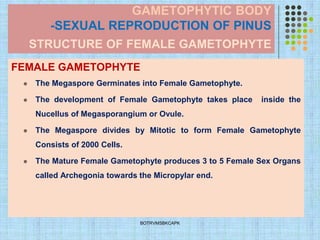
⚫ The Megaspore Germinates into Female Gametophyte.
⚫ The development of Female Gametophyte takes place inside the
Nucellus of Megasporangium or Ovule.
⚫ The Megaspore divides by Mitotic to form Female Gametophyte
Consists of 2000 Cells.
⚫ The Mature Female Gametophyte produces 3 to 5 Female Sex Organs
called Archegonia towards the Micropylar end.
BOTRVMSBKCAPK
PINUS -FEMALE GAMETOPHYTE
.
BOTRVMSBKCAPK
GAMETOPHYTIC BODY
-SEXUAL REPRODUCTION OF PINUS
STRUCTURE OF FEMALE GAMETOPHYTE
ARCHEGONIA
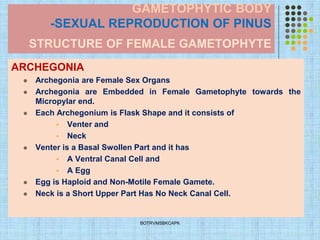
⚫ Archegonia are Female Sex Organs
⚫ Archegonia are Embedded in Female Gametophyte towards the
Micropylar end.
⚫ Each Archegonium is Flask Shape and it consists of
▪ Venter and
▪ Neck
⚫ Venter is a Basal Swollen Part and it has
▪ A Ventral Canal Cell and
▪ A Egg
⚫ Egg is Haploid and Non-Motile Female Gamete.
⚫ Neck is a Short Upper Part Has No Neck Canal Cell.
BOTRVMSBKCAPK
GAMETOPHYTIC BODY
-SEXUAL REPRODUCTION OF PINUS
POLLINATION
POLLINATION
⚫ The Process of Transfer of Pollens (Microspores) from
Microsporangia of Male Cones to Ovules (Megasporangia) in Pinus is
called Pollination.
⚫ In Pinus, the Pollination is take place by Wind. So, it is called
Anemophillous.
⚫ After Mature, the Male Cones Releases Enormous Yellow Coloured
Pollens into the Air, it is Look Like Sulphur Rain.
⚫ After Mature, the Female Cones allows the Pollens Between
Megasporophylls by the Elongation of Cone Axis.
⚫ At the Same Time, the Nucellus of Mature Ovule Secretes Mucilage
Pollination Drops through the Micropyle that Receives and Bring the
Pollens in to Pollen Chamber.
BOTRVMSBKCAPK
GAMETOPHYTIC BODY
-SEXUAL REPRODUCTION OF PINUS
FERTILIZATION
FERTILIZATION
⚫ Fertilization takes place after one year of Pollination.
⚫ The Pollen Tube carries the Tube Cell, Stalk Cell and 2 Sperms into
the Archegonium.
⚫ The Tip of Pollen Tube is Dissolve and Discharged the content in to
the Venter of Archegonium.
⚫ One of the Functional Sperm fuse with Egg to form Diploid Zygote.
⚫ The Tube Cell, Stalk Cell and the Second Sperm Degenerate and
Disappear.
BOTRVMSBKCAPK
GAMETOPHYTIC BODY
-SEXUAL REPRODUCTION OF PINUS
DEVELOPMENT OF EMBRYO
.
BOTRVMSBKCAPK
DEVELOPMENT OF EMBRYO
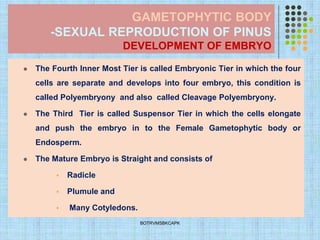
• The Zygote develops thick
wall to form Oospore.
• The Oospore divides Four
Times by Mitosis to form 16
celled Pro-Embryo.
• The 16 cells Pro-Embryo
arranged in 4Tiers of Four
Cells each.
GAMETOPHYTIC BODY
-SEXUAL REPRODUCTION OF PINUS
DEVELOPMENT OF EMBRYO
⚫ The Fourth Inner Most Tier is called Embryonic Tier in which the four
cells are separate and develops into four embryo, this condition is
called Polyembryony and also called Cleavage Polyembryony.
⚫ The Third Tier is called Suspensor Tier in which the cells elongate
and push the embryo in to the Female Gametophytic body or
Endosperm.
⚫ The Mature Embryo is Straight and consists of
▪ Radicle
▪ Plumule and
▪ Many Cotyledons.
BOTRVMSBKCAPK
GAMETOPHYTIC BODY
-SEXUAL REPRODUCTION OF PINUS
SEED
.
BOTRVMSBKCAPK
SEED
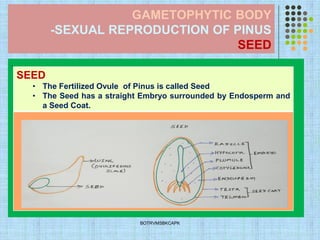
• The Fertilized Ovule of Pinus is called Seed
• The Seed has a straight Embryo surrounded by Endosperm and
a Seed Coat.
GAMETOPHYTIC BODY
-SEXUAL REPRODUCTION OF PINUS
SEED
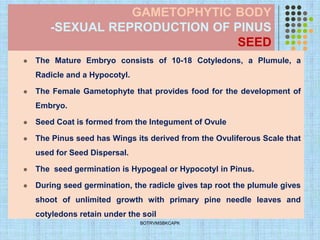
⚫ The Mature Embryo consists of 10-18 Cotyledons, a Plumule, a
Radicle and a Hypocotyl.
⚫ The Female Gametophyte that provides food for the development of
Embryo.
⚫ Seed Coat is formed from the Integument of Ovule
⚫ The Pinus seed has Wings its derived from the Ovuliferous Scale that
used for Seed Dispersal.
⚫ The seed germination is Hypogeal or Hypocotyl in Pinus.
⚫ During seed germination, the radicle gives tap root the plumule gives
shoot of unlimited growth with primary pine needle leaves and
cotyledons retain under the soil
BOTRVMSBKCAPK
LIFE CYCLE OF PINUS
LIFE CYCLE
⚫ Life Cycle is called Alternations of Generation.
⚫ It consists of Two Bodies namely
▪ Sporophytic Body and
▪ Gametophytic Body
⚫ In which the spores producing Sporophytic body and gametes
producing Gametophytic body are Depends each other and Alternate
with one another.
BOTRVMSBKCAPK
LIFE CYCLE OF PINUS
.
BOTRVMSBKCAPK
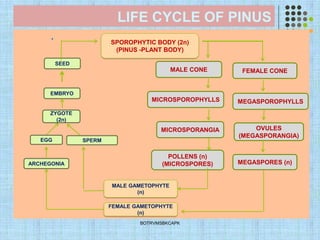
MALE CONE FEMALE CONE
POLLENS (n)
(MICROSPORES) MEGASPORES (n)
EMBRYO
MALE GAMETOPHYTE
(n)
FEMALE GAMETOPHYTE
(n)
ARCHEGONIA
ZYGOTE
(2n)
EGG SPERM
SEED
MICROSPOROPHYLLS MEGASPOROPHYLLS
MICROSPORANGIA OVULES
(MEGASPORANGIA)
SPOROPHYTIC BODY (2n)
(PINUS -PLANT BODY)

5 2 -pinus

  • 1.
  • 2.
    GYMNOSPERMS -PINUS POINTS TOREMEMBER ⚫ It is Conifer Tree. ⚫ It is commonly called Pine Tree. ⚫ It is Forest Makers of the World. ⚫ It is Ever Green Tree. ⚫ Dimorphic Branches – Long Shoot and Dwarf Shoot. ⚫ Dimorphic Leaves – Foliage Leaves and Scale Leaves. ⚫ Foliage Leaves are called Pine Needles. ⚫ Dwarf Shoot with Foliage Leaves is called Spur Shoot or Foliar Spur. ⚫ Presence of Mycorrhizal Symbiotic Root. BOTRVMSBKCAPK
  • 3.
    GYMNOSPERMS -PINUS POINTS TOREMEMBER ⚫ The seed germination is Hypogeal or Hypocotyl in Pinus. ⚫ Turpentine is obtained from Pinus. ⚫ Seeds of Pinus are roasted or boiled and Edible. ⚫ Wine is prepared from the seeds of Cycas revolute. ⚫ Wood Alcohol is extracted from Pinus. ⚫ Timber of Pinus used for making Packing cases, Pencils, Match Boxes, Match Sticks, Building Materials, Furniture etc., ⚫ Turpentine and Resin are extracted from Pinus roxburghii BOTRVMSBKCAPK
  • 4.
  • 5.
  • 6.
  • 7.
    GYMNOSPERMS PINUS SYSTEMATIC POSITION ⚫ DIVISION: GYMNOSPERMAE ⚫ CLASS : CONIFEROPHYTA ⚫ ORDER : CONIFERALES ⚫ FAMILY : PINACEAE ⚫ GENUS : PINUS ⚫ SPECIES : 105 BOTRVMSBKCAPK
  • 8.
    GYMNOSPERMS -PINUS STRUCTURE OFPLANT BODY OF PINUS STRUCTURE OF PLANT BODY OF PINUS (or) STRUCTURE OF PINE TREE (or) SPOROPHYTIC BODY OF PINUS ⚫ It is a Conical, Tall, and Evergreen Tree ⚫ The Plant Body is Diploid Sporophyte, consists of ▪ Root ▪ Stem and ▪ Leaves BOTRVMSBKCAPK
  • 9.
    STRUCTURE OF PINUS . BOTRVMSBKCAPK MAINSTEM PINUS ROOT STEM MYCORRHIZAL ROOT LEAVES TAP ROOT SYSTEM BRANCHES SCALE LEAVES FOILAGE LEAVES (PINE NEEDLES) BRANCHES OF LIMITED (DWARF SHOOT) BRANCHES OF UNLIMITED (LONG SHOOT)
  • 10.
    GYMNOSPERMS -PINUS STRUCTURE OFPLANT BODY OF PINUS BOTRVMSBKCAPK ROOT • The Root System is Tap Root with numerous Lateral Roots. • Some Young Lateral Roots are Symbiotic and Associated with Fungus to form Mycorrhizae.
  • 11.
    GYMNOSPERMS -PINUS STRUCTURE OFPLANT BODY OF PINUS STEM ⚫ The Stem consists of ▪ Main Stem and ▪ Branches. ⚫ The Growth of Main Stem is Continuous by Apical Bud and Produces Branches in Whorls. ⚫ The Main Stem is covered by Scale Leaves. ⚫ The Lower Branches are Longer than Upper Branches in the Pine Tree, this arrangement gives Conical Shape. So the Trees are called Conifers. ⚫ The Branches are Dimorphic (Two Types) namely ▪ Long Shoots and ▪ Dwarf shoots BOTRVMSBKCAPK
  • 12.
    GYMNOSPERMS -PINUS STRUCTURE OFPLANT BODY OF PINUS BOTRVMSBKCAPK LONG SHOOT • The Long Shoots develops from the axil of Scale Leaves of Main Stem. • The Growth of Long Shoot is Continuous by Apical Bud. So it is called Branches of Unlimited Growth. • The Long Shoots are covered by Scale Leaves.
  • 13.
    GYMNOSPERMS -PINUS STRUCTURE OFPLANT BODY OF PINUS DWARF SHOOT or SPUR SHOOT ⚫ The Dwarf Shoots develops from the axil of Scale leaves of Long Shoot. ⚫ The Growth of Dwarf Shoot is Restricted by the loss of Apical Bud. So it is called Branches of Limited Growth ⚫ The Dwarf Shoots are covered by Scale Leaves and End with Foliage Leaves or Pine Needles. ⚫ The Dwarf Shoot with many Pine Needles is called Spur Shoot or Foliar Spur BOTRVMSBKCAPK
  • 14.
    GYMNOSPERMS -PINUS STRUCTURE OFPLANT BODY OF PINUS LEAVES ⚫ The Leaves are Dimorphic ie Two types namely ⚫ Foliage Leaves and ⚫ Scale Leaves FOLIAGE LEAVES ⚫ Foliage Leaves are Green and Needle like. ⚫ Also called Pine Needle. ⚫ Involved in Photosynthesis. SCALE LEAVES ⚫ Scale Leaves are Brown and Membranous. ⚫ Also called Cataphylls. ⚫ Gives Protection to Buds. BOTRVMSBKCAPK
  • 15.
    INTERNAL STRUCTURE T.S OFPINUS NEEDLE INTERNAL STRUCTURE OF PINUS LEAF (Or) T.S OF PINUS NEEDLE The T.S Pinus Needle shows • Epidermis • Mesophyll and • Stele BOTRVMSBKCAPK
  • 16.
    INTERNAL STRUCTURE T.S OFPINUS NEEDLE EPIDERMIS ⚫ It is an outer most multicellular unilayer. ⚫ It is made up of thick walled Parenchyma ⚫ Presence of thick Cuticle ⚫ Stomata are Sunken ⚫ It gives protection to the internal tissue. MESOPHYLL ⚫ It is a tissue present below the epidermis ⚫ It consists of ▪ Outer Hypodermis ▪ Middle Arm Parenchyma and ▪ Inner Endodermis BOTRVMSBKCAPK
  • 17.
    INTERNAL STRUCTURE T.S OFPINUS NEEDLE ⚫ The Outer Hypodermis made up of 2-3 layers of Sclerenchyma, interrupted by Air-Cavities in the place of Stomata ⚫ The Middle Parenchyma cells are fold inward like arms and to form Arm Parenchyma, contain many Chloroplasts. ⚫ The Inner Parenchyma cells are arranged in a layer called Endodermis ⚫ The Mesophyll also contain Two Resin Canals ⚫ It is involved in Photosynthesis. BOTRVMSBKCAPK
  • 18.
    INTERNAL STRUCTURE T.S OFPINUS NEEDLE STELE ⚫ It is an inner most Conductive Tissue ⚫ It consists of ▪ Pericycle and ▪ Vascular Bundle ⚫ Pericycle is Multicellular, Multilayered and made up of Three types of Cells namely ⚫ Albuminous Cells ⚫ Tracheidal Cells and ⚫ Transfusion Tissue BOTRVMSBKCAPK
  • 19.
    INTERNAL STRUCTURE OFPINUS T.S OF PINUS NEEDLE VASCULAR BUNDLE ⚫ Vascular Bundles are Two and embedded in the Transfusion Tissue ⚫ It is Open and Collateral ⚫ It consists of ▪ Xylem ▪ Cambium and ▪ Phloem ⚫ Phloem towards Upper side, Xylem towards Lower side and Cambium present between Xylem and Phloem ⚫ The Tracheidal Cells associate with Xylem and involved in conduction of Water and minerals ⚫ The Albuminous Cells associate with Phloem and involved in conduction of Food. BOTRVMSBKCAPK
  • 20.
    INTERNAL STRUCTURE T.S OFYOUNG ROOT OF PINUS INTERNAL STRUCTURE OF ROOT (Or) T.S OF YOUNG ROOT OF PINUS The T.S of Young Pinus Root shows Epidermis Cortex Stele and Pith BOTRVMSBKCAPK
  • 21.
    INTERNAL STRUCTURE T.S OFYOUNG ROOT OF PINUS EPIDERMIS ⚫ It is an Outermost Multicellular Unilayer. ⚫ Some Epidermal cells Extent Outsides to form Unicellular Root Hairs for Absorption. ⚫ It Gives Protection to the Internal Tissues. CORTEX ⚫ It is a Tissue Present Below the Epidermis. ⚫ It is made up of Parenchyma Cells. ⚫ It is End with Single Layer called Endodermis. ⚫ It is Involved in Storage. BOTRVMSBKCAPK
  • 22.
    INTERNAL STRUCTURE T.S OFYOUNG ROOT OF PINUS STELE ⚫ It is a Conductive Tissue consists of ▪ Pericycle and ▪ Vascular tissue ⚫ The Pericycle is a Multicellular and Multilayered and it encloses the vascular tissue. ⚫ The Lateral Roots are develops from Pericycle. ⚫ The Vascular Tissue consists of 2-6 Vascular Bundles. ⚫ Each Vascular bundle is Radial, in which Xylem and Phloem arranged in different Radii. XYLEM ⚫ Xylem is Y-shaped and Resin Canals are present between the Arms of Xylem. ⚫ Xylem is made up of ▪ Tracheids and ▪ Xylem parenchymaBOTRVMSBKCAPK
  • 23.
    INTERNAL STRUCTURE T.S OFYOUNG ROOT OF PINUS ⚫ Xylem is consists of ▪ Protoxylem and ▪ Metaxylem ⚫ Xylem is Exarch, in which the Metaxylem present at the Centre and Protoxylem towards outside. ⚫ Xylem is Diarch in which the Protoxylem ends with Two Points. PHLOEM ⚫ Phloem is made up of ▪ Sieve Cells and ▪ Phloem Parenchyma. PITH ⚫ It is a Tissue Present at the Centre. ⚫ It is Very Small and made up of Parenchyma Cells. BOTRVMSBKCAPK
  • 24.
    INTERNAL STRUCTURE T.S OFOLD ROOT OF PINUS BOTRVMSBKCAPK T.S OF OLD ROOT OF PINUS (Or) SECONDARY GROWTH OF PINUS ROOT The T.S of (Secondary Growth) Pinus Old Root shows Cork Secondary Cortex Vascular Tissue and Pith
  • 25.
    INTERNAL STRUCTURE T.S OFOLD ROOT OF PINUS CORK ⚫ It is an Outermost Layer. ⚫ It Develops from the Primary Cortex by Crushing of Cells. ⚫ It Gives Protection to the Internal Tissues. SECONDARY CORTEX ⚫ It is a Tissue Present Below the Cork. ⚫ It is made up of Parenchyma Cells. ⚫ It contains some Resin Canal. ⚫ Also contains Stone Cells. VASCULAR TISSUE ⚫ It consists of ⚫ Primary Phloem ⚫ Secondary phloem ⚫ Secondary Xylem and ⚫ Primary Xylem BOTRVMSBKCAPK
  • 26.
    INTERNAL STRUCTURE T.S OFOLD ROOT OF PINUS PRIMARY PHLOEM ⚫ It is Formed from Cambium of vascular bundle towards outside during Primary Growth. ⚫ It is Crushed during Secondary Growth. SECONDARY PHLOEM ⚫ It is Few Layered. ⚫ It is made up of ⚫ Sieve Tubes ⚫ Sieve Plates ⚫ Phloem Parenchyma and ⚫ Albuminous Cells. BOTRVMSBKCAPK
  • 27.
    INTERNAL STRUCTURE T.S OFOLD ROOT OF PINUS SECONDARY XYLEM ⚫ It is well developed. ⚫ It is made up of Tracheids. ⚫ It is Separated by Uniseriate Medullary Rays. PRIMARY XYLEM ⚫ It is Y Shaped ⚫ It is Diarch and Exarch PITH ⚫ It is crushed BOTRVMSBKCAPK
  • 28.
    INTERNAL STRUCTURE T.S OFPINUS YOUNG STEM INTERNAL STRUCTURE OF STEM (Or) T.S OF PINUS YOUNG STEM The T.S of Young Pinus Stem shows Epidermis Cortex Stele and Pith BOTRVMSBKCAPK
  • 29.
    INTERNAL STRUCTURE T.S OFPINUS YOUNG STEM EPIDERMIS ⚫ It is an Outer Most Multicellular Unilayer. ⚫ It is an Irregular Outline due to the Presence of Scale Leaves. ⚫ Cuticle is Present. ⚫ It Gives Protection to the Internal Tissues. CORTEX ⚫ It is a Tissue Present Below the Epidermis. ⚫ It is made up of ▪ Outer Hypodermis ▪ Middle Parenchyma and ▪ Inner Endodermis. BOTRVMSBKCAPK
  • 30.
    INTERNAL STRUCTURE T.S OFPINUS YOUNG STEM ⚫ The Outer Hypodermis made up of 2-3 Layers of Sclerenchyma Cells Gives Mechanical Support. ⚫ The Middle many Layers of Parenchyma Cells Involved in Storage and also contains many Resin Canals. ⚫ Each Resin Canal is surrounded by a layer of Glandular Epithelial Cells that Secrete Turpentine. ⚫ The Inner Parenchyma Cells arranged in Single Layer called Endodermis. STELE ⚫ It is a conductive tissue consists of ▪ Pericycle and ▪ Vascular Tissue. BOTRVMSBKCAPK
  • 31.
    INTERNAL STRUCTURE T.S OFPINUS YOUNG STEM ⚫ The Pericycle is a Multicellular and Few Layered and it encloses the vascular tissue. ⚫ The Vascular Tissue consists of 5-8 Vascular Bundles Separated by Medullary Rays. ⚫ The Vascular Bundles are arranged in a Ring. ⚫ Each Vascular Bundle is Open in which the Cambium is Present Between Xylem and Phloem. ⚫ Each Vascular Bundle is Collateral in which the Xylem and Phloem arranged in Same Radius. XYLEM ⚫ Xylem is made up of ▪ Tracheids and ▪ Xylem parenchyma BOTRVMSBKCAPK
  • 32.
    INTERNAL STRUCTURE T.S OFPINUS YOUNG STEM ⚫ Xylem consists of ▪ Protoxylem and ▪ Metaxylem ⚫ Xylem is Endarch in which the metaxylem toward outside and the protoxylem toward inside of Stem. PHLOEM ⚫ Phloem is made up of ▪ Sieve Cells ▪ Sieve Plates and ▪ Phloem Parenchyma. PITH ⚫ It is a Tissue Present at the Centre ⚫ It is made up of Parenchyma Cells connected with cortex by Medullary Rays. BOTRVMSBKCAPK
  • 33.
    INTERNAL STRUCTURE T.S OFPINUS OLD STEM T.S OF OLD STEM OF PINUS (Or) SECONDARY GROWTH OF PINUS STEM The T.S of (Secondary Growth) Pinus Old Stem shows Bark Secondary Cortex Vascular Tissue and Pith BOTRVMSBKCAPK
  • 34.
    INTERNAL STRUCTURE T.S OFPINUS OLD STEM BARK ⚫ It is an Outer Most Dead Cork Tissue. ⚫ It is Formed from Cork Cambium or Phellogen Towards Outside. ⚫ Cork Cambium or Phellogen is a Lateral Meristematic Tissue formed from the outer cells of Cortex during Secondary Growth. SECONDARY CORTX ⚫ It is Present Below the Bark. ⚫ It is made up of Parenchyma Cells. ⚫ Some cells Filled with Tannin. ⚫ It also contains some Resin Canal. ⚫ It is Formed from Cork Cambium or Phellogen Towards Inside. BOTRVMSBKCAPK
  • 35.
    INTERNAL STRUCTURE T.S OFPINUS OLD STEM VASCULAR TISSUE It consists of ▪ Primary Phloem ▪ Secondary Phloem ▪ Secondary Xylem and ▪ Primary Xylem PRIMARY PHLOEM ⚫ It is Formed from Cambium of Vascular Bundle Towards Outside during Primary Growth. ⚫ It is Crushed during Secondary Growth. ⚫ Cambium is a Lateral Meristematic Tissue present between Xylem and Phloem of Vascular Bundle BOTRVMSBKCAPK
  • 36.
    INTERNAL STRUCTURE T.S OFPINUS OLD STEM SECONDARY PHLOEM ⚫ The Secondary Phloem formed from Cambial Ring towards outside during Secondary Growth ⚫ It consists of ▪ Sieve Tubes and ▪ Phloem Parenchyma ⚫ The Cambial Ring is a Lateral Meristematic Tissue formed from the extension of Intrafascicular Cambium of Vascular Bundles and joins to form continuous Ring called Cambial during Secondary Growth SECONDARY XYLEM ⚫ The Secondary Xylem is also called Wood ⚫ The Secondary Xylem formed from Cambial Ring towards inside during Secondary Growth BOTRVMSBKCAPK
  • 37.
    INTERNAL STRUCTURE T.S OFPINUS OLD STEM ⚫ It consists of ▪ Tracheids and ▪ Xylem Parenchyma ⚫ It is Transverse by Secondary Medullary Rays. PRIMARY XYLEM ⚫ It is formed from cambium of vascular bundle during Primary Growth ⚫ It is Endarch PITH ⚫ It is a Tissue present at the Centre. ⚫ It is Made up of small and Parenchymatous Cells. ⚫ Many cells filled with Tannin. BOTRVMSBKCAPK
  • 38.
    PINUS REPRODUCTION REPRODUCTION OF PINUS(or) ASEXUAL REPRODUCTION OF PINUS (or) REPRODUCTION OF SPOROPHYTIC BODY OF PINUS ⚫ The Plant Body of Pinus is a Diploid Sporophyte ⚫ It Reproduces Asexually by Spores through the Special Structure called Cones. ⚫ Cones are Two types ▪ Male Cone and ▪ Female Cone ⚫ Pinus is Unisexual ie Male and female Cones are Separated ⚫ Pinus is a Heterospores ie it produces two types of spores namely ▪ Microspores and ▪ Megaspores. ⚫ Pinus is a Monoecious and ie Male and female Cones are produced in Separated branches of the Same Plant BOTRVMSBKCAPK
  • 39.
    ASEXUAL REPRODUCTION OFPINUS . BOTRVMSBKCAPK PINUS (2n) MALE CONE FEMALE CONE POLLENS (n) (MICROSPORES) MEGASPORES (n) MICROSPOROPHYLLS MEGASPOROPHYLLS MICROSPORANGIA OVULES (MEGASPORANGIA) MICROSPORE MOTHER CELLS (2n) MEGASPORE MOTHER CELL (2n)
  • 40.
    PINUS REPRODUCTION MALE CONE ⚫ Itis a Male Reproductive Organ and also called Staminate Strobilus. ⚫ Male Cones are formed in Clusters in the axils of Scale Leaves at the Tip of Long Shoot. ⚫ Each Cone has Central Cone Axis with Numerous Spirally Arranged Microsporophylls ⚫ Each Microsporophyll has a small Stalk with terminal Leafy Expansion. ⚫ Each Microsporophyll Produces Two Microsporangia on its lower side. ⚫ The Microsporangium consists of ▪ Archesporial Cells and ▪ Microsporangial Wall BOTRVMSBKCAPK
  • 41.
  • 42.
    PINUS REPRODUCTION ⚫ The InnerArchesporial Cells divides to form many Microspore Mother Cells (Pollen Mother Cells) ⚫ The Outer Microsporangial Wall is Multilayered in which the Inner most Layer is called Tapetum ⚫ Later, Each Microspore Mother Cell undergoes Meiosis to form Four Haploid Winged Pollens (Microspores). ⚫ The Pollen Develops in to Male Gametophytes. BOTRVMSBKCAPK
  • 43.
    PINUS REPRODUCTION . BOTRVMSBKCAPK MICROSPORES (POLLENS) The Microsporesare Small, Spherical and Unicellular. Each Microspore consists of Microspore Wall and Protoplasm.
  • 44.
    PINUS REPRODUCTION ⚫ The outerMicrospore wall is of two layered, namely ▪ Outer Exine and ▪ Inner Intine. ⚫ The Inner Protoplasm contains More Cytoplasm and a Haploid Nucleus ⚫ The Outer Exine is Rigid, made up of Cutin and it Expands Lateral Sides to form Two Wings. ⚫ The Outer Exine is not Continuous and it Leave a Gap is called Pollen Pore. ⚫ The Inner Intine is Elastic, Continuous and made up of Cellulose and it Extent Outwards to form Pollen Tube during Pollen Germination. ⚫ Wings are Used for the Dispersal Pollen by Wind. BOTRVMSBKCAPK
  • 45.
    PINUS REPRODUCTION FEMALE CONE ⚫ Itis a Female Reproductive Organ and also called Ovulate Strobilus. ⚫ Female cones are formed in Few in the axils of Scale Leaves at the Base of Long Shoot. ⚫ Each Cone has Central Cone Axis with Numerous Spirally Arranged Megasporophylls ⚫ Each Megasporophyll has Two kinds of Scales, namely ▪ Bract Scale and ▪ Ovuliferous Scale BOTRVMSBKCAPK
  • 46.
  • 47.
    PINUS REPRODUCTION ⚫ The BractScale is Small, Thin, Membranous and develops from Cone Axis. ⚫ The Ovuliferous Scale is Stout, Thick, Woody and develops from the base of upper surface of Bract Scale. ⚫ The Ovuliferous Scale produces Two Megasporangia or Ovules at the base on its upper surface ⚫ The Megasporangium produces only one Functional Megaspore. ⚫ The Megaspore develops in to Female Gametophyte with in the Ovule. BOTRVMSBKCAPK
  • 48.
    PINUS STRCTURE OF OVULE STRCTUREOF OVULE ⚫ The Megasporangium or Ovule consists of ▪ Integument and ▪ Nucellus ⚫ The Outer Integument is made up of Three Layered, namely ▪ Outer Fleshy Layer ▪ Middle Stony Layer and ▪ Inner Fleshy Layer. ⚫ The Inner Nucellus is a Nutritive Tissue. BOTRVMSBKCAPK
  • 49.
  • 50.
    PINUS STRCTURE OF OVULE ⚫The Integument Leaves an Opening is called Micropyle ⚫ During the Development of Ovule, a cell in Nucellus near to Micropyle is Differentiate and act as Megaspore Mother Cell ⚫ The Megaspore Mother Cell undergoes Meiosis to form Four Haploid Megaspores in Linear Tetrads. ⚫ In which, Three Megaspores are Disintegrate towards Micropyle and Remaining One is Functional. ⚫ The Functional Megaspore develops in to Female Gametophyte with in the Ovule. BOTRVMSBKCAPK
  • 51.
    GAMETOPHYTIC BODY OFPINUS STRUCTURE and REPRODUCTION GAMETOPHYTIC BODY ⚫ The Gametophytic Body of Pinus is Small and Haploid ⚫ The Gametophytic Body of Pinus is Dioecious in which the Male and Female Gametophytic Bodies are Separated. REPRODUCTION OF GAMETOPHYTIC BODY ⚫ The Gametophytic Body Reproduces by Sexual Method. SEXUAL REPRODUCTION ⚫ Sexual Reproduction is Oogamous type. BOTRVMSBKCAPK
  • 52.
    SEXUAL REPRODUCTION OFPINUS . BOTRVMSBKCAPK EMBRYO MALE GAMETOPHYTE FEMALE GAMETOPHYTE ARCHEGONIA ZYGOTE EGG SPERM SEED
  • 53.
    GAMETOPHYTIC BODY -SEXUAL REPRODUCTIONOF PINUS STRUCTURE OF MALE GAMETOPHYTE MALE GAMETOPHYTE ⚫ Microspore or Pollen Germinates in to Male Gametophyte. ⚫ The development of Male Gametophyte starts inside the Microsporangium or Pollen Sac and ends on the surface of Nucellus. ⚫ The Pollen First divides to form a Small First Prothallial Cell and a Large Cell ⚫ The Large Cell further divides to form a Second Prothallial Cell and a Large Antheridial Cell ⚫ The Antheridial Cell further divides in to a Generative Cell and a Tube Cell. BOTRVMSBKCAPK
  • 54.
    DEVELOPMENT OF MALEGAMETOPHYTE . BOTRVMSBKCAPK LARGE CELL PROTHALLIAL CELL-II GENERATIVE CELL TUBE CELL ANTHERIDIAL CELL STALK CELL PROTHALLIAL CELL-I POLLEN BODY CELL SPERM SPERM
  • 55.
    STRUCTURE OF MALE GAMETOPHYTE BOTRVMSBKCAPK •In this 4- Celled Condition, the Pollen Released from the Microsporangium of Male Cone and transfer to the Ovule by Wind, this process called Pollination. • At the time of Pollination, the Nucellus secretes mucilage Pollination Drops that Receives and Brings the Pollens in to Pollen Chamber.
  • 56.
    GAMETOPHYTIC BODY -SEXUAL REPRODUCTIONOF PINUS STRUCTURE OF MALE GAMETOPHYTE ⚫ Further development of Pollen takes place on the Nucellus by the formation of Pollen Tube. ⚫ The Pollen Tube Penetrates the Nucellus and grows towards the Archegonium by the direction of Tube Cell. ⚫ At the same time, the Generative Cell divides in to Body Cell and a Stalk Cell, they also entered in to pollen tube. ⚫ Finally, a week before the Fertilization the Body Cell divides in to two unequal Male Gametes called Sperms. ⚫ The Sperms are Small Haploid, Short Lived and Non-Motile Male Gametes. BOTRVMSBKCAPK
  • 57.
    GAMETOPHYTIC BODY -SEXUAL REPRODUCTIONOF PINUS STRUCTURE OF FEMALE GAMETOPHYTE FEMALE GAMETOPHYTE ⚫ The Megaspore Germinates into Female Gametophyte. ⚫ The development of Female Gametophyte takes place inside the Nucellus of Megasporangium or Ovule. ⚫ The Megaspore divides by Mitotic to form Female Gametophyte Consists of 2000 Cells. ⚫ The Mature Female Gametophyte produces 3 to 5 Female Sex Organs called Archegonia towards the Micropylar end. BOTRVMSBKCAPK
  • 58.
  • 59.
    GAMETOPHYTIC BODY -SEXUAL REPRODUCTIONOF PINUS STRUCTURE OF FEMALE GAMETOPHYTE ARCHEGONIA ⚫ Archegonia are Female Sex Organs ⚫ Archegonia are Embedded in Female Gametophyte towards the Micropylar end. ⚫ Each Archegonium is Flask Shape and it consists of ▪ Venter and ▪ Neck ⚫ Venter is a Basal Swollen Part and it has ▪ A Ventral Canal Cell and ▪ A Egg ⚫ Egg is Haploid and Non-Motile Female Gamete. ⚫ Neck is a Short Upper Part Has No Neck Canal Cell. BOTRVMSBKCAPK
  • 60.
    GAMETOPHYTIC BODY -SEXUAL REPRODUCTIONOF PINUS POLLINATION POLLINATION ⚫ The Process of Transfer of Pollens (Microspores) from Microsporangia of Male Cones to Ovules (Megasporangia) in Pinus is called Pollination. ⚫ In Pinus, the Pollination is take place by Wind. So, it is called Anemophillous. ⚫ After Mature, the Male Cones Releases Enormous Yellow Coloured Pollens into the Air, it is Look Like Sulphur Rain. ⚫ After Mature, the Female Cones allows the Pollens Between Megasporophylls by the Elongation of Cone Axis. ⚫ At the Same Time, the Nucellus of Mature Ovule Secretes Mucilage Pollination Drops through the Micropyle that Receives and Bring the Pollens in to Pollen Chamber. BOTRVMSBKCAPK
  • 61.
    GAMETOPHYTIC BODY -SEXUAL REPRODUCTIONOF PINUS FERTILIZATION FERTILIZATION ⚫ Fertilization takes place after one year of Pollination. ⚫ The Pollen Tube carries the Tube Cell, Stalk Cell and 2 Sperms into the Archegonium. ⚫ The Tip of Pollen Tube is Dissolve and Discharged the content in to the Venter of Archegonium. ⚫ One of the Functional Sperm fuse with Egg to form Diploid Zygote. ⚫ The Tube Cell, Stalk Cell and the Second Sperm Degenerate and Disappear. BOTRVMSBKCAPK
  • 62.
    GAMETOPHYTIC BODY -SEXUAL REPRODUCTIONOF PINUS DEVELOPMENT OF EMBRYO . BOTRVMSBKCAPK DEVELOPMENT OF EMBRYO • The Zygote develops thick wall to form Oospore. • The Oospore divides Four Times by Mitosis to form 16 celled Pro-Embryo. • The 16 cells Pro-Embryo arranged in 4Tiers of Four Cells each.
  • 63.
    GAMETOPHYTIC BODY -SEXUAL REPRODUCTIONOF PINUS DEVELOPMENT OF EMBRYO ⚫ The Fourth Inner Most Tier is called Embryonic Tier in which the four cells are separate and develops into four embryo, this condition is called Polyembryony and also called Cleavage Polyembryony. ⚫ The Third Tier is called Suspensor Tier in which the cells elongate and push the embryo in to the Female Gametophytic body or Endosperm. ⚫ The Mature Embryo is Straight and consists of ▪ Radicle ▪ Plumule and ▪ Many Cotyledons. BOTRVMSBKCAPK
  • 64.
    GAMETOPHYTIC BODY -SEXUAL REPRODUCTIONOF PINUS SEED . BOTRVMSBKCAPK SEED • The Fertilized Ovule of Pinus is called Seed • The Seed has a straight Embryo surrounded by Endosperm and a Seed Coat.
  • 65.
    GAMETOPHYTIC BODY -SEXUAL REPRODUCTIONOF PINUS SEED ⚫ The Mature Embryo consists of 10-18 Cotyledons, a Plumule, a Radicle and a Hypocotyl. ⚫ The Female Gametophyte that provides food for the development of Embryo. ⚫ Seed Coat is formed from the Integument of Ovule ⚫ The Pinus seed has Wings its derived from the Ovuliferous Scale that used for Seed Dispersal. ⚫ The seed germination is Hypogeal or Hypocotyl in Pinus. ⚫ During seed germination, the radicle gives tap root the plumule gives shoot of unlimited growth with primary pine needle leaves and cotyledons retain under the soil BOTRVMSBKCAPK
  • 66.
    LIFE CYCLE OFPINUS LIFE CYCLE ⚫ Life Cycle is called Alternations of Generation. ⚫ It consists of Two Bodies namely ▪ Sporophytic Body and ▪ Gametophytic Body ⚫ In which the spores producing Sporophytic body and gametes producing Gametophytic body are Depends each other and Alternate with one another. BOTRVMSBKCAPK
  • 67.
    LIFE CYCLE OFPINUS . BOTRVMSBKCAPK MALE CONE FEMALE CONE POLLENS (n) (MICROSPORES) MEGASPORES (n) EMBRYO MALE GAMETOPHYTE (n) FEMALE GAMETOPHYTE (n) ARCHEGONIA ZYGOTE (2n) EGG SPERM SEED MICROSPOROPHYLLS MEGASPOROPHYLLS MICROSPORANGIA OVULES (MEGASPORANGIA) SPOROPHYTIC BODY (2n) (PINUS -PLANT BODY)