Gajendra C V
Research scholar
Department of tree breeding
Forest college and research institute, Mettupalayam
Pteridophytes
• Seedless vascular plants – Vascular cryptogams
• In Gk Pteron means. Feather , phyton means plants (Feather like fronds / leaves)
• Reproduce by means of spores
• First land plants
• Botanical amphibians : Bryophytes
• Botanical snakes or snakes of plant kingdom: Pteridophytes
• Dominant plants during carboniferous period : Age of Pteridophytes
Status of Pteridophytes – India
• 500 species of ferns and 100 species of fern allies (other than the order of
fillicales) are on record from India
• Pteridophytic flora of India comprises of 67 families, 191 genera and
more than 1000 species including 47 endemic Indian ferns, and 414
species of pteridophytes (219 at risk, of which 160 critically EN, 82 NT,
113 rare) constituting 41-43 % of the total number of 950 -1000
pteridophytes of india. (Vineet and Satyanarayana, 2015)
• A W Eichler
Further Pteridophytes Classified into 4 classes
Psilophyta
Psilopsida
Psilotum
and Rhynia
Lycophyta
Lycospisda
(Lycopodinae)
Lycopodium
Arthrophyta
Sphenopsida
(Equisetinae)
Equisetum
Filicophyta
Pteropsida
(Filicinae)
Ferns
Pteridophyta
1. Psilotum
2. Rhynia
3. Lycopodium
4. Equisetum
5. Ferns
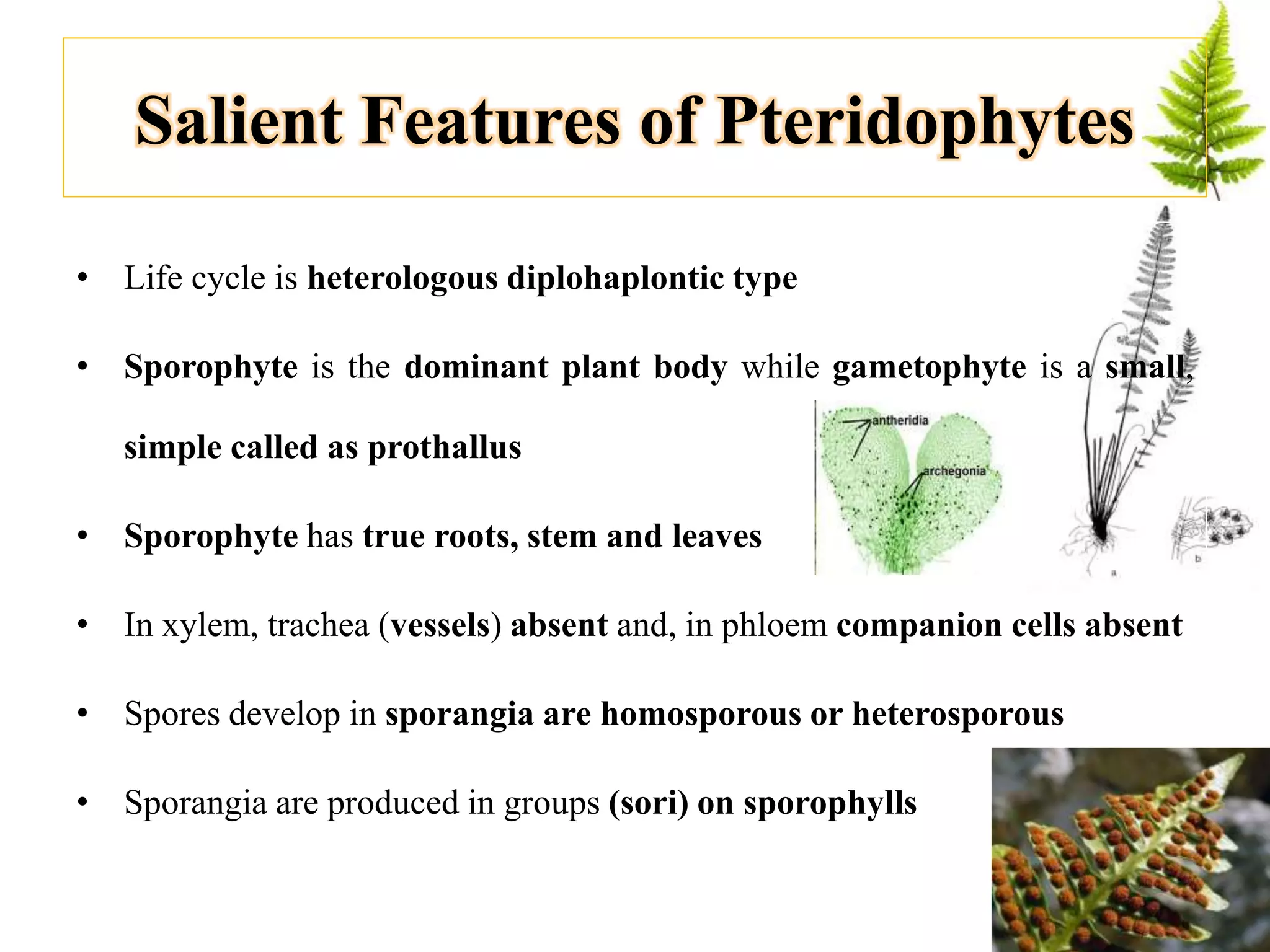
Salient Features of Pteridophytes
• Life cycle is heterologous diplohaplontic type
• Sporophyte is the dominant plant body while gametophyte is a small,
simple called as prothallus
• Sporophyte has true roots, stem and leaves
• In xylem, trachea (vessels) absent and, in phloem companion cells absent
• Spores develop in sporangia are homosporous or heterosporous
• Sporangia are produced in groups (sori) on sporophylls
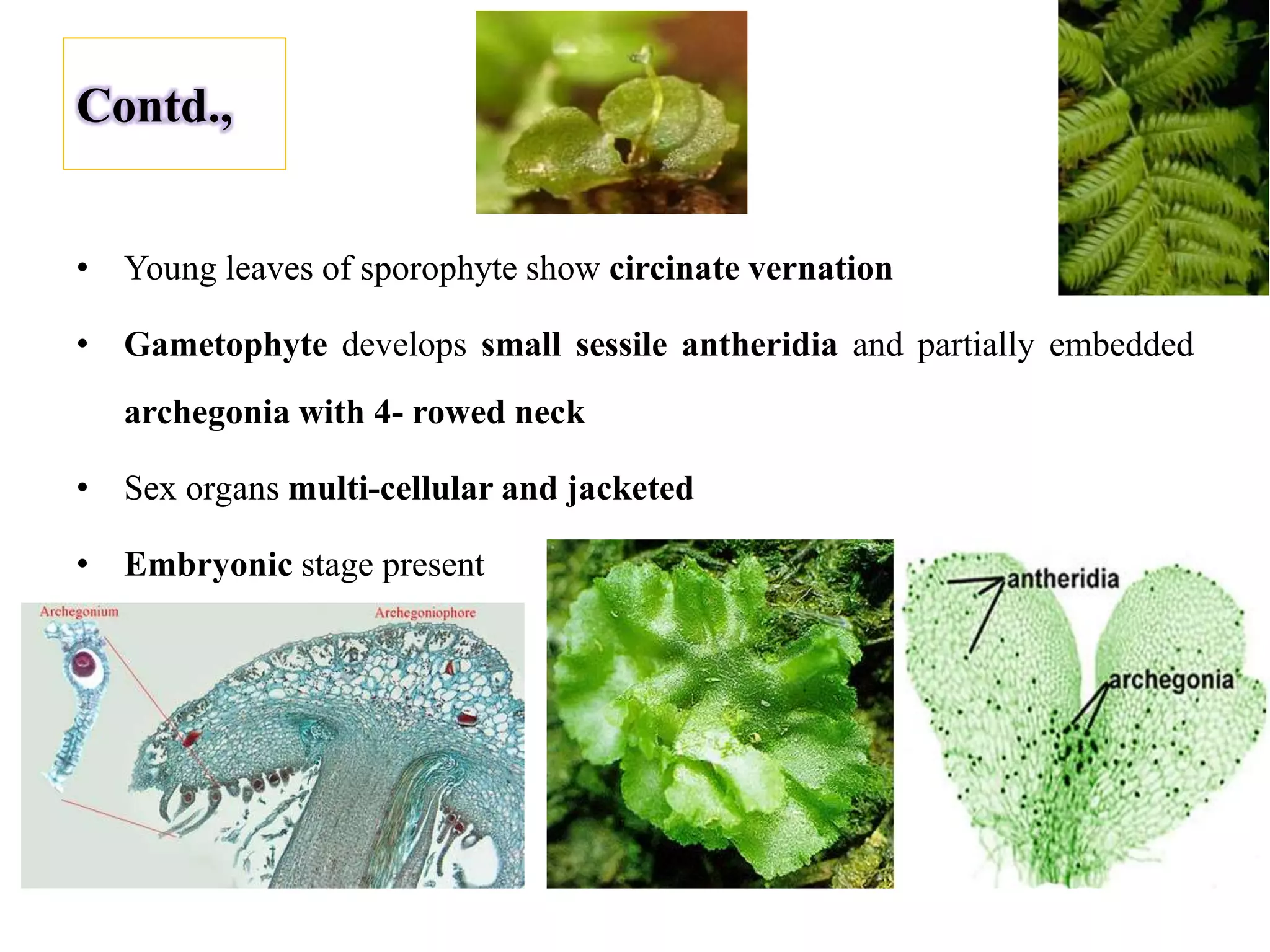
Contd.,
• Young leaves of sporophyte show circinate vernation
• Gametophyte develops small sessile antheridia and partially embedded
archegonia with 4- rowed neck
• Sex organs multi-cellular and jacketed
• Embryonic stage present
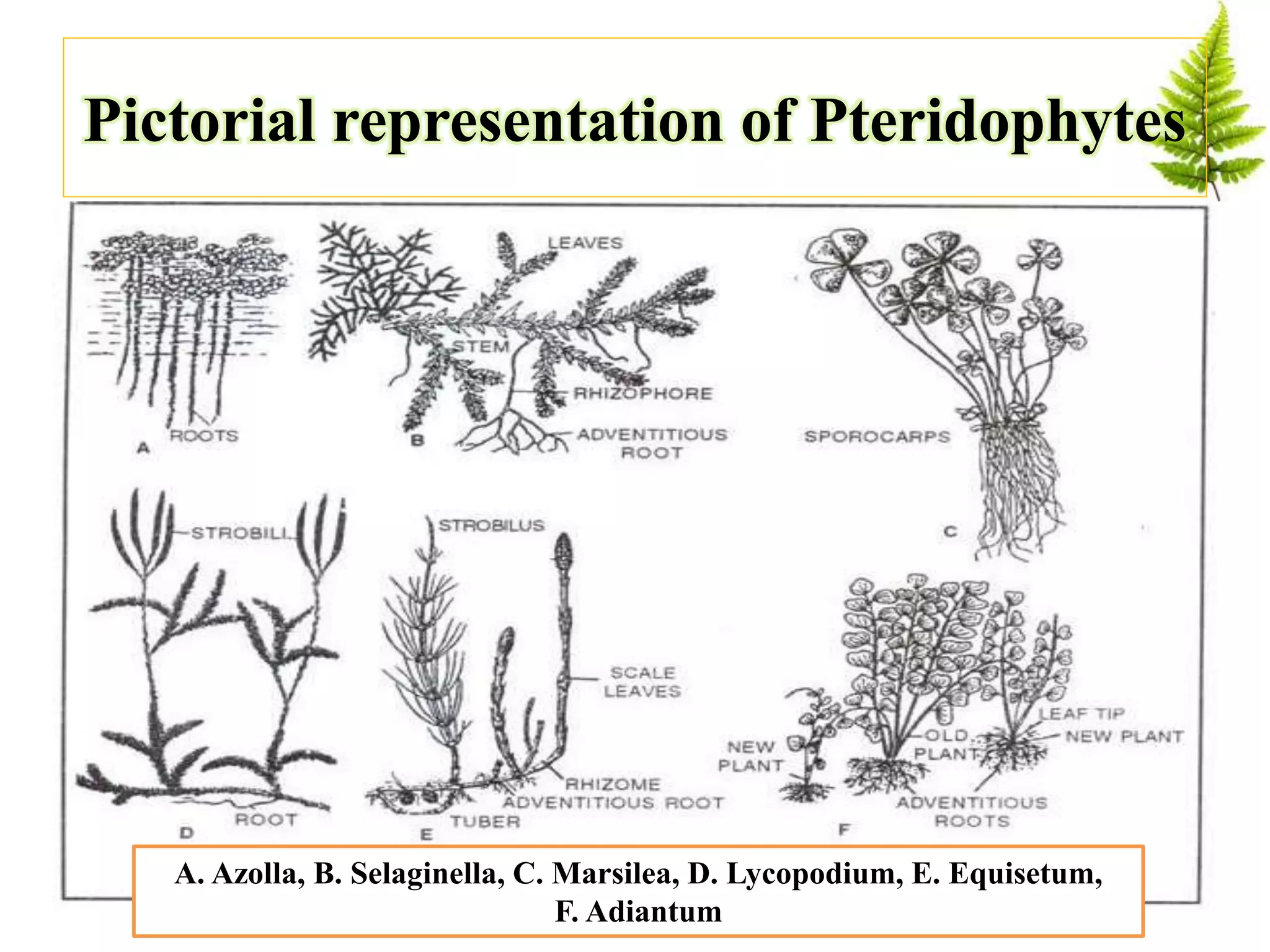
Pictorial representation of Pteridophytes
A. Azolla, B. Selaginella, C. Marsilea, D. Lycopodium, E. Equisetum,
F. Adiantum
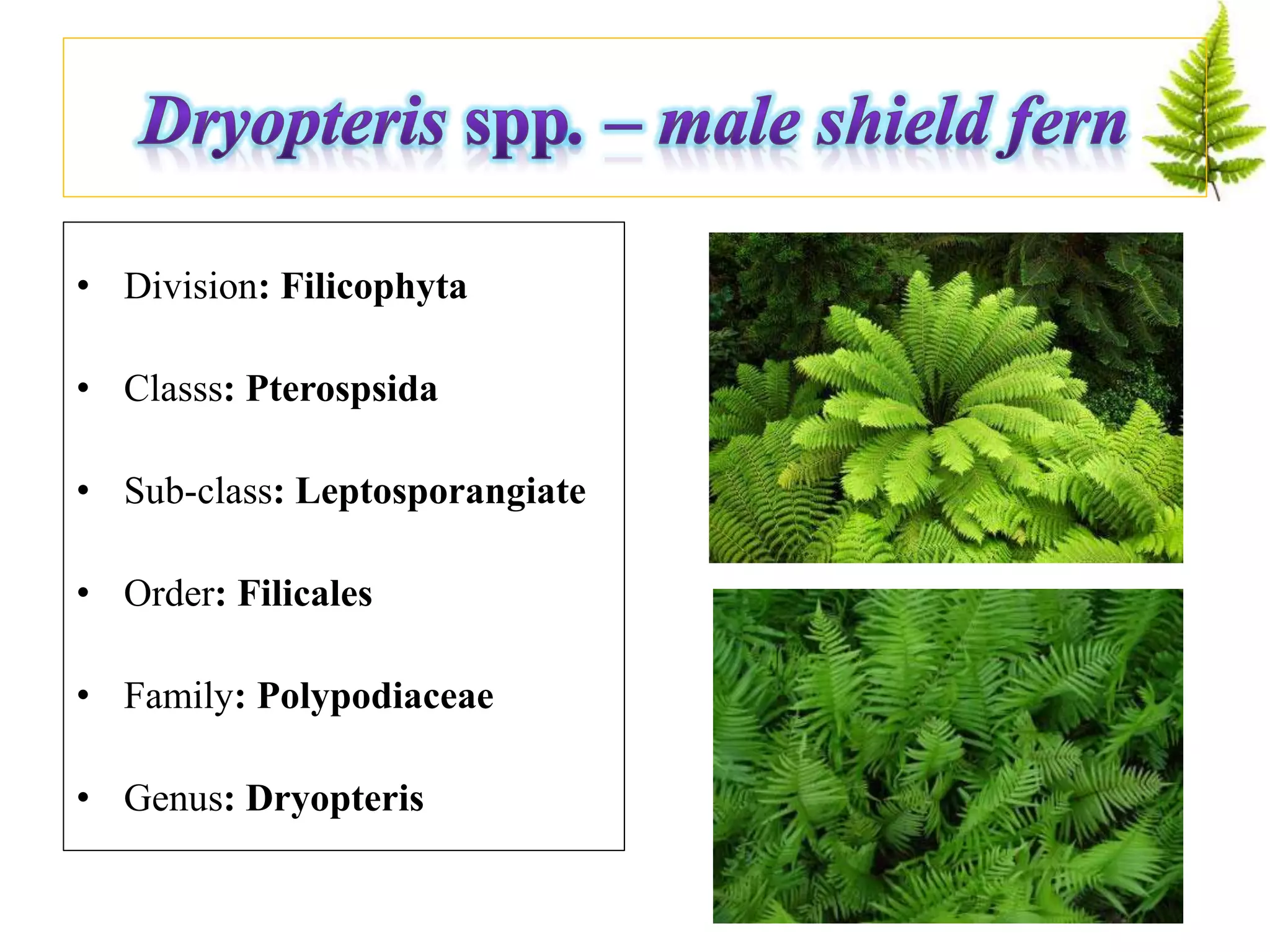
• Division: Filicophyta
• Classs: Pterospsida
• Sub-class: Leptosporangiate
• Order: Filicales
• Family: Polypodiaceae
• Genus: Dryopteris
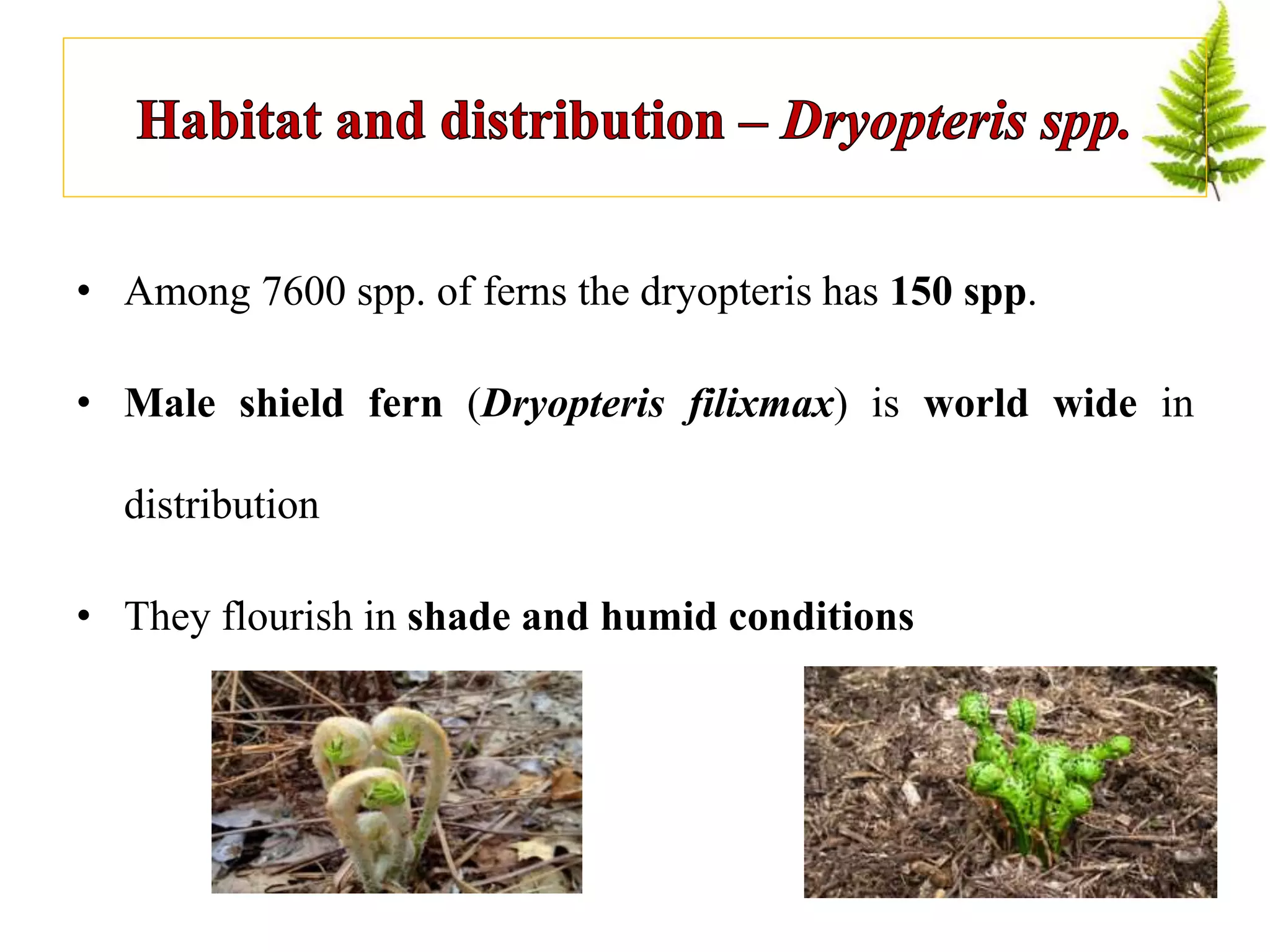
• Among 7600 spp. of ferns the dryopteris has 150 spp.
• Male shield fern (Dryopteris filixmax) is world wide in
distribution
• They flourish in shade and humid conditions
External features – Dryopteris spp.
• It is a perennial herb
• It survives during unfavourable conditions
(underground rhizome)
• The rhizome bears a numerous aerial
leaves which are bipinnate compound
• The younger leaves show circinate coiling
like watchspring
• The older leaves are termed as fronds
• The lower part of rachis is covered by
brown coloured scale like structures called
raments
• The leaves show open furcate venation
Internal structure – Dryopteris spp.
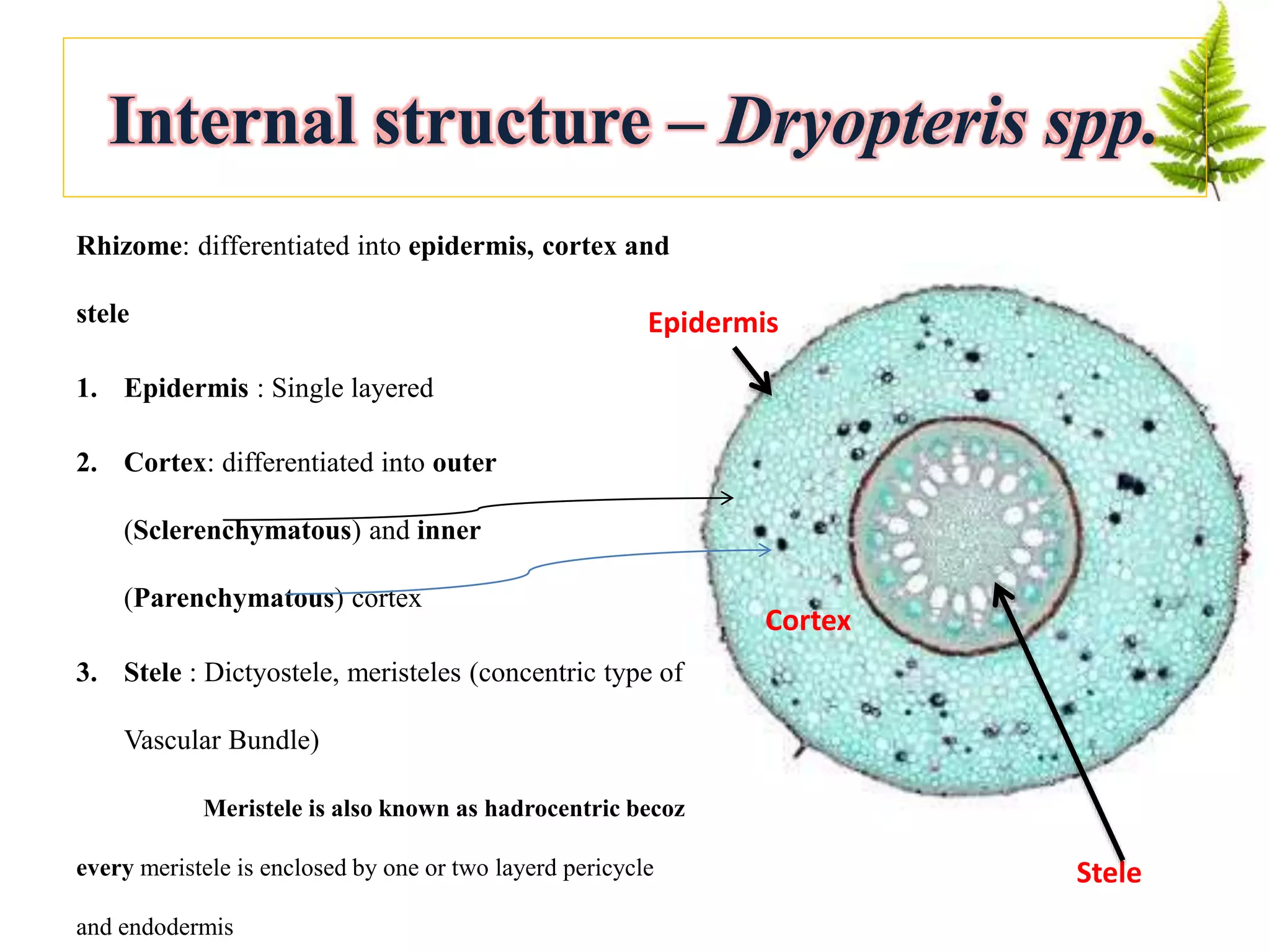
Rhizome: differentiated into epidermis, cortex and
stele
1. Epidermis : Single layered
2. Cortex: differentiated into outer
(Sclerenchymatous) and inner
(Parenchymatous) cortex
3. Stele : Dictyostele, meristeles (concentric type of
Vascular Bundle)
Meristele is also known as hadrocentric becoz
every meristele is enclosed by one or two layerd pericycle
and endodermis
Epidermis
Cortex
Stele
Internal structure – contd.,
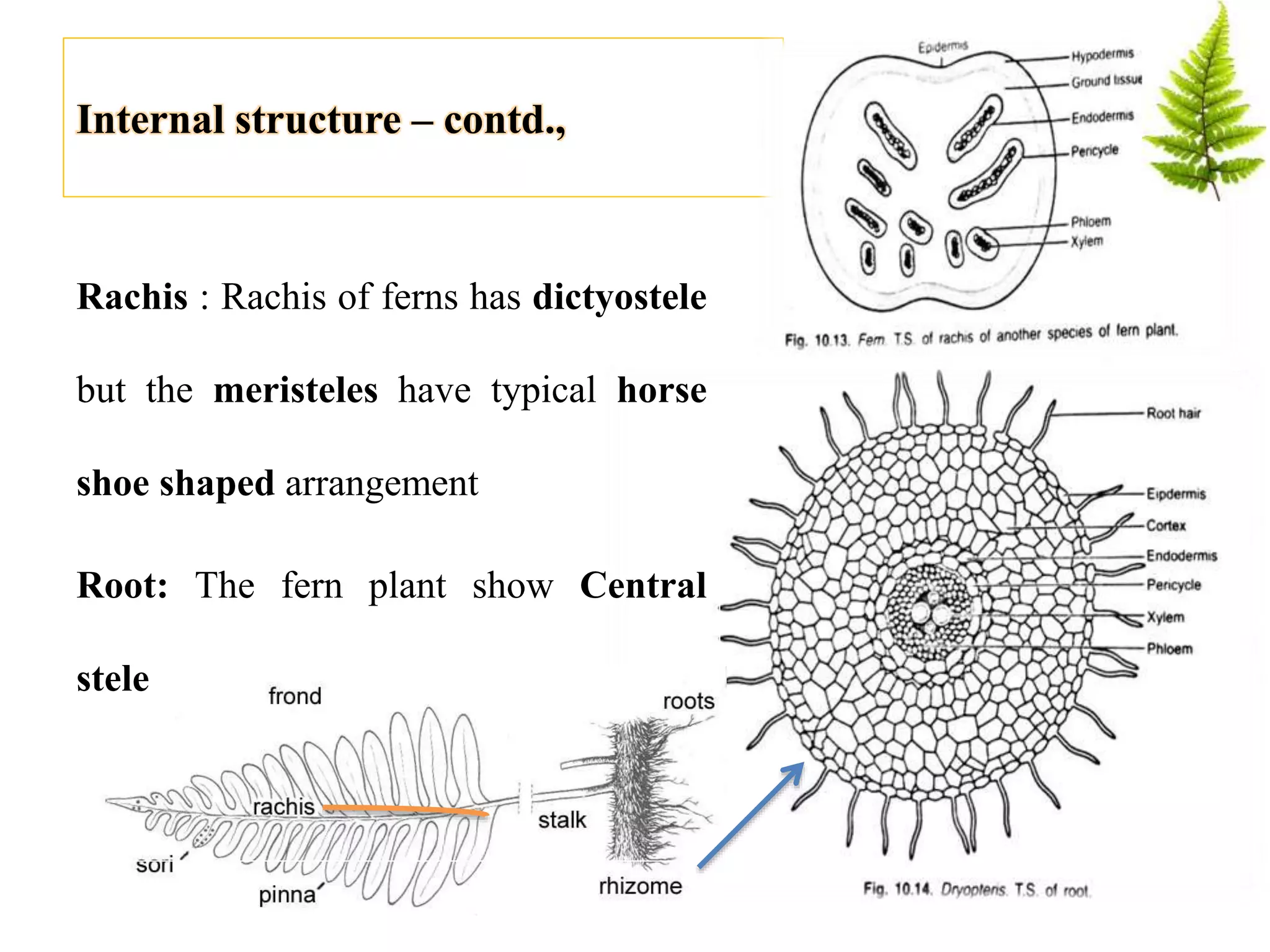
Rachis : Rachis of ferns has dictyostele
but the meristeles have typical horse
shoe shaped arrangement
Root: The fern plant show Central
stele
Reproduction – Dryopteris spp.
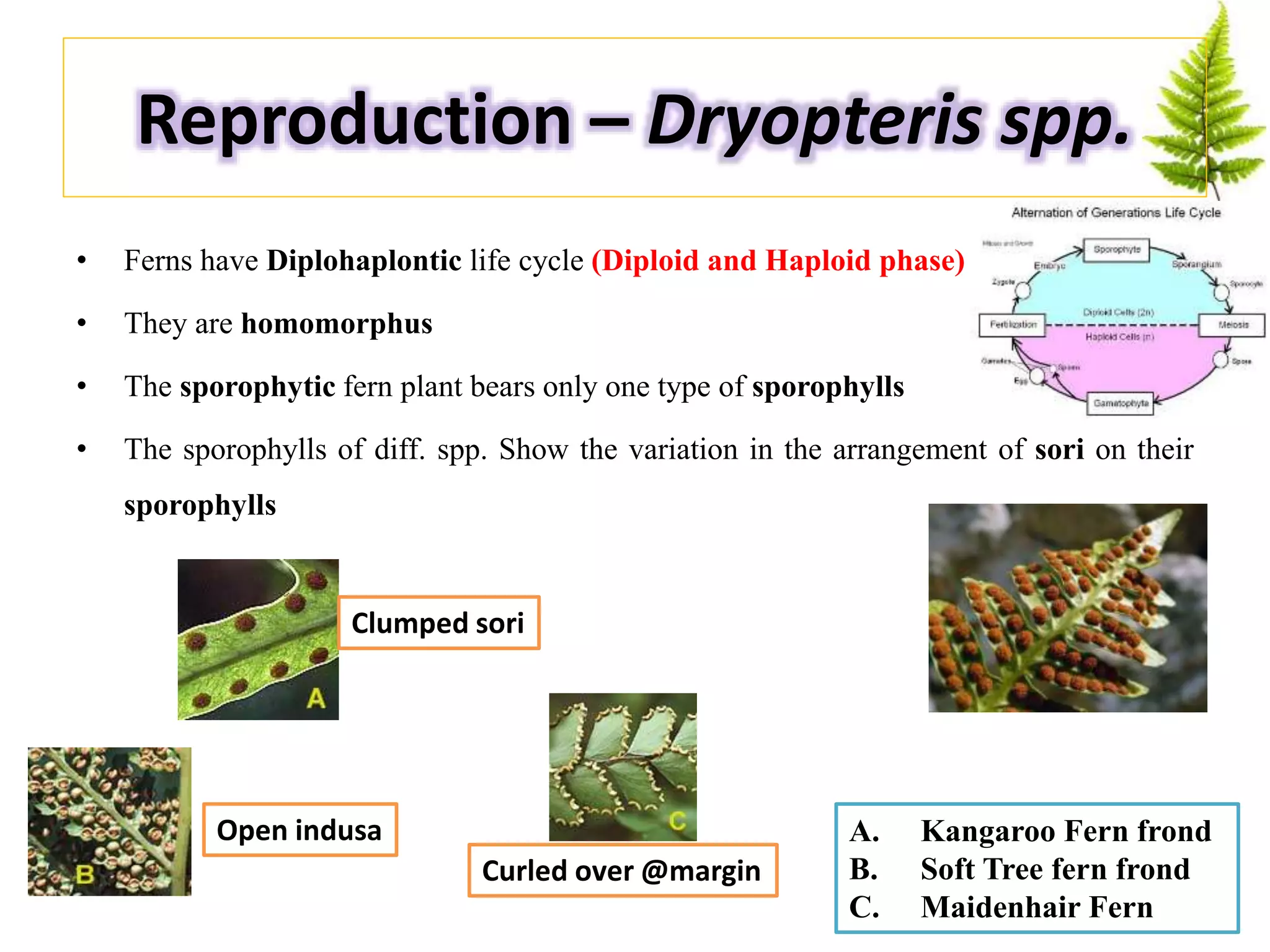
• Ferns have Diplohaplontic life cycle (Diploid and Haploid phase)
• They are homomorphus
• The sporophytic fern plant bears only one type of sporophylls
• The sporophylls of diff. spp. Show the variation in the arrangement of sori on their
sporophylls
A. Kangaroo Fern frond
B. Soft Tree fern frond
C. Maidenhair Fern
Clumped sori
Open indusa
Curled over @margin
Contd.
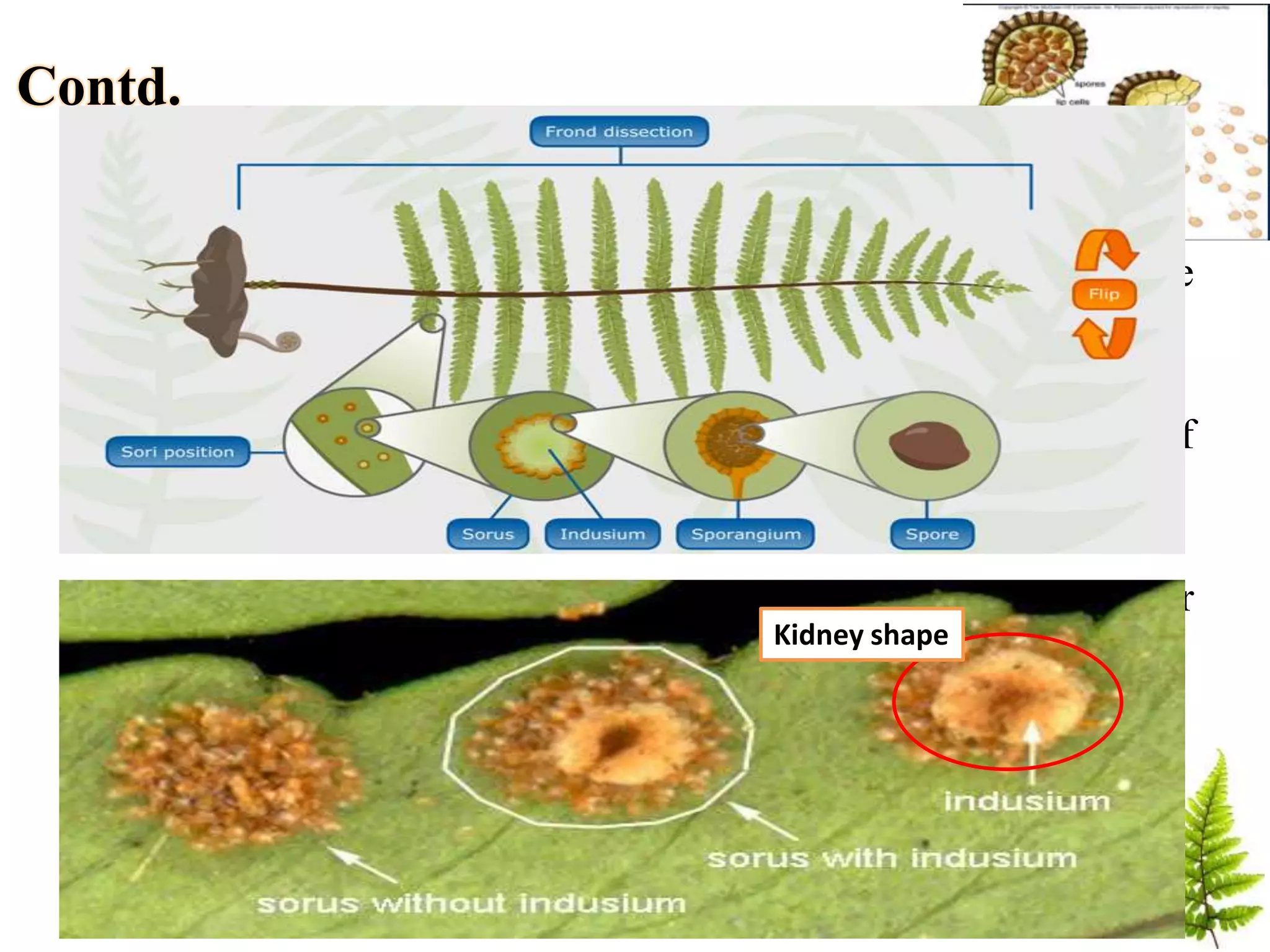
• The sori appear reniform due to the kidney shaped protective
thin and membranous covering called indusium
• There is a single layered thick ring like structure consisting of
annulus and stomium
• The sporangium contains 16 spore mother cells which after
reduction division produces 64 haploids
• Dehiscence of the capsule – Catapult mechanism
Kidney shape
Gametophyte
• Spore of the fern germinates when suitable substratum and
temperature and moisture conditions are ideal
• It grows into a small green, flat, heart shaped dorsiventral
thallus which is known as Prothallus
– Antheridia and Archegonia
Chemotactic movement
(mallic acid is rich @
archegonial tip)
Fig: Dryopteris Archegonium at the
time of fertilization
Zygote (2n)
Sporophyte
• The oospore divides transversely
and vertically to form a total of 8
cell, which divide separately to
form the embryo
• While one half of the embryo gives
rise to foot and stem the other half
gives rise to root and cotyledon
The Sporophyte continues to grow while the
Gametophyte dies
Very small heart-shaped
non-vascular gametophyte
with rhizoids. Sporophyte
sprouting up.
1. Sporophyte creates and releases haploid
sporesAdult
Sporophyte
.
.
.
.
Ground
2. Haploid spores land in the soil
Ground
Fern gametophytes
are called a prothallus
Let’s zoom in
3. From the haploid spores, gametophyte
grows in the soil
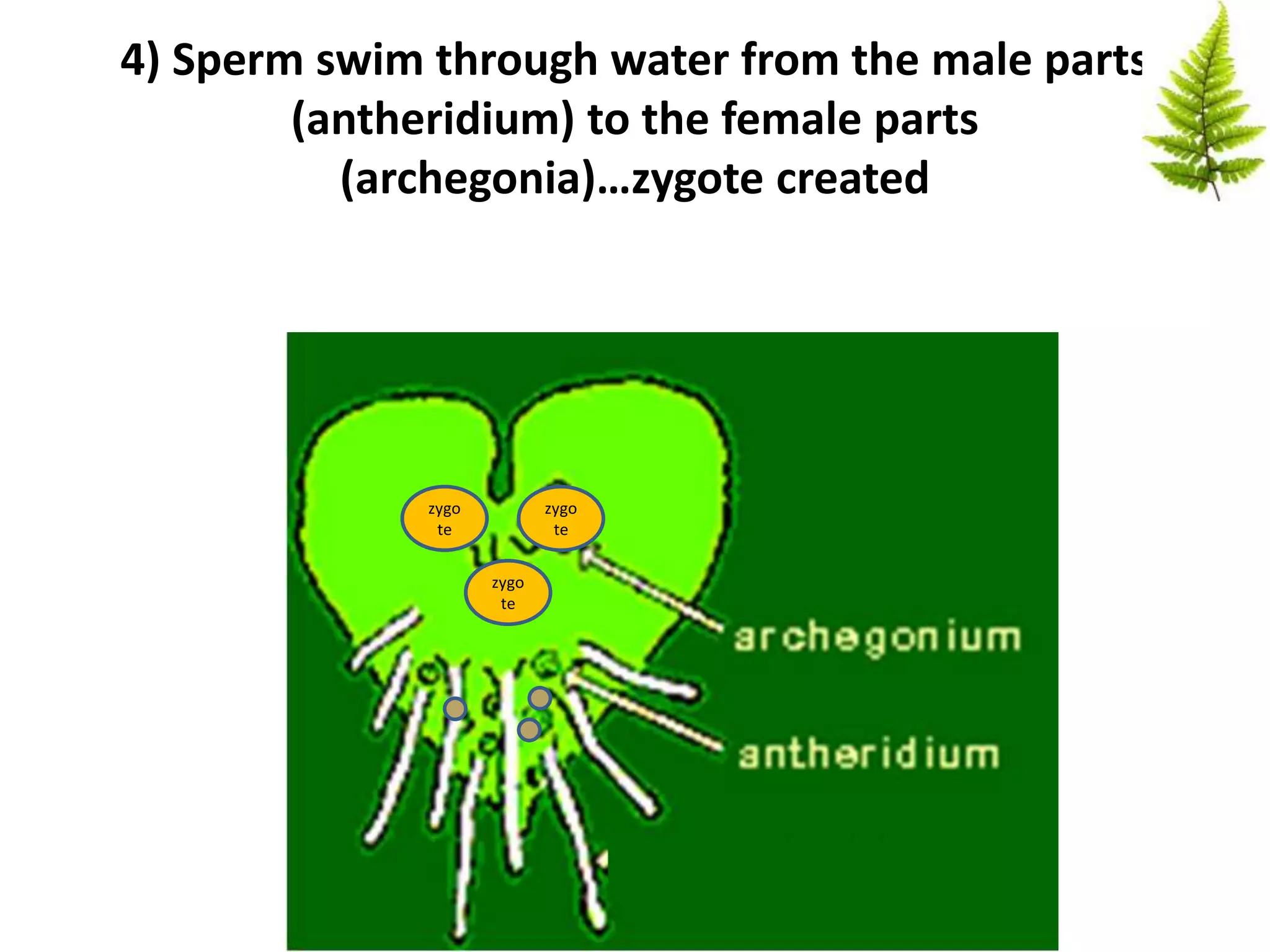
4) Sperm swim through water from the male parts
(antheridium) to the female parts
(archegonia)…zygote created
eggegg
egg
zygo
te
zygo
te
zygo
te
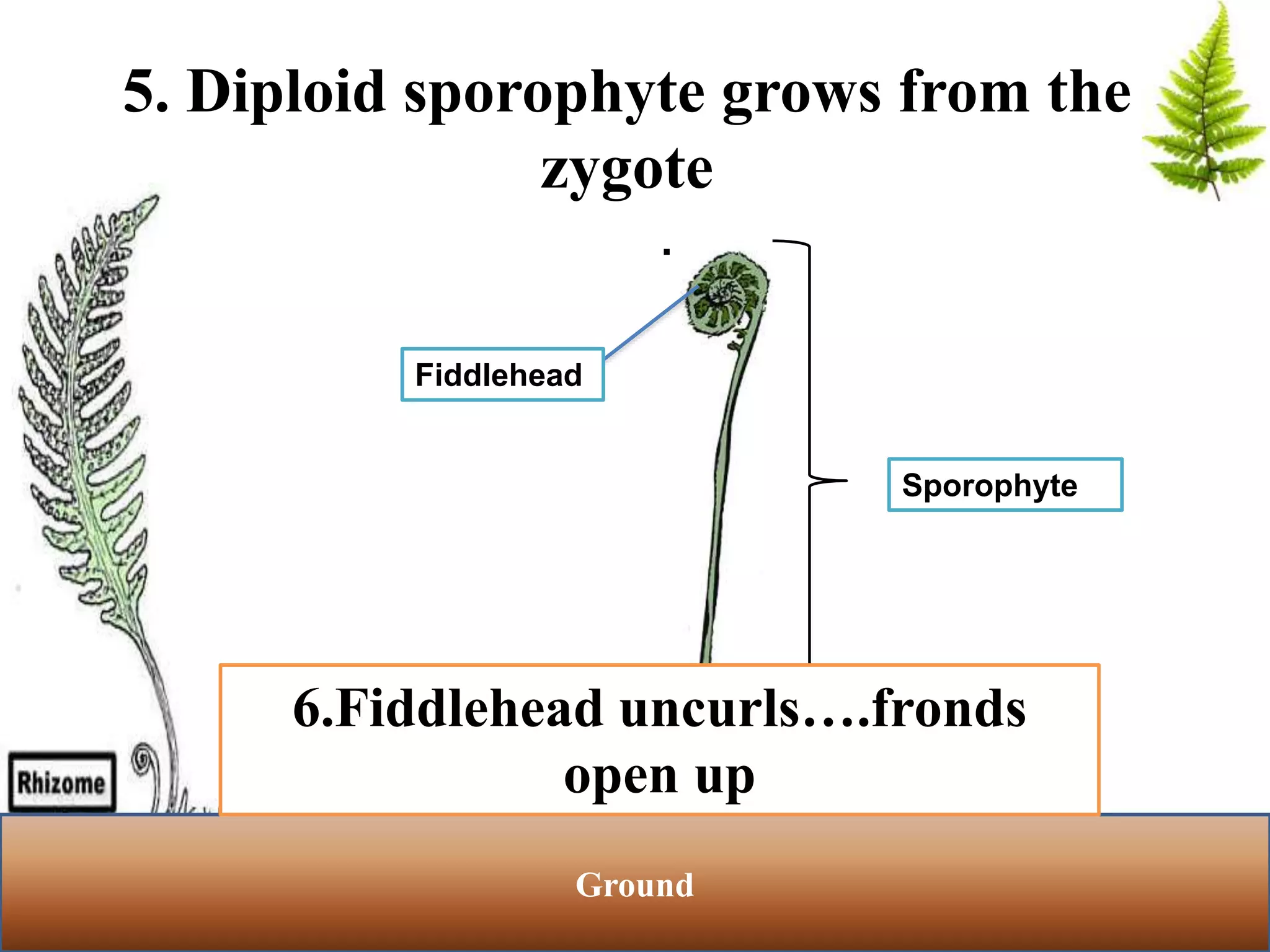
5. Diploid sporophyte grows from the
zygote
Sporophyte
Fiddlehead
Ground
.
6.Fiddlehead uncurls….fronds
open up
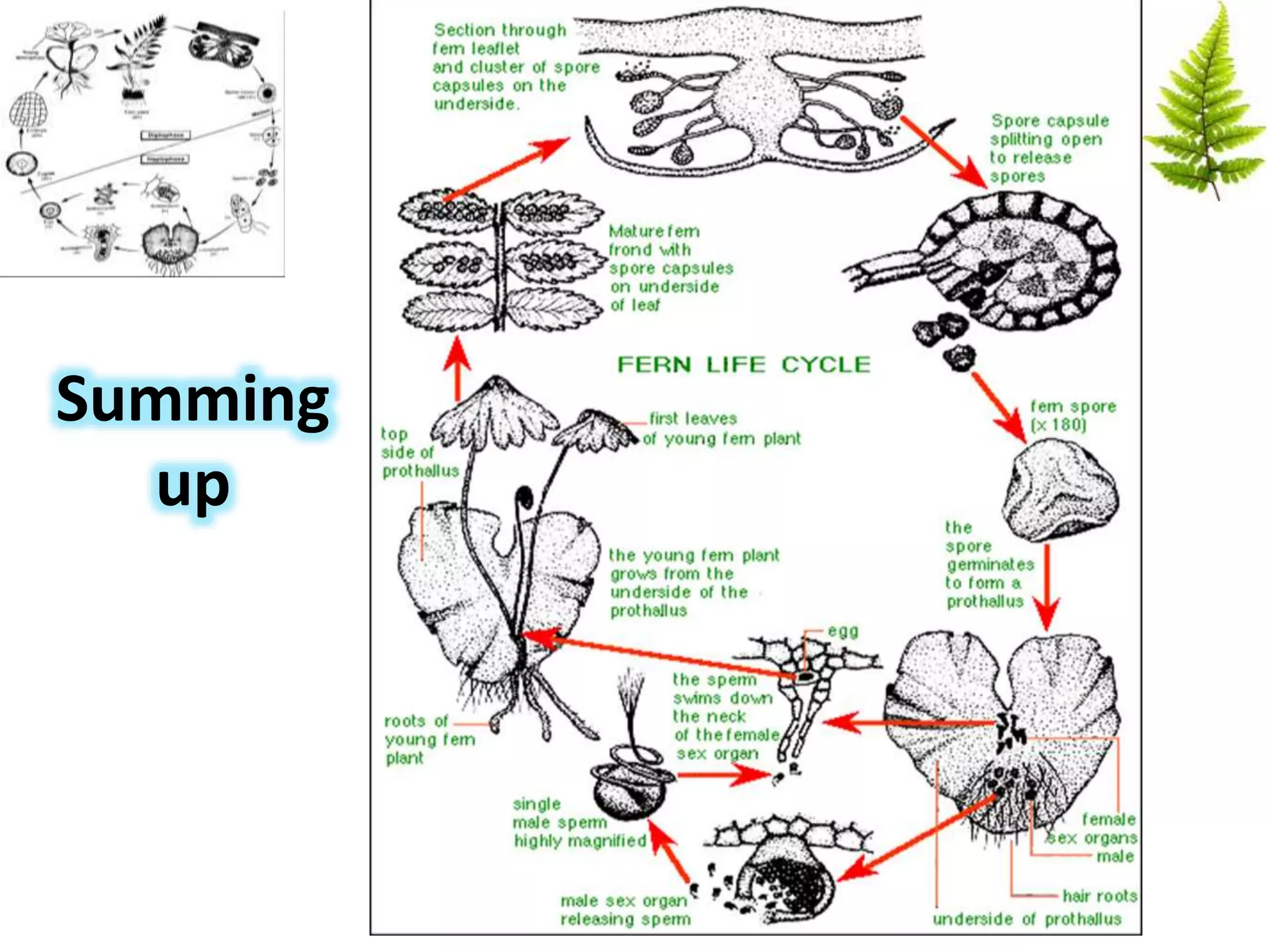
Summing
up
Let’s think……..
1. What affects where ferns will grow?
Factors of locality i.e., Edaphic, Climatic topographic and
Biotic factors
2. Why do ferns grow in some places and not others, and why
do some species thrive where others don't?
Ferns are having a very successful niche plants: they are
well adapted to particular environmental niches - soil moisture,
humidity, light, etc. For example, in our region, the Mother
Spleen wort fern always grows near waterfalls and in Evergreen
forests, Bracket fern is found on grounds with high moisture
content and litter fall
References
• http://www.home.aone.net.au/~byzantium/ferns/about
.html
• A text book of botany by A C Dutta
• Botany by V. Verma
Pteridophytes

Pteridophytes

  • 1.
    Gajendra C V Researchscholar Department of tree breeding Forest college and research institute, Mettupalayam
  • 2.
    Pteridophytes • Seedless vascularplants – Vascular cryptogams • In Gk Pteron means. Feather , phyton means plants (Feather like fronds / leaves) • Reproduce by means of spores • First land plants • Botanical amphibians : Bryophytes • Botanical snakes or snakes of plant kingdom: Pteridophytes • Dominant plants during carboniferous period : Age of Pteridophytes
  • 3.
    Status of Pteridophytes– India • 500 species of ferns and 100 species of fern allies (other than the order of fillicales) are on record from India • Pteridophytic flora of India comprises of 67 families, 191 genera and more than 1000 species including 47 endemic Indian ferns, and 414 species of pteridophytes (219 at risk, of which 160 critically EN, 82 NT, 113 rare) constituting 41-43 % of the total number of 950 -1000 pteridophytes of india. (Vineet and Satyanarayana, 2015)
  • 4.
    • A WEichler
  • 5.
    Further Pteridophytes Classifiedinto 4 classes Psilophyta Psilopsida Psilotum and Rhynia Lycophyta Lycospisda (Lycopodinae) Lycopodium Arthrophyta Sphenopsida (Equisetinae) Equisetum Filicophyta Pteropsida (Filicinae) Ferns Pteridophyta
  • 6.
    1. Psilotum 2. Rhynia 3.Lycopodium 4. Equisetum 5. Ferns
  • 7.
    Salient Features ofPteridophytes • Life cycle is heterologous diplohaplontic type • Sporophyte is the dominant plant body while gametophyte is a small, simple called as prothallus • Sporophyte has true roots, stem and leaves • In xylem, trachea (vessels) absent and, in phloem companion cells absent • Spores develop in sporangia are homosporous or heterosporous • Sporangia are produced in groups (sori) on sporophylls
  • 8.
    Contd., • Young leavesof sporophyte show circinate vernation • Gametophyte develops small sessile antheridia and partially embedded archegonia with 4- rowed neck • Sex organs multi-cellular and jacketed • Embryonic stage present
  • 9.
    Pictorial representation ofPteridophytes A. Azolla, B. Selaginella, C. Marsilea, D. Lycopodium, E. Equisetum, F. Adiantum
  • 10.
    • Division: Filicophyta •Classs: Pterospsida • Sub-class: Leptosporangiate • Order: Filicales • Family: Polypodiaceae • Genus: Dryopteris
  • 11.
    • Among 7600spp. of ferns the dryopteris has 150 spp. • Male shield fern (Dryopteris filixmax) is world wide in distribution • They flourish in shade and humid conditions
  • 12.
    External features –Dryopteris spp. • It is a perennial herb • It survives during unfavourable conditions (underground rhizome) • The rhizome bears a numerous aerial leaves which are bipinnate compound • The younger leaves show circinate coiling like watchspring • The older leaves are termed as fronds • The lower part of rachis is covered by brown coloured scale like structures called raments • The leaves show open furcate venation
  • 13.
    Internal structure –Dryopteris spp. Rhizome: differentiated into epidermis, cortex and stele 1. Epidermis : Single layered 2. Cortex: differentiated into outer (Sclerenchymatous) and inner (Parenchymatous) cortex 3. Stele : Dictyostele, meristeles (concentric type of Vascular Bundle) Meristele is also known as hadrocentric becoz every meristele is enclosed by one or two layerd pericycle and endodermis Epidermis Cortex Stele
  • 14.
    Internal structure –contd., Rachis : Rachis of ferns has dictyostele but the meristeles have typical horse shoe shaped arrangement Root: The fern plant show Central stele
  • 15.
    Reproduction – Dryopterisspp. • Ferns have Diplohaplontic life cycle (Diploid and Haploid phase) • They are homomorphus • The sporophytic fern plant bears only one type of sporophylls • The sporophylls of diff. spp. Show the variation in the arrangement of sori on their sporophylls A. Kangaroo Fern frond B. Soft Tree fern frond C. Maidenhair Fern Clumped sori Open indusa Curled over @margin
  • 16.
    Contd. • The soriappear reniform due to the kidney shaped protective thin and membranous covering called indusium • There is a single layered thick ring like structure consisting of annulus and stomium • The sporangium contains 16 spore mother cells which after reduction division produces 64 haploids • Dehiscence of the capsule – Catapult mechanism Kidney shape
  • 17.
    Gametophyte • Spore ofthe fern germinates when suitable substratum and temperature and moisture conditions are ideal • It grows into a small green, flat, heart shaped dorsiventral thallus which is known as Prothallus – Antheridia and Archegonia
  • 18.
    Chemotactic movement (mallic acidis rich @ archegonial tip) Fig: Dryopteris Archegonium at the time of fertilization Zygote (2n)
  • 19.
    Sporophyte • The oosporedivides transversely and vertically to form a total of 8 cell, which divide separately to form the embryo • While one half of the embryo gives rise to foot and stem the other half gives rise to root and cotyledon The Sporophyte continues to grow while the Gametophyte dies Very small heart-shaped non-vascular gametophyte with rhizoids. Sporophyte sprouting up.
  • 20.
    1. Sporophyte createsand releases haploid sporesAdult Sporophyte . . . . Ground
  • 21.
    2. Haploid sporesland in the soil Ground Fern gametophytes are called a prothallus Let’s zoom in 3. From the haploid spores, gametophyte grows in the soil
  • 22.
    4) Sperm swimthrough water from the male parts (antheridium) to the female parts (archegonia)…zygote created eggegg egg zygo te zygo te zygo te
  • 23.
    5. Diploid sporophytegrows from the zygote Sporophyte Fiddlehead Ground . 6.Fiddlehead uncurls….fronds open up
  • 24.
  • 27.
    Let’s think…….. 1. Whataffects where ferns will grow? Factors of locality i.e., Edaphic, Climatic topographic and Biotic factors 2. Why do ferns grow in some places and not others, and why do some species thrive where others don't? Ferns are having a very successful niche plants: they are well adapted to particular environmental niches - soil moisture, humidity, light, etc. For example, in our region, the Mother Spleen wort fern always grows near waterfalls and in Evergreen forests, Bracket fern is found on grounds with high moisture content and litter fall
  • 28.
    References • http://www.home.aone.net.au/~byzantium/ferns/about .html • Atext book of botany by A C Dutta • Botany by V. Verma