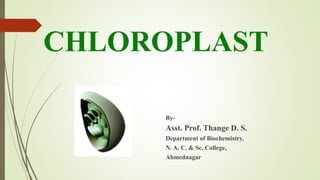
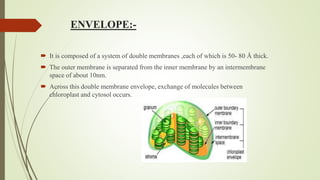
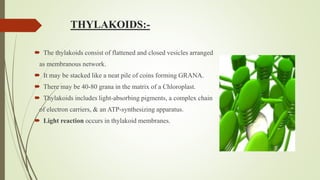
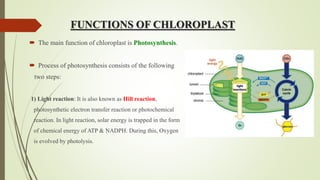
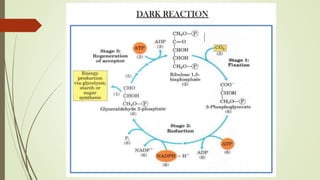
Chloroplasts are organelles found in plant cells and eukaryotic photosynthetic organisms that conduct photosynthesis. They have a double membrane envelope and contain a stroma, thylakoids, and chloroplast DNA. Thylakoids contain light-absorbing pigments and perform the light reactions of photosynthesis, while the stroma is the site of the dark reactions where CO2 is fixed into sugars. Chloroplasts are essential for photosynthesis as they trap solar energy to produce ATP and NADPH via light reactions, and use these products to fix CO2 into carbohydrates via dark reactions, providing energy for plant growth.