STELAR
EVOLUTION IN
PTERIDOPHYTES
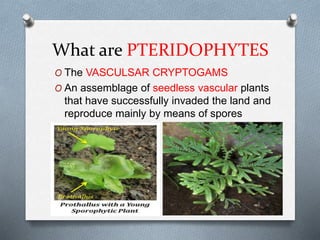
What are PTERIDOPHYTES
O The VASCULSAR CRYPTOGAMS
O An assemblage of seedless vascular plants
that have successfully invaded the land and
reproduce mainly by means of spores
Vascular plants together
share a number of apomorphies
O Lignified secondary walls
O Sclerenchyma
O Tracheary elements, cells of xylem tissue
O Sieve elements, cells of phloem tissue
O An endodermis
O An independent, long-lived sporophyte.
O Sporophytic leaves .
O Roots (secondarily lost in the Psilophytes) .
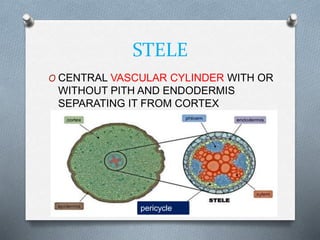
STELE
O CENTRAL VASCULAR CYLINDER WITH OR
WITHOUT PITH AND ENDODERMIS
SEPARATING IT FROM CORTEX
pericycle
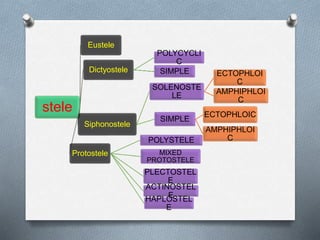
stele
Eustele
Dictyostele
POLYCYCLI
C
SIMPLE
Siphonostele
SOLENOSTE
LE
ECTOPHLOI
C
AMPHIPHLOI
C
SIMPLE
ECTOPHLOIC
AMPHIPHLOI
C
Protostele
POLYSTELE
MIXED
PROTOSTELE
PLECTOSTEL
E
ACTINOSTEL
EHAPLOSTEL
E
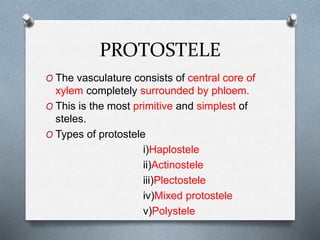
PROTOSTELE
O The vasculature consists of central core of
xylem completely surrounded by phloem.
O This is the most primitive and simplest of
steles.
O Types of protostele
i)Haplostele
ii)Actinostele
iii)Plectostele
iv)Mixed protostele
v)Polystele
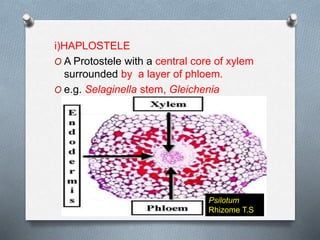
i)HAPLOSTELE
O A Protostele with a central core of xylem
surrounded by a layer of phloem.
O e.g. Selaginella stem, Gleichenia
Psilotum
Rhizome T.S
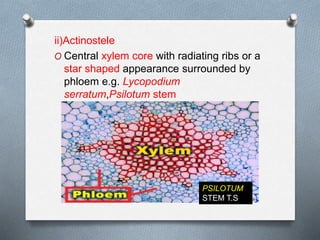
ii)Actinostele
O Central xylem core with radiating ribs or a
star shaped appearance surrounded by
phloem e.g. Lycopodium
serratum,Psilotum stem
PSILOTUM
STEM T.S
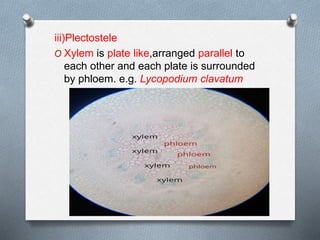
iii)Plectostele
O Xylem is plate like,arranged parallel to
each other and each plate is surrounded
by phloem. e.g. Lycopodium clavatum
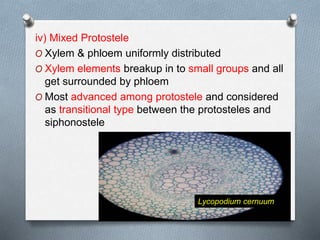
iv) Mixed Protostele
O Xylem & phloem uniformly distributed
O Xylem elements breakup in to small groups and all
get surrounded by phloem
O Most advanced among protostele and considered
as transitional type between the protosteles and
siphonostele
Lycopodium cernuum
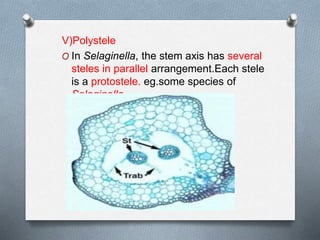
V)Polystele
O In Selaginella, the stem axis has several
steles in parallel arrangement.Each stele
is a protostele. eg.some species of
Selaginella
SIPHONOSTELE
O Medullated stele (Stele with central pith).
O Pith is surrounded by xyelm and phloem
on the outside.
O Types of siphonostele
i)Simple Siphonostele
ii)Solenostele
i)Simple Siphonostele
O Modified protostele with a central pith.
O Central pith is often parenchymatous rarely
sclerenchymatous.
O Types of Simple siphonostele
a)Ectophloic siphonostele
b)Amphiphloic
siphonostele
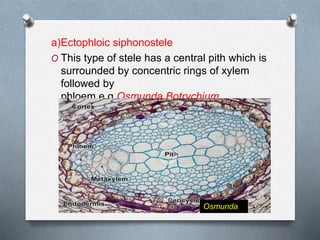
a)Ectophloic siphonostele
O This type of stele has a central pith which is
surrounded by concentric rings of xylem
followed by
phloem.e.g.Osmunda,Botrychium
Osmunda
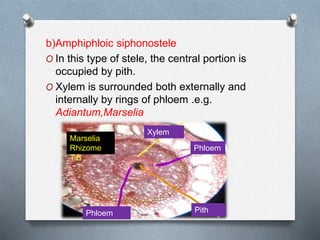
b)Amphiphloic siphonostele
O In this type of stele, the central portion is
occupied by pith.
O Xylem is surrounded both externally and
internally by rings of phloem .e.g.
Adiantum,Marselia
Xylem
Pith
Phloem
Phloem
Marselia
Rhizome
T.S
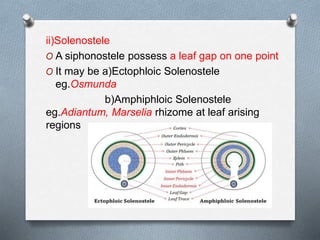
ii)Solenostele
O A siphonostele possess a leaf gap on one point
O It may be a)Ectophloic Solenostele
eg.Osmunda
b)Amphiphloic Solenostele
eg.Adiantum, Marselia rhizome at leaf arising
regions
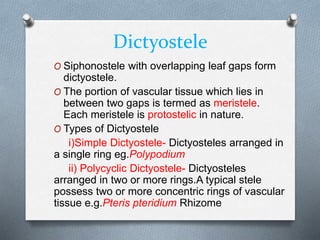
Dictyostele
O Siphonostele with overlapping leaf gaps form
dictyostele.
O The portion of vascular tissue which lies in
between two gaps is termed as meristele.
Each meristele is protostelic in nature.
O Types of Dictyostele
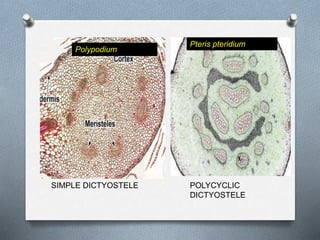
i)Simple Dictyostele- Dictyosteles arranged in
a single ring eg.Polypodium
ii) Polycyclic Dictyostele- Dictyosteles
arranged in two or more rings.A typical stele
possess two or more concentric rings of vascular
tissue e.g.Pteris pteridium Rhizome
Polypodium
Pteris pteridium
SIMPLE DICTYOSTELE POLYCYCLIC
DICTYOSTELE
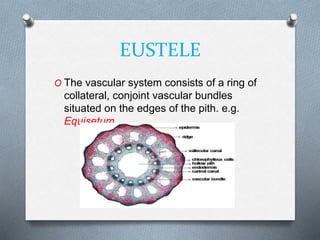
EUSTELE
O The vascular system consists of a ring of
collateral, conjoint vascular bundles
situated on the edges of the pith. e.g.
Equisetum

Stelar evolution in Pteridophytes-BOTANY