CHLOROPHYCEAE
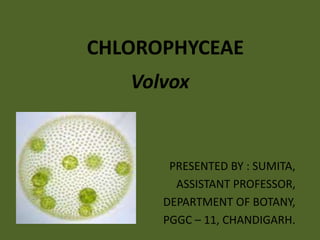
Volvox
PRESENTED BY : SUMITA,
ASSISTANT PROFESSOR,
DEPARTMENT OF BOTANY,
PGGC – 11, CHANDIGARH.
Systematic position
Kingdom - Plantae
Division - Chlorophyta
Class - Chlorophyceae
Order - Volvocales
Family -Volvocaceae
Genus- Volvox
OCCURENCE
- Includes about 20 species
- All are aquatic and free floating
- They mostly occur in fresh water bodies
- It forms a beautiful green coloured phytoplankton on
the surface of water body
- It occurs as green rolling balls of pin head sized
coenobia
VEGETATIVE STRUCTURE
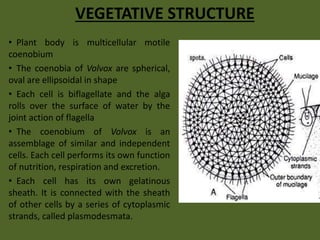
• Plant body is multicellular motile
coenobium
• The coenobia of Volvox are spherical,
oval are ellipsoidal in shape
• Each cell is biflagellate and the alga
rolls over the surface of water by the
joint action of flagella
• The coenobium of Volvox is an
assemblage of similar and independent
cells. Each cell performs its own function
of nutrition, respiration and excretion.
• Each cell has its own gelatinous
sheath. It is connected with the sheath
of other cells by a series of cytoplasmic
strands, called plasmodesmata.
REPRODUCTION
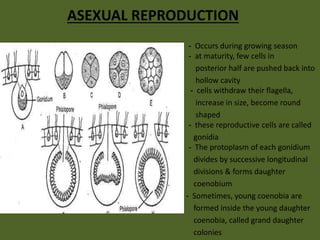
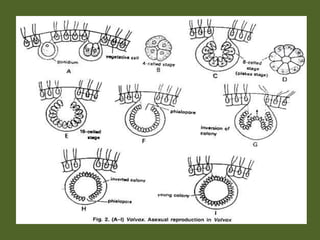
ASEXUAL REPRODUCTION
- Occurs during growing season
- at maturity, few cells in
posterior half are pushed back into
hollow cavity
- cells withdraw their flagella,
increase in size, become round
shaped
- these reproductive cells are called
gonidia
- The protoplasm of each gonidium
divides by successive longitudinal
divisions & forms daughter
coenobium
- Sometimes, young coenobia are
formed inside the young daughter
coenobia, called grand daughter
colonies
SEXUAL REPRODUCTION
• OOGAMOUS TYPE
• Male sex organs: Antheridia (androgonia)
• Female sex organs: oogonia (Gynogonidia)
• Some species are monoecious and some are dioecious
• Some cells at posterior half of coenobium retract flagella,
enlarge, & become gametangia
• Male gametangium give rise to antheridium and female
gametangium to oogonium
ANTHERIDIA (ANDROGONIDIA) and
OOGONIA (GYNOGONIDIA)
• Each antherozoid is uninucleate, biflagellate and possesses a
small chloroplast.
• The mass of antherozoids (spermatozoids) is released at maturity.
• The protoplasm of female gametangium does not divide, but
metamorphosed into single, non flagellated green spherical egg
or oosphere.
• The female gametangium is now called oogonium.
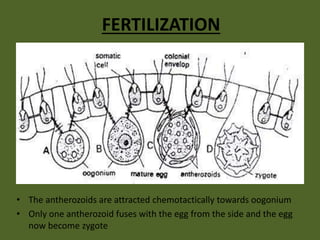
FERTILIZATION
• The antherozoids are attracted chemotactically towards oogonium
• Only one antherozoid fuses with the egg from the side and the egg
now become zygote
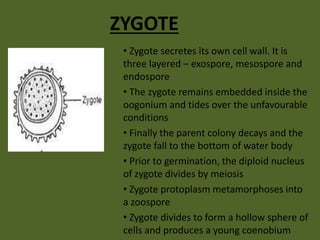
ZYGOTE
• Zygote secretes its own cell wall. It is
three layered – exospore, mesospore and
endospore
• The zygote remains embedded inside the
oogonium and tides over the unfavourable
conditions
• Finally the parent colony decays and the
zygote fall to the bottom of water body
• Prior to germination, the diploid nucleus
of zygote divides by meiosis
• Zygote protoplasm metamorphoses into
a zoospore
• Zygote divides to form a hollow sphere of
cells and produces a young coenobium
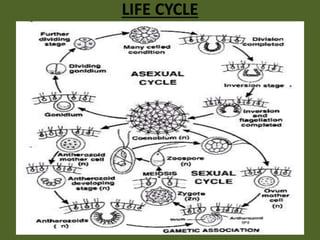
LIFE CYCLE
THANKS

Volvox ppt

  • 1.
    CHLOROPHYCEAE Volvox PRESENTED BY :SUMITA, ASSISTANT PROFESSOR, DEPARTMENT OF BOTANY, PGGC – 11, CHANDIGARH.
  • 2.
    Systematic position Kingdom -Plantae Division - Chlorophyta Class - Chlorophyceae Order - Volvocales Family -Volvocaceae Genus- Volvox
  • 3.
    OCCURENCE - Includes about20 species - All are aquatic and free floating - They mostly occur in fresh water bodies - It forms a beautiful green coloured phytoplankton on the surface of water body - It occurs as green rolling balls of pin head sized coenobia
  • 4.
    VEGETATIVE STRUCTURE • Plantbody is multicellular motile coenobium • The coenobia of Volvox are spherical, oval are ellipsoidal in shape • Each cell is biflagellate and the alga rolls over the surface of water by the joint action of flagella • The coenobium of Volvox is an assemblage of similar and independent cells. Each cell performs its own function of nutrition, respiration and excretion. • Each cell has its own gelatinous sheath. It is connected with the sheath of other cells by a series of cytoplasmic strands, called plasmodesmata.
  • 5.
  • 6.
    ASEXUAL REPRODUCTION - Occursduring growing season - at maturity, few cells in posterior half are pushed back into hollow cavity - cells withdraw their flagella, increase in size, become round shaped - these reproductive cells are called gonidia - The protoplasm of each gonidium divides by successive longitudinal divisions & forms daughter coenobium - Sometimes, young coenobia are formed inside the young daughter coenobia, called grand daughter colonies
  • 8.
    SEXUAL REPRODUCTION • OOGAMOUSTYPE • Male sex organs: Antheridia (androgonia) • Female sex organs: oogonia (Gynogonidia) • Some species are monoecious and some are dioecious • Some cells at posterior half of coenobium retract flagella, enlarge, & become gametangia • Male gametangium give rise to antheridium and female gametangium to oogonium
  • 9.
    ANTHERIDIA (ANDROGONIDIA) and OOGONIA(GYNOGONIDIA) • Each antherozoid is uninucleate, biflagellate and possesses a small chloroplast. • The mass of antherozoids (spermatozoids) is released at maturity. • The protoplasm of female gametangium does not divide, but metamorphosed into single, non flagellated green spherical egg or oosphere. • The female gametangium is now called oogonium.
  • 10.
    FERTILIZATION • The antherozoidsare attracted chemotactically towards oogonium • Only one antherozoid fuses with the egg from the side and the egg now become zygote
  • 11.
    ZYGOTE • Zygote secretesits own cell wall. It is three layered – exospore, mesospore and endospore • The zygote remains embedded inside the oogonium and tides over the unfavourable conditions • Finally the parent colony decays and the zygote fall to the bottom of water body • Prior to germination, the diploid nucleus of zygote divides by meiosis • Zygote protoplasm metamorphoses into a zoospore • Zygote divides to form a hollow sphere of cells and produces a young coenobium
  • 12.
  • 13.