:A POWERPOINT PRESENTATION
Index
:
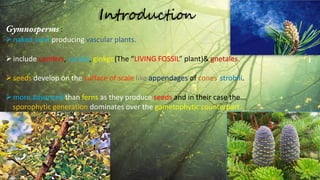
naked seed producing vascular plants.
include conifers, cycads, ginkgo(The “LIVING FOSSIL” plant)& gnetales.
seeds develop on the surface of scale like appendages of cones/strobili.
more advanced than ferns as they produce seeds and in their case the
sporophytic generation dominates over the gametophytic counterpart.
 There are about 700 to 900 extant* species of Gymnosperms.
(Note: Extant- term refers to taxa still found to be living.)
 Gymnosperms originated in late carboniferous period.
 They are considered to be the result of genome duplication
event which took place around 319 Mya.
 The fossils of Pro-gymnosperms, belonging to late Devonian
period around 383 Mya, exhibit some characters found in the
gymnosperms.
 By the end of the Palaeozoic era, they replaced most of the
ferns becoming the dominant vegetation of the Mesozoic era.
 The end of Mesozoic era marked start of their extinction.




GENERAL CHARACTERISTIC FEATURES






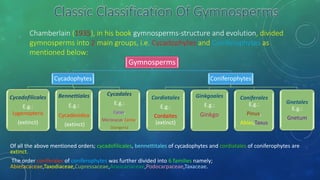
Classic Classification Of Gymnosperms
Chamberlain (1935), in his book gymnosperms-structure and evolution, divided
gymnosperms into 2 main groups, i.e. Cycadophytes and Coniferophytes as
mentioned below:
Of all the above mentioned orders; cycadofilicales, bennettitales of cycadophytes and cordiatales of coniferophytes are
extinct.
The order coniferales of coniferophytes was further divided into 6 families namely;
Abietacaceae,Taxodiaceae,Cupressaceae,Araucariaceae,Podocarpaceae,Taxaceae.
Gymnosperms
Cycadophytes
Cycadofilicales
E.g.:
Lygenopteris
(extinct)
Bennettiales
E.g.:
Cycadeoidea
(extinct)
Cycadales
E.g.:
Cycas,
Microcycas,Zamia,
Stangeria
Coniferophytes
Cordiatales
E.g.:
Cordaites
(extinct)
Ginkgoales
E.g.:
Ginkgo
Coniferales
E.g.:
Pinus,
Abies,Taxus
Gnetales
E.g.:
Gnetum
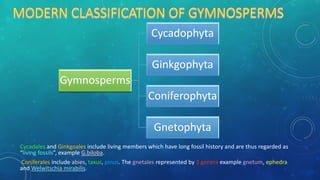
MODERN CLASSIFICATION OF GYMNOSPERMS
Cycadales and Ginkgoales include living members which have long fossil history and are thus regarded as
“living fossils”, example G.biloba.
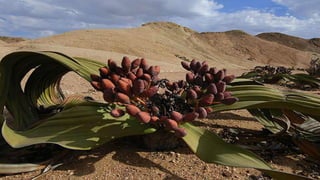
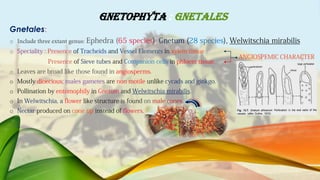
Coniferales include abies, taxus, pinus. The gnetales represented by 3 genera example gnetum, ephedra
and Welwitschia mirabilis.
Gymnosperms
Cycadophyta
Ginkgophyta
Coniferophyta
Gnetophyta
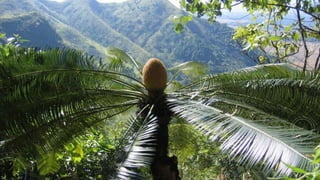
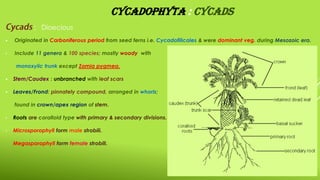
CYCADOPHYTA : CYCADS
: Dioecious
 Originated in Carboniferous period from seed ferns i.e. Cycadofilicales & were dominant veg. during Mesozoic era.
• Include 11 genera & 100 species; mostly woody with
monoxylic trunk except Zamia pygmea.
 Stem/Caudex : unbranched with leaf scars
 Leaves/Frond: pinnately compound, arranged in whorls;
found in crown/apex region of stem.
• Roots are coralloid type with primary & secondary divisions.
• Microsporophyll form male strobili.
Megasporophyll form female strobili.
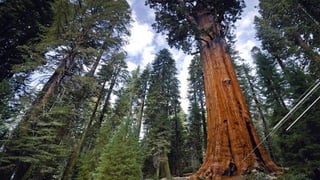
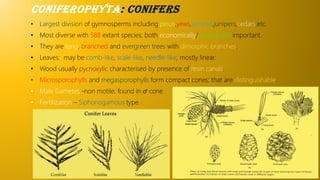
Coniferophyta: Conifers
• Largest division of gymnosperms including pinus,yews,spruces,junipers,cedars,etc.
• Most diverse with 588 extant species; both economically/ecologically important.
• They are long, branched and evergreen trees with dimorphic branches.
• Leaves: may be comb-like, scale-like, needle-like; mostly linear.
• Wood usually pycnoxylic characterised by presence of resin canals.
• Microsporophylls and megasporophylls form compact cones; that are distinguishable.
• Male Gametes -non motile; found in ♂ cone
• Fertilization – Siphonogamous type.
Ginkgophyta : Ginkgo
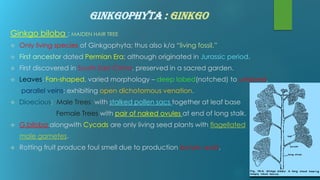
Ginkgo biloba : MAIDEN HAIR TREE
 Only living species of Ginkgophyta; thus also k/a “living fossil.”
 First ancestor dated Permian Era; although originated in Jurassic period.
 First discovered in South East China, preserved in a sacred garden.
 Leaves: Fan-shaped, varied morphology – deep lobed(notched) to unlobed,
parallel veins; exhibiting open dichotomous venation.
 Dioecious; Male Trees with stalked pollen sacs together at leaf base
Female Trees with pair of naked ovules at end of long stalk.
 G.biloba alongwith Cycads are only living seed plants with flagellated
male gametes.
 Rotting fruit produce foul smell due to production butyric acid.
GNETOPHYTA : GNETALES
Gnetales:
o
o
o
o
o
o
o
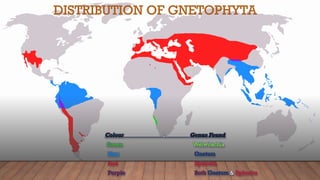
DISTRIBUTION OF GNETOPHYTA
Colour : Genus Found
Green Welwitschia
Blue Gnetum
Red Ephedra
Purple Both Gnetum & Ephedra
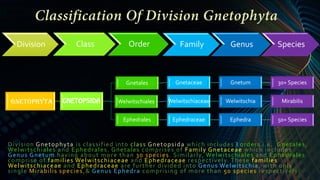
Division Gnetophyta is classified into class Gnetopsida which includes orders i.e. Gnetales,
Welwitschiales and Ephedrales. Gnetales comprises of Family Gnetaceae which includes
Genus Gnetum having about more than 30 species. Similarly, Welwitschiales and Ephedrales
comprise of families Welwitschiaceae and Ephedraceae respectively. These families
Welwitschiaceae and Ephedraceae are further divided into Genus Welwitschia, with only
single Mirabilis species,& Genus Ephedra comprising of more than 50 species respectively.
Gnetophyta
Gnetales Gnetaceae Gnetum 30+ Species
Welwitschiales Welwitschiaceae Welwitschia Mirabilis
Ephedrales Ephedraceae Ephedra 50+ Species
Division Class Order Family Genus Species
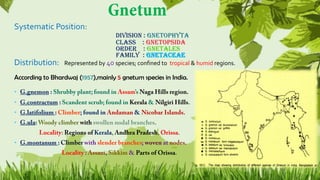
Systematic Position:
Division : Gnetophyta
Class : Gnetopsida
Order : Gnetales
Family : Gnetaceae
Distribution: Represented by 40 species; confined to tropical & humid regions.
According to Bhardwaj (1957),mainly 5 gnetum species in India.
•
•
•
•
•
Characteristic Features Of Gnetum
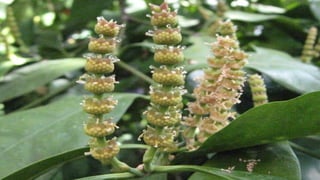
Most Species are climbers except few being shrubs & trees.
Branches 2 types : Branches of limited growth
Branches of unlimited growth
Climbing Species have branches of limited growth (short shoots)
and unbranched with foliage leaves.
Leaves: Dicot like scaly leaves; large & oval with entire margins
9-10 in pairs arranged in decussate fashion with
reticulate venation.
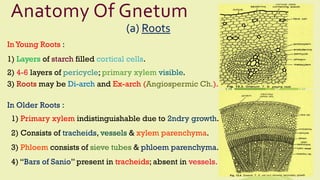
Anatomy Of Gnetum
(a) Roots
InYoung Roots :
1) Layers of starch filled cortical cells.
2) 4-6 layers of pericycle; primary xylem visible.
3) Roots may be Di-arch and Ex-arch (Angiospermic Ch.).
In Older Roots :
1) Primary xylem indistinguishable due to 2ndry growth.
2) Consists of tracheids, vessels & xylem parenchyma.
3) Phloem consists of sieve tubes & phloem parenchyma.
4) “Bars of Sanio” present in tracheids; absent in vessels.
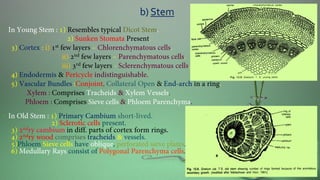
b) Stem
•
•
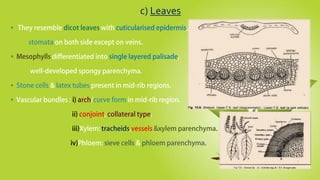
c) Leaves




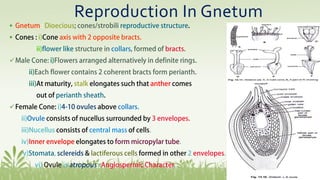
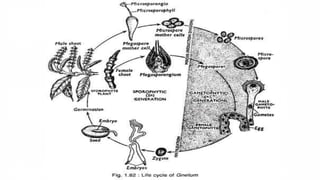
Reproduction In Gnetum




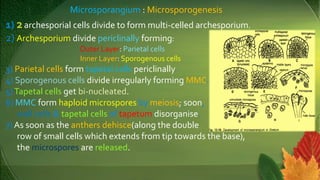
Microsporangium : Microsporogenesis
1) 2archesporial cells divide to form multi-celled archesporium.
2) Archesporium divide periclinally forming:
Outer Layer: Parietal cells
Inner Layer: Sporogenous cells
3) Parietal cells form tapetal cells periclinally.
4) Sporogenous cells divide irregularly forming MMC.
5)Tapetal cells get bi-nucleated.
6) MMC form haploid microspores by meiosis; soon,
wall cells & tapetal cells of tapetum disorganise.
7) As soon as the anthers dehisce(along the double
row of small cells which extends from tip towards the base),
the microspores are released.
Megasporangium : Megasporogenesis
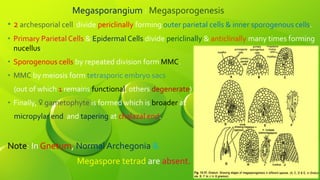
• 2 archesporial cell divide periclinally forming outer parietal cells & inner sporogenous cells.
• Primary Parietal Cells & Epidermal Cells divide periclinally & anticlinally many times forming
nucellus.
• Sporogenous cells by repeated division form MMC.
• MMC by meiosis form tetrasporic embryo sacs
(out of which 1 remains functional, others degenerate)
• Finally, ♀ gametophyte is formed which is broader at
micropylar end and tapering at chalazal end.
Note: In Gnetum, Normal Archegonia &
Megaspore tetrad are absent.
Pollination, Fertilization And Post Fertilization
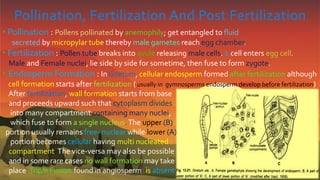
• Pollination : Pollens pollinated by anemophily; get entangled to fluid
secreted by micropylar tube thereby male gametes reach egg chamber.
• Fertilization : Pollen tube breaks into ovule releasing male cells. 1 cell enters egg cell.
Male and Female nuclei, lie side by side for sometime, then fuse to form zygote.
• Endosperm Formation : In Gnetum, cellular endosperm formed after fertilization although
cell formation starts after fertilization ( usually in gymnosperms endosperm develop before fertilization)
After fertilization, wall formation starts from base
and proceeds upward such that cytoplasm divides
into many compartment containing many nuclei,
which fuse to form a single nucleus.The upper (B)
portion usually remains free- nuclear while lower (A)
portion becomes cellular having multi nucleated
compartment.The vice-versa may also be possible
and in some rare cases no wall formation may take
place.Triple Fusion(found in angiosperm) is absent.
Embryo In Gnetum
• In Gnetum, different species show variable embryonal development.
(Acc. to Maheshwari &Vasil, the first division of zygote in angiosperms is accompanied by wall formation
while in gymnosperms(except Sequoia spp.),free nuclear division.Thus, Gnetum in this respect forms a link b/w
gymnosperms and angiosperms as it shows both free nuclear division & cell division.)
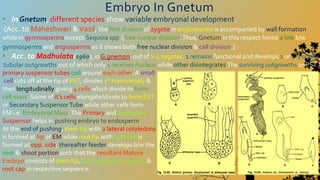
• Acc. to Madhulata(1960), in G.gnemon: out of 2-4 zygotes, 1 remains functional and develops 1 or 2-3 small
tubular outgrowths,out of which only 1 receives nucleus while other disintegrates.The surviving outgrowths or PST
primary suspensor tubes coil around each other. A small
cell cuts off at the tip of PST, divides 1st transversely &
then longitudinally giving 4 cells which divide to form
cell mass. Some of it’s cells elongate/divide to form SST
or Secondary SuspensorTube while other cells form
EM i.e. Embryonal Mass.The Primary and Secondary
Suspensor helps in pushing embryo to endosperm.
At the end of pushing, stem tip with 2 lateral cotyledons
is formed at tip of EM while root tip with root cap is
formed at opp. side; thereafter feeder develops b/w the
root & shoot portion such that the resultant Mature
Embryo consists of stem tip, two cotyledons root tip &
root cap in respective sequence.
Germination Of Seed In Gnetum
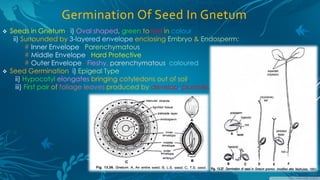
 Seeds in Gnetum: i) Oval shaped, green to red in colour
ii) Surrounded by 3-layered envelope enclosing Embryo & Endosperm:
# Inner Envelope : Parenchymatous
# Middle Envelope : Hard Protective
# Outer Envelope : Fleshy, parenchymatous, coloured
 Seed Germination: i) Epigeal Type
ii) Hypocotyl elongates bringing cotyledons out of soil.
iii) First pair of foliage leaves produced by develop. plumule.
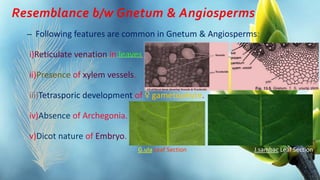
Resemblance b/w Gnetum & Angiosperms
– Following features are common in Gnetum & Angiosperms:
i)Reticulate venation in leaves.
ii)Presence of xylem vessels.
iii)Tetrasporic development of ♀ gametophyte.
iv)Absence of Archegonia.
v)Dicot nature of Embryo.
G.ula Leaf Section J.sambac Leaf Section
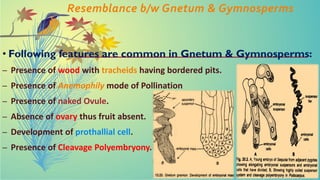
Resemblance b/w Gnetum & Gymnosperms
• Following features are common in Gnetum & Gymnosperms:
– Presence of wood with tracheids having bordered pits.
– Presence of Anemophily mode of Pollination
– Presence of naked Ovule.
– Absence of ovary thus fruit absent.
– Development of prothallial cell.
– Presence of Cleavage Polyembryony.
Gnetum: A Powerpoint Presentation on Gymnospems

Gnetum: A Powerpoint Presentation on Gymnospems

  • 1.
  • 2.
  • 3.
    : naked seed producingvascular plants. include conifers, cycads, ginkgo(The “LIVING FOSSIL” plant)& gnetales. seeds develop on the surface of scale like appendages of cones/strobili. more advanced than ferns as they produce seeds and in their case the sporophytic generation dominates over the gametophytic counterpart.
  • 4.
     There areabout 700 to 900 extant* species of Gymnosperms. (Note: Extant- term refers to taxa still found to be living.)  Gymnosperms originated in late carboniferous period.  They are considered to be the result of genome duplication event which took place around 319 Mya.  The fossils of Pro-gymnosperms, belonging to late Devonian period around 383 Mya, exhibit some characters found in the gymnosperms.  By the end of the Palaeozoic era, they replaced most of the ferns becoming the dominant vegetation of the Mesozoic era.  The end of Mesozoic era marked start of their extinction.
  • 6.
  • 7.
  • 8.
    Classic Classification OfGymnosperms Chamberlain (1935), in his book gymnosperms-structure and evolution, divided gymnosperms into 2 main groups, i.e. Cycadophytes and Coniferophytes as mentioned below: Of all the above mentioned orders; cycadofilicales, bennettitales of cycadophytes and cordiatales of coniferophytes are extinct. The order coniferales of coniferophytes was further divided into 6 families namely; Abietacaceae,Taxodiaceae,Cupressaceae,Araucariaceae,Podocarpaceae,Taxaceae. Gymnosperms Cycadophytes Cycadofilicales E.g.: Lygenopteris (extinct) Bennettiales E.g.: Cycadeoidea (extinct) Cycadales E.g.: Cycas, Microcycas,Zamia, Stangeria Coniferophytes Cordiatales E.g.: Cordaites (extinct) Ginkgoales E.g.: Ginkgo Coniferales E.g.: Pinus, Abies,Taxus Gnetales E.g.: Gnetum
  • 9.
    MODERN CLASSIFICATION OFGYMNOSPERMS Cycadales and Ginkgoales include living members which have long fossil history and are thus regarded as “living fossils”, example G.biloba. Coniferales include abies, taxus, pinus. The gnetales represented by 3 genera example gnetum, ephedra and Welwitschia mirabilis. Gymnosperms Cycadophyta Ginkgophyta Coniferophyta Gnetophyta
  • 11.
    CYCADOPHYTA : CYCADS :Dioecious  Originated in Carboniferous period from seed ferns i.e. Cycadofilicales & were dominant veg. during Mesozoic era. • Include 11 genera & 100 species; mostly woody with monoxylic trunk except Zamia pygmea.  Stem/Caudex : unbranched with leaf scars  Leaves/Frond: pinnately compound, arranged in whorls; found in crown/apex region of stem. • Roots are coralloid type with primary & secondary divisions. • Microsporophyll form male strobili. Megasporophyll form female strobili.
  • 13.
    Coniferophyta: Conifers • Largestdivision of gymnosperms including pinus,yews,spruces,junipers,cedars,etc. • Most diverse with 588 extant species; both economically/ecologically important. • They are long, branched and evergreen trees with dimorphic branches. • Leaves: may be comb-like, scale-like, needle-like; mostly linear. • Wood usually pycnoxylic characterised by presence of resin canals. • Microsporophylls and megasporophylls form compact cones; that are distinguishable. • Male Gametes -non motile; found in ♂ cone • Fertilization – Siphonogamous type.
  • 15.
    Ginkgophyta : Ginkgo Ginkgobiloba : MAIDEN HAIR TREE  Only living species of Ginkgophyta; thus also k/a “living fossil.”  First ancestor dated Permian Era; although originated in Jurassic period.  First discovered in South East China, preserved in a sacred garden.  Leaves: Fan-shaped, varied morphology – deep lobed(notched) to unlobed, parallel veins; exhibiting open dichotomous venation.  Dioecious; Male Trees with stalked pollen sacs together at leaf base Female Trees with pair of naked ovules at end of long stalk.  G.biloba alongwith Cycads are only living seed plants with flagellated male gametes.  Rotting fruit produce foul smell due to production butyric acid.
  • 17.
  • 18.
    DISTRIBUTION OF GNETOPHYTA Colour: Genus Found Green Welwitschia Blue Gnetum Red Ephedra Purple Both Gnetum & Ephedra
  • 19.
    Division Gnetophyta isclassified into class Gnetopsida which includes orders i.e. Gnetales, Welwitschiales and Ephedrales. Gnetales comprises of Family Gnetaceae which includes Genus Gnetum having about more than 30 species. Similarly, Welwitschiales and Ephedrales comprise of families Welwitschiaceae and Ephedraceae respectively. These families Welwitschiaceae and Ephedraceae are further divided into Genus Welwitschia, with only single Mirabilis species,& Genus Ephedra comprising of more than 50 species respectively. Gnetophyta Gnetales Gnetaceae Gnetum 30+ Species Welwitschiales Welwitschiaceae Welwitschia Mirabilis Ephedrales Ephedraceae Ephedra 50+ Species Division Class Order Family Genus Species
  • 21.
    Systematic Position: Division :Gnetophyta Class : Gnetopsida Order : Gnetales Family : Gnetaceae Distribution: Represented by 40 species; confined to tropical & humid regions. According to Bhardwaj (1957),mainly 5 gnetum species in India. • • • • •
  • 22.
    Characteristic Features OfGnetum Most Species are climbers except few being shrubs & trees. Branches 2 types : Branches of limited growth Branches of unlimited growth Climbing Species have branches of limited growth (short shoots) and unbranched with foliage leaves. Leaves: Dicot like scaly leaves; large & oval with entire margins 9-10 in pairs arranged in decussate fashion with reticulate venation.
  • 23.
    Anatomy Of Gnetum (a)Roots InYoung Roots : 1) Layers of starch filled cortical cells. 2) 4-6 layers of pericycle; primary xylem visible. 3) Roots may be Di-arch and Ex-arch (Angiospermic Ch.). In Older Roots : 1) Primary xylem indistinguishable due to 2ndry growth. 2) Consists of tracheids, vessels & xylem parenchyma. 3) Phloem consists of sieve tubes & phloem parenchyma. 4) “Bars of Sanio” present in tracheids; absent in vessels.
  • 24.
  • 25.
  • 26.
  • 27.
    Microsporangium : Microsporogenesis 1)2archesporial cells divide to form multi-celled archesporium. 2) Archesporium divide periclinally forming: Outer Layer: Parietal cells Inner Layer: Sporogenous cells 3) Parietal cells form tapetal cells periclinally. 4) Sporogenous cells divide irregularly forming MMC. 5)Tapetal cells get bi-nucleated. 6) MMC form haploid microspores by meiosis; soon, wall cells & tapetal cells of tapetum disorganise. 7) As soon as the anthers dehisce(along the double row of small cells which extends from tip towards the base), the microspores are released.
  • 28.
    Megasporangium : Megasporogenesis •2 archesporial cell divide periclinally forming outer parietal cells & inner sporogenous cells. • Primary Parietal Cells & Epidermal Cells divide periclinally & anticlinally many times forming nucellus. • Sporogenous cells by repeated division form MMC. • MMC by meiosis form tetrasporic embryo sacs (out of which 1 remains functional, others degenerate) • Finally, ♀ gametophyte is formed which is broader at micropylar end and tapering at chalazal end. Note: In Gnetum, Normal Archegonia & Megaspore tetrad are absent.
  • 29.
    Pollination, Fertilization AndPost Fertilization • Pollination : Pollens pollinated by anemophily; get entangled to fluid secreted by micropylar tube thereby male gametes reach egg chamber. • Fertilization : Pollen tube breaks into ovule releasing male cells. 1 cell enters egg cell. Male and Female nuclei, lie side by side for sometime, then fuse to form zygote. • Endosperm Formation : In Gnetum, cellular endosperm formed after fertilization although cell formation starts after fertilization ( usually in gymnosperms endosperm develop before fertilization) After fertilization, wall formation starts from base and proceeds upward such that cytoplasm divides into many compartment containing many nuclei, which fuse to form a single nucleus.The upper (B) portion usually remains free- nuclear while lower (A) portion becomes cellular having multi nucleated compartment.The vice-versa may also be possible and in some rare cases no wall formation may take place.Triple Fusion(found in angiosperm) is absent.
  • 30.
    Embryo In Gnetum •In Gnetum, different species show variable embryonal development. (Acc. to Maheshwari &Vasil, the first division of zygote in angiosperms is accompanied by wall formation while in gymnosperms(except Sequoia spp.),free nuclear division.Thus, Gnetum in this respect forms a link b/w gymnosperms and angiosperms as it shows both free nuclear division & cell division.) • Acc. to Madhulata(1960), in G.gnemon: out of 2-4 zygotes, 1 remains functional and develops 1 or 2-3 small tubular outgrowths,out of which only 1 receives nucleus while other disintegrates.The surviving outgrowths or PST primary suspensor tubes coil around each other. A small cell cuts off at the tip of PST, divides 1st transversely & then longitudinally giving 4 cells which divide to form cell mass. Some of it’s cells elongate/divide to form SST or Secondary SuspensorTube while other cells form EM i.e. Embryonal Mass.The Primary and Secondary Suspensor helps in pushing embryo to endosperm. At the end of pushing, stem tip with 2 lateral cotyledons is formed at tip of EM while root tip with root cap is formed at opp. side; thereafter feeder develops b/w the root & shoot portion such that the resultant Mature Embryo consists of stem tip, two cotyledons root tip & root cap in respective sequence.
  • 31.
    Germination Of SeedIn Gnetum  Seeds in Gnetum: i) Oval shaped, green to red in colour ii) Surrounded by 3-layered envelope enclosing Embryo & Endosperm: # Inner Envelope : Parenchymatous # Middle Envelope : Hard Protective # Outer Envelope : Fleshy, parenchymatous, coloured  Seed Germination: i) Epigeal Type ii) Hypocotyl elongates bringing cotyledons out of soil. iii) First pair of foliage leaves produced by develop. plumule.
  • 33.
    Resemblance b/w Gnetum& Angiosperms – Following features are common in Gnetum & Angiosperms: i)Reticulate venation in leaves. ii)Presence of xylem vessels. iii)Tetrasporic development of ♀ gametophyte. iv)Absence of Archegonia. v)Dicot nature of Embryo. G.ula Leaf Section J.sambac Leaf Section
  • 34.
    Resemblance b/w Gnetum& Gymnosperms • Following features are common in Gnetum & Gymnosperms: – Presence of wood with tracheids having bordered pits. – Presence of Anemophily mode of Pollination – Presence of naked Ovule. – Absence of ovary thus fruit absent. – Development of prothallial cell. – Presence of Cleavage Polyembryony.