Sphagnales
Bryophytes
Bog mosses or peat mosses
 Commonly c/as ‘bog mosses or peat mosses’
 Bog: Badly drained permanently wet land with high rainfall
 Common in upland and waste areas of temperature regions
 Peat: Partially decomposed plant material
 Common in areas with poor drainage
Department of Botany JES College Jalna
Distribution and Habitat
3
 Only genus – Sphagnum, a bog moss
 Some called as turf moss
 Cosmopolitan – north & south tropics, through temperate
regions extending to sub-arctic and sub-antarctic regions
 Dense masses in ponds, lakes which contain little amount of
lime
 In cooler cliamtes – dominates the vegetation
 350 Species
 > 20 in India
Department of Botany JES College Jalna
Distribution and Habitat
4
 Grows in water with pH range from 3.7 to 4.9
 Size – few inches to 7 inches
 Perennial moss: Older parts die regularly and in combination
with the remains of other surrounding plants, form a
compact mass k/as peat
 Since, Peat former – great commercial importance
Department of Botany JES College Jalna
Mature Gametophyte
5
 Erect, branched – differentiated into
stem & leaves
 Rhizoids – colourless, survive for a
short time
 Apex – posses no. of densely crowded
short branches called ‘coma’
 Posteriorly, branches arise in tufts in
axil of every fourth leaf
 Each tuft – 3 to 8 branches
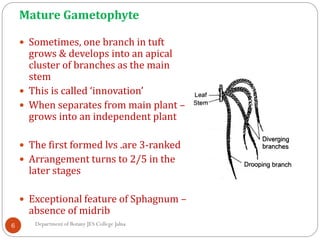
 Divergent branches: Short, stout,
outward & upward
 Drooping or flagelliform branches:
Hang downward, close & around the
stem (absent in submerged forms)
Department of Botany JES College Jalna
Mature Gametophyte
6
 Sometimes, one branch in tuft
grows & develops into an apical
cluster of branches as the main
stem
 This is called ‘innovation’
 When separates from main plant –
grows into an independent plant
 The first formed lvs .are 3-ranked
 Arrangement turns to 2/5 in the
later stages
 Exceptional feature of Sphagnum –
absence of midrib
Department of Botany JES College Jalna
Reproduction
7
 Vegetative reproduction
 Innovations
 Some multiply by primary protonema :- Few thalloidal
cells of primary protonema become meristematic & forms
multicellular filament
This develops into a thallus-like, flat secondary protonema
• Sexual reproduction
• Both monoeciuos and dioecious species
• Antheridia – on Antheridial or Male branches
• Archegonia – on Archegonial or Female branches
Department of Botany JES College Jalna
Reproduction
8
 Antheridial or Male Branches
 Catkin-like small structures
 Arranged spirally or in straight
rows on main axis
 Possess many small, coloured lvs -
Yellow, brown or reddish
 Axil of each leaf – antheridial
branch develops antheridium –
acropetally
Department of Botany JES College Jalna
Reproduction
9
 Mature Antheridium
 Long stalk & globular body
 Stalk – 2 to 4 rows of cells
 Single layered sterile jacket
enclosing androcyte cells
 Androcyte – metamorphoses into
biflagellate, unicellular, uninucleate
antherozoid
 Antheridium – dehisces by several
irregular lobes or valves at the apex
Department of Botany JES College Jalna
Reproduction
10
 Archegonial Branches
 Shorter than antheridial branches
 Bud-like strcutures bearing single
or 2-5 archegonia surrounded by
lvs.
 Lvs – green & larger than lvs of
vegetative branches
 These are c/as ‘perichaetium’
 Primary archegonium : develops
from apical cell
 Secondary archegonia : develop
from derivatives of apical cell
Department of Botany JES College Jalna
Reproduction
11
 Mature Archegonium
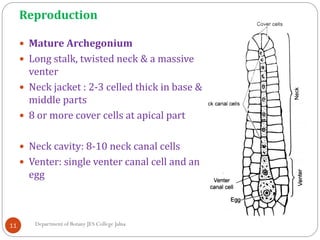
 Long stalk, twisted neck & a massive
venter
 Neck jacket : 2-3 celled thick in base &
middle parts
 8 or more cover cells at apical part
 Neck cavity: 8-10 neck canal cells
 Venter: single venter canal cell and an
egg
Department of Botany JES College Jalna
Reproduction
12
 Mature Sporophyte
 Contains foot, seta & capsule
 Foot : Parenchymatous; bulbous or
cylindrical body; haustorial in function
 Seta: ill-developed; inconspicuous and
has very narrow structure
 Capsule: Well-developed, quite
conspicuous & spherical
 Dark-brown or black coloured
 Has 2-7 layered wall
 Outer layer – epidermis with several
nonfunctional stomata
Department of Botany JES College Jalna
Reproduction
13
 Mature Sporophyte
 Capsule wall with chloroplasts
 Operculum : at apical part of the capsule (It
is a circular, biconvex disc-shaped
structure)
 Annulus : circular groove of thin-walled
cells separates the operculum from capsule
• Columella : central part of the
capsule; made up of sterile cells
• Dome-shaped arch of fertile
sporogenous tissue is present over
the columella
• Calyptra & perichaetium surround the
sporophyte in young conditions
Department of Botany JES College Jalna
Reproduction
14
 Mature Sporophyte
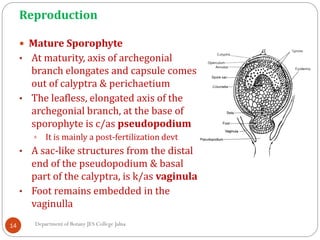
• At maturity, axis of archegonial
branch elongates and capsule comes
out of calyptra & perichaetium
• The leafless, elongated axis of the
archegonial branch, at the base of
sporophyte is c/as pseudopodium
 It is mainly a post-fertilization devt
• A sac-like structures from the distal
end of the pseudopodium & basal
part of the calyptra, is k/as vaginula
• Foot remains embedded in the
vaginulla
Department of Botany JES College Jalna
Reproduction
15
 Dehiscence of capsule
• Capsule dehisces by ‘air-gun mechanism’
• Due to heat of the sunny day, columella &
the capsule wall become dry and get
shrivelled
• It develops air space under the spore sac
• Capsule changes its shape from spherical
to cylindrical
• Air inside the capsule gets compressed,
and a pressure also develops inside the
capsule
• Due to this, operculum breaks off at the
aanulus
• Spore sac ruptures and the spores are
blown to a height of several centimetres
Department of Botany JES College Jalna