Chlamydia
A sexually transmitted
infection caused by the
bacterium Chlamydia
trachomatis.
Genera
Family
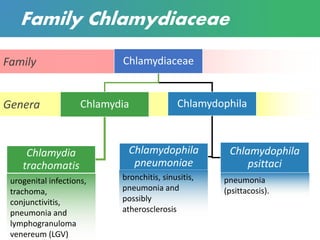
Family Chlamydiaceae
Chlamydiaceae
Chlamydia
Chlamydia
trachomatis
Chlamydophila
Chlamydophila
pneumoniae
Chlamydophila
psittaci
urogenital infections,
trachoma,
conjunctivitis,
pneumonia and
lymphogranuloma
venereum (LGV)
bronchitis, sinusitis,
pneumonia and
possibly
atherosclerosis
pneumonia
(psittacosis).
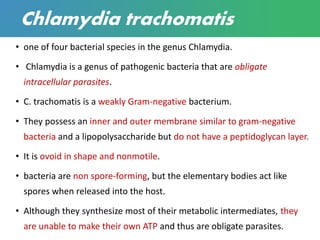
Chlamydia trachomatis
• one of four bacterial species in the genus Chlamydia.
• Chlamydia is a genus of pathogenic bacteria that are obligate
intracellular parasites.
• C. trachomatis is a weakly Gram-negative bacterium.
• They possess an inner and outer membrane similar to gram-negative
bacteria and a lipopolysaccharide but do not have a peptidoglycan layer.
• It is ovoid in shape and nonmotile.
• bacteria are non spore-forming, but the elementary bodies act like
spores when released into the host.
• Although they synthesize most of their metabolic intermediates, they
are unable to make their own ATP and thus are obligate parasites.
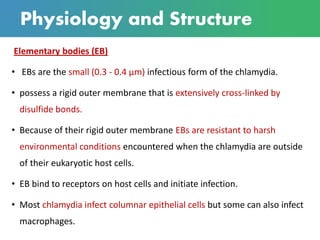
Physiology and Structure
Elementary bodies (EB)
• EBs are the small (0.3 - 0.4 μm) infectious form of the chlamydia.
• possess a rigid outer membrane that is extensively cross-linked by
disulfide bonds.
• Because of their rigid outer membrane EBs are resistant to harsh
environmental conditions encountered when the chlamydia are outside
of their eukaryotic host cells.
• EB bind to receptors on host cells and initiate infection.
• Most chlamydia infect columnar epithelial cells but some can also infect
macrophages.
Physiology and Structure
Reticulate bodies (RB)
• RBs are the non-infectious intracellular from of the
chlamydia.
• They are the metabolically active replicating form of
the chlamydia.
• They possess a fragile membrane lacking the extensive
disulfide bonds characteristic of the EB.
Physiology and Structure
Chlamydia trachomatis inclusion bodies
(brown) in a McCoy cell culture
LifeCycle
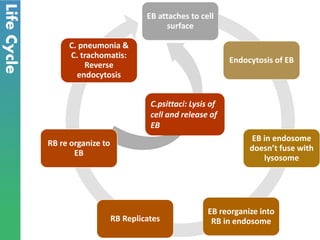
EB attaches to cell
surface
Endocytosis of EB
EB in endosome
doesn’t fuse with
lysosome
EB reorganize into
RB in endosomeRB Replicates
RB re organize to
EB
C. pneumonia &
C. trachomatis:
Reverse
endocytosis
LifeCycle
C.psittaci: Lysis of
cell and release of
EB
LifeCycle–notes
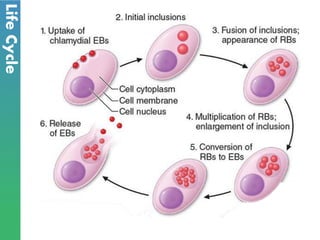
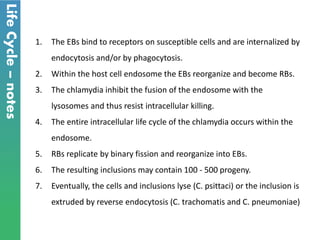
1. The EBs bind to receptors on susceptible cells and are internalized by
endocytosis and/or by phagocytosis.
2. Within the host cell endosome the EBs reorganize and become RBs.
3. The chlamydia inhibit the fusion of the endosome with the
lysosomes and thus resist intracellular killing.
4. The entire intracellular life cycle of the chlamydia occurs within the
endosome.
5. RBs replicate by binary fission and reorganize into EBs.
6. The resulting inclusions may contain 100 - 500 progeny.
7. Eventually, the cells and inclusions lyse (C. psittaci) or the inclusion is
extruded by reverse endocytosis (C. trachomatis and C. pneumoniae)
C. trachomatis
• C. trachomatis is the causative agent of trachoma,
urogenital disease, infant pneumonia and
lymphogranuloma venereum.
• It has a limited host range and only infects human
epithelial cells
• infects non-ciliated columnar epithelial cells.
• Disease result from destruction of the cells and the
host inflammatory response.
C. trachomatis : Ocular Infection
Trachoma
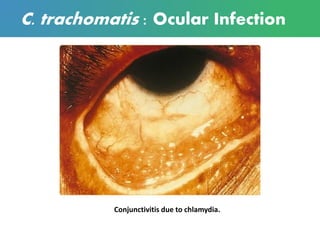
• Chronic infection or repeated reinfection with C. trachomatis (var: trachoma)
results in inflammation and follicle formation involving the entire
conjunctiva.
• Scarring of the conjunctiva causes turning in of the eyelids and eventual
scarring, ulceration and blood vessel formation in the cornea, resulting in
blindness.
• The name trachoma comes from 'trakhus' meaning rough which characterizes
the appearance of the conjunctiva.
• Inflammation in the tissue also interferes with the flow of tears which is an
important antibacterial defense mechanisms. Thus, secondary bacterial
infections occur.
C. trachomatis : Ocular Infection
Inclusion conjunctivitis
• Inclusion conjunctivitis is caused by C. trachomatis (biovar:
trachoma) associated with genital infections
• The infection is characterized by a mucopurulent discharge, corneal
infiltrates and occasional corneal vascularization.
• In chronic cases corneal scarring may occur.
• In neonates infection results from passage through an infected birth
canal and becomes apparent after 5 - 12 days.
• Ear infection can accompany the ocular disease.
C. trachomatis : Ocular Infection
Conjunctivitis due to chlamydia.
C. trachomatis : Ocular Infection
Ocular lymphogranuloma venereum
• Infection with C. trachomatis (biovar: LGV) can lead to oculoglandular
conjunctivitis.
• In addition to the conjunctivitis, patients also have an associated
lymphadenopathy.
Infant pneumonia
• Infants infected with C. trachomatis (biovar: trachoma; serovars: D - K) at
birth can develop pneumonia.
• The children develop symptoms of wheezing and cough but not fever. The
disease is often preceded by neonatal conjunctivitis.
C. trachomatis : Ocular Infection
Urogenital infections
• Chlamydia is known as the "silent epidemic", as in women it may
not cause any symptoms in 70–80% of cases
symptoms can include
• abnormal vaginal bleeding or discharge
• abdominal pain, painful sexual intercourse, fever
• painful urination or the urge to urinate more often than usual
• Postpartum fever in infected mothers is common.
• Premature delivery and an increased rate of ectopic pregnancy due
to salpingitis can occur
C. trachomatis : Ocular Infection
Urogenital infections
• After a 3 week incubation period patients may develop urethral discharge,
dysuria and pyuria
• Post-gonococcal urethritis also occurs in men infected with both Neisseria
gonorrhoeae and C. trachomatis. The symptoms of chlamydial infection
occur after treatment for gonorrhea because the incubation time is longer.
• Chlamydia will develop pelvic inflammatory diseases and about 20% of
these women will become infertile
• untreated cases (18%) result in chronic pelvic pain.
• Women infected with chlamydia have a 3 - 5 fold increased risk of
acquiring HIV.
C. trachomatis : Ocular Infection
Urogenital infections
• In men, infection show symptoms of infectious inflammation of the
urethra - 50% of cases
Symptoms that may occur include:
• a painful or burning sensation when urinating
• discharge from the penis
• testicular pain or swelling, or fever.
• chlamydia in men can spread to the testicles causing epididymitis,
which can lead to sterility
• Chlamydia is also a potential cause of prostatic inflammation in men
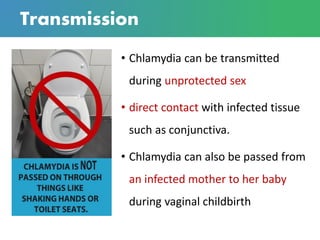
Transmission
• Chlamydia can be transmitted
during unprotected sex
• direct contact with infected tissue
such as conjunctiva.
• Chlamydia can also be passed from
an infected mother to her baby
during vaginal childbirth
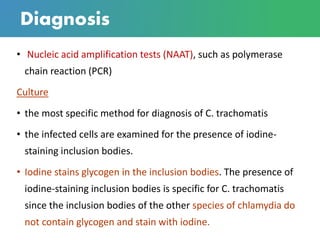
Diagnosis
• Nucleic acid amplification tests (NAAT), such as polymerase
chain reaction (PCR)
Culture
• the most specific method for diagnosis of C. trachomatis
• the infected cells are examined for the presence of iodine-
staining inclusion bodies.
• Iodine stains glycogen in the inclusion bodies. The presence of
iodine-staining inclusion bodies is specific for C. trachomatis
since the inclusion bodies of the other species of chlamydia do
not contain glycogen and stain with iodine.
Diagnosis
Antigen detection
• Direct immunofluorescence and ELISA kits that detect the group
specific or strain-specific outer membrane proteins are available for
diagnosis.
• Neither is as good as culture, particularly with samples containing few
organisms (e.g. asymptomatic patients).
Serology
• Serological tests for diagnosis are of limited value in adults, since the
tests do not distinguish between current and past infections.
• Detection of high titer IgM antibodies is indicative of a recent infection.
• Detection of IgM antibodies in neonatal infection is useful.
Treatment and Prevention
• Tetracyclines, erythromycin and sulfonamides are used for
treatment but they are of limited value in endemic areas where
reinfection is common.
• Vaccines are of little value and are not used. Treatment coupled
with improved sanitation to prevent reinfection is the best way
to control infection.
• Safe sexual practices and prompt treatment of symptomatic
patients and their sexual partners can prevent genital infections.
• the use of condoms, or having sex with only one other person,
who is not infected

Chlamydia - The silent killer

  • 1.
    Chlamydia A sexually transmitted infectioncaused by the bacterium Chlamydia trachomatis.
  • 2.
  • 3.
    Chlamydia trachomatis • oneof four bacterial species in the genus Chlamydia. • Chlamydia is a genus of pathogenic bacteria that are obligate intracellular parasites. • C. trachomatis is a weakly Gram-negative bacterium. • They possess an inner and outer membrane similar to gram-negative bacteria and a lipopolysaccharide but do not have a peptidoglycan layer. • It is ovoid in shape and nonmotile. • bacteria are non spore-forming, but the elementary bodies act like spores when released into the host. • Although they synthesize most of their metabolic intermediates, they are unable to make their own ATP and thus are obligate parasites.
  • 4.
    Physiology and Structure Elementarybodies (EB) • EBs are the small (0.3 - 0.4 μm) infectious form of the chlamydia. • possess a rigid outer membrane that is extensively cross-linked by disulfide bonds. • Because of their rigid outer membrane EBs are resistant to harsh environmental conditions encountered when the chlamydia are outside of their eukaryotic host cells. • EB bind to receptors on host cells and initiate infection. • Most chlamydia infect columnar epithelial cells but some can also infect macrophages.
  • 5.
    Physiology and Structure Reticulatebodies (RB) • RBs are the non-infectious intracellular from of the chlamydia. • They are the metabolically active replicating form of the chlamydia. • They possess a fragile membrane lacking the extensive disulfide bonds characteristic of the EB.
  • 6.
    Physiology and Structure Chlamydiatrachomatis inclusion bodies (brown) in a McCoy cell culture
  • 7.
  • 8.
    EB attaches tocell surface Endocytosis of EB EB in endosome doesn’t fuse with lysosome EB reorganize into RB in endosomeRB Replicates RB re organize to EB C. pneumonia & C. trachomatis: Reverse endocytosis LifeCycle C.psittaci: Lysis of cell and release of EB
  • 9.
    LifeCycle–notes 1. The EBsbind to receptors on susceptible cells and are internalized by endocytosis and/or by phagocytosis. 2. Within the host cell endosome the EBs reorganize and become RBs. 3. The chlamydia inhibit the fusion of the endosome with the lysosomes and thus resist intracellular killing. 4. The entire intracellular life cycle of the chlamydia occurs within the endosome. 5. RBs replicate by binary fission and reorganize into EBs. 6. The resulting inclusions may contain 100 - 500 progeny. 7. Eventually, the cells and inclusions lyse (C. psittaci) or the inclusion is extruded by reverse endocytosis (C. trachomatis and C. pneumoniae)
  • 10.
    C. trachomatis • C.trachomatis is the causative agent of trachoma, urogenital disease, infant pneumonia and lymphogranuloma venereum. • It has a limited host range and only infects human epithelial cells • infects non-ciliated columnar epithelial cells. • Disease result from destruction of the cells and the host inflammatory response.
  • 11.
    C. trachomatis :Ocular Infection Trachoma • Chronic infection or repeated reinfection with C. trachomatis (var: trachoma) results in inflammation and follicle formation involving the entire conjunctiva. • Scarring of the conjunctiva causes turning in of the eyelids and eventual scarring, ulceration and blood vessel formation in the cornea, resulting in blindness. • The name trachoma comes from 'trakhus' meaning rough which characterizes the appearance of the conjunctiva. • Inflammation in the tissue also interferes with the flow of tears which is an important antibacterial defense mechanisms. Thus, secondary bacterial infections occur.
  • 12.
    C. trachomatis :Ocular Infection Inclusion conjunctivitis • Inclusion conjunctivitis is caused by C. trachomatis (biovar: trachoma) associated with genital infections • The infection is characterized by a mucopurulent discharge, corneal infiltrates and occasional corneal vascularization. • In chronic cases corneal scarring may occur. • In neonates infection results from passage through an infected birth canal and becomes apparent after 5 - 12 days. • Ear infection can accompany the ocular disease.
  • 13.
    C. trachomatis :Ocular Infection Conjunctivitis due to chlamydia.
  • 14.
    C. trachomatis :Ocular Infection Ocular lymphogranuloma venereum • Infection with C. trachomatis (biovar: LGV) can lead to oculoglandular conjunctivitis. • In addition to the conjunctivitis, patients also have an associated lymphadenopathy. Infant pneumonia • Infants infected with C. trachomatis (biovar: trachoma; serovars: D - K) at birth can develop pneumonia. • The children develop symptoms of wheezing and cough but not fever. The disease is often preceded by neonatal conjunctivitis.
  • 15.
    C. trachomatis :Ocular Infection Urogenital infections • Chlamydia is known as the "silent epidemic", as in women it may not cause any symptoms in 70–80% of cases symptoms can include • abnormal vaginal bleeding or discharge • abdominal pain, painful sexual intercourse, fever • painful urination or the urge to urinate more often than usual • Postpartum fever in infected mothers is common. • Premature delivery and an increased rate of ectopic pregnancy due to salpingitis can occur
  • 16.
    C. trachomatis :Ocular Infection Urogenital infections • After a 3 week incubation period patients may develop urethral discharge, dysuria and pyuria • Post-gonococcal urethritis also occurs in men infected with both Neisseria gonorrhoeae and C. trachomatis. The symptoms of chlamydial infection occur after treatment for gonorrhea because the incubation time is longer. • Chlamydia will develop pelvic inflammatory diseases and about 20% of these women will become infertile • untreated cases (18%) result in chronic pelvic pain. • Women infected with chlamydia have a 3 - 5 fold increased risk of acquiring HIV.
  • 17.
    C. trachomatis :Ocular Infection Urogenital infections • In men, infection show symptoms of infectious inflammation of the urethra - 50% of cases Symptoms that may occur include: • a painful or burning sensation when urinating • discharge from the penis • testicular pain or swelling, or fever. • chlamydia in men can spread to the testicles causing epididymitis, which can lead to sterility • Chlamydia is also a potential cause of prostatic inflammation in men
  • 18.
    Transmission • Chlamydia canbe transmitted during unprotected sex • direct contact with infected tissue such as conjunctiva. • Chlamydia can also be passed from an infected mother to her baby during vaginal childbirth
  • 19.
    Diagnosis • Nucleic acidamplification tests (NAAT), such as polymerase chain reaction (PCR) Culture • the most specific method for diagnosis of C. trachomatis • the infected cells are examined for the presence of iodine- staining inclusion bodies. • Iodine stains glycogen in the inclusion bodies. The presence of iodine-staining inclusion bodies is specific for C. trachomatis since the inclusion bodies of the other species of chlamydia do not contain glycogen and stain with iodine.
  • 20.
    Diagnosis Antigen detection • Directimmunofluorescence and ELISA kits that detect the group specific or strain-specific outer membrane proteins are available for diagnosis. • Neither is as good as culture, particularly with samples containing few organisms (e.g. asymptomatic patients). Serology • Serological tests for diagnosis are of limited value in adults, since the tests do not distinguish between current and past infections. • Detection of high titer IgM antibodies is indicative of a recent infection. • Detection of IgM antibodies in neonatal infection is useful.
  • 21.
    Treatment and Prevention •Tetracyclines, erythromycin and sulfonamides are used for treatment but they are of limited value in endemic areas where reinfection is common. • Vaccines are of little value and are not used. Treatment coupled with improved sanitation to prevent reinfection is the best way to control infection. • Safe sexual practices and prompt treatment of symptomatic patients and their sexual partners can prevent genital infections. • the use of condoms, or having sex with only one other person, who is not infected