CHLAMYDIA

                                           II MBBS


24/02/2008   Dr Ekta, Microbiology, GMCA
KEY WORDS
    Intracellular                Inclusion conjunctivitis
    Energy parasites             Lymphogranuloma venereum
    Elementary body              Frei test
    Reticulate body              Genital chlamydiasis
    Inclusion bodies – HP, LCL   C. psittaci
    Biotypes/ serotypes          Psittacosis
    Tissue culture               Ornithosis
    C. trachomatis               C. pneumoniae
    Trachoma

24/02/2008         Dr Ekta, Microbiology, GMCA
INTRODUCTION
     Obligate intracellular parasites of humans,
     animals & birds

     Resemble bacteria except it cannot multiply
     outside living cells/ tissues (like viruses)

     Cannot synthesize ATP – depends on host cell
     for energy & nutrient sources. Hence, called
     Energy Parasites.
24/02/2008      Dr Ekta, Microbiology, GMCA
CHLAMYDIA
     4 species in the Genus Chlamydia –
       C. trachomatis,
       C. pneumoniae,       affects humans
       C. psittaci and
       C. pecorum           affects ruminants

     All are non-motile, gram negative; share
     antigens, have both DNA and RNA.
24/02/2008      Dr Ekta, Microbiology, GMCA
Classification
   C.trachomatis : eye & genital infections, infant
   pneumonia, and LGV (Lymphogranuloma
   Venereum) in adults

   C.pneumoniae : different types of respiratory
   infections.

   C.psittaci : psittacosis in man, ornithosis in birds
24/02/2008       Dr Ekta, Microbiology, GMCA
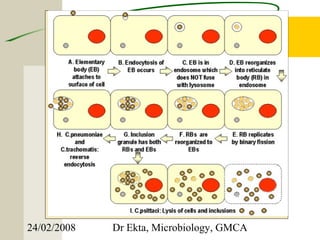
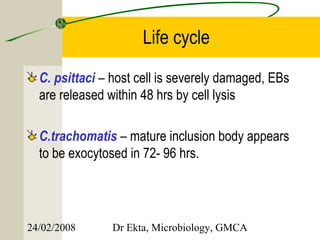
Life cycle
      Chlamydiae occur in 2 forms :
 1.   Elementary body – extracellular, infective form
 2.   Reticulate body – intracellular, growing & replicative
      form

 •    Chlamydial microcolony within the host cell is called
      Inclusion body.
 •    Mature inclusion body contains 100 - 500 elementary
      bodies
24/02/2008         Dr Ekta, Microbiology, GMCA
24/02/2008   Dr Ekta, Microbiology, GMCA
Life cycle
  C. psittaci – host cell is severely damaged, EBs
  are released within 48 hrs by cell lysis

  C.trachomatis – mature inclusion body appears
  to be exocytosed in 72- 96 hrs.


24/02/2008      Dr Ekta, Microbiology, GMCA
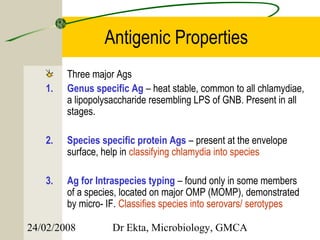
Antigenic Properties
        Three major Ags
   1.   Genus specific Ag – heat stable, common to all chlamydiae,
        a lipopolysaccharide resembling LPS of GNB. Present in all
        stages.

   2.   Species specific protein Ags – present at the envelope
        surface, help in classifying chlamydia into species

   3.   Ag for Intraspecies typing – found only in some members
        of a species, located on major OMP (MOMP), demonstrated
        by micro- IF. Classifies species into serovars/ serotypes

24/02/2008         Dr Ekta, Microbiology, GMCA
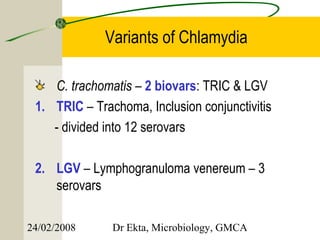
Variants of Chlamydia

    C. trachomatis – 2 biovars: TRIC & LGV
 1. TRIC – Trachoma, Inclusion conjunctivitis
    - divided into 12 serovars

 2. LGV – Lymphogranuloma venereum – 3
    serovars

24/02/2008     Dr Ekta, Microbiology, GMCA
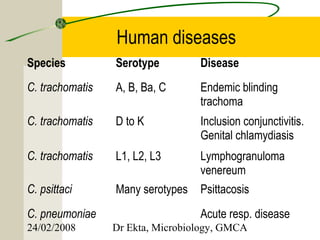
Human diseases
Species          Serotype         Disease
C. trachomatis   A, B, Ba, C      Endemic blinding
                                  trachoma
C. trachomatis   D to K           Inclusion conjunctivitis.
                                  Genital chlamydiasis
C. trachomatis   L1, L2, L3       Lymphogranuloma
                                  venereum
C. psittaci      Many serotypes   Psittacosis
C. pneumoniae                     Acute resp. disease
24/02/2008       Dr Ekta, Microbiology, GMCA
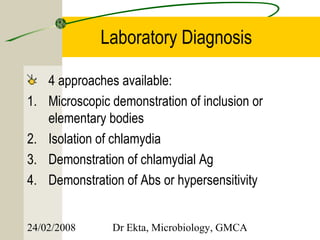
Laboratory Diagnosis

     4 approaches available:
1.   Microscopic demonstration of inclusion or
     elementary bodies
2.   Isolation of chlamydia
3.   Demonstration of chlamydial Ag
4.   Demonstration of Abs or hypersensitivity


24/02/2008       Dr Ekta, Microbiology, GMCA
Microscopy
   Gram negative but stained better by Giemsa, Castaneda
   or Machiavello stains.
   Giemsa Stain: Elementary body & the Reticulate body
   stains blue in cytoplasm
   Lugol’s iodine: rapid & simple screening method for
   ocular infections, stains glycogen matrix of C. trachomatis
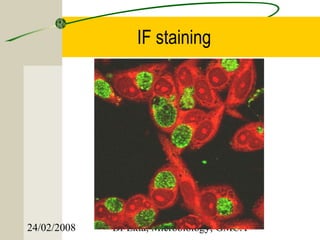
   Immunoflurescence staining: more sensitive & specific,
   by using monoclonal Abs. Identifies inclusion bodies as
   well as extracellular elementary bodies. Used for ocular,
   cervical or urethral specimens.
24/02/2008        Dr Ekta, Microbiology, GMCA
IF staining


24/02/2008   Dr Ekta, Microbiology, GMCA
Culture

    Yolk sac of 6 - 8 days old chick embryo.

    Tissue culture – McCoy, HeLa cell lines

  * C. psittaci carry the risk of laboratory infection.


24/02/2008       Dr Ekta, Microbiology, GMCA
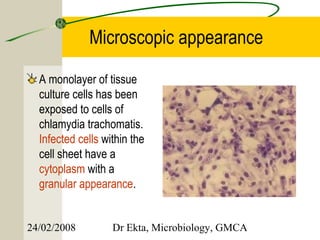
Microscopic appearance

  A monolayer of tissue
  culture cells has been
  exposed to cells of
  chlamydia trachomatis.
  Infected cells within the
  cell sheet have a
  cytoplasm with a
  granular appearance.


24/02/2008         Dr Ekta, Microbiology, GMCA
Demonstration of antigens
   Micro – IF : infected ocular or genital samples
   are stained with fluorescent conjugated Ab

   ELISA – best for screening large number of
   specimens, detects LPS Ag

   Molecular methods - PCR

24/02/2008      Dr Ekta, Microbiology, GMCA
Chlamydia trachomatis

     Leading cause of ocular & genital infections
     Pathogenicities:
1.   Trachoma
2.   Inclusion conjunctivitis
3.   Infant pneumonia
4.   Genital infections – genital chlamydiasis, LGV


24/02/2008       Dr Ekta, Microbiology, GMCA
Trachoma
   Greek word trakkus – rough (roughness of
   conjunctiva)
   Caused by C. trachomatis types A, B & C.
   Chronic keratoconjunctivitis
   Transmitted by fingers, fomites, flies or dust
   Established trachoma passes through 4 stages
   (I – IV).
   Infectivity is maximum in early cases, stage IV is
   non infectious.
24/02/2008       Dr Ekta, Microbiology, GMCA
Laboratory diagnosis of Trachoma

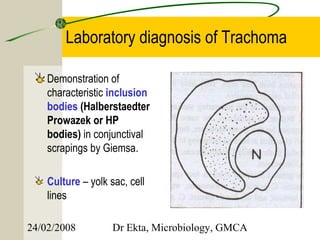
    Demonstration of
    characteristic inclusion
    bodies (Halberstaedter
    Prowazek or HP
    bodies) in conjunctival
    scrapings by Giemsa.

    Culture – yolk sac, cell
    lines

24/02/2008          Dr Ekta, Microbiology, GMCA
Treatment & Control
  Local application of antibiotics
  Oral administration - Tetracycline or
  Doxycycline for several weeks
  Single dose Azithromycin
  Control – mass education & chemotherapy


24/02/2008    Dr Ekta, Microbiology, GMCA
Inclusion Conjunctivitis
    Caused by C. trachomatis types D to K

    Naturally present in the genital tract

    Neonatal form - “Inclusion Blenorrhoea”, develops
    when the infant is in birth canal, appears 5-12 days after
    birth, prevented by local application of antibiotics

    Adult form – “Swimming Pool Conjunctivitis” –
    associated with bathing in community swimming pools
    contaminated with chlamydia from genital secretions.

24/02/2008         Dr Ekta, Microbiology, GMCA
Infant Pneumonia

    Usually occurs around 4-16 wks of age.
    Cough & wheezing. Rarely fever
    Conjunctivitis often precedes pneumonia


24/02/2008     Dr Ekta, Microbiology, GMCA
Genital Infections

      Two types :
   1. Genital chlamydiasis
   2. Lymphogranuloma venereum


24/02/2008   Dr Ekta, Microbiology, GMCA
Genital chlamydiasis
   Most common STD, clinical spectrum similar to gonococcal
   infections.
   Men – urethritis (NGU), epididymitis, proctitis & Reiter’s syndrome
   Women – acute urethral syndrome, mucopurulent cervicitis,
   endometritis, salpingitis, PID, infertility, ectopic pregnancy,
   premature delivery, postpartum fever.

   Diagnosis – gram stained smears of urogenital exudates showing
    – more than 4 neutrophils / OIF in urethritis,
    – >30 / OIF in cervicitis.
   Confirmatory tests – culture, micro-IF, ELISA, PCR

24/02/2008              Dr Ekta, Microbiology, GMCA
Lymphogranuloma venereum

   Most commonly caused by L2 type
   Site – regional lymph nodes
   Incubation period – 3 days to 5 wks
   1° lesion – small painless papulovesicular lesion
   on external genitalia
   2° stage – after 2 wks, lymphatic spread to
   draining LNs (men – inguinal, women – intrapelvic
   & pararectal)
24/02/2008     Dr Ekta, Microbiology, GMCA
Lymphogranuloma venereum
   Nodes enlarge, suppurate, become adherent to
   the skin & break down to form discharging
   sinuses.
   Metastatic complications – may occur, involves
   joints, eyes & meninges
   3° stage – chronic, lasts for several years;
   scarring & lymphatic blockage
   Late sequelae more distressing in women – rectal
   strictures, elephantiasis of vulva (esthiomene)
24/02/2008     Dr Ekta, Microbiology, GMCA
Laboratory Diagnosis of LGV
    Demonstration of elementary bodies in
    materials aspirated from bubos (inguinal)
    Isolation – cell cultures
    Serology – detection of Abs
 1. CFT 1: 64 or more
 2. Micro- IF 1: 512 or more
    Frei Test – ID test using crude chlamydial Ag,
    not done now.
24/02/2008     Dr Ekta, Microbiology, GMCA
Chlamydia psittaci
   Causes Psittacosis – disease of parrots
   Shed in the droppings or nasal discharges and
   aerosols are liberated.
   Humans – occupational disease as in poultry
   workers, pigeon farmers, petshop owners,
   veterinarians; laboratory acquired infection
   Infection by inhalation.
   Mild influenza like syndrome to fatal pneumonia
24/02/2008      Dr Ekta, Microbiology, GMCA
Laboratory Diagnosis

  Specimen – blood (early stages), later sputum
  Demonstration of LCL (Levinthal-Cole-Lillie)
  Inclusion bodies in alveolar macrophages,
  mouse brain, yolk sac, cell cultures
  LCL bodies - more diffuse & irrregular, not
  stained by iodine
  Serology – CFT, micro-IF

24/02/2008     Dr Ekta, Microbiology, GMCA
Chlamydia pneumoniae
    Isolated in 1986 from acute respiratory diseases
    in adults in Taiwan – C. psittaci strain TWAR
    Later classified as a separate species.
    Common cause of respiratory disease in older
    children & adults.
    C/F – pharyngitis, sinusitis, bronchitis &
    pneumonia (atypical pneumonia)
    Outbreaks in closed communities.
    Reinfections are common.
24/02/2008      Dr Ekta, Microbiology, GMCA
Chlamydia pneumoniae
   Diagnosis – Ag detection by EIA, direct IF, PCR,
   as isolation is very difficult.
   Treatment – clarithromycin or azithromycin
   Newer findings – suspected to be associated
   with atherosclerosis and its clinical effects like
   coronary, carotid & cerebral arterial disease.
   Evidences – detection of chlamydial Ags in
   plaques, isolation of chlamydia from coronary
   artery plaques, experimental induction of
   atheroma in rabbits infected with chlamydia
24/02/2008      Dr Ekta, Microbiology, GMCA
So…What’s Chlamydia anyways?
  How is it detected, treated and prevented?
  If it happens to me, what do I do?
  What are the possible complications?


  Chlamidia


24/02/2008          Dr Ekta, Microbiology, GMCA

Chlamydia

  • 1.
    CHLAMYDIA II MBBS 24/02/2008 Dr Ekta, Microbiology, GMCA
  • 2.
    KEY WORDS Intracellular Inclusion conjunctivitis Energy parasites Lymphogranuloma venereum Elementary body Frei test Reticulate body Genital chlamydiasis Inclusion bodies – HP, LCL C. psittaci Biotypes/ serotypes Psittacosis Tissue culture Ornithosis C. trachomatis C. pneumoniae Trachoma 24/02/2008 Dr Ekta, Microbiology, GMCA
  • 3.
    INTRODUCTION Obligate intracellular parasites of humans, animals & birds Resemble bacteria except it cannot multiply outside living cells/ tissues (like viruses) Cannot synthesize ATP – depends on host cell for energy & nutrient sources. Hence, called Energy Parasites. 24/02/2008 Dr Ekta, Microbiology, GMCA
  • 4.
    CHLAMYDIA 4 species in the Genus Chlamydia – C. trachomatis, C. pneumoniae, affects humans C. psittaci and C. pecorum affects ruminants All are non-motile, gram negative; share antigens, have both DNA and RNA. 24/02/2008 Dr Ekta, Microbiology, GMCA
  • 5.
    Classification C.trachomatis : eye & genital infections, infant pneumonia, and LGV (Lymphogranuloma Venereum) in adults C.pneumoniae : different types of respiratory infections. C.psittaci : psittacosis in man, ornithosis in birds 24/02/2008 Dr Ekta, Microbiology, GMCA
  • 6.
    Life cycle Chlamydiae occur in 2 forms : 1. Elementary body – extracellular, infective form 2. Reticulate body – intracellular, growing & replicative form • Chlamydial microcolony within the host cell is called Inclusion body. • Mature inclusion body contains 100 - 500 elementary bodies 24/02/2008 Dr Ekta, Microbiology, GMCA
  • 7.
    24/02/2008 Dr Ekta, Microbiology, GMCA
  • 8.
    Life cycle C. psittaci – host cell is severely damaged, EBs are released within 48 hrs by cell lysis C.trachomatis – mature inclusion body appears to be exocytosed in 72- 96 hrs. 24/02/2008 Dr Ekta, Microbiology, GMCA
  • 9.
    Antigenic Properties Three major Ags 1. Genus specific Ag – heat stable, common to all chlamydiae, a lipopolysaccharide resembling LPS of GNB. Present in all stages. 2. Species specific protein Ags – present at the envelope surface, help in classifying chlamydia into species 3. Ag for Intraspecies typing – found only in some members of a species, located on major OMP (MOMP), demonstrated by micro- IF. Classifies species into serovars/ serotypes 24/02/2008 Dr Ekta, Microbiology, GMCA
  • 10.
    Variants of Chlamydia C. trachomatis – 2 biovars: TRIC & LGV 1. TRIC – Trachoma, Inclusion conjunctivitis - divided into 12 serovars 2. LGV – Lymphogranuloma venereum – 3 serovars 24/02/2008 Dr Ekta, Microbiology, GMCA
  • 11.
    Human diseases Species Serotype Disease C. trachomatis A, B, Ba, C Endemic blinding trachoma C. trachomatis D to K Inclusion conjunctivitis. Genital chlamydiasis C. trachomatis L1, L2, L3 Lymphogranuloma venereum C. psittaci Many serotypes Psittacosis C. pneumoniae Acute resp. disease 24/02/2008 Dr Ekta, Microbiology, GMCA
  • 12.
    Laboratory Diagnosis 4 approaches available: 1. Microscopic demonstration of inclusion or elementary bodies 2. Isolation of chlamydia 3. Demonstration of chlamydial Ag 4. Demonstration of Abs or hypersensitivity 24/02/2008 Dr Ekta, Microbiology, GMCA
  • 13.
    Microscopy Gram negative but stained better by Giemsa, Castaneda or Machiavello stains. Giemsa Stain: Elementary body & the Reticulate body stains blue in cytoplasm Lugol’s iodine: rapid & simple screening method for ocular infections, stains glycogen matrix of C. trachomatis Immunoflurescence staining: more sensitive & specific, by using monoclonal Abs. Identifies inclusion bodies as well as extracellular elementary bodies. Used for ocular, cervical or urethral specimens. 24/02/2008 Dr Ekta, Microbiology, GMCA
  • 14.
    IF staining 24/02/2008 Dr Ekta, Microbiology, GMCA
  • 15.
    Culture Yolk sac of 6 - 8 days old chick embryo. Tissue culture – McCoy, HeLa cell lines * C. psittaci carry the risk of laboratory infection. 24/02/2008 Dr Ekta, Microbiology, GMCA
  • 16.
    Microscopic appearance A monolayer of tissue culture cells has been exposed to cells of chlamydia trachomatis. Infected cells within the cell sheet have a cytoplasm with a granular appearance. 24/02/2008 Dr Ekta, Microbiology, GMCA
  • 17.
    Demonstration of antigens Micro – IF : infected ocular or genital samples are stained with fluorescent conjugated Ab ELISA – best for screening large number of specimens, detects LPS Ag Molecular methods - PCR 24/02/2008 Dr Ekta, Microbiology, GMCA
  • 18.
    Chlamydia trachomatis Leading cause of ocular & genital infections Pathogenicities: 1. Trachoma 2. Inclusion conjunctivitis 3. Infant pneumonia 4. Genital infections – genital chlamydiasis, LGV 24/02/2008 Dr Ekta, Microbiology, GMCA
  • 19.
    Trachoma Greek word trakkus – rough (roughness of conjunctiva) Caused by C. trachomatis types A, B & C. Chronic keratoconjunctivitis Transmitted by fingers, fomites, flies or dust Established trachoma passes through 4 stages (I – IV). Infectivity is maximum in early cases, stage IV is non infectious. 24/02/2008 Dr Ekta, Microbiology, GMCA
  • 20.
    Laboratory diagnosis ofTrachoma Demonstration of characteristic inclusion bodies (Halberstaedter Prowazek or HP bodies) in conjunctival scrapings by Giemsa. Culture – yolk sac, cell lines 24/02/2008 Dr Ekta, Microbiology, GMCA
  • 21.
    Treatment & Control Local application of antibiotics Oral administration - Tetracycline or Doxycycline for several weeks Single dose Azithromycin Control – mass education & chemotherapy 24/02/2008 Dr Ekta, Microbiology, GMCA
  • 22.
    Inclusion Conjunctivitis Caused by C. trachomatis types D to K Naturally present in the genital tract Neonatal form - “Inclusion Blenorrhoea”, develops when the infant is in birth canal, appears 5-12 days after birth, prevented by local application of antibiotics Adult form – “Swimming Pool Conjunctivitis” – associated with bathing in community swimming pools contaminated with chlamydia from genital secretions. 24/02/2008 Dr Ekta, Microbiology, GMCA
  • 23.
    Infant Pneumonia Usually occurs around 4-16 wks of age. Cough & wheezing. Rarely fever Conjunctivitis often precedes pneumonia 24/02/2008 Dr Ekta, Microbiology, GMCA
  • 24.
    Genital Infections Two types : 1. Genital chlamydiasis 2. Lymphogranuloma venereum 24/02/2008 Dr Ekta, Microbiology, GMCA
  • 25.
    Genital chlamydiasis Most common STD, clinical spectrum similar to gonococcal infections. Men – urethritis (NGU), epididymitis, proctitis & Reiter’s syndrome Women – acute urethral syndrome, mucopurulent cervicitis, endometritis, salpingitis, PID, infertility, ectopic pregnancy, premature delivery, postpartum fever. Diagnosis – gram stained smears of urogenital exudates showing – more than 4 neutrophils / OIF in urethritis, – >30 / OIF in cervicitis. Confirmatory tests – culture, micro-IF, ELISA, PCR 24/02/2008 Dr Ekta, Microbiology, GMCA
  • 26.
    Lymphogranuloma venereum Most commonly caused by L2 type Site – regional lymph nodes Incubation period – 3 days to 5 wks 1° lesion – small painless papulovesicular lesion on external genitalia 2° stage – after 2 wks, lymphatic spread to draining LNs (men – inguinal, women – intrapelvic & pararectal) 24/02/2008 Dr Ekta, Microbiology, GMCA
  • 27.
    Lymphogranuloma venereum Nodes enlarge, suppurate, become adherent to the skin & break down to form discharging sinuses. Metastatic complications – may occur, involves joints, eyes & meninges 3° stage – chronic, lasts for several years; scarring & lymphatic blockage Late sequelae more distressing in women – rectal strictures, elephantiasis of vulva (esthiomene) 24/02/2008 Dr Ekta, Microbiology, GMCA
  • 28.
    Laboratory Diagnosis ofLGV Demonstration of elementary bodies in materials aspirated from bubos (inguinal) Isolation – cell cultures Serology – detection of Abs 1. CFT 1: 64 or more 2. Micro- IF 1: 512 or more Frei Test – ID test using crude chlamydial Ag, not done now. 24/02/2008 Dr Ekta, Microbiology, GMCA
  • 29.
    Chlamydia psittaci Causes Psittacosis – disease of parrots Shed in the droppings or nasal discharges and aerosols are liberated. Humans – occupational disease as in poultry workers, pigeon farmers, petshop owners, veterinarians; laboratory acquired infection Infection by inhalation. Mild influenza like syndrome to fatal pneumonia 24/02/2008 Dr Ekta, Microbiology, GMCA
  • 30.
    Laboratory Diagnosis Specimen – blood (early stages), later sputum Demonstration of LCL (Levinthal-Cole-Lillie) Inclusion bodies in alveolar macrophages, mouse brain, yolk sac, cell cultures LCL bodies - more diffuse & irrregular, not stained by iodine Serology – CFT, micro-IF 24/02/2008 Dr Ekta, Microbiology, GMCA
  • 31.
    Chlamydia pneumoniae Isolated in 1986 from acute respiratory diseases in adults in Taiwan – C. psittaci strain TWAR Later classified as a separate species. Common cause of respiratory disease in older children & adults. C/F – pharyngitis, sinusitis, bronchitis & pneumonia (atypical pneumonia) Outbreaks in closed communities. Reinfections are common. 24/02/2008 Dr Ekta, Microbiology, GMCA
  • 32.
    Chlamydia pneumoniae Diagnosis – Ag detection by EIA, direct IF, PCR, as isolation is very difficult. Treatment – clarithromycin or azithromycin Newer findings – suspected to be associated with atherosclerosis and its clinical effects like coronary, carotid & cerebral arterial disease. Evidences – detection of chlamydial Ags in plaques, isolation of chlamydia from coronary artery plaques, experimental induction of atheroma in rabbits infected with chlamydia 24/02/2008 Dr Ekta, Microbiology, GMCA
  • 33.
    So…What’s Chlamydia anyways? How is it detected, treated and prevented? If it happens to me, what do I do? What are the possible complications? Chlamidia 24/02/2008 Dr Ekta, Microbiology, GMCA