CHLAMYDIAE
RATHEESH R.L
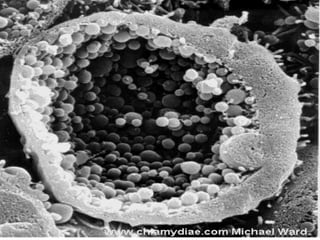
• The genus chlamydiae consist of small, non-
motile, gram negative obligate intracellular
parasites.
• They lack the ability to produce their own ATP
hence uses the host’s ATP.
• These genus consist of three important
species which are medically important and
cause various diseases in humans,
– C.PNEUMONIA
– C.PSITTACI
– C.TRACHOMATIS
PATHOGENESIS
• C.PNEUMONIA
The organism causes respiratory
disease known as pneumonia and is considered
as the third most cause of pneumonia after
Strep. Pneumniae and H.influenza.
• C.PSITTACI
This bacterium can infect parrots and
other avian species (eg, turkeys, pigeons, ducks).
Another term for this infection is ornithosis
A contagious disease of birds, caused by
chlamydiae and transmissible (especially from
parrots) to human beings as a form of pneumonia
• Incubation periods in caged birds vary from days to weeks
and longer. Most commonly this period is approximately 3
to 10 days. Latent infections are common and active
disease may occur several years after exposure.
• The incubation period of this disease is however difficult to
assess due to these chronically infected birds that develop
persistent, asymptomatic infections.
• C. psittaci is related to Chlamydia trachomatis,
the most common human STD, and Chlamydia
pneumonia, a cause of human pneumonia.
• Chlamydia pneumonia is also being
investigated as possibly being associated
with cardiovascular disease in humans.
• C.TRACHOMATIS
Chlamydia infection is a common
sexually transmitted infection in humans caused
by the bacterium Chlamydia trachomatis.
The organism causes both ocular and
genital lesions
Ocular lesions
• Because of the ocular lesions it can cause
– Trachoma
– Inclusion conjunctivitis
Trachoma
• Trachoma is a bacterial infection that affects
the eyes.
• Causes scarring and vascularization of cornea
• It's contagious, spreading through contact
with the eyes, eyelids, and nose or throat
secretions of infected people.
• It can also be passed on by handling infected
items, such as handkerchiefs
Inclusion conjunctivitis
• It is most prevalent in sexually active adults.
• Infection transferred from genital secretions
to eye by hand contact leading inclusion
conjunctivitis.
• It is also known as paratrachoma
genital lesions
• The most common genital lesions are,
- lympho granuloma venereum
- non-gonococcal urethritis
lympho granuloma venereum
• Lymphogranuloma venereum (LGV) is a long-
term (chronic) infection of the lymphatic system.
It is caused by any of 3 different types (serovars)
of the bacteria Chlamydia trachomatis.
• The bacteria are spread by sexual contact.
non-gonococcal urethritis
• Nongonococcal urethritis (NGU) is an
inflammation of the urethra that is not caused
by gonorrheal infection.
LAB DIAGNOSIS
• Hematological investigations
• No significant findings
• Bacteriological investigations
• Microscopy
• Culture studies
• Serological studies
• Skin test
Microscopy
• Smears made from the specimen are stained
and observed under a light microscope –
typical reniform incusion bodies surrounding
the nucleus can be seen.
Culture studies
• Usually egg yolk sac culture or chick embryo
culture or tissue culture is advised.
Serological studies
• Compliment fixation test is used
Skin test
• A test performed to confirm a diagnosis of lympho
granuloma venereum.
• Killed antigen, originally derived from infected
patients, is injected intradermally in one forearm,
and a control material is injected into the other arm.
• If a red, thickened papule
develops at the site of injection of antigen, the test
result is positive.
TREATMENT
• Sulfonamides are found to be effective against
chlamydiae infection.
20. chlamydiae

20. chlamydiae

  • 1.
  • 3.
    • The genuschlamydiae consist of small, non- motile, gram negative obligate intracellular parasites. • They lack the ability to produce their own ATP hence uses the host’s ATP.
  • 4.
    • These genusconsist of three important species which are medically important and cause various diseases in humans, – C.PNEUMONIA – C.PSITTACI – C.TRACHOMATIS
  • 5.
    PATHOGENESIS • C.PNEUMONIA The organismcauses respiratory disease known as pneumonia and is considered as the third most cause of pneumonia after Strep. Pneumniae and H.influenza.
  • 6.
    • C.PSITTACI This bacteriumcan infect parrots and other avian species (eg, turkeys, pigeons, ducks). Another term for this infection is ornithosis A contagious disease of birds, caused by chlamydiae and transmissible (especially from parrots) to human beings as a form of pneumonia
  • 7.
    • Incubation periodsin caged birds vary from days to weeks and longer. Most commonly this period is approximately 3 to 10 days. Latent infections are common and active disease may occur several years after exposure. • The incubation period of this disease is however difficult to assess due to these chronically infected birds that develop persistent, asymptomatic infections.
  • 8.
    • C. psittaciis related to Chlamydia trachomatis, the most common human STD, and Chlamydia pneumonia, a cause of human pneumonia. • Chlamydia pneumonia is also being investigated as possibly being associated with cardiovascular disease in humans.
  • 9.
    • C.TRACHOMATIS Chlamydia infectionis a common sexually transmitted infection in humans caused by the bacterium Chlamydia trachomatis. The organism causes both ocular and genital lesions
  • 10.
    Ocular lesions • Becauseof the ocular lesions it can cause – Trachoma – Inclusion conjunctivitis
  • 11.
    Trachoma • Trachoma isa bacterial infection that affects the eyes. • Causes scarring and vascularization of cornea • It's contagious, spreading through contact with the eyes, eyelids, and nose or throat secretions of infected people. • It can also be passed on by handling infected items, such as handkerchiefs
  • 12.
    Inclusion conjunctivitis • Itis most prevalent in sexually active adults. • Infection transferred from genital secretions to eye by hand contact leading inclusion conjunctivitis. • It is also known as paratrachoma
  • 13.
    genital lesions • Themost common genital lesions are, - lympho granuloma venereum - non-gonococcal urethritis
  • 14.
    lympho granuloma venereum •Lymphogranuloma venereum (LGV) is a long- term (chronic) infection of the lymphatic system. It is caused by any of 3 different types (serovars) of the bacteria Chlamydia trachomatis. • The bacteria are spread by sexual contact.
  • 15.
    non-gonococcal urethritis • Nongonococcalurethritis (NGU) is an inflammation of the urethra that is not caused by gonorrheal infection.
  • 16.
    LAB DIAGNOSIS • Hematologicalinvestigations • No significant findings • Bacteriological investigations • Microscopy • Culture studies • Serological studies • Skin test
  • 17.
    Microscopy • Smears madefrom the specimen are stained and observed under a light microscope – typical reniform incusion bodies surrounding the nucleus can be seen.
  • 18.
    Culture studies • Usuallyegg yolk sac culture or chick embryo culture or tissue culture is advised.
  • 19.
  • 20.
    Skin test • Atest performed to confirm a diagnosis of lympho granuloma venereum. • Killed antigen, originally derived from infected patients, is injected intradermally in one forearm, and a control material is injected into the other arm. • If a red, thickened papule develops at the site of injection of antigen, the test result is positive.
  • 21.
    TREATMENT • Sulfonamides arefound to be effective against chlamydiae infection.