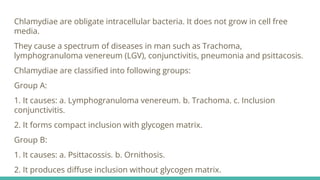
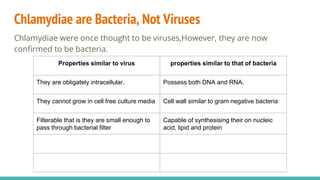
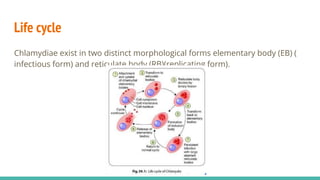
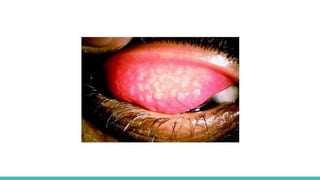
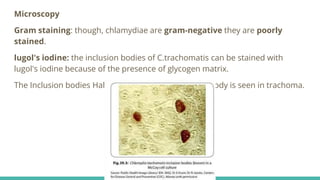
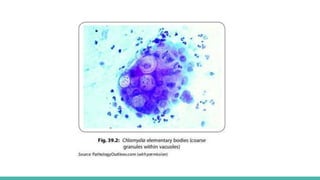
Chlamydiae are obligate intracellular bacteria that cause diseases like trachoma, pneumonia, and psittacosis in humans. They exist in two forms - the infectious elementary body and replicating reticulate body. Chlamydiae undergo a biphasic life cycle inside host cells, starting with endocytosis of the elementary body which then differentiates into a reticulate body and undergoes cell division before re-differentiating into more elementary bodies. Chlamydia trachomatis causes ocular infections like trachoma and genital infections, while Chlamydophila psittaci causes psittacosis. Laboratory diagnosis involves microscopy, antigen detection, nucleic acid amplification tests, and cell culture. Treatment