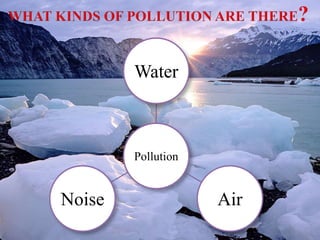





Pollution
Water
AirNoise
Air Pollution
• Any visible or invisible particle or
gas found in the air that is not part
of the original, normal
composition.
Air pollution is defined as the presence of
unwanted and undesirable foreign particles and
gases in the air which may have adverse effects on
human beings , plants , vegetation's and important
structures.
Air pollution is of public health concern and can
occur as :
1. Indoor air pollution Micro scale
2.Outdoor air pollution Meso scale
3.Air pollution at global level Macro scale
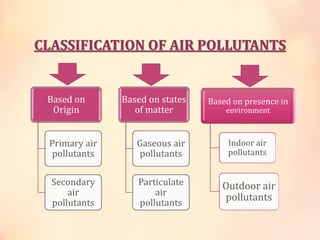
CLASSIFICATION OF AIR POLLUTANTS
Based on
Origin
Primary air
pollutants
Secondary
air
pollutants
Based on states
of matter
Gaseous air
pollutants
Particulate
air
pollutants
Based on presence in
environment
Indoor air
pollutants
Outdoor air
pollutants
CLASSIFICATION OF AIR POLLUTANTS
I. Classification based on Origin of pollutants:
• Primary air pollutants: Primary air pollutants are those which are directly
emitted from the source into the atmosphere, and remains in the same form in
the atmosphere. For example: Sulphur oxides, Nitrogen oxides, Carbon monoxide,
etc. The air pollutants are emitted by man made sources like, transportation, fuel
combustion, industrial operations, etc.
• Secondary air pollutants: Secondary air pollutants are those which are formed
by chemical reactions among primary pollutants and atmospheric chemical
species. For example: Ozone, Sulphur trioxide, Ketones, etc.
II. Classification based on states of matter:
• Gaseous air pollutants: Gaseous air pollutants are those air pollutants which
are found in the gaseous state at normal temperature and pressure in the
atmosphere. For example: Carbon-monoxide, Carbon-dioxide, Nitrogen oxides,
Sulphur oxides, etc.
• Particulate air pollutants : Particulates are finely divided, air borne, solid and liquid
particles, which remain for very longtime in air, in suspension. Depending on their size
and mode of formation, particulate air pollutants are further classified as below:
• Aerosols: These are air borne suspensions of solid or liquid particles smaller than 1
mm size. Example: dust, smoke, mist, fume, etc.
• Dust: It consists of small solid particles (size 1 to 200 micro-meter) and are generated
by material crushing, grinding or blasting.
• Smoke: They are also fine solid particles of size around 0.1 to 1 micro-meter, formed
by the incomplete combustion of organic matter like coal and wood.
• Mist: It consist of liquid droplets of size around 0.1 to 10 micro-meter and formed by
the condensation of vapours in the atmosphere.
• Fog: If the mist is made up of water droplets at high concentration so as to obscure
vision then mist is called as fog.
• Soot: These are the carbon particles impregnated with tar, and released by the
incomplete combustion of carbonaceous materials.
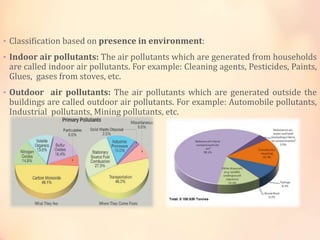
• Classification based on presence in environment:
• Indoor air pollutants: The air pollutants which are generated from households
are called indoor air pollutants. For example: Cleaning agents, Pesticides, Paints,
Glues, gases from stoves, etc.
• Outdoor air pollutants: The air pollutants which are generated outside the
buildings are called outdoor air pollutants. For example: Automobile pollutants,
Industrial pollutants, Mining pollutants, etc.
Natural : forest fires, pollen, dust
storm, foul gases etc.
Unnatural : man-made; coal,
wood and other fuels used in
cars, homes, and factories for
energy.
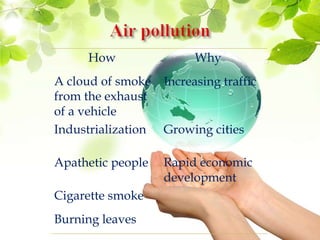
Sources
How Why
A cloud of smoke
from the exhaust
of a vehicle
Increasing traffic
Industrialization Growing cities
Apathetic people Rapid economic
development
Cigarette smoke
Burning leaves
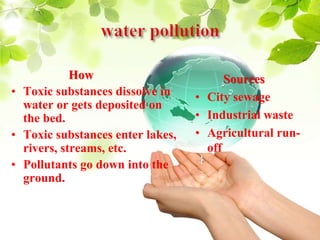
How
• Toxic substances dissolve in
water or gets deposited on
the bed.
• Toxic substances enter lakes,
rivers, streams, etc.
• Pollutants go down into the
ground.
Sources
• City sewage
• Industrial waste
• Agricultural run-
off
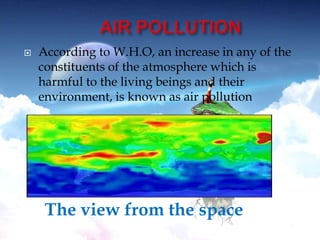
 According to W.H.O, an increase in any of the
constituents of the atmosphere which is
harmful to the living beings and their
environment, is known as air pollution
The view from the space
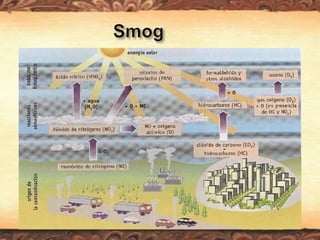
 Photo Chemical Smog  Photo Chemical Smog
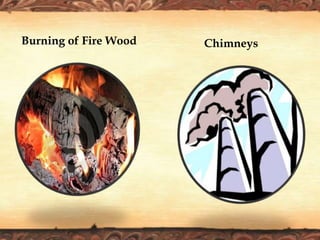
Burning of Fire Wood Chimneys
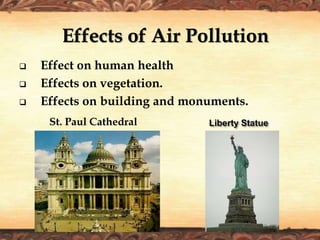
 Effect on human health
 Effects on vegetation.
 Effects on building and monuments.
Effects of Air Pollution
St. Paul Cathedral
Causes by air pollution
•Learn more; stay up to date
•Tellyour friendsand familyabout pollution.
•Make sure get pollutionchecks onour cars.
•Joina groupto stop pollution.
•Encourage yourparents to carpool to work.
•Switch offlights,fan, heat,etc.whenyouleave the room.
 Solution for Air pollution:-
 Air pollution can be controlled by a
thorough understanding of its causes.
 Establishment of industries away from the
towns and cities.
 Increasing the length of the chyeysmn in
industries.
 Growing more plants and trees.
 Use of efficient engines in automobiles.
 Use of smokeless choola.
 Use of petrol without lead (Unleaded petrol)
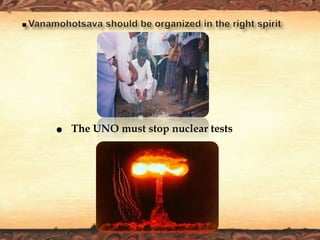
. The UNO must stop nuclear tests
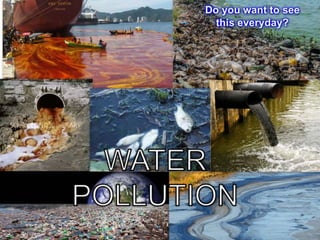
 Effluent from various industries, Sewage
containing domestic waster and pesticides
from agricultural lands are finding their way
into water bodies leading to water pollution.
 Causes of Water Pollution: Water pollution is
mainly due to the following causes.
WATER QUALITY STANDARDS
• THE DEFINITION OF WATER QUALITY DEPENDS
ON THE INTENDED USES OF THE WATER WHICH
MAY BE EITHER HUMAN CONSUMPTION OR IT
MAY BE FOR INDUSTRIES, IRRIGATION, POWER
GENERATION, RECREATION ETC.
• MAIN PARAMETERS WHICH ARE REQUIRED TO BE
TESTED FOR DETERMINING THE QUALITY OF
WATER CAN BE DIVIDED IN TO
• 1. PHYSICAL
• 2.CHEMICAL
• 3. MICROBIOLOGICAL
PHYSICAL PARAMETERS
INCLUDES
a) TURBIDITY
b) COLOUR
c) ODOUR
d) TASTE
e) TEMPERATURE
CHEMICAL PARAMETERS
INCLUDES:
• SOLIDS
• HARDNESS
• CHLORIDES
• PH
• DISSOLVED GASES LIKE OXYGEN,
CARBON, DIOXIDE, HYDROGEN, SULPHIDE
• METELS AND OTHER INORGANIC
SUBSTANCE LIKE FLUORIDE, IRON &
MANGANESE, LEASD, ARSENIC, IODIDES,
MICROBIOLOGICAL
PARAMETERS INCLUDES VARIOUS
MICROORGANISMS PRESENT IN WATER IT
MAY BE PATHOGENIC OR NON PATHOGENIC
THE WATER BODIES AS WELL AS DRINKING
WATER ARE
I. INDIAN STANDARDS INSTITUTION(ISI)
II. WORLD HEALTH ORGANIZATION(WHO)
III. UNITED STATES PUBLIC HEALTH
SERVICE(USPHS)
IV. INDIAN COUNCIL OF MEDICAL
RESEARCH(ICMR)
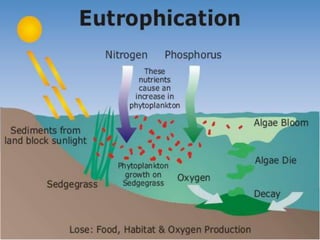
EUTROPHICATION
• DEPENDING UPON THE INCREASING LEVELS OF
PRODUCTIVITY THE WATER BODIES CAN BE
CLASSIFIED IN TO
1. OLIGOTROPHIC:- WATER WITH POOR NUTRIENT
STATUS AND VERY LOW PRODUCTIVITY OF
AQUATIC PLANTS.
2. MASOTROPHIC:- WATER WITH MODERATE
NUTRIENT STATUS AND MODERATE
PRODUCTIVITY OF AQUATIC PLANTS.
3. EUTROPHIC:- WATER WITH RICH NUTRIENT
STATUS AND HIGH PRODUCTIVITY OF AQUATIC
• EUTROPHICATION IS A NATURAL PROCESS AND MAY
TAKE THOUSANDS OF YEARS.
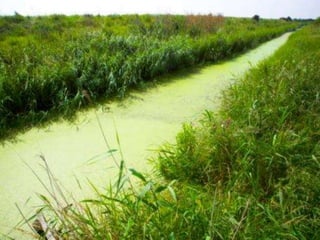
• WITH TIME THE NUTRIENT STATUS OF THE WATER
BODIES GRADUALLY INCREASES. WHICH LEADS TO
MORE BIOLOGICAL PRODUCTIVITY AND ALGAE BLOOMS
OCCURS AND WATER BECOMES MURKY. THE LAKE THUS
BECOMES EUTROPHIC.
• A YOUNG LAKE OR A NEWLY FORMED LAKE HAS LOW
NUTRIENT CONTENT AND HAS LOW PLANT
PRODUCTIVITY.
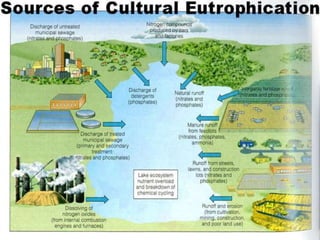
• WITH PASSAGE OF TIME SUCH LAKES ACQUIRES
NUTRIENTS FROM SURFACE RUNOFF FROM
AGRICULTURAL FIELDS, DOMESTIC SEWAGE ETC WHICH
• THE INDUSTRIAL WASTES, MUNICIPAL WASTER, RUNOFF
FROM AGRICULTURAL LANDS PROVIDE PLENTY OF
PHOSPHATES, NITRATES AND VARIOUS MINERALS
STIMULATING ALGAL GROWTH.
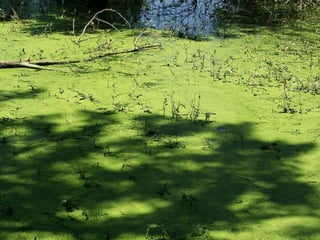
• DUE TO WHICH THE WATER BODY BECOMES GREEN.
• IN DUE COURSE OF TIME THE ALGAL BLOOM MAY DIE
ABRUPTLY.
• THE DECAYING ORGANIC MATTER CAUSES DEPLETION
OF DO, DESTROYING FISH AND OTHER AQUATIC
SPECIES.
• BAD TASTE, BAD ODOUR IS PRODUCED AND ALSO
 Industrial pollutants like mercury, chromium,
cadmium and lead are poisonous. They are also
capable of entering the food chains and cause
diseases in man, Mercury is known to cause a disease
called Minimart.
 Organ chlorine pesticides like D.D.T. in the
agricultural wastes are non-degradable and move
along the food chains. It may lead to bio
magnification.
 Some industrial effluents can cause changes in color,
odor and taste of water in the natural water bodies.
Contamination of water also leads to spread of water
borne diseases such as cholera, amoebiasis and other
diseases.
• Encourage your
family to walk more
• Take the school bus
• Reduce the amount
of spray bottles
• Do not burn leaves in
your yard- put them
in a compost
• Keep your family
cars in tune
• Put catalytic
converters on cars
• Share your room
with others when the
air conditioner is on
• Take care of your
trees
•Keep lakes clean
•Take your used motor oil to a drop off place
•Use latex paint instead of oil and rinse your brushes
in the sink rather than the yard
•Fill a spray bottle with soapy water instead of bug
spray
•Plant trees to prevent soil erosion
•Keep litter, pet waste, leaves, and grass clippings out
of gutters and storm drains.
WHAT IS NOISE POLLUTION?
 Sound that is unwanted or disrupts one’s quality of life is
called as noise. When there is lot of noise in the environment,
it is termed as noise pollution.
 Sound becomes undesirable when it disturbs the normal
activities such as working, sleeping, and during conversations.
 It is an underrated environmental problem because of the fact
that we can’t see, smell, or taste it.
 World Health Organization stated that “Noise must be
recognized as a major threat to human well-being”
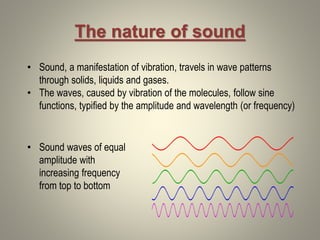
The nature of sound
• Sound, a manifestation of vibration, travels in wave patterns
through solids, liquids and gases.
• The waves, caused by vibration of the molecules, follow sine
functions, typified by the amplitude and wavelength (or frequency)
• Sound waves of equal
amplitude with
increasing frequency
from top to bottom
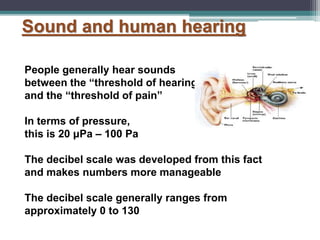
Sound and human hearing
People generally hear sounds
between the “threshold of hearing”
and the “threshold of pain”
In terms of pressure,
this is 20 μPa – 100 Pa
The decibel scale was developed from this fact
and makes numbers more manageable
The decibel scale generally ranges from
approximately 0 to 130
Health Effects
• According to the USEPA, there are direct links between
noise and health. Also, noise pollution adversely affects
the lives of millions of people.
• Noise pollution can damage physiological and
psychological health.
• High blood pressure, stress related illness, sleep
disruption, hearing loss, and productivity loss are the
problems related to noise pollution.
• It can also cause memory loss, severe depression, and
panic attacks.
SOURCES OF NOISE POLLUTION
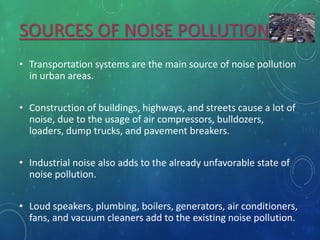
• Transportation systems are the main source of noise pollution
in urban areas.
• Construction of buildings, highways, and streets cause a lot of
noise, due to the usage of air compressors, bulldozers,
loaders, dump trucks, and pavement breakers.
• Industrial noise also adds to the already unfavorable state of
noise pollution.
• Loud speakers, plumbing, boilers, generators, air conditioners,
fans, and vacuum cleaners add to the existing noise pollution.
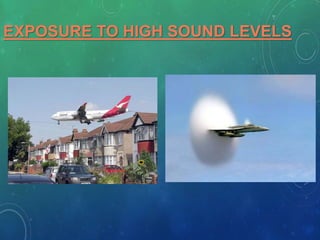
EXPOSURE TO HIGH SOUND LEVELS
SOLUTIONS FOR NOISE POLLUTION
• Planting bushes and trees in and around sound generating sources is an
effective solution for noise pollution.
• Regular servicing and tuning of automobiles can effectively reduce the noise
pollution.
• Buildings can be designed with suitable noise absorbing material for the
walls, windows, and ceilings.
• Workers should be provided with equipments such as ear plugs and earmuffs
for hearing protection.
• Similar to automobiles, lubrication of the machinery and servicing
should be done to minimize noise generation.
• Soundproof doors and windows can be installed to block
unwanted noise from outside.
• Regulations should be imposed to restrict the usage of play
loudspeakers in crowded areas and public places.
• Factories and industries should be located far from the residential
areas.
Reduce
ReuseRecycle
THANK YOU.

Che 6 7 air & noise pollution

  • 2.
  • 3.
  • 4.
    • Any visibleor invisible particle or gas found in the air that is not part of the original, normal composition.
  • 5.
    Air pollution isdefined as the presence of unwanted and undesirable foreign particles and gases in the air which may have adverse effects on human beings , plants , vegetation's and important structures. Air pollution is of public health concern and can occur as : 1. Indoor air pollution Micro scale 2.Outdoor air pollution Meso scale 3.Air pollution at global level Macro scale
  • 6.
    CLASSIFICATION OF AIRPOLLUTANTS Based on Origin Primary air pollutants Secondary air pollutants Based on states of matter Gaseous air pollutants Particulate air pollutants Based on presence in environment Indoor air pollutants Outdoor air pollutants
  • 7.
    CLASSIFICATION OF AIRPOLLUTANTS I. Classification based on Origin of pollutants: • Primary air pollutants: Primary air pollutants are those which are directly emitted from the source into the atmosphere, and remains in the same form in the atmosphere. For example: Sulphur oxides, Nitrogen oxides, Carbon monoxide, etc. The air pollutants are emitted by man made sources like, transportation, fuel combustion, industrial operations, etc. • Secondary air pollutants: Secondary air pollutants are those which are formed by chemical reactions among primary pollutants and atmospheric chemical species. For example: Ozone, Sulphur trioxide, Ketones, etc. II. Classification based on states of matter: • Gaseous air pollutants: Gaseous air pollutants are those air pollutants which are found in the gaseous state at normal temperature and pressure in the atmosphere. For example: Carbon-monoxide, Carbon-dioxide, Nitrogen oxides, Sulphur oxides, etc.
  • 8.
    • Particulate airpollutants : Particulates are finely divided, air borne, solid and liquid particles, which remain for very longtime in air, in suspension. Depending on their size and mode of formation, particulate air pollutants are further classified as below: • Aerosols: These are air borne suspensions of solid or liquid particles smaller than 1 mm size. Example: dust, smoke, mist, fume, etc. • Dust: It consists of small solid particles (size 1 to 200 micro-meter) and are generated by material crushing, grinding or blasting. • Smoke: They are also fine solid particles of size around 0.1 to 1 micro-meter, formed by the incomplete combustion of organic matter like coal and wood. • Mist: It consist of liquid droplets of size around 0.1 to 10 micro-meter and formed by the condensation of vapours in the atmosphere. • Fog: If the mist is made up of water droplets at high concentration so as to obscure vision then mist is called as fog. • Soot: These are the carbon particles impregnated with tar, and released by the incomplete combustion of carbonaceous materials.
  • 9.
    • Classification basedon presence in environment: • Indoor air pollutants: The air pollutants which are generated from households are called indoor air pollutants. For example: Cleaning agents, Pesticides, Paints, Glues, gases from stoves, etc. • Outdoor air pollutants: The air pollutants which are generated outside the buildings are called outdoor air pollutants. For example: Automobile pollutants, Industrial pollutants, Mining pollutants, etc.
  • 10.
    Natural : forestfires, pollen, dust storm, foul gases etc. Unnatural : man-made; coal, wood and other fuels used in cars, homes, and factories for energy. Sources
  • 13.
    How Why A cloudof smoke from the exhaust of a vehicle Increasing traffic Industrialization Growing cities Apathetic people Rapid economic development Cigarette smoke Burning leaves
  • 14.
    How • Toxic substancesdissolve in water or gets deposited on the bed. • Toxic substances enter lakes, rivers, streams, etc. • Pollutants go down into the ground. Sources • City sewage • Industrial waste • Agricultural run- off
  • 15.
     According toW.H.O, an increase in any of the constituents of the atmosphere which is harmful to the living beings and their environment, is known as air pollution The view from the space
  • 16.
     Photo ChemicalSmog  Photo Chemical Smog
  • 18.
    Burning of FireWood Chimneys
  • 20.
     Effect onhuman health  Effects on vegetation.  Effects on building and monuments. Effects of Air Pollution St. Paul Cathedral
  • 21.
    Causes by airpollution
  • 26.
    •Learn more; stayup to date •Tellyour friendsand familyabout pollution. •Make sure get pollutionchecks onour cars. •Joina groupto stop pollution. •Encourage yourparents to carpool to work. •Switch offlights,fan, heat,etc.whenyouleave the room.  Solution for Air pollution:-
  • 27.
     Air pollutioncan be controlled by a thorough understanding of its causes.  Establishment of industries away from the towns and cities.  Increasing the length of the chyeysmn in industries.  Growing more plants and trees.  Use of efficient engines in automobiles.  Use of smokeless choola.  Use of petrol without lead (Unleaded petrol)
  • 28.
    . The UNOmust stop nuclear tests
  • 30.
     Effluent fromvarious industries, Sewage containing domestic waster and pesticides from agricultural lands are finding their way into water bodies leading to water pollution.  Causes of Water Pollution: Water pollution is mainly due to the following causes.
  • 31.
    WATER QUALITY STANDARDS •THE DEFINITION OF WATER QUALITY DEPENDS ON THE INTENDED USES OF THE WATER WHICH MAY BE EITHER HUMAN CONSUMPTION OR IT MAY BE FOR INDUSTRIES, IRRIGATION, POWER GENERATION, RECREATION ETC. • MAIN PARAMETERS WHICH ARE REQUIRED TO BE TESTED FOR DETERMINING THE QUALITY OF WATER CAN BE DIVIDED IN TO • 1. PHYSICAL • 2.CHEMICAL • 3. MICROBIOLOGICAL
  • 32.
    PHYSICAL PARAMETERS INCLUDES a) TURBIDITY b)COLOUR c) ODOUR d) TASTE e) TEMPERATURE
  • 33.
    CHEMICAL PARAMETERS INCLUDES: • SOLIDS •HARDNESS • CHLORIDES • PH • DISSOLVED GASES LIKE OXYGEN, CARBON, DIOXIDE, HYDROGEN, SULPHIDE • METELS AND OTHER INORGANIC SUBSTANCE LIKE FLUORIDE, IRON & MANGANESE, LEASD, ARSENIC, IODIDES,
  • 34.
    MICROBIOLOGICAL PARAMETERS INCLUDES VARIOUS MICROORGANISMSPRESENT IN WATER IT MAY BE PATHOGENIC OR NON PATHOGENIC THE WATER BODIES AS WELL AS DRINKING WATER ARE I. INDIAN STANDARDS INSTITUTION(ISI) II. WORLD HEALTH ORGANIZATION(WHO) III. UNITED STATES PUBLIC HEALTH SERVICE(USPHS) IV. INDIAN COUNCIL OF MEDICAL RESEARCH(ICMR)
  • 35.
    EUTROPHICATION • DEPENDING UPONTHE INCREASING LEVELS OF PRODUCTIVITY THE WATER BODIES CAN BE CLASSIFIED IN TO 1. OLIGOTROPHIC:- WATER WITH POOR NUTRIENT STATUS AND VERY LOW PRODUCTIVITY OF AQUATIC PLANTS. 2. MASOTROPHIC:- WATER WITH MODERATE NUTRIENT STATUS AND MODERATE PRODUCTIVITY OF AQUATIC PLANTS. 3. EUTROPHIC:- WATER WITH RICH NUTRIENT STATUS AND HIGH PRODUCTIVITY OF AQUATIC
  • 37.
    • EUTROPHICATION ISA NATURAL PROCESS AND MAY TAKE THOUSANDS OF YEARS. • WITH TIME THE NUTRIENT STATUS OF THE WATER BODIES GRADUALLY INCREASES. WHICH LEADS TO MORE BIOLOGICAL PRODUCTIVITY AND ALGAE BLOOMS OCCURS AND WATER BECOMES MURKY. THE LAKE THUS BECOMES EUTROPHIC. • A YOUNG LAKE OR A NEWLY FORMED LAKE HAS LOW NUTRIENT CONTENT AND HAS LOW PLANT PRODUCTIVITY. • WITH PASSAGE OF TIME SUCH LAKES ACQUIRES NUTRIENTS FROM SURFACE RUNOFF FROM AGRICULTURAL FIELDS, DOMESTIC SEWAGE ETC WHICH
  • 39.
    • THE INDUSTRIALWASTES, MUNICIPAL WASTER, RUNOFF FROM AGRICULTURAL LANDS PROVIDE PLENTY OF PHOSPHATES, NITRATES AND VARIOUS MINERALS STIMULATING ALGAL GROWTH. • DUE TO WHICH THE WATER BODY BECOMES GREEN. • IN DUE COURSE OF TIME THE ALGAL BLOOM MAY DIE ABRUPTLY. • THE DECAYING ORGANIC MATTER CAUSES DEPLETION OF DO, DESTROYING FISH AND OTHER AQUATIC SPECIES. • BAD TASTE, BAD ODOUR IS PRODUCED AND ALSO
  • 42.
     Industrial pollutantslike mercury, chromium, cadmium and lead are poisonous. They are also capable of entering the food chains and cause diseases in man, Mercury is known to cause a disease called Minimart.  Organ chlorine pesticides like D.D.T. in the agricultural wastes are non-degradable and move along the food chains. It may lead to bio magnification.  Some industrial effluents can cause changes in color, odor and taste of water in the natural water bodies. Contamination of water also leads to spread of water borne diseases such as cholera, amoebiasis and other diseases.
  • 43.
    • Encourage your familyto walk more • Take the school bus • Reduce the amount of spray bottles • Do not burn leaves in your yard- put them in a compost • Keep your family cars in tune • Put catalytic converters on cars • Share your room with others when the air conditioner is on • Take care of your trees
  • 44.
    •Keep lakes clean •Takeyour used motor oil to a drop off place •Use latex paint instead of oil and rinse your brushes in the sink rather than the yard •Fill a spray bottle with soapy water instead of bug spray •Plant trees to prevent soil erosion •Keep litter, pet waste, leaves, and grass clippings out of gutters and storm drains.
  • 46.
    WHAT IS NOISEPOLLUTION?  Sound that is unwanted or disrupts one’s quality of life is called as noise. When there is lot of noise in the environment, it is termed as noise pollution.  Sound becomes undesirable when it disturbs the normal activities such as working, sleeping, and during conversations.  It is an underrated environmental problem because of the fact that we can’t see, smell, or taste it.  World Health Organization stated that “Noise must be recognized as a major threat to human well-being”
  • 47.
    The nature ofsound • Sound, a manifestation of vibration, travels in wave patterns through solids, liquids and gases. • The waves, caused by vibration of the molecules, follow sine functions, typified by the amplitude and wavelength (or frequency) • Sound waves of equal amplitude with increasing frequency from top to bottom
  • 48.
    Sound and humanhearing People generally hear sounds between the “threshold of hearing” and the “threshold of pain” In terms of pressure, this is 20 μPa – 100 Pa The decibel scale was developed from this fact and makes numbers more manageable The decibel scale generally ranges from approximately 0 to 130
  • 49.
    Health Effects • Accordingto the USEPA, there are direct links between noise and health. Also, noise pollution adversely affects the lives of millions of people. • Noise pollution can damage physiological and psychological health. • High blood pressure, stress related illness, sleep disruption, hearing loss, and productivity loss are the problems related to noise pollution. • It can also cause memory loss, severe depression, and panic attacks.
  • 50.
    SOURCES OF NOISEPOLLUTION • Transportation systems are the main source of noise pollution in urban areas. • Construction of buildings, highways, and streets cause a lot of noise, due to the usage of air compressors, bulldozers, loaders, dump trucks, and pavement breakers. • Industrial noise also adds to the already unfavorable state of noise pollution. • Loud speakers, plumbing, boilers, generators, air conditioners, fans, and vacuum cleaners add to the existing noise pollution.
  • 51.
    EXPOSURE TO HIGHSOUND LEVELS
  • 52.
    SOLUTIONS FOR NOISEPOLLUTION • Planting bushes and trees in and around sound generating sources is an effective solution for noise pollution. • Regular servicing and tuning of automobiles can effectively reduce the noise pollution. • Buildings can be designed with suitable noise absorbing material for the walls, windows, and ceilings. • Workers should be provided with equipments such as ear plugs and earmuffs for hearing protection.
  • 53.
    • Similar toautomobiles, lubrication of the machinery and servicing should be done to minimize noise generation. • Soundproof doors and windows can be installed to block unwanted noise from outside. • Regulations should be imposed to restrict the usage of play loudspeakers in crowded areas and public places. • Factories and industries should be located far from the residential areas.
  • 54.
  • 56.