L- 12
AIR POLLUTION METEOROLOGY
Air Pollution and Control
(Elective-I)
Contents of unit-IV
The meteorology and air pollution

L-12 Introduction, Different meteorological factors and their
effect, laps rate and stability of the atmosphere, stability
classes Problems on temperature gradient and stability.
L-13 Inversion phenomenon, Precipitation and its relation to
scavenging pollutant in the air, wind pattern, direction,
velocity and fluctuations, Problems, Maximum Mixing Depth,
problems. .
L-14  MMD problems continued, plume behaviour.
L-15 Models of diffusions and dispersion, GDM- assumptions,
model equation, limitations, problems.
L -16GDM problems continued, Line source
L-17 Effective stack height, Problems.
L -18  Min of safe stack height, problems.
What is Meteorology?
• Meteorology is the science of the atmosphere.
The atmosphere is the media into which all air
pollutants are emitted.
• Atmospheric processes such as the movement of
air (wind) and the exchange of heat (convection
and radiation for example) dictate the fate of
pollutants as they go through the stages of
transport, dispersion, transformation and
removal. Air pollution meteorology is the study
of how these atmospheric processes affect the
fate of air pollutants.
•

•

•

Knowledge of air pollution meteorology
is used to manage and control the
release of pollutants into the ambient
air.
Managing the release of air pollutants
helps ensure that ambient pollutant
concentrations comply with national
ambient air quality standards.
Knowledge of air pollution meteorology
is essential in order to understand the
Importance of meteorology
• Understanding air pollution meteorology and its
influence in pollutant dispersion is essential in air
quality planning activities.
• Engineers use this knowledge to help locate air
pollution monitoring stations and to develop
implementation plans to bring ambient air
quality into compliance with standards.
• Meteorology is used in predicting the ambient
impact of a new source of air pollution and to
determine the effect on air quality from
modifications to existing sources.
• When meteorological conditions develop that
are not conducive to pollutant dispersion,
governmental air pollution agencies must act
fast to ensure that air pollutants don’t build
up to unacceptable levels in the air we
breathe.
• When pollutant levels become excessively
high, an air pollution episode results and
emissions into the atmosphere must be
curtailed.
• Example is Donora episode
• The towns people were accustomed to receiving
some emissions from the local steel mill, zinc
smelter, and sulphuric acid plant.
• But, they were not prepared for the dangerously
high concentrations of pollutants that built up and
became trapped over the town.
• The meteorological conditions in Donora during
this five-day period (high pressure system and
strong temperature inversion) produced light
winds and dense fog.
• The air was not able to move horizontally or
vertically and just lingered over the town.
SOLAR RADIATION
Solar Radiation
• At upper boundary of atmosphere, vertical solar
radiation = 8.16 J/cm2min (solar constant)
• Maximum intensity at λ = 0.4 to 0.8 μm = visible
portion of electromagnetic spectrum
• ~ 42% of energy
–
–
–
–
–

Absorbed by higher atmosphere
Reflected by clouds
Back-scattered by atmosphere
Reflected by earth’s surface
Absorbed by water vapor & clouds

• 47% adsorbed by land and water
Insolation
• Quantity of solar radiation reaching a unit
area of the earth’s surface
– Angle of incidence
– Thickness of the atmosphere
– Characteristics of surface

• Albedo: fraction of incident radiation that
is reflected by a surface
Solar Incidence Angle
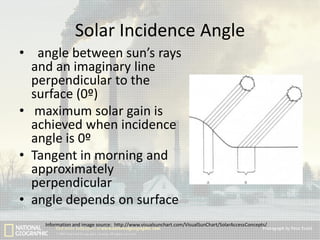
• angle between sun’s rays
and an imaginary line
perpendicular to the
surface (0º)
• maximum solar gain is
achieved when incidence
angle is 0º
• Tangent in morning and
approximately
perpendicular
• angle depends on surface
Information and image source: http://www.visualsunchart.com/VisualSunChart/SolarAccessConcepts/
BASICS OF AIR MOVEMENT
• Air pressure differences cause the
movement of air
• Air moving parallel to the ground is
called wind
• Air moving up or down is called a
current
• Air generally moves from the poles to
the equator, this is because air flows
from high pressure to low pressure
–High pressure forms when cold air sinks
(at the poles)
–Low pressure forms when warm air
rises (at the equator)

• But the air doesn’t flow in a straight
line
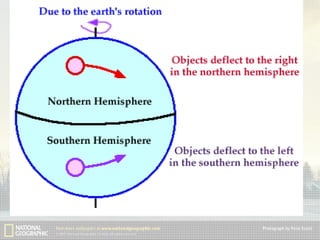
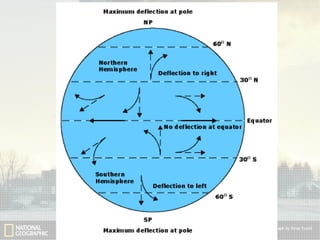
Coriolis Effect
• Causes air to move in a curved path
• It is caused by the Earth spinning on its
axis
• The Earth spins fastest at the equator,
and slowest near the poles
• As air moves from the equator to the
pole, it will travel east faster than the
land beneath it causing the air to follow
a curved path
LAND AND SEA BREEZE
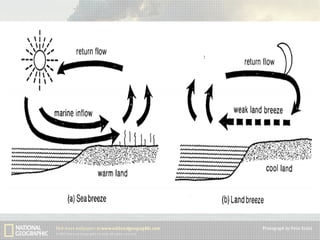
• Because land surfaces heat and cool quicker
than the sea or other water bodies,
temperature gradients develop that can
result in the generation of localised wind
flows.
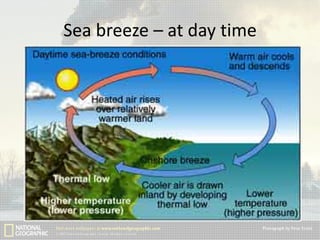
• A sea breeze develops during the day as the
air over the land warms more quickly than
the air over the sea.
• It rises, bringing in an onshore breeze, with a
return flow aloft.
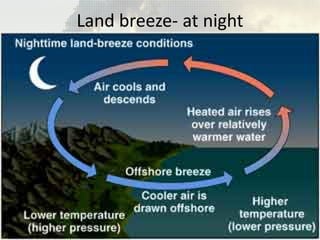
• At night the opposite occurs and a land
breeze develops, flowing towards the sea
under an area of subsidence.
• Sea breezes are generally strongest during
the day in summer and land breezes
strongest during winter nights.
• They can both have significant effect s on
air quality over urban areas, as they are
recirculating air currents that can return
pollutant s (instead of remove them) to an
area fro m which the y were released
earlier in the day .
Sea breeze – at day time
Land breeze- at night
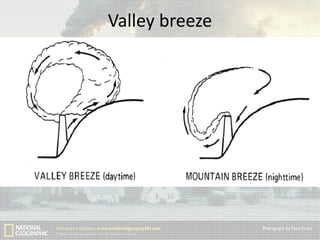
Valley breeze
• Mountain and valley winds are generated
due to similar heating and cooling
mechanisms to sea−land breezes.
• During the day the air above a slope is
heated and becomes warmer than
neighboring air at the same height
above sea level, but further above the
ground. It rises due to convection, and
up slope mountain winds occur.
• At night the mountain slopes cool more
quickly than the surrounding air, and the
cool air drains down the slope,
generating valley winds.
• This heating and cooling often results in
closed circulation patterns, which can
trap and/or recirculate air pollution in the
mountain −valley system .
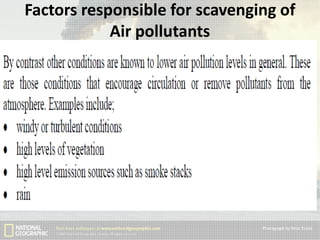
Factors responsible for scavenging of
Air pollutants
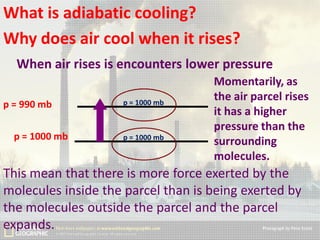
What is adiabatic cooling?
Why does air cool when it rises?
When air rises is encounters lower pressure
p = 990 mb
p = 1000 mb

p = 1000 mb

p = 1000 mb

Momentarily, as
the air parcel rises
it has a higher
pressure than the
surrounding
molecules.

This mean that there is more force exerted by the
molecules inside the parcel than is being exerted by
the molecules outside the parcel and the parcel
expands.
This means there is more force exerted from
inside the parcel than there is from the outside
and the parcel expands.

p = 990 mb
less force

p = 1000 mb

p = 990 mb

more force

less force
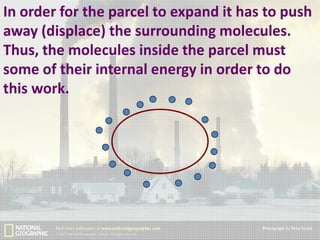
In order for the parcel to expand it has to push
away (displace) the surrounding molecules.
Thus, the molecules inside the parcel must
some of their internal energy in order to do
this work.
Since the temperature is a function of
the internal energy, when the internal
energy decreases, then the
temperature decreases.
Thus, the rising parcel expands and
cools.
This process is called adiabatic cooling.
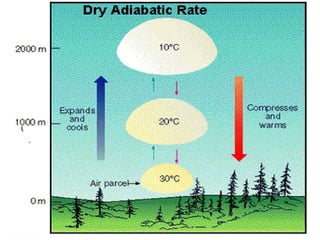
Lapse Rate
• Important characteristic of atmosphere is
ability to resist vertical motion: stability
• Affects ability to disperse pollutants
• When small volume of air is displaced
upward
– Encounters lower pressure
– Expands to lower temperature
– Assume no heat transfers to surrounding
atmosphere
– Called adiabatic expansion
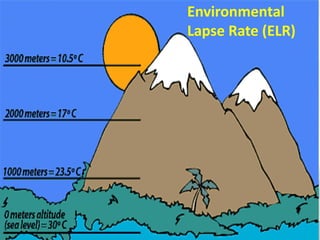
• The actual temperature profile of the ambient
air shows the environmental lapse rate.
Sometimes called the prevailing or
atmospheric lapse rate, it is the result of
complex interactions of meteorological
factors, and is usually considered to be a
decrease in temperature with height.
Environmental
Lapse Rate (ELR)
Adiabatic Expansion
To determine the change in temperature with
respect to elevation due to adiabatic expansion
– Atmosphere considered a stationary column of air
in a gravitational field
– Gas is a dry ideal gas
– Ignoring friction and inertial effects
( dT/dz)adiabatic perfect gas = - (g M/ Cp)
• T = temperature
• z = vertical distance
• g = acceleration due to gravity
• M = molecular weight of air
• Cp = heat capacity of the gas at constant
pressure
Adiabatic Expansion
( dT/dz) adiabatic perfect gas = 0.0098°C/m = -0.980 C/100 m (Can be
approximated as -10C/100 m)
or
( dT/dz) adiabatic perfect gas = -5.4°F/ft
Change in Temp. with change in height
• Important is ability to resist vertical
motion: stability
• Comparison of Γ to actual environment
lapse rate indicates stability of
atmosphere
• Degree of stability is a measure of the
ability of the atmosphere to disperse
pollutants
Lapse rate
• Lapse rate is the negative of temperature
gradient
• Dry adiabatic lapse rate =
Metric:
Γ = - 1°C/100m or
SI:
Γ = - 5.4°F/1000ft
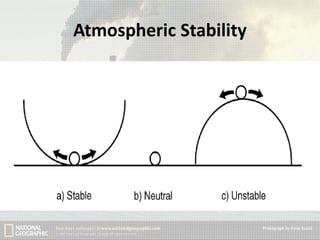
Atmospheric Stability
• Affects dispersion of pollutants
• Temperature/elevation relationship
principal determinant of atmospheric
stability
• Stable
– Little vertical mixing
– Pollutants emitted near surface tend to
stay there
– Environmental lapse rate is same as the
dry adiabatic lapse rate

• 4 common scenarios (Cases/Types)
Atmospheric Stability
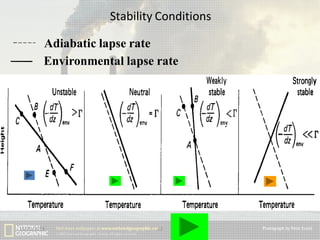
Stability Conditions
Adiabatic lapse rate
Environmental lapse rate

15/10/2013

42
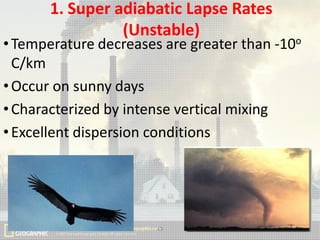
1. Super adiabatic Lapse Rates
(Unstable)

• Temperature decreases are greater than -10o
C/km
• Occur on sunny days
• Characterized by intense vertical mixing
• Excellent dispersion conditions

15/10/2013

43
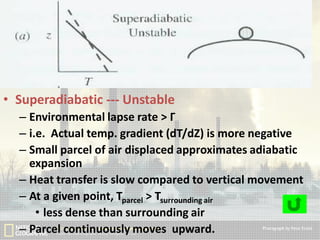
• Superadiabatic --- Unstable
– Environmental lapse rate > Γ
– i.e. Actual temp. gradient (dT/dZ) is more negative
– Small parcel of air displaced approximates adiabatic
expansion
– Heat transfer is slow compared to vertical movement
– At a given point, Tparcel > Tsurrounding air
• less dense than surrounding air
– Parcel continuously moves upward.
2. Neutral Lapse Rates
• Rate of change of Temperature is similar
(nearly equal) to the adiabatic lapse rate
• Results from:
– Cloudy conditions
– Elevated wind speeds
– Day/night transitions

• Describes good dispersion conditions

15/10/2013

45
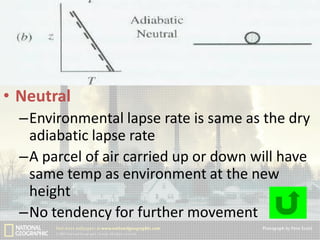
• Neutral
–Environmental lapse rate is same as the dry
adiabatic lapse rate
–A parcel of air carried up or down will have
same temp as environment at the new
height
–No tendency for further movement
3. Isothermal Lapse Rates
(Weakly Stable)
• Characterized by no temperature change
with height. (dT/dZ= constant)
• Atmosphere is somewhat stable
• Dispersion conditions are moderate
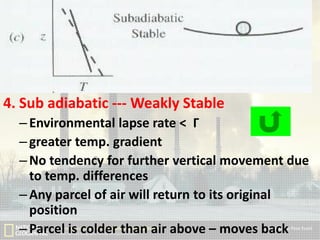
4. Sub adiabatic --- Weakly Stable
– Environmental lapse rate < Γ
– greater temp. gradient
– No tendency for further vertical movement due
to temp. differences
– Any parcel of air will return to its original
position
– Parcel is colder than air above – moves back
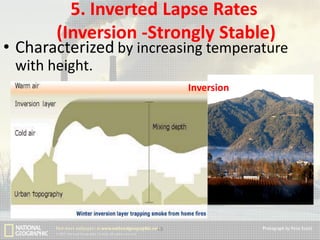
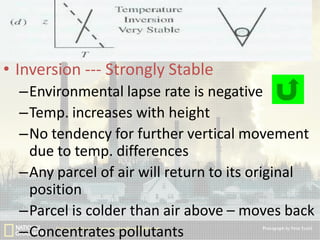
5. Inverted Lapse Rates
(Inversion -Strongly Stable)

• Characterized by increasing temperature
with height.
Inversion

49
• Inversion --- Strongly Stable
–Environmental lapse rate is negative
–Temp. increases with height
–No tendency for further vertical movement
due to temp. differences
–Any parcel of air will return to its original
position
–Parcel is colder than air above – moves back
–Concentrates pollutants
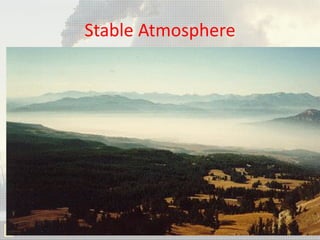
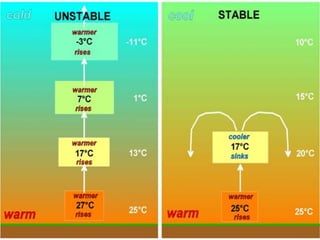
Stable Atmosphere
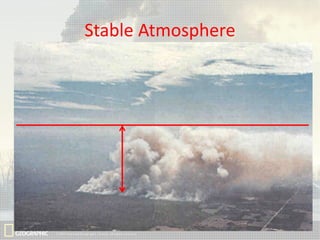
Stable Atmosphere
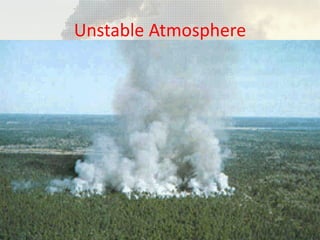
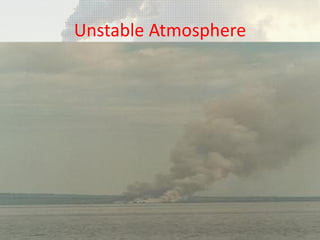
Unstable Atmosphere
Unstable Atmosphere
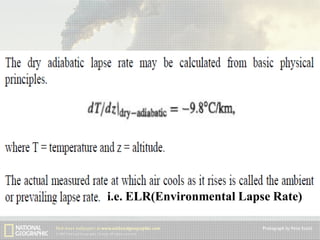
i.e. ELR(Environmental Lapse Rate)
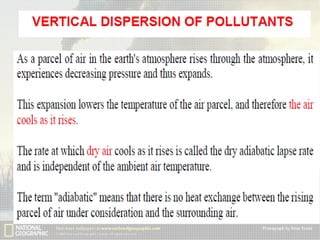
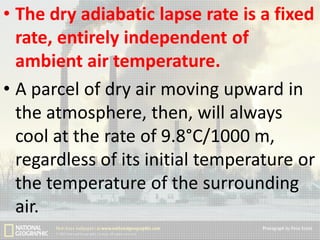
• The dry adiabatic lapse rate is a fixed
rate, entirely independent of
ambient air temperature.
• A parcel of dry air moving upward in
the atmosphere, then, will always
cool at the rate of 9.8°C/1000 m,
regardless of its initial temperature or
the temperature of the surrounding
air.
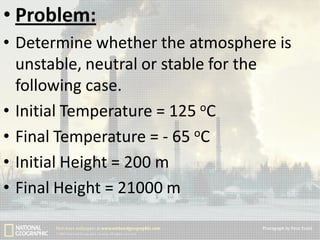
• Problem:
• Determine whether the atmosphere is
unstable, neutral or stable for the
following case.
• Initial Temperature = 125 oC
• Final Temperature = - 65 oC
• Initial Height = 200 m
• Final Height = 21000 m
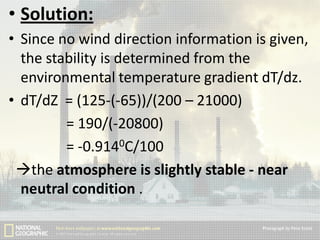
• Solution:
• Since no wind direction information is given,
the stability is determined from the
environmental temperature gradient dT/dz.
• dT/dZ = (125-(-65))/(200 – 21000)
= 190/(-20800)
= -0.9140C/100
the atmosphere is slightly stable - near
neutral condition .
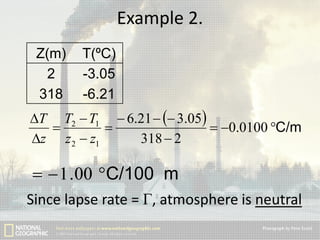
Example 2.
Z(m)
2
318

T(ºC)
-3.05
-6.21

T T2  T1  6.21   3.05


 0.0100 C/m
z z 2  z1
318  2

  1 .00 C/100 m
Since lapse rate = Г, atmosphere is neutral
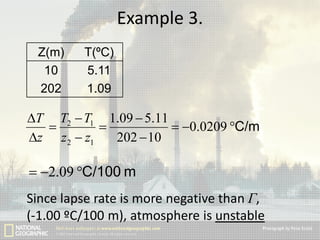
Example 3.
Z(m)
10
202

T(ºC)
5.11
1.09

T T2  T1 1.09  5.11


 0.0209 C/m
z z 2  z1
202  10

 2.09 C/100 m
Since lapse rate is more negative than Г,
(-1.00 ºC/100 m), atmosphere is unstable
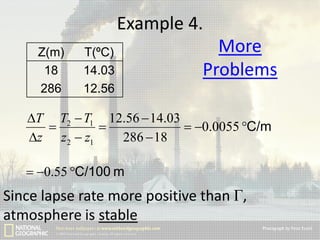
Example 4.
Z(m)
18
286

T(ºC)
14.03
12.56

More
Problems

T T2  T1 12.56  14.03


 0.0055 C/m
z z2  z1
286  18
 0.55 C/100 m

Since lapse rate more positive than Г,
atmosphere is stable
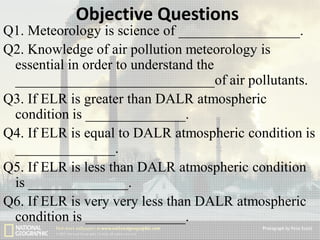
Objective Questions
Q1. Meteorology is science of _________________.
Q2. Knowledge of air pollution meteorology is
essential in order to understand the
____________________________of air pollutants.
Q3. If ELR is greater than DALR atmospheric
condition is ______________.
Q4. If ELR is equal to DALR atmospheric condition is
______________.
Q5. If ELR is less than DALR atmospheric condition
is ______________.
Q6. If ELR is very very less than DALR atmospheric
condition is ______________.
Q7. _________________ stability condition is most
favorable for dispersion of pollutants.
Q8. The environmental, or prevailing, lapse rate can be
determined from the ______________________.
Q9. The dry adiabatic lapse rate is ____________.
Q12. The actual temperature profile of the ambient air
can be used to determine the___________________
lapse rate.
Theory Questions
Q1. Define meteorology and discuss importance of the
same.
Q2. Explain stability conditions?
Q3. What is adiabatic cooling?
Q4. Define the following
1. ELR
2. Atmospheric Stability condition
3. Lapse rate
Q5. Write a note on
1.DALR 2. Pasquill’s Stability classes

AIR POLLUTION CONTROL L 12 and 13

  • 1.
    L- 12 AIR POLLUTIONMETEOROLOGY Air Pollution and Control (Elective-I)
  • 2.
    Contents of unit-IV Themeteorology and air pollution L-12 Introduction, Different meteorological factors and their effect, laps rate and stability of the atmosphere, stability classes Problems on temperature gradient and stability. L-13 Inversion phenomenon, Precipitation and its relation to scavenging pollutant in the air, wind pattern, direction, velocity and fluctuations, Problems, Maximum Mixing Depth, problems. . L-14  MMD problems continued, plume behaviour. L-15 Models of diffusions and dispersion, GDM- assumptions, model equation, limitations, problems. L -16GDM problems continued, Line source L-17 Effective stack height, Problems. L -18  Min of safe stack height, problems.
  • 3.
    What is Meteorology? •Meteorology is the science of the atmosphere. The atmosphere is the media into which all air pollutants are emitted. • Atmospheric processes such as the movement of air (wind) and the exchange of heat (convection and radiation for example) dictate the fate of pollutants as they go through the stages of transport, dispersion, transformation and removal. Air pollution meteorology is the study of how these atmospheric processes affect the fate of air pollutants.
  • 4.
    • • • Knowledge of airpollution meteorology is used to manage and control the release of pollutants into the ambient air. Managing the release of air pollutants helps ensure that ambient pollutant concentrations comply with national ambient air quality standards. Knowledge of air pollution meteorology is essential in order to understand the
  • 6.
    Importance of meteorology •Understanding air pollution meteorology and its influence in pollutant dispersion is essential in air quality planning activities. • Engineers use this knowledge to help locate air pollution monitoring stations and to develop implementation plans to bring ambient air quality into compliance with standards. • Meteorology is used in predicting the ambient impact of a new source of air pollution and to determine the effect on air quality from modifications to existing sources.
  • 7.
    • When meteorologicalconditions develop that are not conducive to pollutant dispersion, governmental air pollution agencies must act fast to ensure that air pollutants don’t build up to unacceptable levels in the air we breathe. • When pollutant levels become excessively high, an air pollution episode results and emissions into the atmosphere must be curtailed. • Example is Donora episode
  • 8.
    • The townspeople were accustomed to receiving some emissions from the local steel mill, zinc smelter, and sulphuric acid plant. • But, they were not prepared for the dangerously high concentrations of pollutants that built up and became trapped over the town. • The meteorological conditions in Donora during this five-day period (high pressure system and strong temperature inversion) produced light winds and dense fog. • The air was not able to move horizontally or vertically and just lingered over the town.
  • 9.
  • 10.
    Solar Radiation • Atupper boundary of atmosphere, vertical solar radiation = 8.16 J/cm2min (solar constant) • Maximum intensity at λ = 0.4 to 0.8 μm = visible portion of electromagnetic spectrum • ~ 42% of energy – – – – – Absorbed by higher atmosphere Reflected by clouds Back-scattered by atmosphere Reflected by earth’s surface Absorbed by water vapor & clouds • 47% adsorbed by land and water
  • 11.
    Insolation • Quantity ofsolar radiation reaching a unit area of the earth’s surface – Angle of incidence – Thickness of the atmosphere – Characteristics of surface • Albedo: fraction of incident radiation that is reflected by a surface
  • 12.
    Solar Incidence Angle •angle between sun’s rays and an imaginary line perpendicular to the surface (0º) • maximum solar gain is achieved when incidence angle is 0º • Tangent in morning and approximately perpendicular • angle depends on surface Information and image source: http://www.visualsunchart.com/VisualSunChart/SolarAccessConcepts/
  • 13.
    BASICS OF AIRMOVEMENT
  • 14.
    • Air pressuredifferences cause the movement of air • Air moving parallel to the ground is called wind • Air moving up or down is called a current
  • 15.
    • Air generallymoves from the poles to the equator, this is because air flows from high pressure to low pressure –High pressure forms when cold air sinks (at the poles) –Low pressure forms when warm air rises (at the equator) • But the air doesn’t flow in a straight line
  • 16.
    Coriolis Effect • Causesair to move in a curved path • It is caused by the Earth spinning on its axis • The Earth spins fastest at the equator, and slowest near the poles • As air moves from the equator to the pole, it will travel east faster than the land beneath it causing the air to follow a curved path
  • 19.
    LAND AND SEABREEZE • Because land surfaces heat and cool quicker than the sea or other water bodies, temperature gradients develop that can result in the generation of localised wind flows. • A sea breeze develops during the day as the air over the land warms more quickly than the air over the sea. • It rises, bringing in an onshore breeze, with a return flow aloft.
  • 20.
    • At nightthe opposite occurs and a land breeze develops, flowing towards the sea under an area of subsidence. • Sea breezes are generally strongest during the day in summer and land breezes strongest during winter nights. • They can both have significant effect s on air quality over urban areas, as they are recirculating air currents that can return pollutant s (instead of remove them) to an area fro m which the y were released earlier in the day .
  • 22.
    Sea breeze –at day time
  • 23.
  • 24.
  • 25.
    • Mountain andvalley winds are generated due to similar heating and cooling mechanisms to sea−land breezes. • During the day the air above a slope is heated and becomes warmer than neighboring air at the same height above sea level, but further above the ground. It rises due to convection, and up slope mountain winds occur.
  • 26.
    • At nightthe mountain slopes cool more quickly than the surrounding air, and the cool air drains down the slope, generating valley winds. • This heating and cooling often results in closed circulation patterns, which can trap and/or recirculate air pollution in the mountain −valley system .
  • 28.
    Factors responsible forscavenging of Air pollutants
  • 29.
    What is adiabaticcooling? Why does air cool when it rises? When air rises is encounters lower pressure p = 990 mb p = 1000 mb p = 1000 mb p = 1000 mb Momentarily, as the air parcel rises it has a higher pressure than the surrounding molecules. This mean that there is more force exerted by the molecules inside the parcel than is being exerted by the molecules outside the parcel and the parcel expands.
  • 30.
    This means thereis more force exerted from inside the parcel than there is from the outside and the parcel expands. p = 990 mb less force p = 1000 mb p = 990 mb more force less force
  • 31.
    In order forthe parcel to expand it has to push away (displace) the surrounding molecules. Thus, the molecules inside the parcel must some of their internal energy in order to do this work.
  • 32.
    Since the temperatureis a function of the internal energy, when the internal energy decreases, then the temperature decreases. Thus, the rising parcel expands and cools. This process is called adiabatic cooling.
  • 33.
    Lapse Rate • Importantcharacteristic of atmosphere is ability to resist vertical motion: stability • Affects ability to disperse pollutants • When small volume of air is displaced upward – Encounters lower pressure – Expands to lower temperature – Assume no heat transfers to surrounding atmosphere – Called adiabatic expansion
  • 34.
    • The actualtemperature profile of the ambient air shows the environmental lapse rate. Sometimes called the prevailing or atmospheric lapse rate, it is the result of complex interactions of meteorological factors, and is usually considered to be a decrease in temperature with height.
  • 35.
  • 36.
    Adiabatic Expansion To determinethe change in temperature with respect to elevation due to adiabatic expansion – Atmosphere considered a stationary column of air in a gravitational field – Gas is a dry ideal gas – Ignoring friction and inertial effects ( dT/dz)adiabatic perfect gas = - (g M/ Cp) • T = temperature • z = vertical distance • g = acceleration due to gravity • M = molecular weight of air • Cp = heat capacity of the gas at constant pressure
  • 37.
    Adiabatic Expansion ( dT/dz)adiabatic perfect gas = 0.0098°C/m = -0.980 C/100 m (Can be approximated as -10C/100 m) or ( dT/dz) adiabatic perfect gas = -5.4°F/ft Change in Temp. with change in height
  • 38.
    • Important isability to resist vertical motion: stability • Comparison of Γ to actual environment lapse rate indicates stability of atmosphere • Degree of stability is a measure of the ability of the atmosphere to disperse pollutants
  • 39.
    Lapse rate • Lapserate is the negative of temperature gradient • Dry adiabatic lapse rate = Metric: Γ = - 1°C/100m or SI: Γ = - 5.4°F/1000ft
  • 40.
    Atmospheric Stability • Affectsdispersion of pollutants • Temperature/elevation relationship principal determinant of atmospheric stability • Stable – Little vertical mixing – Pollutants emitted near surface tend to stay there – Environmental lapse rate is same as the dry adiabatic lapse rate • 4 common scenarios (Cases/Types)
  • 41.
  • 42.
    Stability Conditions Adiabatic lapserate Environmental lapse rate 15/10/2013 42
  • 43.
    1. Super adiabaticLapse Rates (Unstable) • Temperature decreases are greater than -10o C/km • Occur on sunny days • Characterized by intense vertical mixing • Excellent dispersion conditions 15/10/2013 43
  • 44.
    • Superadiabatic ---Unstable – Environmental lapse rate > Γ – i.e. Actual temp. gradient (dT/dZ) is more negative – Small parcel of air displaced approximates adiabatic expansion – Heat transfer is slow compared to vertical movement – At a given point, Tparcel > Tsurrounding air • less dense than surrounding air – Parcel continuously moves upward.
  • 45.
    2. Neutral LapseRates • Rate of change of Temperature is similar (nearly equal) to the adiabatic lapse rate • Results from: – Cloudy conditions – Elevated wind speeds – Day/night transitions • Describes good dispersion conditions 15/10/2013 45
  • 46.
    • Neutral –Environmental lapserate is same as the dry adiabatic lapse rate –A parcel of air carried up or down will have same temp as environment at the new height –No tendency for further movement
  • 47.
    3. Isothermal LapseRates (Weakly Stable) • Characterized by no temperature change with height. (dT/dZ= constant) • Atmosphere is somewhat stable • Dispersion conditions are moderate
  • 48.
    4. Sub adiabatic--- Weakly Stable – Environmental lapse rate < Γ – greater temp. gradient – No tendency for further vertical movement due to temp. differences – Any parcel of air will return to its original position – Parcel is colder than air above – moves back
  • 49.
    5. Inverted LapseRates (Inversion -Strongly Stable) • Characterized by increasing temperature with height. Inversion 49
  • 50.
    • Inversion ---Strongly Stable –Environmental lapse rate is negative –Temp. increases with height –No tendency for further vertical movement due to temp. differences –Any parcel of air will return to its original position –Parcel is colder than air above – moves back –Concentrates pollutants
  • 51.
  • 52.
  • 53.
  • 54.
  • 57.
  • 59.
    • The dryadiabatic lapse rate is a fixed rate, entirely independent of ambient air temperature. • A parcel of dry air moving upward in the atmosphere, then, will always cool at the rate of 9.8°C/1000 m, regardless of its initial temperature or the temperature of the surrounding air.
  • 60.
    • Problem: • Determinewhether the atmosphere is unstable, neutral or stable for the following case. • Initial Temperature = 125 oC • Final Temperature = - 65 oC • Initial Height = 200 m • Final Height = 21000 m
  • 61.
    • Solution: • Sinceno wind direction information is given, the stability is determined from the environmental temperature gradient dT/dz. • dT/dZ = (125-(-65))/(200 – 21000) = 190/(-20800) = -0.9140C/100 the atmosphere is slightly stable - near neutral condition .
  • 62.
    Example 2. Z(m) 2 318 T(ºC) -3.05 -6.21 T T2 T1  6.21   3.05    0.0100 C/m z z 2  z1 318  2   1 .00 C/100 m Since lapse rate = Г, atmosphere is neutral
  • 63.
    Example 3. Z(m) 10 202 T(ºC) 5.11 1.09 T T2 T1 1.09  5.11    0.0209 C/m z z 2  z1 202  10  2.09 C/100 m Since lapse rate is more negative than Г, (-1.00 ºC/100 m), atmosphere is unstable
  • 64.
    Example 4. Z(m) 18 286 T(ºC) 14.03 12.56 More Problems T T2 T1 12.56  14.03    0.0055 C/m z z2  z1 286  18  0.55 C/100 m Since lapse rate more positive than Г, atmosphere is stable
  • 65.
    Objective Questions Q1. Meteorologyis science of _________________. Q2. Knowledge of air pollution meteorology is essential in order to understand the ____________________________of air pollutants. Q3. If ELR is greater than DALR atmospheric condition is ______________. Q4. If ELR is equal to DALR atmospheric condition is ______________. Q5. If ELR is less than DALR atmospheric condition is ______________. Q6. If ELR is very very less than DALR atmospheric condition is ______________.
  • 66.
    Q7. _________________ stabilitycondition is most favorable for dispersion of pollutants. Q8. The environmental, or prevailing, lapse rate can be determined from the ______________________. Q9. The dry adiabatic lapse rate is ____________. Q12. The actual temperature profile of the ambient air can be used to determine the___________________ lapse rate.
  • 67.
    Theory Questions Q1. Definemeteorology and discuss importance of the same. Q2. Explain stability conditions? Q3. What is adiabatic cooling? Q4. Define the following 1. ELR 2. Atmospheric Stability condition 3. Lapse rate Q5. Write a note on 1.DALR 2. Pasquill’s Stability classes