L-29 and L-30
Self Purification of Streams and
DO Sag CurveDO Sag Curve
Environmental Engg-II
Section –II starts
1
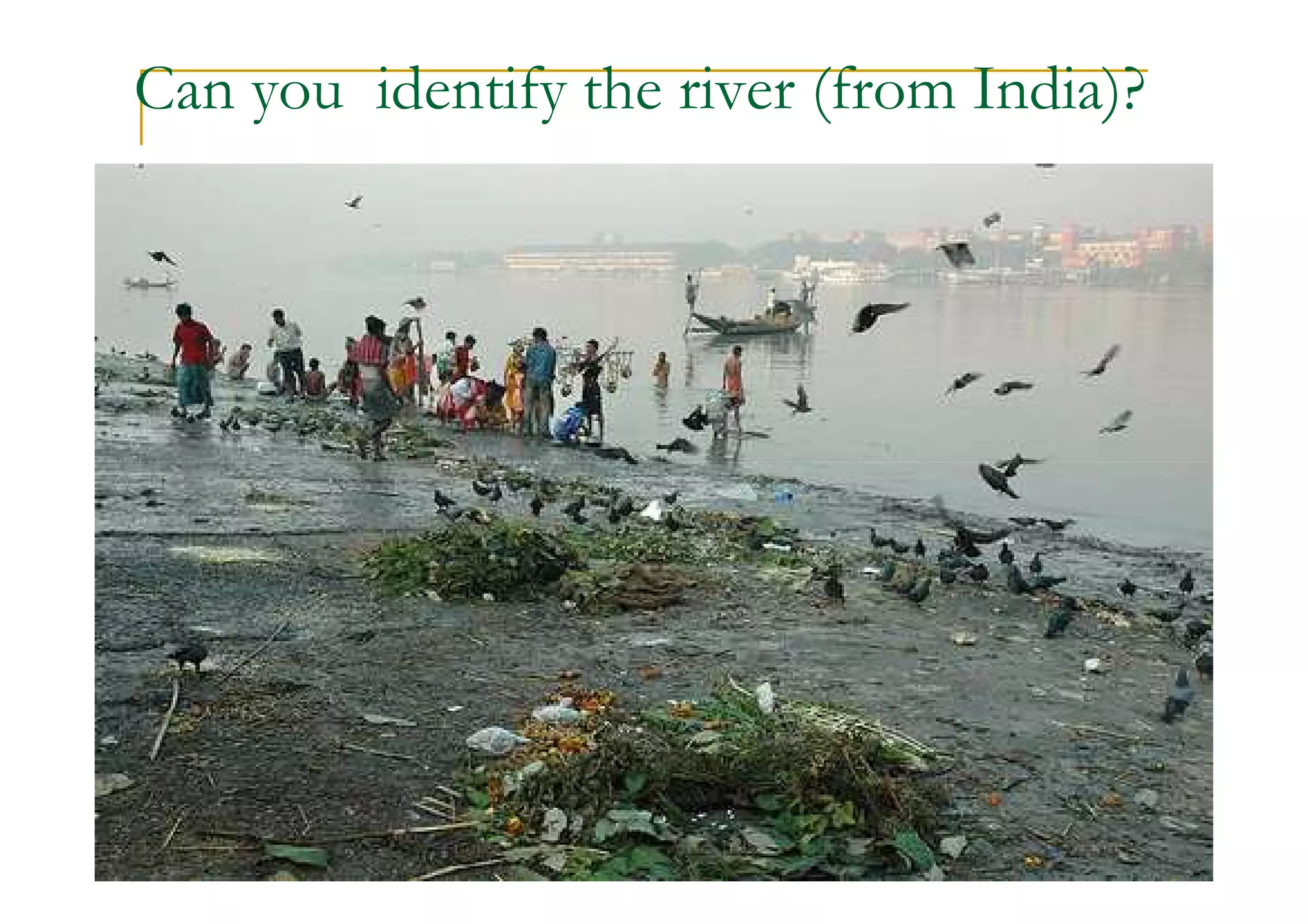
Can you identify the river (from India)?
2
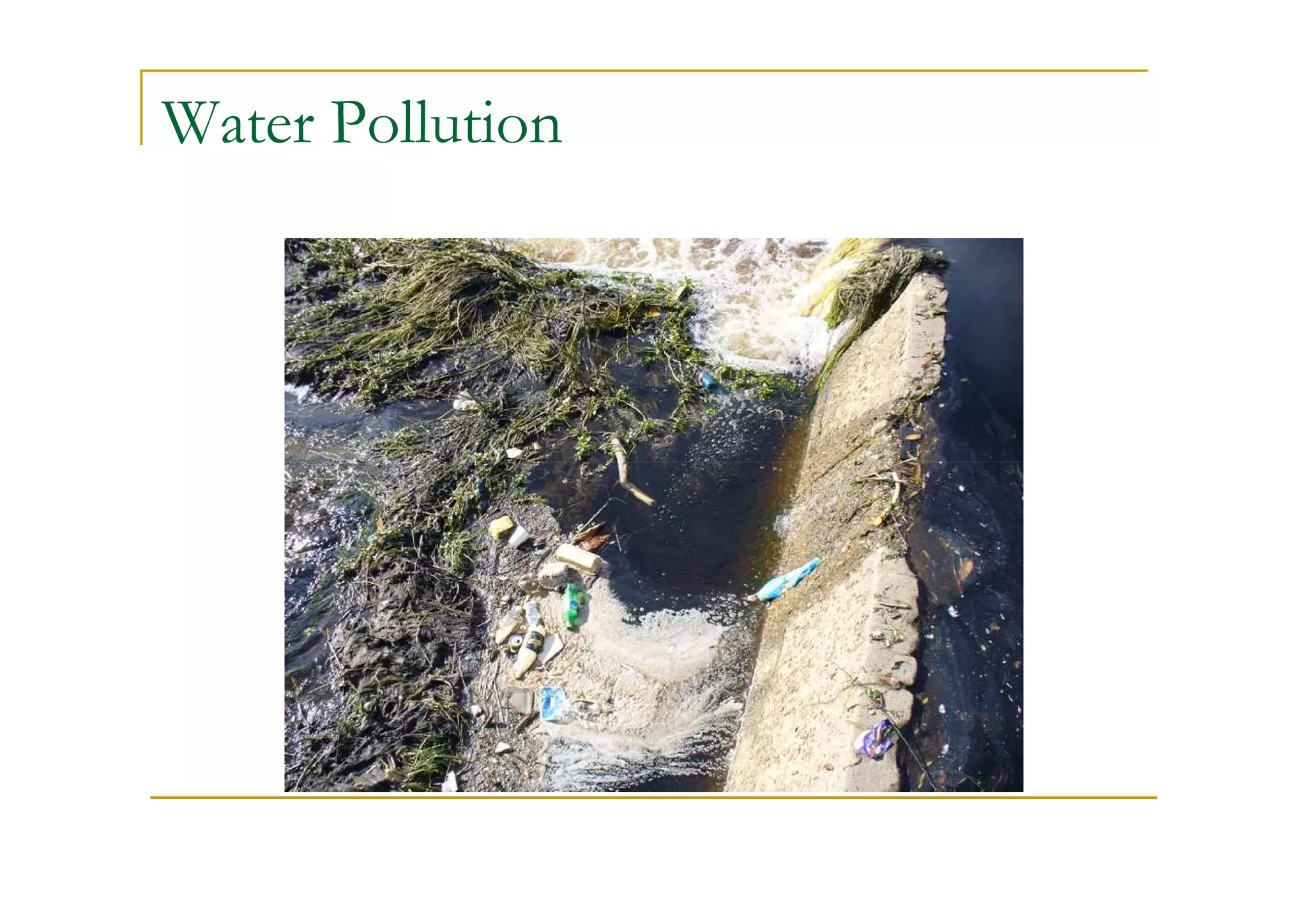
Water Pollution
What is self purification of stream?
When wastewater is discharged into the
river or stream, the BOD of mix increases
initially and DO level starts falling.
As river water travels further BOD
gradually reduces and DO increases and
reaches its saturation level.
Thus river gets purified on its own.
This phenomena is known as self
purification of stream
4
5
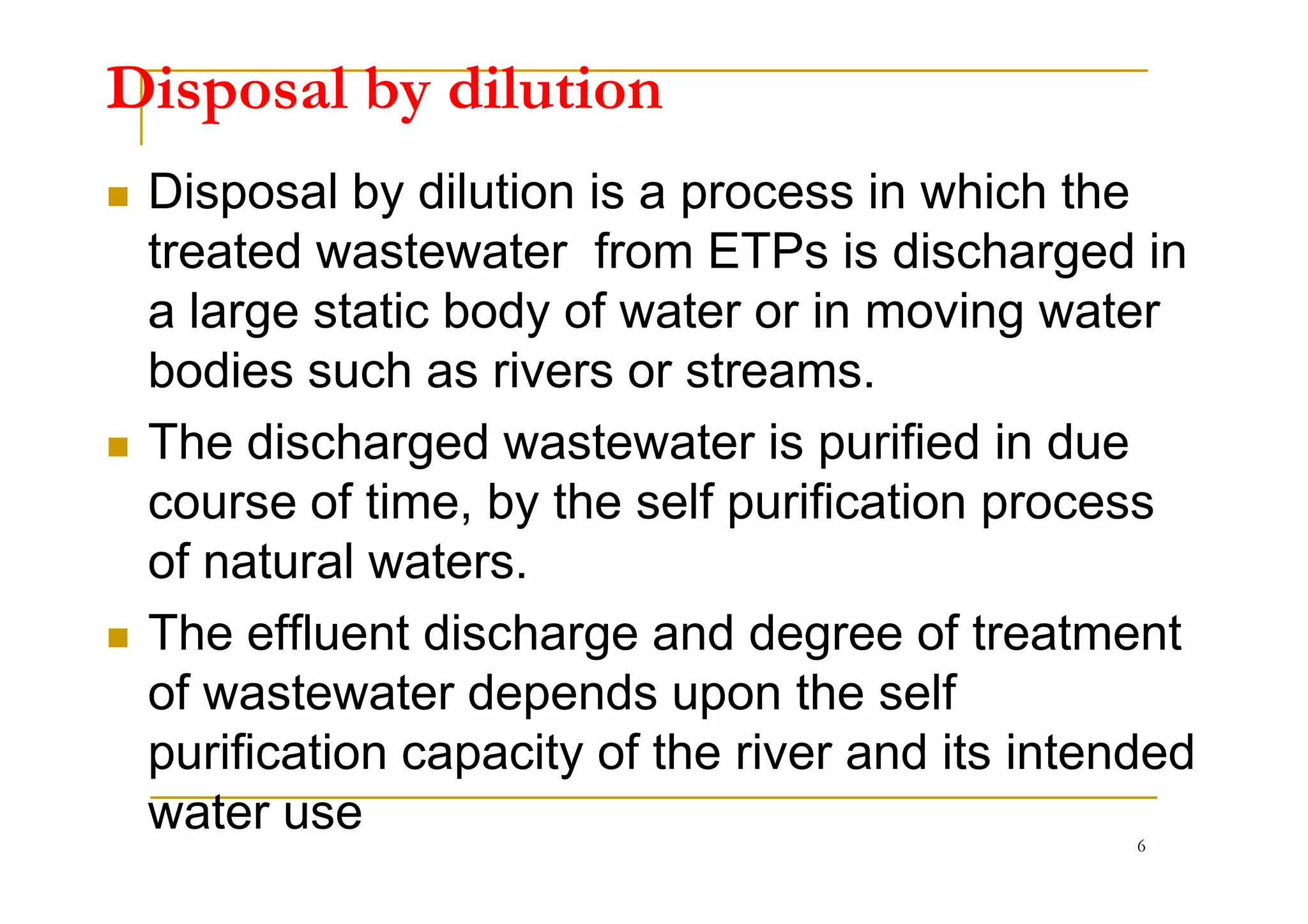
Disposal by dilution
Disposal by dilution is a process in which the
treated wastewater from ETPs is discharged in
a large static body of water or in moving water
bodies such as rivers or streams.
The discharged wastewater is purified in dueThe discharged wastewater is purified in due
course of time, by the self purification process
of natural waters.
The effluent discharge and degree of treatment
of wastewater depends upon the self
purification capacity of the river and its intended
water use 6
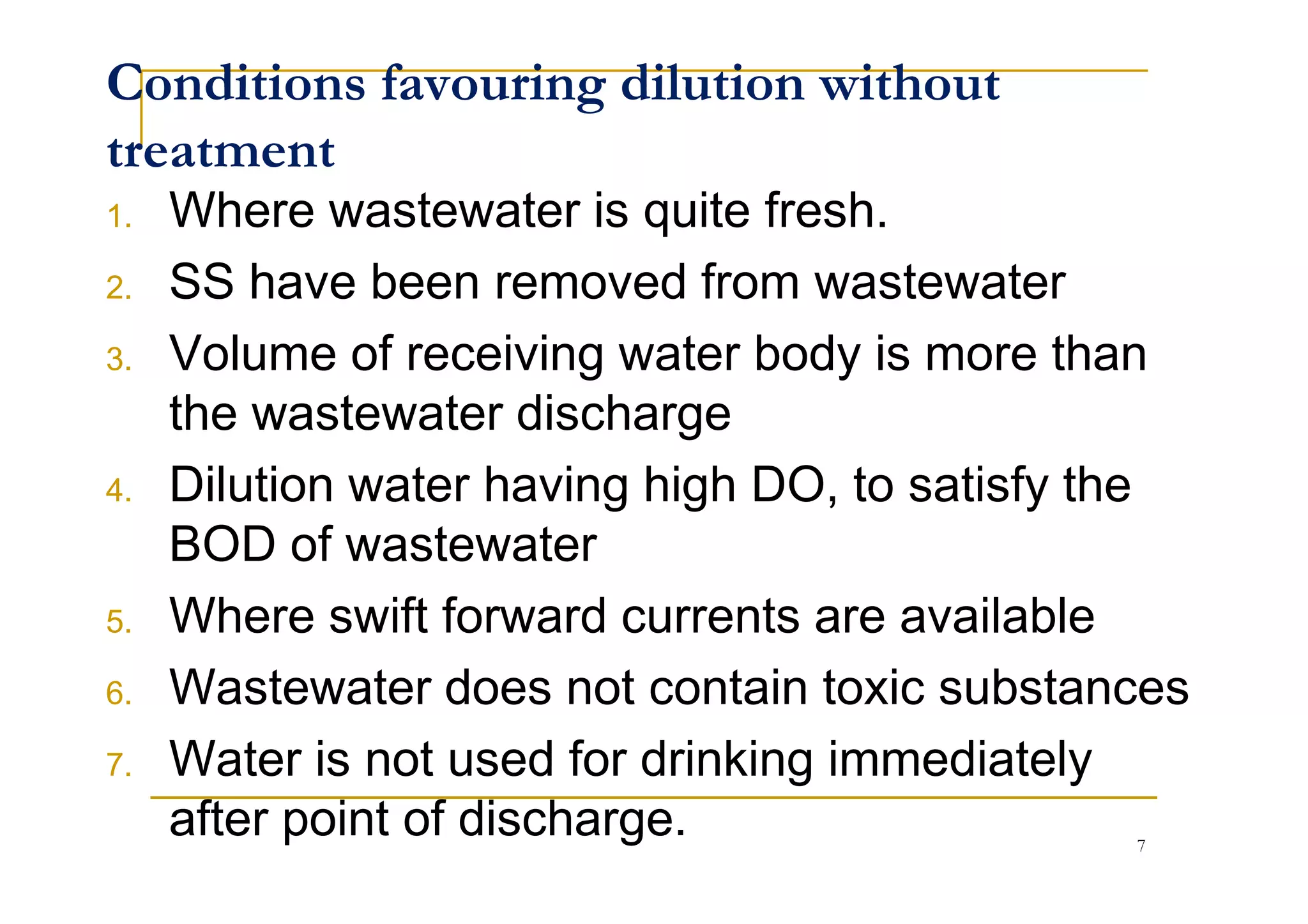
Conditions favouring dilution without
treatment
1. Where wastewater is quite fresh.
2. SS have been removed from wastewater
3. Volume of receiving water body is more than
the wastewater discharge
Dilution water having high DO, to satisfy the4. Dilution water having high DO, to satisfy the
BOD of wastewater
5. Where swift forward currents are available
6. Wastewater does not contain toxic substances
7. Water is not used for drinking immediately
after point of discharge. 7
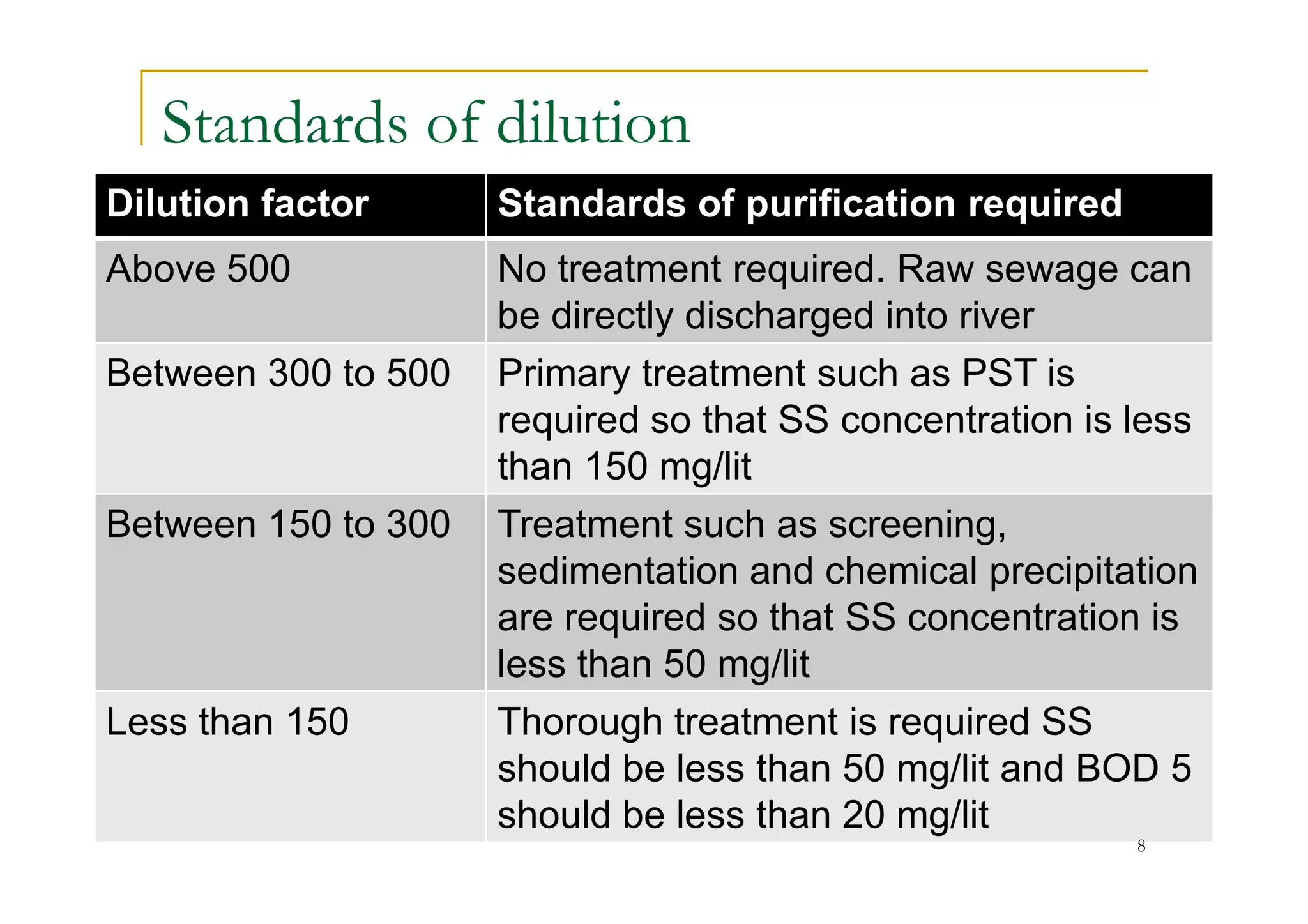
Standards of dilution
Dilution factor Standards of purification required
Above 500 No treatment required. Raw sewage can
be directly discharged into river
Between 300 to 500 Primary treatment such as PST is
required so that SS concentration is less
than 150 mg/litthan 150 mg/lit
Between 150 to 300 Treatment such as screening,
sedimentation and chemical precipitation
are required so that SS concentration is
less than 50 mg/lit
Less than 150 Thorough treatment is required SS
should be less than 50 mg/lit and BOD 5
should be less than 20 mg/lit
8
ACTIONS INVOLVED IN SELF
PURIFICATION OF STREAMS
9
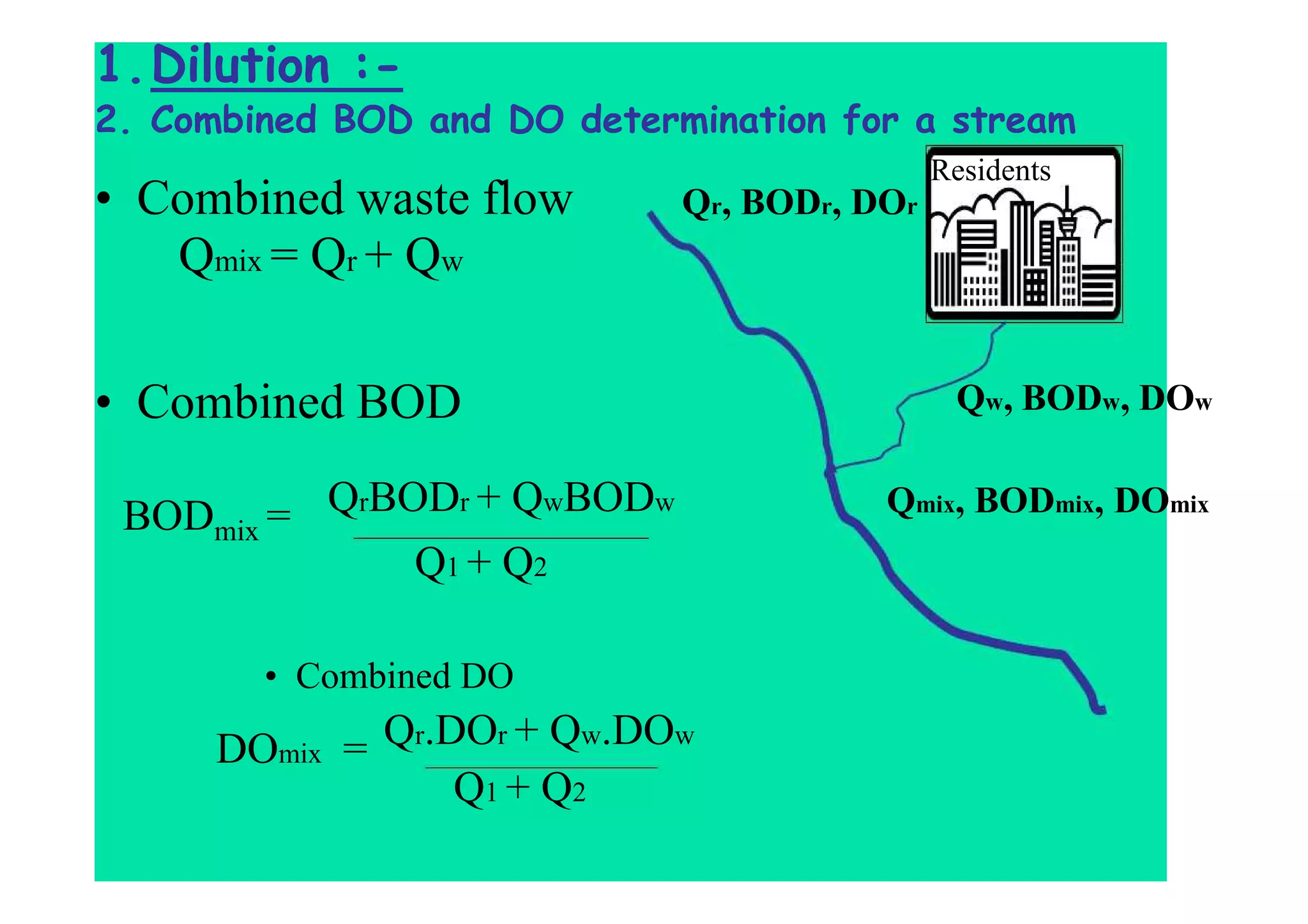
Qw, BODw, DOw
Qr, BODr, DOr
1.Dilution :-
2. Combined BOD and DO determination for a stream
Residents
• Combined waste flow
Qmix = Qr + Qw
• Combined BOD
Qmix, BODmix, DOmixQrBODr + QwBODw
Q1 + Q2
BODmix =
• Combined DO
Qr.DOr + Qw.DOw
Q1 + Q2
DOmix =
2. Dispersion due to currents
Self purification largely depends upon
currents, which readily disperses
wastewater in the stream, preventing
locally high concentration of pollutants.
High velocity improves aeration whichHigh velocity improves aeration which
reduces the concentration of pollutants.
High velocity improves raeration which
reduces the time of recovery, though
length of stream affected by the
wastewater is increased. 11
3. Sedimentation
If stream velocity is lesser than the scour
velocity of particles then sedimentation will
takes place, which has two effects
1. SS contribute largely to BOD will be
removed by settling and henceremoved by settling and hence
downstream water quality will be
improved.
2. Due to settled solids anaerobic
decomposition may take place
12
4. Oxidation
The organic matter present in the
wastewater is oxidized by aerobic bacteria
utilizing dissolved oxygen of the natural
waters.
This process continues till completeThis process continues till complete
oxidation of organic matter takes place.
The stream which is capable of absorbing
more oxygen through reaeration etc can
purify heavily polluted water in short time
13
5. reduction
Reduction occurs in the stream due to
hydrolysis of organic matter
biologically or chemically.
Anaerobic bacteria will split theAnaerobic bacteria will split the
organic matter into liquids and gases,
thus paving the way for stabilization
by oxidation
14
6. temperature
At low temp activity of bacteria is
low., and hence decomposition is
slow., though DO will be more
because increased solubility of
oxygen in water.oxygen in water.
At higher temperature purification
will take lesser time though amount
of DO is less in the water.
15
7. Sunlight
Sunlight helps certain micro-organisms to
absorb CO2 and give out oxygen, thus
resulting in self purification.
Sunlight acts as disinfectant and
stimulates growth of algae which producesstimulates growth of algae which produces
oxygen during photosynthesis.
Hence wherever there is algal growth
water contains more DO during daytime.
16
ZONES OF POLLUTION IN
THE STREAM
17
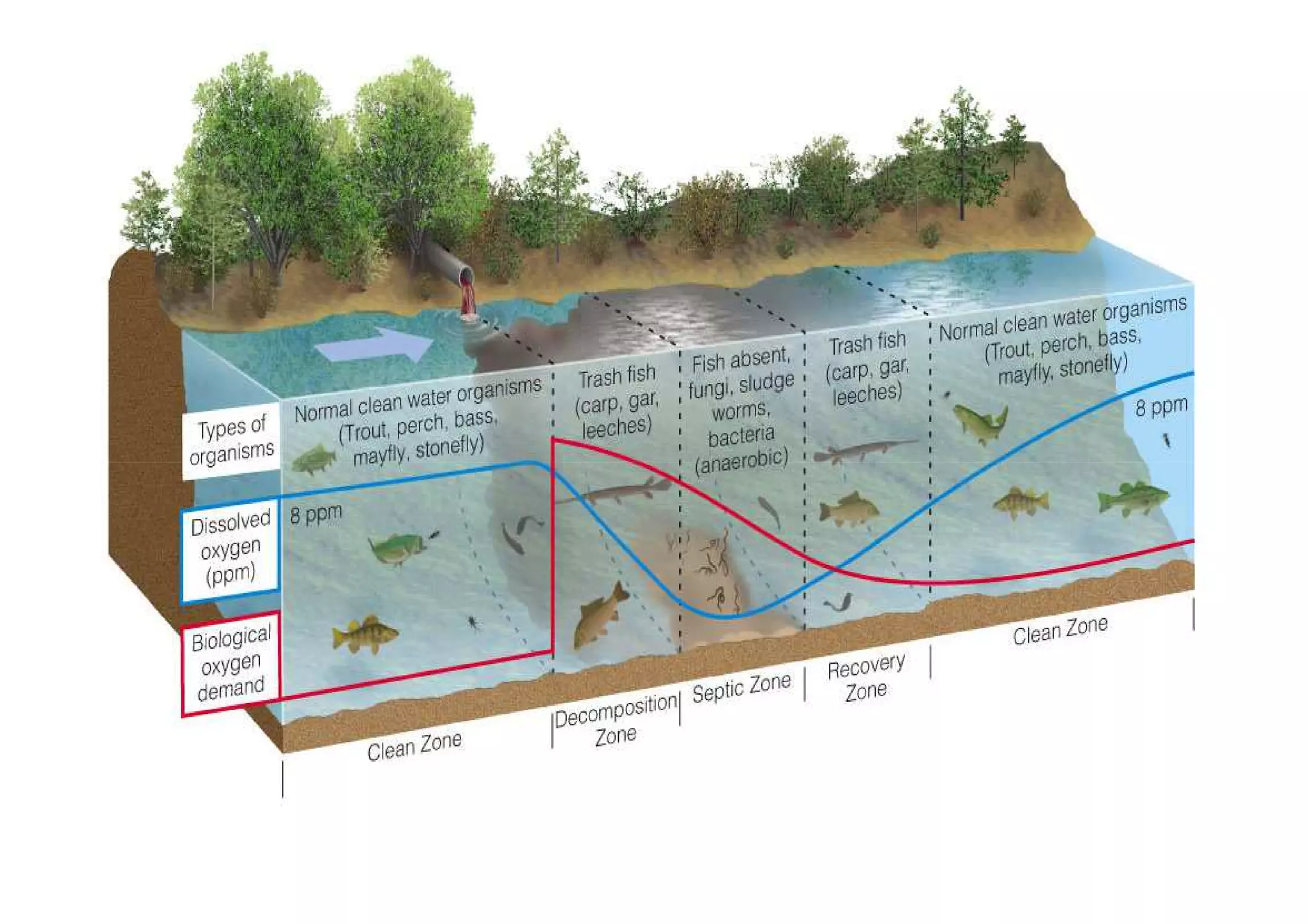
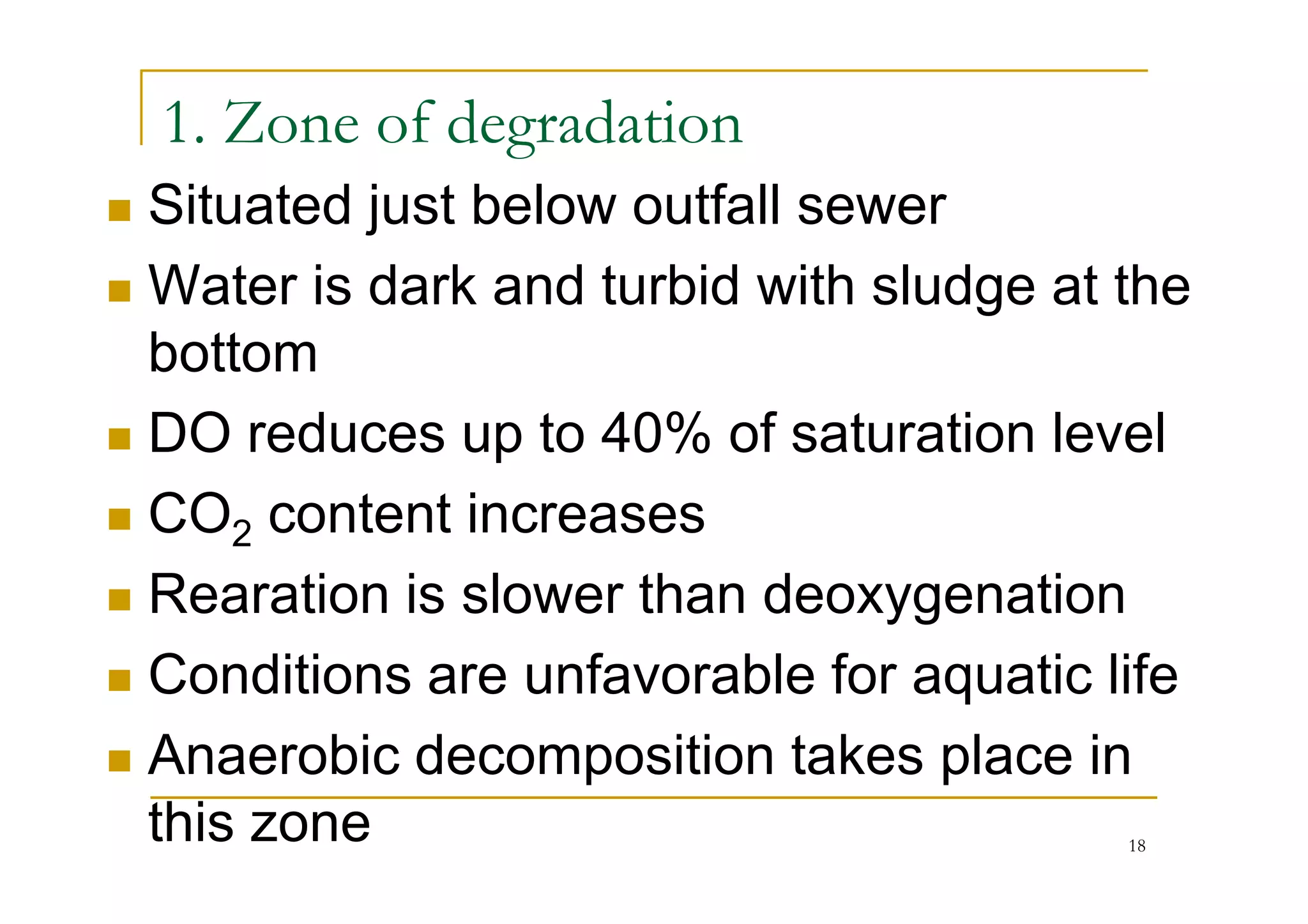
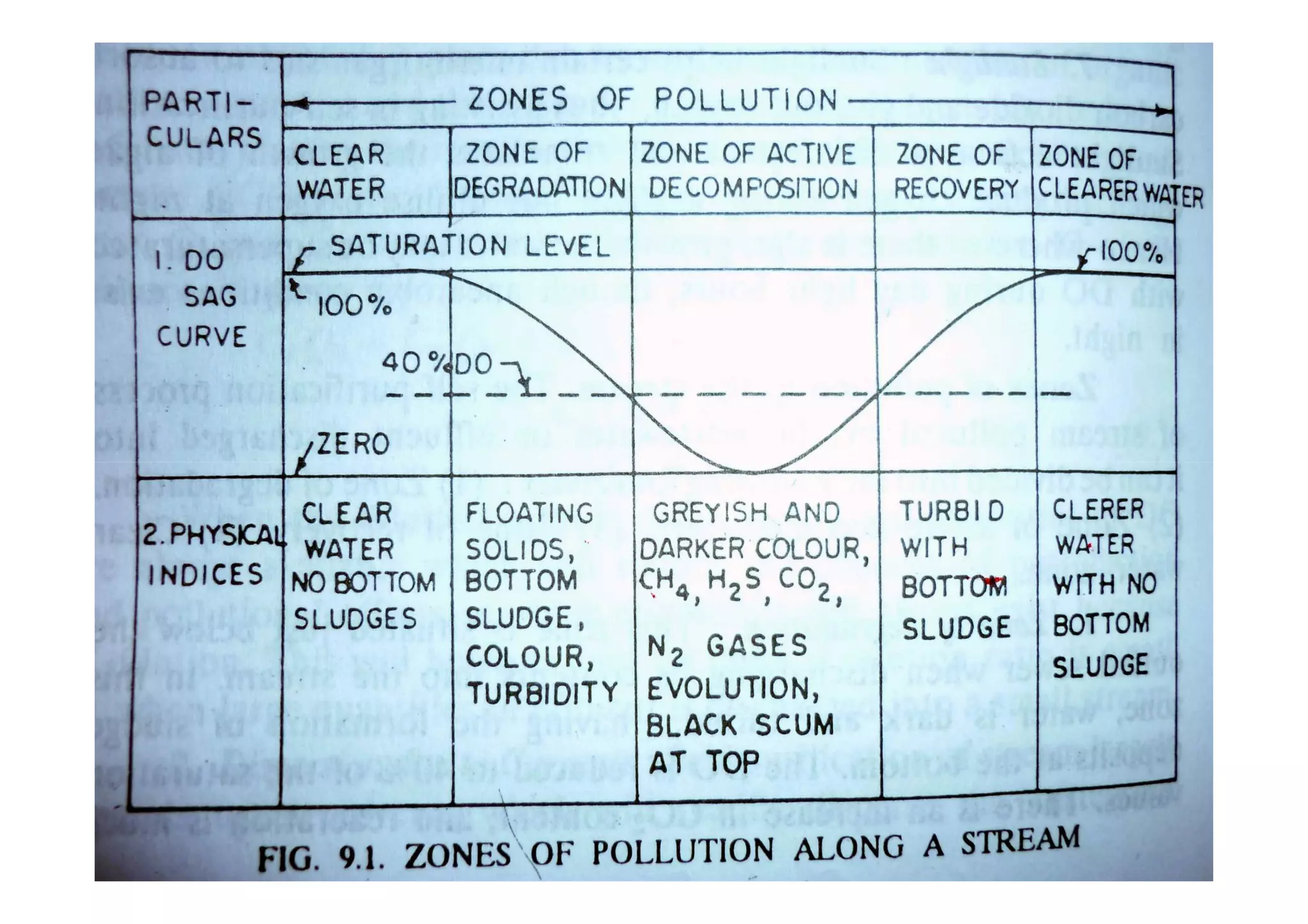
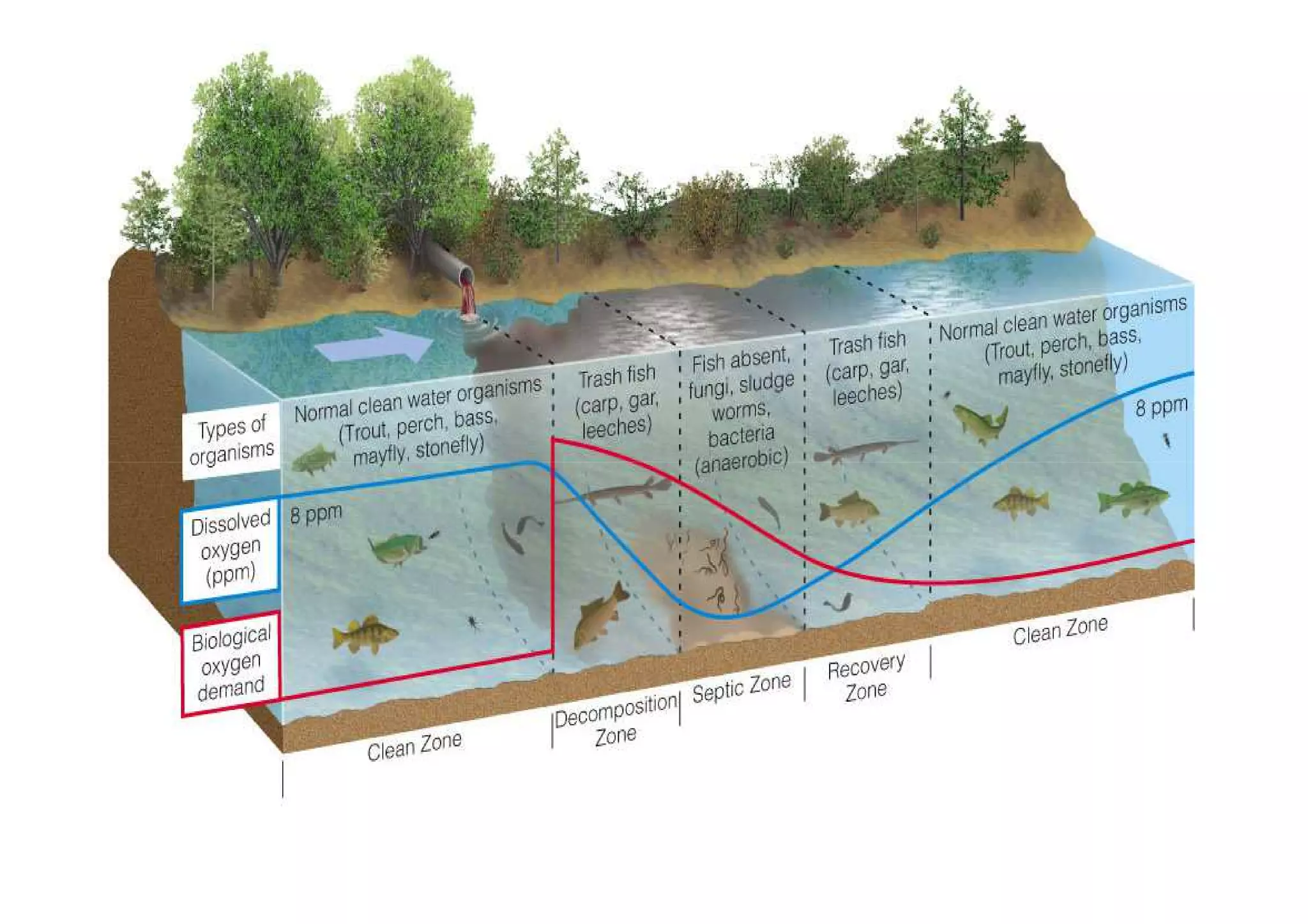
1. Zone of degradation
Situated just below outfall sewer
Water is dark and turbid with sludge at the
bottom
DO reduces up to 40% of saturation levelDO reduces up to 40% of saturation level
CO2 content increases
Rearation is slower than deoxygenation
Conditions are unfavorable for aquatic life
Anaerobic decomposition takes place in
this zone 18
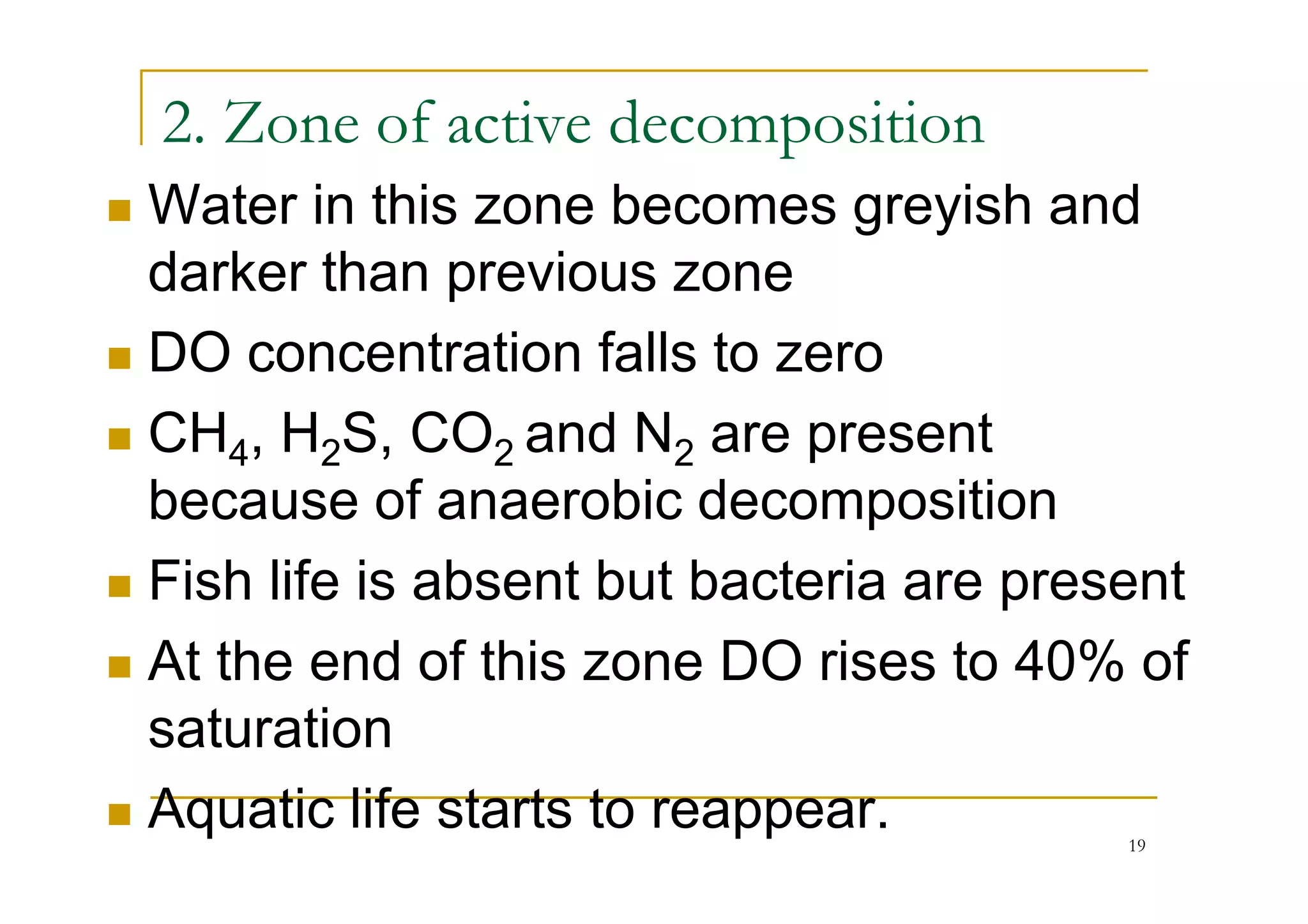
2. Zone of active decomposition
Water in this zone becomes greyish and
darker than previous zone
DO concentration falls to zero
CH4, H2S, CO2 and N2 are presentCH4, H2S, CO2 and N2 are present
because of anaerobic decomposition
Fish life is absent but bacteria are present
At the end of this zone DO rises to 40% of
saturation
Aquatic life starts to reappear. 19
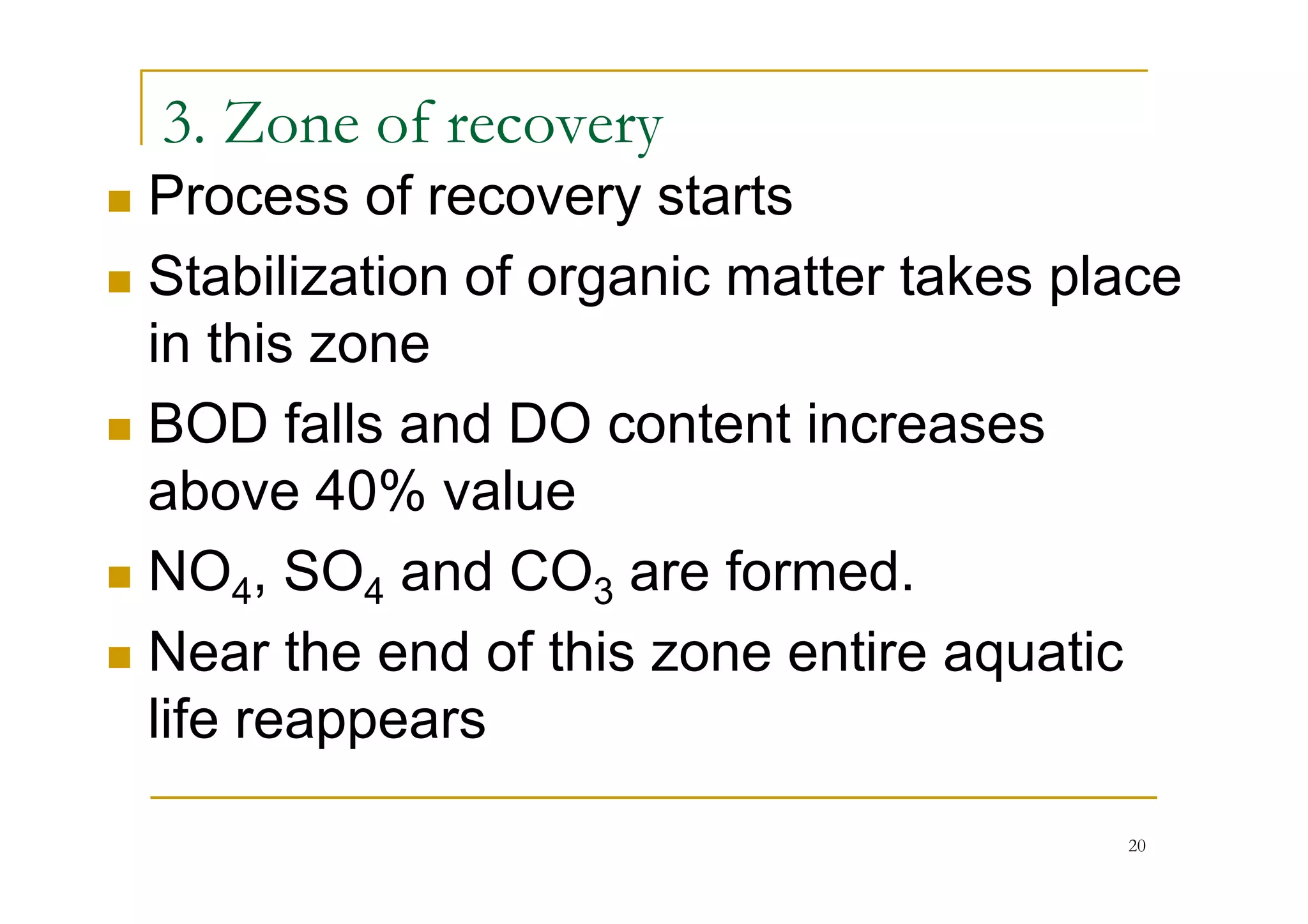
3. Zone of recovery
Process of recovery starts
Stabilization of organic matter takes place
in this zone
BOD falls and DO content increases
above 40% valueabove 40% value
NO4, SO4 and CO3 are formed.
Near the end of this zone entire aquatic
life reappears
20
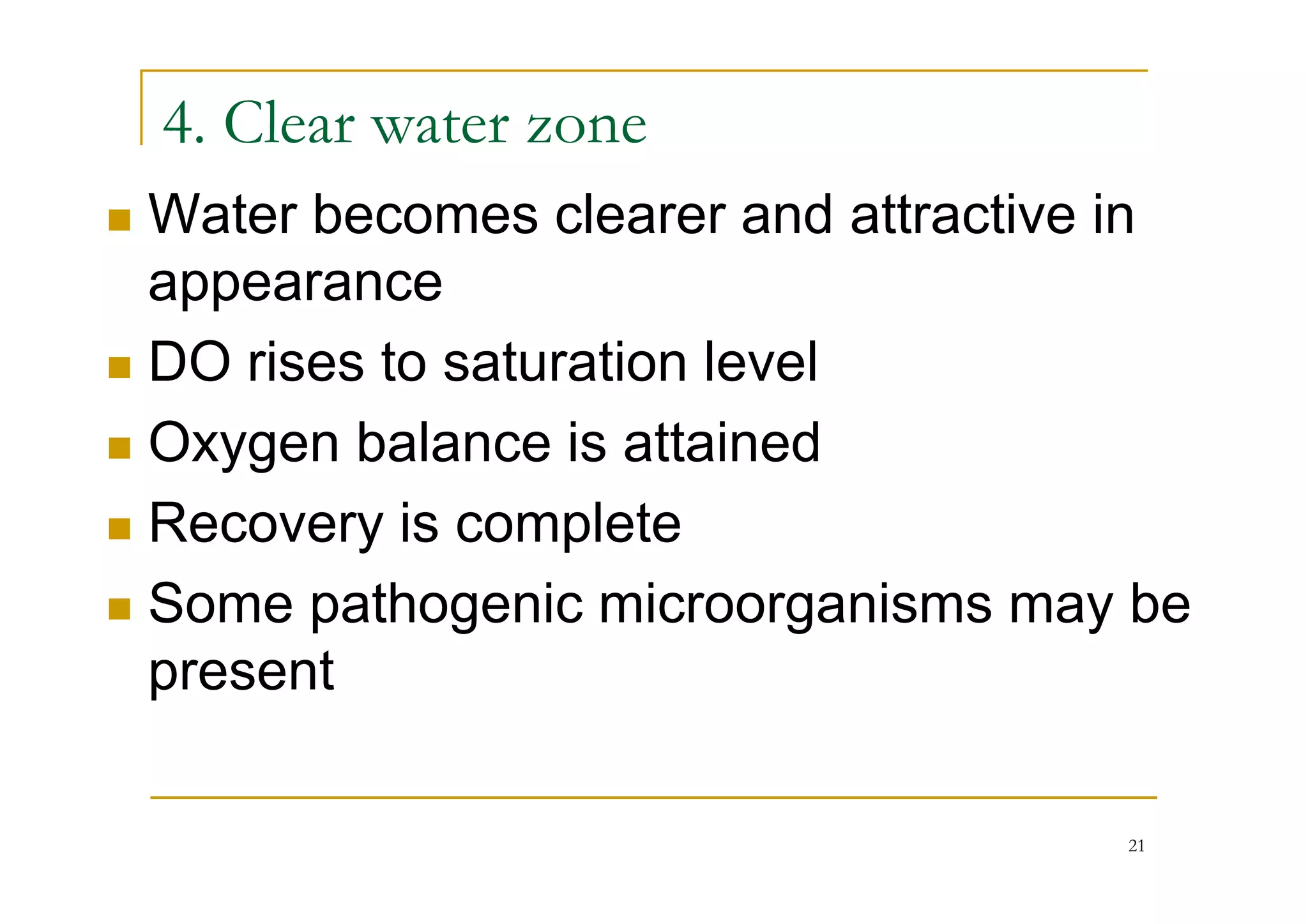
4. Clear water zone
Water becomes clearer and attractive in
appearance
DO rises to saturation level
Oxygen balance is attainedOxygen balance is attained
Recovery is complete
Some pathogenic microorganisms may be
present
21
22
23
DO SAG CURVE
24
25
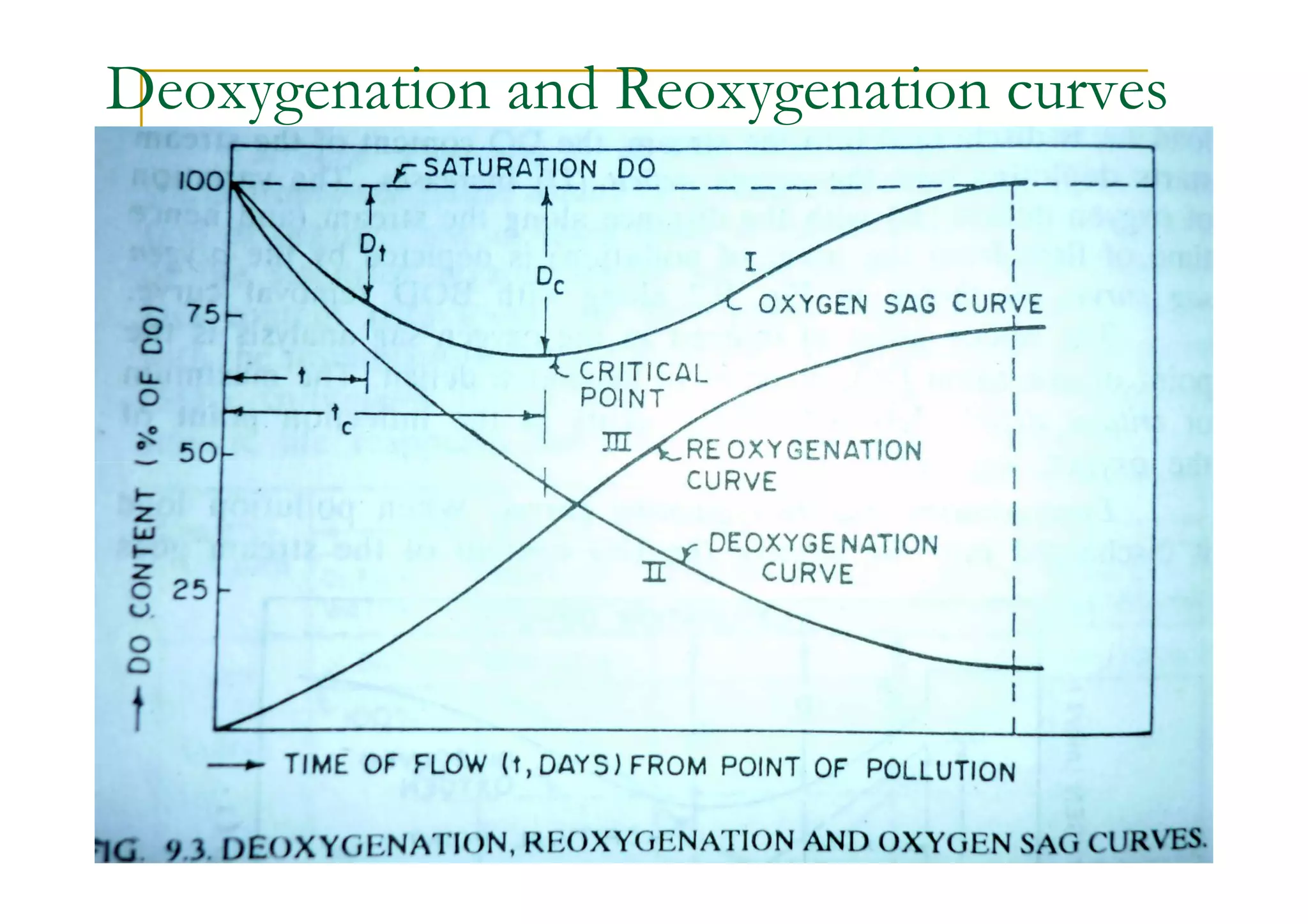
When pollutional load is discharged
into the stream, DO goes on reducing.
This process is known as
deoxygenation.
It depends upon organic matter
present and temperature.present and temperature.
The variation or depletion of DO is
represented graphically by
deoxygenation curve.
26
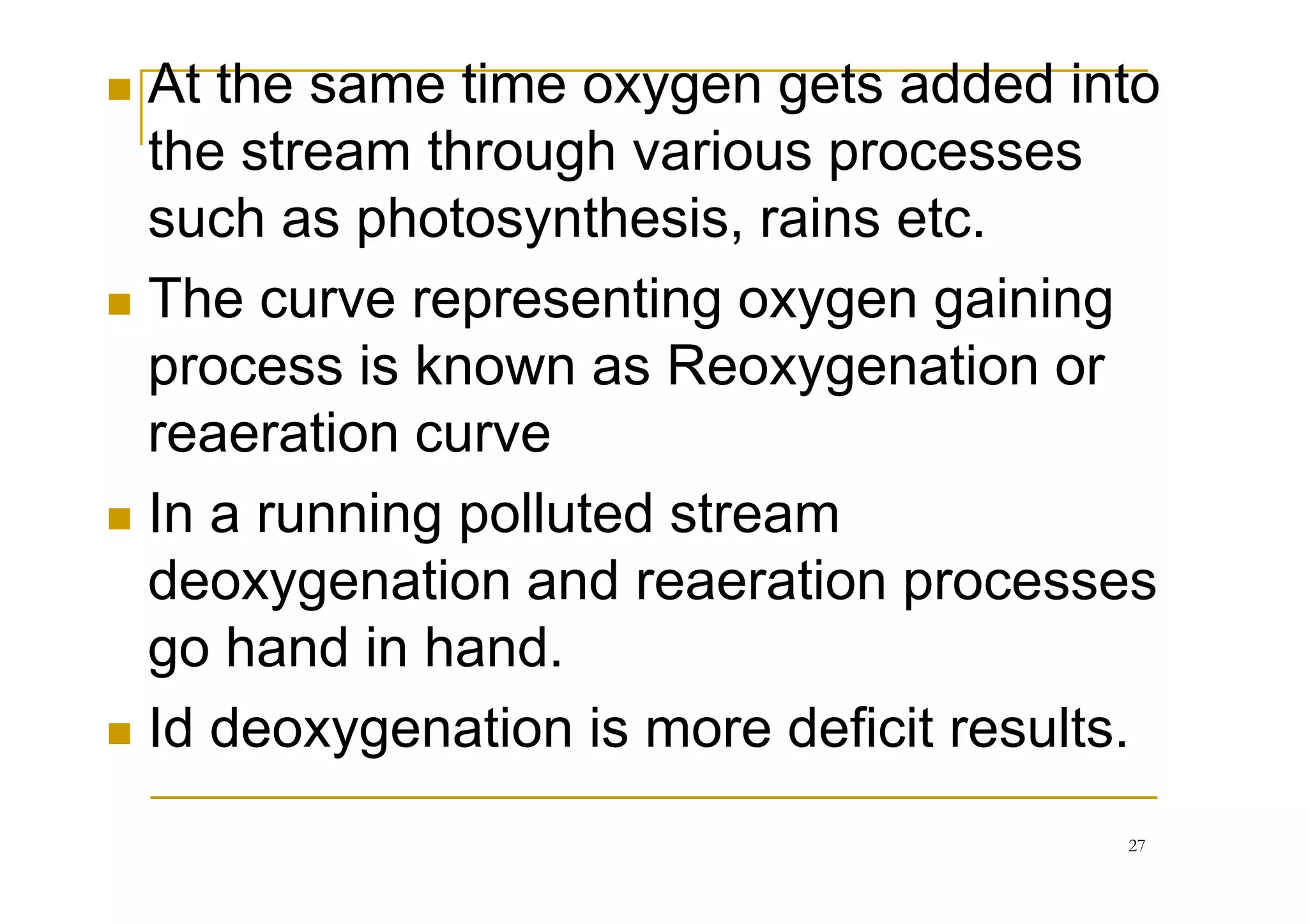
At the same time oxygen gets added into
the stream through various processes
such as photosynthesis, rains etc.
The curve representing oxygen gaining
process is known as Reoxygenation or
reaeration curvereaeration curve
In a running polluted stream
deoxygenation and reaeration processes
go hand in hand.
Id deoxygenation is more deficit results.
27
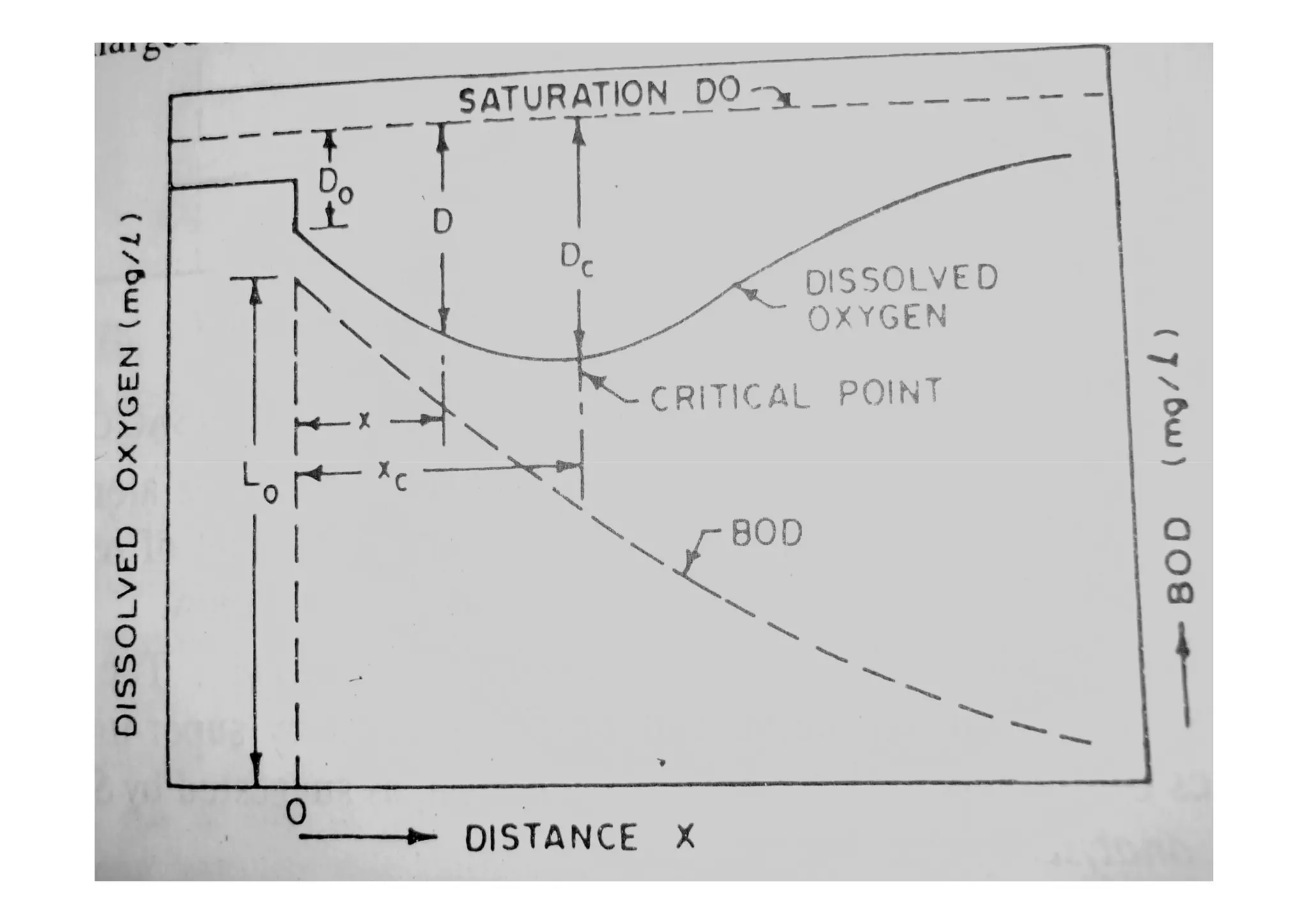
The amount of DO deficit can be obtained by
graphically adding both the curves. The
resultant curve is known as ‘DO sag curve’.
DO deficit is given by
DO deeficit = saturation DO – Actual DO
= DO sat - DO act= DO sat - DO act
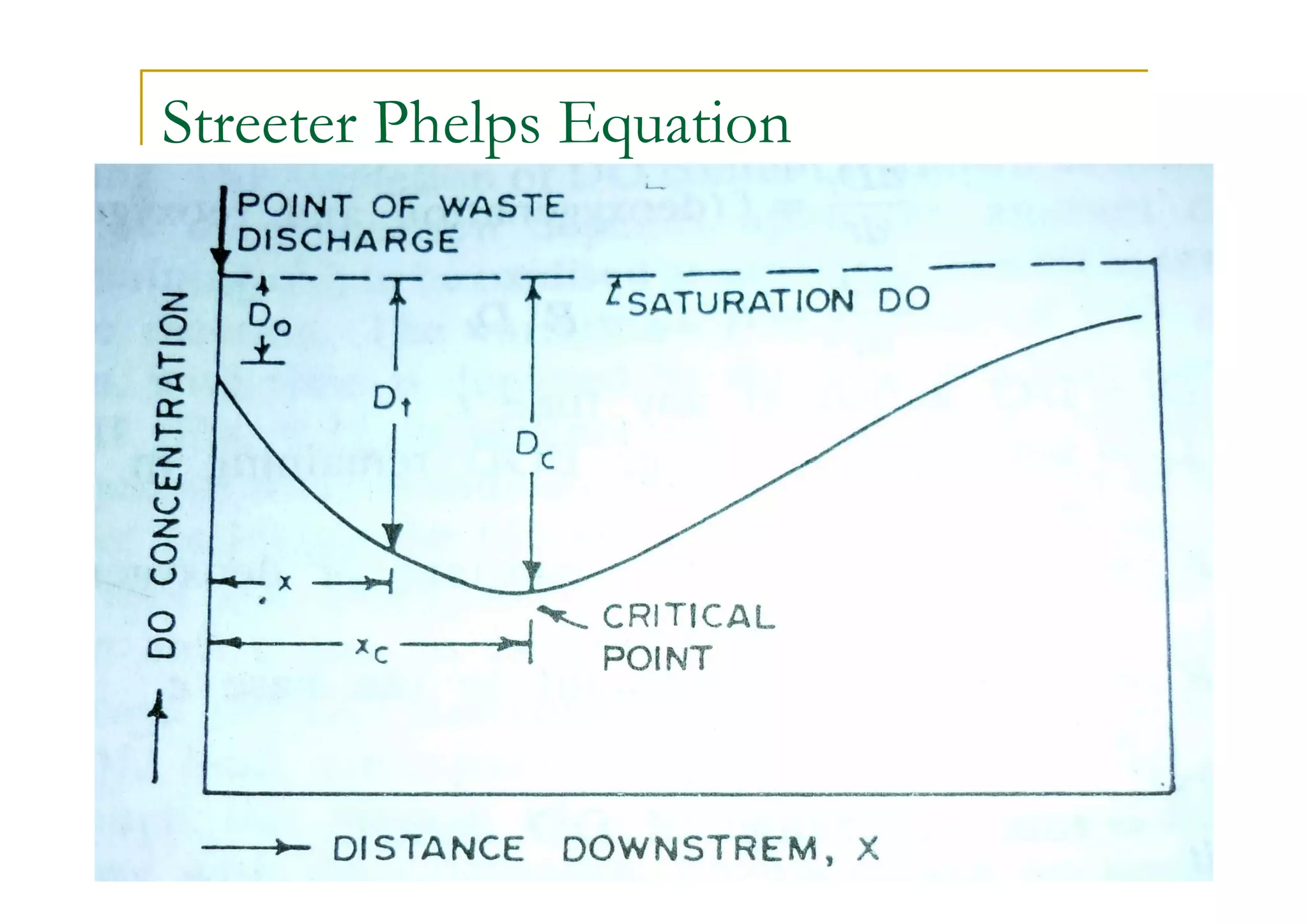
Streeter Phelps equation can be used for
analysis of DO sag curve
28
Deoxygenation and Reoxygenation curves
29
Streeter Phelps Equation
30
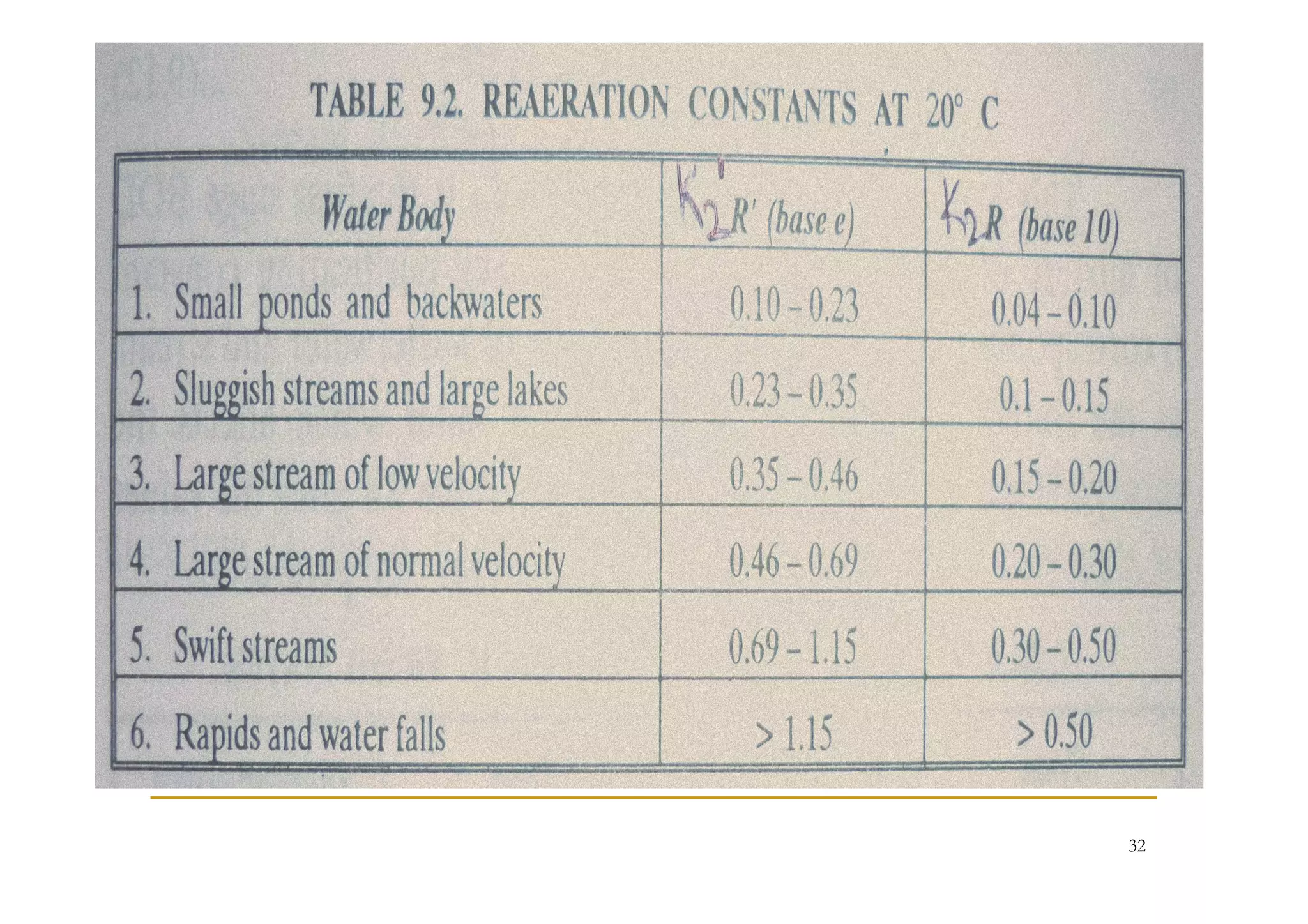
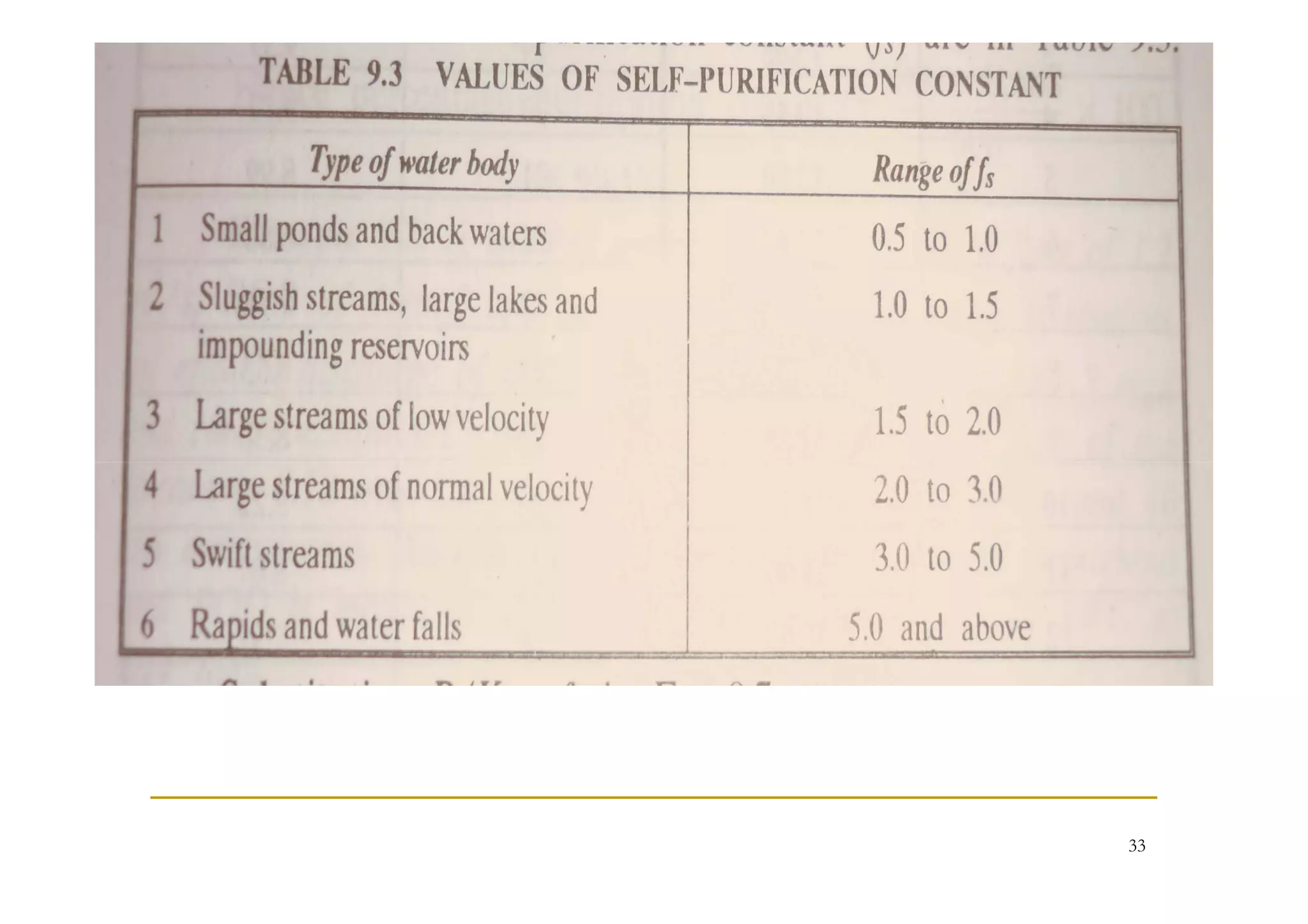
CLASSIFICATION OF
STREAMS
31
32
33
Objective questions
34
Theory questions
Q1. Explain self purification of stream process.
Q3. Write short notes on
1. Actions involved in self purification of stream.
2. Zones of pollution in the stream.
Streeter Phelps equation3. Streeter Phelps equation
4. DO sag curve
35

L 29 do sag and self purification of streams

  • 1.
    L-29 and L-30 SelfPurification of Streams and DO Sag CurveDO Sag Curve Environmental Engg-II Section –II starts 1
  • 2.
    Can you identifythe river (from India)? 2
  • 3.
  • 4.
    What is selfpurification of stream? When wastewater is discharged into the river or stream, the BOD of mix increases initially and DO level starts falling. As river water travels further BOD gradually reduces and DO increases and reaches its saturation level. Thus river gets purified on its own. This phenomena is known as self purification of stream 4
  • 5.
  • 6.
    Disposal by dilution Disposalby dilution is a process in which the treated wastewater from ETPs is discharged in a large static body of water or in moving water bodies such as rivers or streams. The discharged wastewater is purified in dueThe discharged wastewater is purified in due course of time, by the self purification process of natural waters. The effluent discharge and degree of treatment of wastewater depends upon the self purification capacity of the river and its intended water use 6
  • 7.
    Conditions favouring dilutionwithout treatment 1. Where wastewater is quite fresh. 2. SS have been removed from wastewater 3. Volume of receiving water body is more than the wastewater discharge Dilution water having high DO, to satisfy the4. Dilution water having high DO, to satisfy the BOD of wastewater 5. Where swift forward currents are available 6. Wastewater does not contain toxic substances 7. Water is not used for drinking immediately after point of discharge. 7
  • 8.
    Standards of dilution Dilutionfactor Standards of purification required Above 500 No treatment required. Raw sewage can be directly discharged into river Between 300 to 500 Primary treatment such as PST is required so that SS concentration is less than 150 mg/litthan 150 mg/lit Between 150 to 300 Treatment such as screening, sedimentation and chemical precipitation are required so that SS concentration is less than 50 mg/lit Less than 150 Thorough treatment is required SS should be less than 50 mg/lit and BOD 5 should be less than 20 mg/lit 8
  • 9.
    ACTIONS INVOLVED INSELF PURIFICATION OF STREAMS 9
  • 10.
    Qw, BODw, DOw Qr,BODr, DOr 1.Dilution :- 2. Combined BOD and DO determination for a stream Residents • Combined waste flow Qmix = Qr + Qw • Combined BOD Qmix, BODmix, DOmixQrBODr + QwBODw Q1 + Q2 BODmix = • Combined DO Qr.DOr + Qw.DOw Q1 + Q2 DOmix =
  • 11.
    2. Dispersion dueto currents Self purification largely depends upon currents, which readily disperses wastewater in the stream, preventing locally high concentration of pollutants. High velocity improves aeration whichHigh velocity improves aeration which reduces the concentration of pollutants. High velocity improves raeration which reduces the time of recovery, though length of stream affected by the wastewater is increased. 11
  • 12.
    3. Sedimentation If streamvelocity is lesser than the scour velocity of particles then sedimentation will takes place, which has two effects 1. SS contribute largely to BOD will be removed by settling and henceremoved by settling and hence downstream water quality will be improved. 2. Due to settled solids anaerobic decomposition may take place 12
  • 13.
    4. Oxidation The organicmatter present in the wastewater is oxidized by aerobic bacteria utilizing dissolved oxygen of the natural waters. This process continues till completeThis process continues till complete oxidation of organic matter takes place. The stream which is capable of absorbing more oxygen through reaeration etc can purify heavily polluted water in short time 13
  • 14.
    5. reduction Reduction occursin the stream due to hydrolysis of organic matter biologically or chemically. Anaerobic bacteria will split theAnaerobic bacteria will split the organic matter into liquids and gases, thus paving the way for stabilization by oxidation 14
  • 15.
    6. temperature At lowtemp activity of bacteria is low., and hence decomposition is slow., though DO will be more because increased solubility of oxygen in water.oxygen in water. At higher temperature purification will take lesser time though amount of DO is less in the water. 15
  • 16.
    7. Sunlight Sunlight helpscertain micro-organisms to absorb CO2 and give out oxygen, thus resulting in self purification. Sunlight acts as disinfectant and stimulates growth of algae which producesstimulates growth of algae which produces oxygen during photosynthesis. Hence wherever there is algal growth water contains more DO during daytime. 16
  • 17.
    ZONES OF POLLUTIONIN THE STREAM 17
  • 18.
    1. Zone ofdegradation Situated just below outfall sewer Water is dark and turbid with sludge at the bottom DO reduces up to 40% of saturation levelDO reduces up to 40% of saturation level CO2 content increases Rearation is slower than deoxygenation Conditions are unfavorable for aquatic life Anaerobic decomposition takes place in this zone 18
  • 19.
    2. Zone ofactive decomposition Water in this zone becomes greyish and darker than previous zone DO concentration falls to zero CH4, H2S, CO2 and N2 are presentCH4, H2S, CO2 and N2 are present because of anaerobic decomposition Fish life is absent but bacteria are present At the end of this zone DO rises to 40% of saturation Aquatic life starts to reappear. 19
  • 20.
    3. Zone ofrecovery Process of recovery starts Stabilization of organic matter takes place in this zone BOD falls and DO content increases above 40% valueabove 40% value NO4, SO4 and CO3 are formed. Near the end of this zone entire aquatic life reappears 20
  • 21.
    4. Clear waterzone Water becomes clearer and attractive in appearance DO rises to saturation level Oxygen balance is attainedOxygen balance is attained Recovery is complete Some pathogenic microorganisms may be present 21
  • 22.
  • 23.
  • 24.
  • 25.
  • 26.
    When pollutional loadis discharged into the stream, DO goes on reducing. This process is known as deoxygenation. It depends upon organic matter present and temperature.present and temperature. The variation or depletion of DO is represented graphically by deoxygenation curve. 26
  • 27.
    At the sametime oxygen gets added into the stream through various processes such as photosynthesis, rains etc. The curve representing oxygen gaining process is known as Reoxygenation or reaeration curvereaeration curve In a running polluted stream deoxygenation and reaeration processes go hand in hand. Id deoxygenation is more deficit results. 27
  • 28.
    The amount ofDO deficit can be obtained by graphically adding both the curves. The resultant curve is known as ‘DO sag curve’. DO deficit is given by DO deeficit = saturation DO – Actual DO = DO sat - DO act= DO sat - DO act Streeter Phelps equation can be used for analysis of DO sag curve 28
  • 29.
  • 30.
  • 31.
  • 32.
  • 33.
  • 34.
  • 35.
    Theory questions Q1. Explainself purification of stream process. Q3. Write short notes on 1. Actions involved in self purification of stream. 2. Zones of pollution in the stream. Streeter Phelps equation3. Streeter Phelps equation 4. DO sag curve 35