AIR POLLUTION
 Air pollution can be defined as the presence
of toxic chemicals or compounds (including
those of biological origin) in the air, at levels
that pose a health risk. In an even broader
sense, air pollution means the presence of
chemicals or compounds in the air which are
usually not present and which lower the
quality of the air or cause detrimental
changes to the quality of life (such as the
damaging of the ozone layer or causing
global warming).
 When you think of air pollution, you likely
think of human activities, such as coal-
burning plants and emissions from cars,
planes and boats. But, air pollution also
comes from natural sources. Volcanoes are a
great example of a natural pollution source;
they produce large amounts of particles and
gases, and the eruptions send them up into
the atmosphere. Forest fires are a natural
process that also produce large amounts of
potentially harmful gas and particulate
matter.
 A Factsheet is available for each of these
air pollutants:
 Carbon monoxide.
 Lead.
 Nitrogen dioxide.
 Ozone.
 Particles.
 Sulfur dioxide.
 1. Burning of Fossil Fuels: Sulfur dioxide
emitted from the combustion of fossil fuels
like coal, petroleum and other factory
combustibles is one the major cause of air
pollution.
 2. Agricultural activities: Ammonia is a very
common by product from agriculture related
activities and is one of the most hazardous
gases in the atmosphere. Use of insecticides,
pesticides and fertilizers in agricultural
activities has grown quite a lot
 3. Exhaust from factories and industries:
Manufacturing industries release large amount of
carbon monoxide, hydrocarbons, organic
compounds, and chemicals into the air thereby
depleting the quality of air.
 4. Mining operations: Mining is a process wherein
minerals below the earth are extracted using large
equipments. During the process dust and chemicals
are released in the air causing massive air pollution
 5. Indoor air pollution: Household cleaning
products, painting supplies emit toxic chemicals in
the air and cause air pollution. Have you ever
noticed that once you paint walls of your house, it
creates some sort of smell which makes it literally
impossible fo
 1. Respiratory and heart problems
 2. Global warming
 3. Acid Rain
 4. Eutrophication-Release of nitrogen in air
 5. Effect on Wildlife
 6. Depletion of Ozone layer
 Long-term health effects can include chronic
respiratory disease, lung cancer, heart
disease, and even damage to the brain,
nerves, liver, or kidneys. Continual exposure
to air pollution affects the lungs of growing
children and may aggravate or complicate
medical conditions in the elderly.
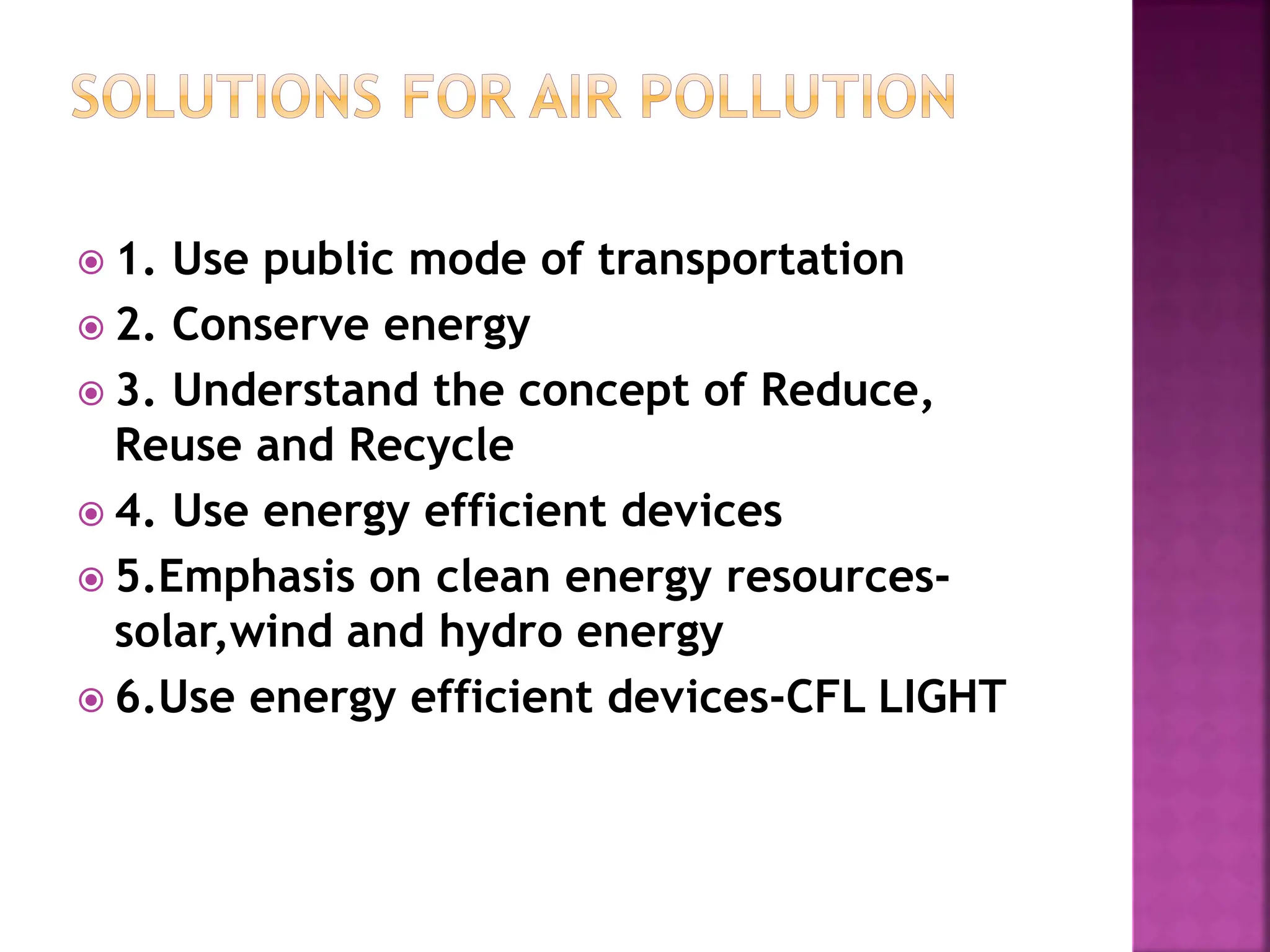
 1. Use public mode of transportation
 2. Conserve energy
 3. Understand the concept of Reduce,
Reuse and Recycle
 4. Use energy efficient devices
 5.Emphasis on clean energy resources-
solar,wind and hydro energy
 6.Use energy efficient devices-CFL LIGHT
 Ecological effects of air pollution can
include long-term changes in water quality,
soil chemistry, and plant species
composition, as well as bioaccumulation of
toxics in fish, birds, and wildlife. ... We use
this information to develop pollution
reduction goals for parks where ecosystems
are damaged.
next
 Water pollution is the contamination of
water bodies (e.g. lakes, rivers, oceans,
aquifers and groundwater). This form of
environmental degradation occurs when
pollutants are directly or indirectly
discharged into water bodies without
adequate treatment to remove harmful
compounds.
 Types of water pollution. There are many types
of water pollution because water comes from
many sources. ...
 Nutrients Pollution. Some wastewater, fertilizers
and sewage contain high levels of nutrients. ...
 Surface water pollution. ...
 Oxygen Depleting. ...
 Microbiological. ...
 Suspended Matter. ...
 Chemical Water Pollution. ...
 Oil Spillage.
 Industry is a huge source of water pollution,
it produces pollutants that are extremely
harmful to people and the environment.
Many industrial facilities use freshwater to
carry away waste from the plant and into
rivers, lakes and oceans.
 Groundwater can be contaminated through
various sources, some listed below:
 Pesticides
 Sewage
 Nutrients
 Synthetic Organics
 POLLUTION AND HOW IT AFFECTS WATER.
... Pollution of drinking water causes many
deaths and much illness among urban
residents all over the world. Particularly in
developing countries, urban water supplies
are often fouled with wastes, and clean
water is scarce.
 Some of these water-borne diseases are
Typhoid, Cholera, Paratyphoid Fever,
Dysentery, Jaundice, Amoebiasis and Malaria.
Chemicals in the water also have negative
effects on our health. Pesticides – can
damage the nervous system and cause cancer
because of the carbonates and
organophosphates that they contain
 Sewage treatments
 Prevent river water to get polluted
 Treatment of wastes before discharge
 Strict adherence to water laws
 Treatment of drainage water
 Treatment plants
 Keep the pond water clean and safe
 Routine cleaning
 Don’t pour insecticides in sinks and toilets
 Self hygiene
 Sanitation
 Public Awareness
next
 Noise pollution affects both health and
behavior. Unwanted sound (noise) can
damage psychological health. Noise
pollution can cause hypertension, high stress
levels, tinnitus, hearing loss, sleep
disturbances, and other harmful effects.
 Noise pollution means an unwanted or
undesirable sound that leads to physical and
mental problems. Noise pollution is
dependent on the loudness and frequency of
the sound. In fact, when the sound exceeds
its limit, it becomes fatal for human and
other organisms. The noise intensity is
measured in decibels or dB. A person can
bear the noise up to 85 decibels, after which
his hearing power can be damaged.
 Natural sources
 Human sources
 Vehicular Noise
 Industrial Noise
 Commercialisation of residential areas
 Domestic Noise
 Construction activities
 Political Activities
 Fireworks
 Loss of hearing and deafness
 Cardiac disturbance
 Sleeplessness
 Headache
 Stress, tension and aggressiveness
 Irregular blood pressure
 Mental imbalance and nervous debility
 Psychological imbalance
 Difficulty in talking
 Noise pollution may cause temporary or
permanent hearing impairment
 You cannot only be deaf but can also come in
the grip of deadly illnesses like impotence
and cancer, besides problems such as lack of
memory, concentration, and interruption in
speech, irritation, irritability, stress and
depression.
 The noise not only creates irritability, anger,
but also accelerates the heart rate by
increasing blood flow in the arteries
 Health experts believe that rising noise gives
rise to neurological disease, nervous
breakdown, hypertension, vision, dizziness,
excessive sweating, exhaustion
 As rapid noise hinders sleep, insomnia has
adverse effects on human functioning
 The sound effects of noise pollution caused
by nuclear explosions spread through
hundreds of kilometres so that biodiversity is
threatened.
 To prevent and control noise pollution it is
necessary to create public awareness.
 People should be made aware that excessive
noise beyond certain limits may cause
deafness.
 They should know that injuries caused by
sound pollution are often irreversible.
 There should be minimum use of sound
producing instruments.
 The Pollution Control Board and the High
Court have already taken effective measures
to bring sound pollution under control.
 Anti-pollution laws should be enacted and
enforced.
 Ban of fire crackers should be imposed and
electric horns should be replaced by bulb
horns.
 The use of microphones should be controlled
and regulated.
next
 Land pollution is the deterioration
(destruction) of the earth’s land surfaces,
often directly or indirectly as a result of
man’s activities and their misuse of land
resources.
It occurs when waste is not disposed of
properly, or can occur when humans throw
chemicals onto the soil in the form of
pesticides, insecticides and fertilizers during
agricultural practices. Exploitation of
minerals (mining activities) has also
contributed to the destruction of the earth’s
surface.
 Litter found on the side of the road.
 Illegal dumping in natural habitats.
 Oil spills that happen inland.
 The use of pesticides and other farming
chemicals.
 Damage and debris caused from
unsustainable mining and logging practices.
 Radiation spills or nuclear accidents.
 Deforestation and soil erosion
 Agricultural activities
 Mining activities
 Overcrowded landfills
 Industrialization
 Construction activities
 Nuclear waste
 Sewage treatment
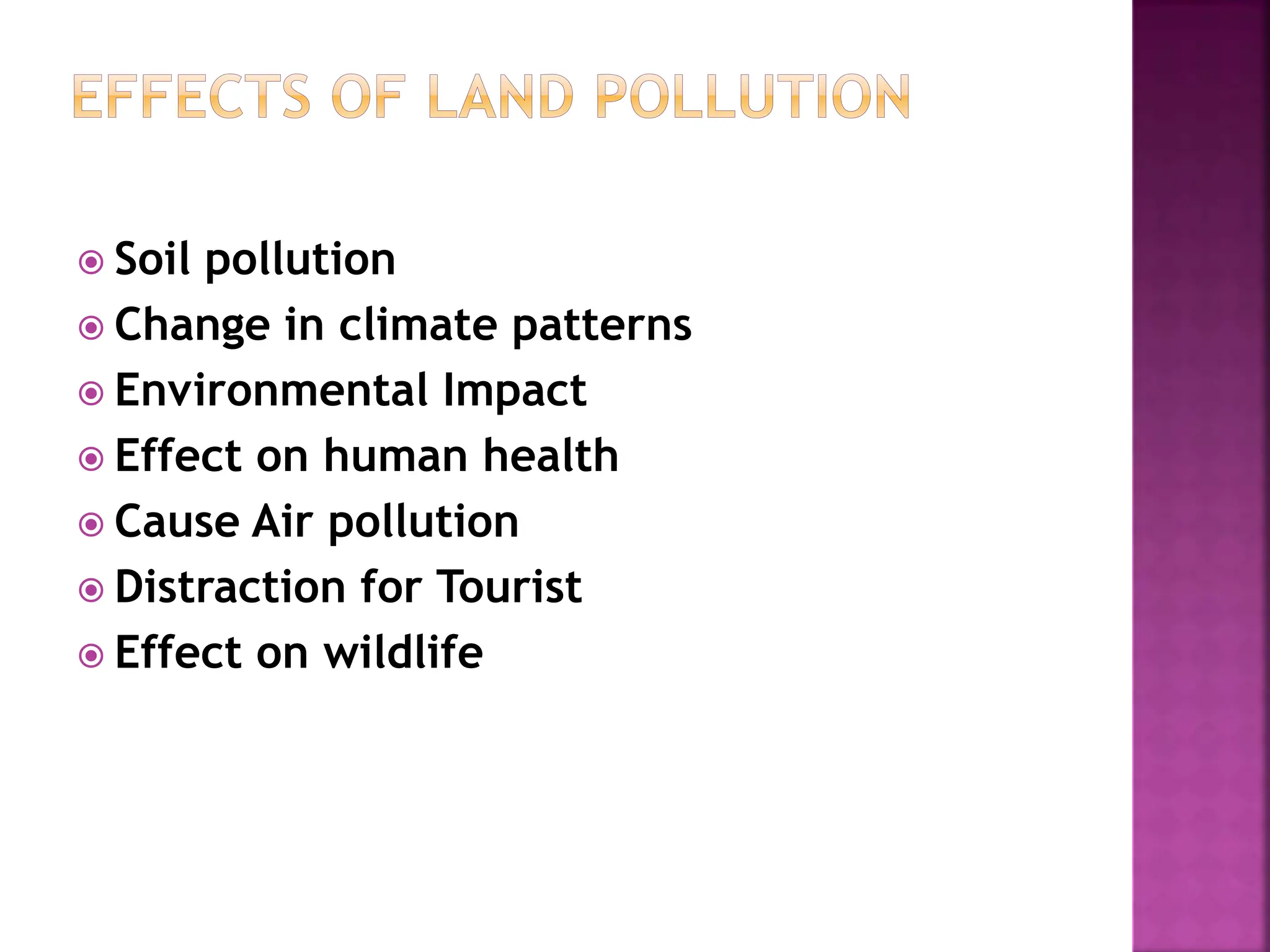
 Soil pollution
 Change in climate patterns
 Environmental Impact
 Effect on human health
 Cause Air pollution
 Distraction for Tourist
 Effect on wildlife
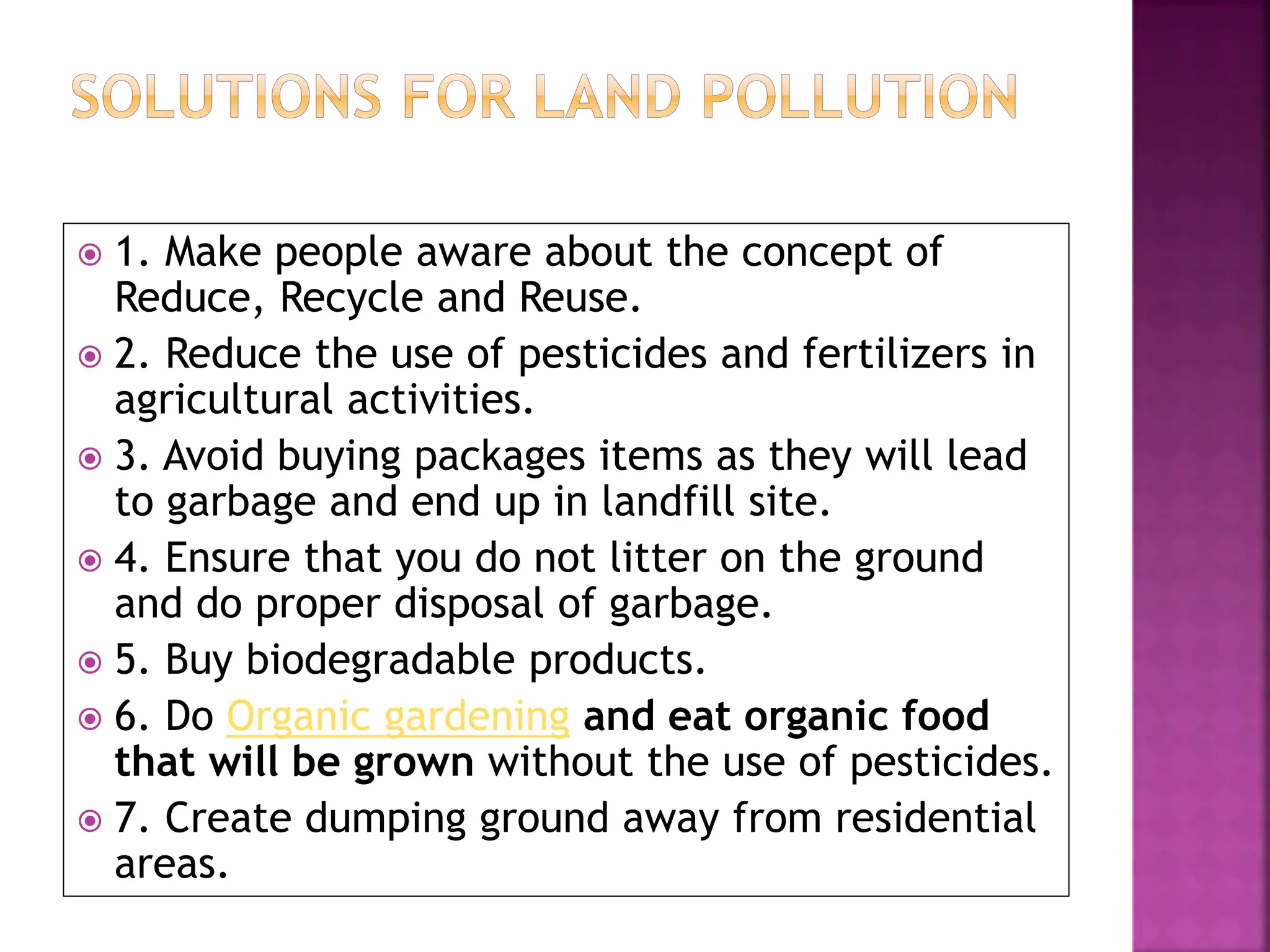
 1. Make people aware about the concept of
Reduce, Recycle and Reuse.
 2. Reduce the use of pesticides and fertilizers in
agricultural activities.
 3. Avoid buying packages items as they will lead
to garbage and end up in landfill site.
 4. Ensure that you do not litter on the ground
and do proper disposal of garbage.
 5. Buy biodegradable products.
 6. Do Organic gardening and eat organic food
that will be grown without the use of pesticides.
 7. Create dumping ground away from residential
areas.
next
 Solid waste management is a term that is
used to refer to the process of collecting and
treating solid wastes. It also offers solutions
for recycling items that do not belong to
garbage or trash. As long as people have
been living in settlements and residential
areas, garbage or solid waste has been an
issue.
 According to Britannica, “Solid-waste
management, the collecting, treating, and
disposing of solid material that is discarded
because it has served its purpose or is no
longer useful. Improper disposal of
municipal solid waste can create unsanitary
conditions, and these conditions in turn can
lead to pollution of the environment and to
outbreaks of vector-borne disease—that is,
diseases spread by rodents and insects.”
 Anaerobic digestion.
 Biodegradation.
 Composting.
 Garden waste dumping.
 Illegal dumping.
 Incineration.
 Landfill.
 Landfill mining.
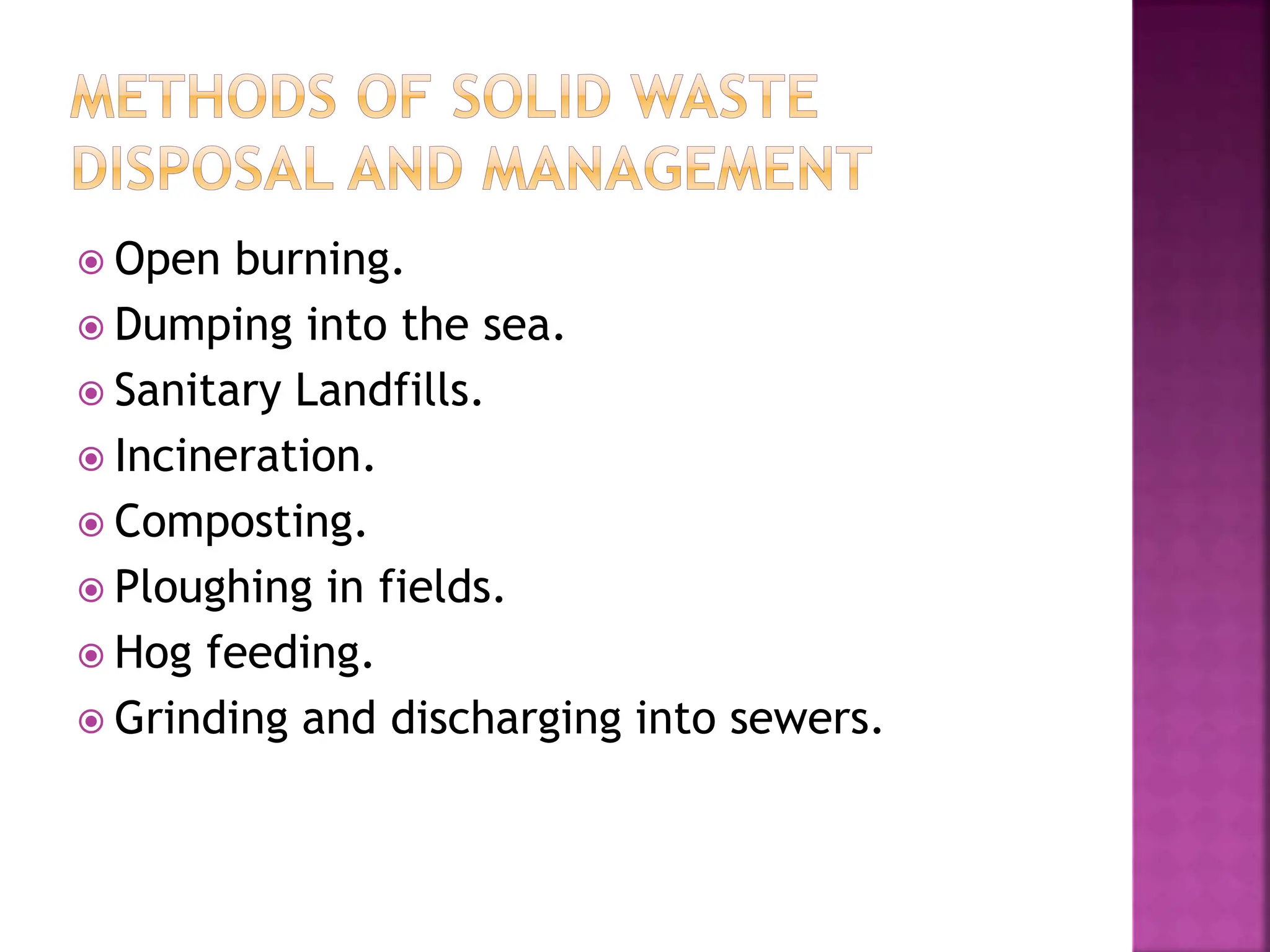
 Open burning.
 Dumping into the sea.
 Sanitary Landfills.
 Incineration.
 Composting.
 Ploughing in fields.
 Hog feeding.
 Grinding and discharging into sewers.
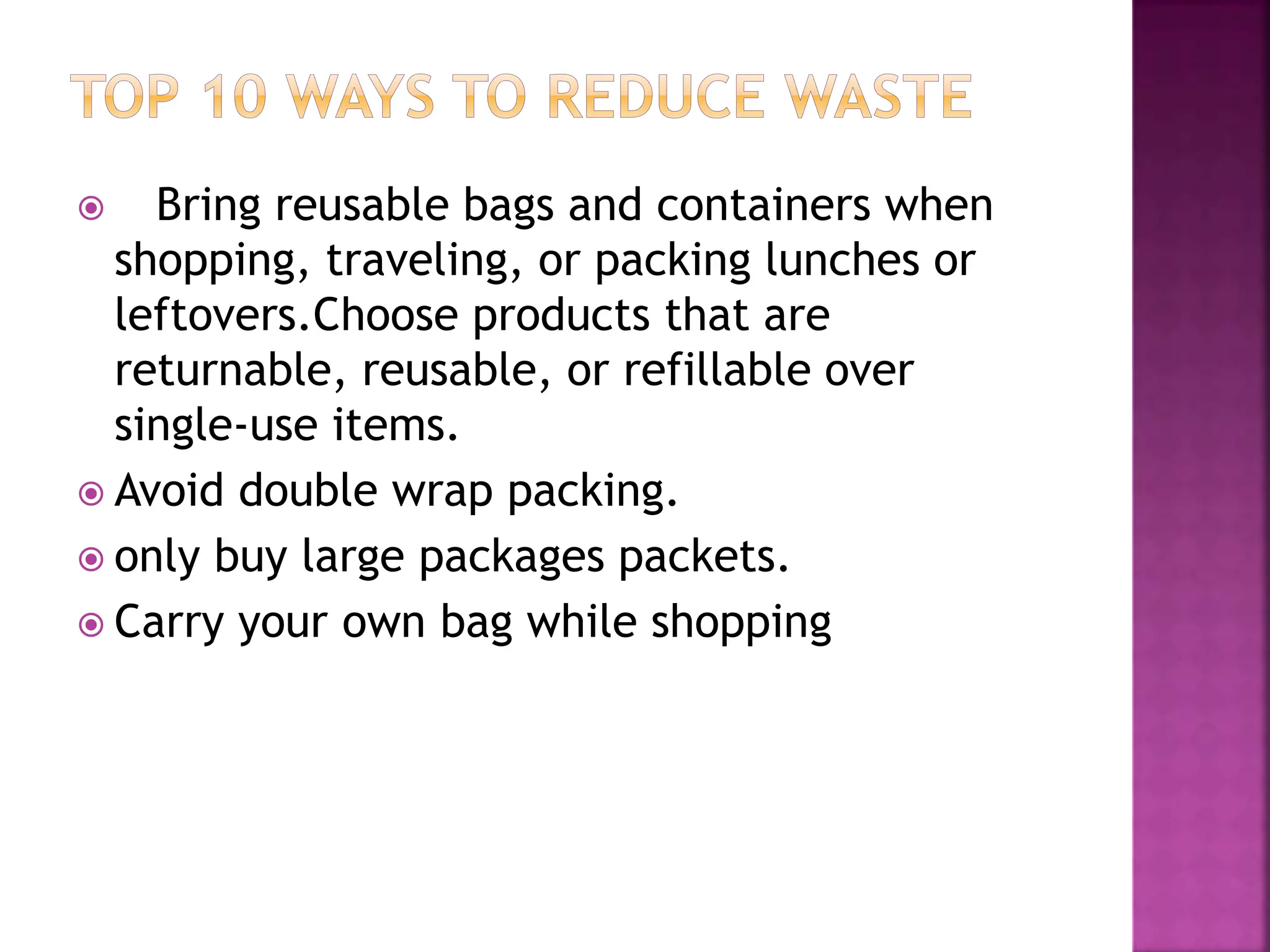
 Bring reusable bags and containers when
shopping, traveling, or packing lunches or
leftovers.Choose products that are
returnable, reusable, or refillable over
single-use items.
 Avoid double wrap packing.
 only buy large packages packets.
 Carry your own bag while shopping
 Compost food scraps and yard waste
 Shop at second-hand stores
 Buy items made of recycled content, and use
and reuse them as much as you can.
 Also, remember that buying in bulk rather
than individual packages will save you lots of
money and reduce waste
next
 Electronic waste" or "E-Waste" may be
defined as discarded computers, office
electronic equipment, entertainment device
electronics, mobile phones, television sets,
and refrigerators. This includes used
electronics which are destined for reuse,
resale, salvage, recycling, or disposal.
 Electronic devices are a complex mixture of
several hundred materials. A mobile phone,
for example, contains 500 to 1,000
components. Many of these contain toxic
heavy metals such as lead, mercury,
cadmium and beryllium, as well as hazardous
chemicals, such as brominated flame
retardants. Polluting PVC plastic is also
frequently used.
 We make a lot of e-waste. When electronics
end up in landfills, toxics like lead, mercury,
and cadmium leach into the soil and water.
The electronic waste problem is huge: More
than 20 million tons of e-waste are produced
every ye
 Effects of e-waste on Environment Through
Landfills. When we throw out our computers,
they wind up in landfills, causing the
possibility of toxic metal leaching into the
groundwater. Toxic metals in e-waste leach
into our supply of resources, threatening
their integrity.
 Recycling is very important as waste has a
huge negative impact on the natural
environment. Harmful chemicals and
greenhouse gasses are released from rubbish
in landfill sites. Recycling helps to reduce
the pollution caused by waste. Habitat
destruction and global warming are some the
affects caused by deforestation.
NEXT
 Recycling saves energy because the
manufacturer doesn't have to produce
something new from raw natural resources.
By using recycled materials we save on
energy consumption, which keeps production
costs down. Recycling reduces the need for
more landfills. No one wants to live next to a
landfill.
 E-waste is a serious environmental problem,
from toxic chemicals and heavy metals
leaching into soils in landfills, to the
pollution to air and water supplies caused
through improper recycling techniques in
developing countries.
 Public health refers to "the science and art
of preventing disease, prolonging life and
promoting human health through organized
efforts and informed choices of society,
organizations, public and private,
communities and individuals."
 Public health programs help keep people
alive. These programs have led to...
increased life expectancies.
 worldwide reductions in infant and child
mortality.
 eradication or reduction of many
communicable diseases.
 Alcohol-related harms
 Food safety
 Healthcare-associated infections
 Heart disease and stroke
 HIV
 Motor vehicle injury
 Nutrition, physical activity and obesity
 Prescription drug overdose
 Teen pregnancy
 Tobacco use
 The work of public health professionals is
important because public health initiatives
affect people every day in every part of the
world. It addresses broad issues that can
affect the health and well-being of
individuals, families, communities,
populations, and societies—both now, and for
generations to come.
 Public health professionals use knowledge
of the interrelation of social, behavioral,
legal, medical, and economic issues. They
work with complex health issues within
communities to protect and improve health
for local, national, and global populations.

air pollution.pptx which has 56 slides maximum

  • 1.
  • 2.
     Air pollutioncan be defined as the presence of toxic chemicals or compounds (including those of biological origin) in the air, at levels that pose a health risk. In an even broader sense, air pollution means the presence of chemicals or compounds in the air which are usually not present and which lower the quality of the air or cause detrimental changes to the quality of life (such as the damaging of the ozone layer or causing global warming).
  • 3.
     When youthink of air pollution, you likely think of human activities, such as coal- burning plants and emissions from cars, planes and boats. But, air pollution also comes from natural sources. Volcanoes are a great example of a natural pollution source; they produce large amounts of particles and gases, and the eruptions send them up into the atmosphere. Forest fires are a natural process that also produce large amounts of potentially harmful gas and particulate matter.
  • 4.
     A Factsheetis available for each of these air pollutants:  Carbon monoxide.  Lead.  Nitrogen dioxide.  Ozone.  Particles.  Sulfur dioxide.
  • 5.
     1. Burningof Fossil Fuels: Sulfur dioxide emitted from the combustion of fossil fuels like coal, petroleum and other factory combustibles is one the major cause of air pollution.  2. Agricultural activities: Ammonia is a very common by product from agriculture related activities and is one of the most hazardous gases in the atmosphere. Use of insecticides, pesticides and fertilizers in agricultural activities has grown quite a lot
  • 6.
     3. Exhaustfrom factories and industries: Manufacturing industries release large amount of carbon monoxide, hydrocarbons, organic compounds, and chemicals into the air thereby depleting the quality of air.  4. Mining operations: Mining is a process wherein minerals below the earth are extracted using large equipments. During the process dust and chemicals are released in the air causing massive air pollution
  • 7.
     5. Indoorair pollution: Household cleaning products, painting supplies emit toxic chemicals in the air and cause air pollution. Have you ever noticed that once you paint walls of your house, it creates some sort of smell which makes it literally impossible fo
  • 8.
     1. Respiratoryand heart problems  2. Global warming  3. Acid Rain  4. Eutrophication-Release of nitrogen in air  5. Effect on Wildlife  6. Depletion of Ozone layer
  • 9.
     Long-term healtheffects can include chronic respiratory disease, lung cancer, heart disease, and even damage to the brain, nerves, liver, or kidneys. Continual exposure to air pollution affects the lungs of growing children and may aggravate or complicate medical conditions in the elderly.
  • 10.
     1. Usepublic mode of transportation  2. Conserve energy  3. Understand the concept of Reduce, Reuse and Recycle  4. Use energy efficient devices  5.Emphasis on clean energy resources- solar,wind and hydro energy  6.Use energy efficient devices-CFL LIGHT
  • 11.
     Ecological effectsof air pollution can include long-term changes in water quality, soil chemistry, and plant species composition, as well as bioaccumulation of toxics in fish, birds, and wildlife. ... We use this information to develop pollution reduction goals for parks where ecosystems are damaged.
  • 12.
  • 13.
     Water pollutionis the contamination of water bodies (e.g. lakes, rivers, oceans, aquifers and groundwater). This form of environmental degradation occurs when pollutants are directly or indirectly discharged into water bodies without adequate treatment to remove harmful compounds.
  • 14.
     Types ofwater pollution. There are many types of water pollution because water comes from many sources. ...  Nutrients Pollution. Some wastewater, fertilizers and sewage contain high levels of nutrients. ...  Surface water pollution. ...  Oxygen Depleting. ...  Microbiological. ...  Suspended Matter. ...  Chemical Water Pollution. ...  Oil Spillage.
  • 15.
     Industry isa huge source of water pollution, it produces pollutants that are extremely harmful to people and the environment. Many industrial facilities use freshwater to carry away waste from the plant and into rivers, lakes and oceans.
  • 16.
     Groundwater canbe contaminated through various sources, some listed below:  Pesticides  Sewage  Nutrients  Synthetic Organics
  • 17.
     POLLUTION ANDHOW IT AFFECTS WATER. ... Pollution of drinking water causes many deaths and much illness among urban residents all over the world. Particularly in developing countries, urban water supplies are often fouled with wastes, and clean water is scarce.
  • 18.
     Some ofthese water-borne diseases are Typhoid, Cholera, Paratyphoid Fever, Dysentery, Jaundice, Amoebiasis and Malaria. Chemicals in the water also have negative effects on our health. Pesticides – can damage the nervous system and cause cancer because of the carbonates and organophosphates that they contain
  • 19.
     Sewage treatments Prevent river water to get polluted  Treatment of wastes before discharge  Strict adherence to water laws  Treatment of drainage water  Treatment plants  Keep the pond water clean and safe  Routine cleaning  Don’t pour insecticides in sinks and toilets
  • 20.
     Self hygiene Sanitation  Public Awareness
  • 21.
  • 22.
     Noise pollutionaffects both health and behavior. Unwanted sound (noise) can damage psychological health. Noise pollution can cause hypertension, high stress levels, tinnitus, hearing loss, sleep disturbances, and other harmful effects.
  • 23.
     Noise pollutionmeans an unwanted or undesirable sound that leads to physical and mental problems. Noise pollution is dependent on the loudness and frequency of the sound. In fact, when the sound exceeds its limit, it becomes fatal for human and other organisms. The noise intensity is measured in decibels or dB. A person can bear the noise up to 85 decibels, after which his hearing power can be damaged.
  • 24.
     Natural sources Human sources  Vehicular Noise  Industrial Noise  Commercialisation of residential areas  Domestic Noise  Construction activities  Political Activities  Fireworks
  • 25.
     Loss ofhearing and deafness  Cardiac disturbance  Sleeplessness  Headache  Stress, tension and aggressiveness  Irregular blood pressure  Mental imbalance and nervous debility  Psychological imbalance  Difficulty in talking
  • 26.
     Noise pollutionmay cause temporary or permanent hearing impairment  You cannot only be deaf but can also come in the grip of deadly illnesses like impotence and cancer, besides problems such as lack of memory, concentration, and interruption in speech, irritation, irritability, stress and depression.  The noise not only creates irritability, anger, but also accelerates the heart rate by increasing blood flow in the arteries
  • 27.
     Health expertsbelieve that rising noise gives rise to neurological disease, nervous breakdown, hypertension, vision, dizziness, excessive sweating, exhaustion  As rapid noise hinders sleep, insomnia has adverse effects on human functioning  The sound effects of noise pollution caused by nuclear explosions spread through hundreds of kilometres so that biodiversity is threatened.
  • 28.
     To preventand control noise pollution it is necessary to create public awareness.  People should be made aware that excessive noise beyond certain limits may cause deafness.  They should know that injuries caused by sound pollution are often irreversible.  There should be minimum use of sound producing instruments.  The Pollution Control Board and the High Court have already taken effective measures to bring sound pollution under control.
  • 29.
     Anti-pollution lawsshould be enacted and enforced.  Ban of fire crackers should be imposed and electric horns should be replaced by bulb horns.  The use of microphones should be controlled and regulated.
  • 30.
  • 31.
     Land pollutionis the deterioration (destruction) of the earth’s land surfaces, often directly or indirectly as a result of man’s activities and their misuse of land resources. It occurs when waste is not disposed of properly, or can occur when humans throw chemicals onto the soil in the form of pesticides, insecticides and fertilizers during agricultural practices. Exploitation of minerals (mining activities) has also contributed to the destruction of the earth’s surface.
  • 32.
     Litter foundon the side of the road.  Illegal dumping in natural habitats.  Oil spills that happen inland.  The use of pesticides and other farming chemicals.  Damage and debris caused from unsustainable mining and logging practices.  Radiation spills or nuclear accidents.
  • 33.
     Deforestation andsoil erosion  Agricultural activities  Mining activities  Overcrowded landfills  Industrialization  Construction activities  Nuclear waste  Sewage treatment
  • 34.
     Soil pollution Change in climate patterns  Environmental Impact  Effect on human health  Cause Air pollution  Distraction for Tourist  Effect on wildlife
  • 35.
     1. Makepeople aware about the concept of Reduce, Recycle and Reuse.  2. Reduce the use of pesticides and fertilizers in agricultural activities.  3. Avoid buying packages items as they will lead to garbage and end up in landfill site.  4. Ensure that you do not litter on the ground and do proper disposal of garbage.  5. Buy biodegradable products.  6. Do Organic gardening and eat organic food that will be grown without the use of pesticides.  7. Create dumping ground away from residential areas.
  • 36.
  • 37.
     Solid wastemanagement is a term that is used to refer to the process of collecting and treating solid wastes. It also offers solutions for recycling items that do not belong to garbage or trash. As long as people have been living in settlements and residential areas, garbage or solid waste has been an issue.
  • 38.
     According toBritannica, “Solid-waste management, the collecting, treating, and disposing of solid material that is discarded because it has served its purpose or is no longer useful. Improper disposal of municipal solid waste can create unsanitary conditions, and these conditions in turn can lead to pollution of the environment and to outbreaks of vector-borne disease—that is, diseases spread by rodents and insects.”
  • 39.
     Anaerobic digestion. Biodegradation.  Composting.  Garden waste dumping.  Illegal dumping.  Incineration.  Landfill.  Landfill mining.
  • 40.
     Open burning. Dumping into the sea.  Sanitary Landfills.  Incineration.  Composting.  Ploughing in fields.  Hog feeding.  Grinding and discharging into sewers.
  • 41.
     Bring reusablebags and containers when shopping, traveling, or packing lunches or leftovers.Choose products that are returnable, reusable, or refillable over single-use items.  Avoid double wrap packing.  only buy large packages packets.  Carry your own bag while shopping
  • 42.
     Compost foodscraps and yard waste  Shop at second-hand stores  Buy items made of recycled content, and use and reuse them as much as you can.  Also, remember that buying in bulk rather than individual packages will save you lots of money and reduce waste
  • 43.
  • 44.
     Electronic waste"or "E-Waste" may be defined as discarded computers, office electronic equipment, entertainment device electronics, mobile phones, television sets, and refrigerators. This includes used electronics which are destined for reuse, resale, salvage, recycling, or disposal.
  • 45.
     Electronic devicesare a complex mixture of several hundred materials. A mobile phone, for example, contains 500 to 1,000 components. Many of these contain toxic heavy metals such as lead, mercury, cadmium and beryllium, as well as hazardous chemicals, such as brominated flame retardants. Polluting PVC plastic is also frequently used.
  • 46.
     We makea lot of e-waste. When electronics end up in landfills, toxics like lead, mercury, and cadmium leach into the soil and water. The electronic waste problem is huge: More than 20 million tons of e-waste are produced every ye
  • 47.
     Effects ofe-waste on Environment Through Landfills. When we throw out our computers, they wind up in landfills, causing the possibility of toxic metal leaching into the groundwater. Toxic metals in e-waste leach into our supply of resources, threatening their integrity.
  • 48.
     Recycling isvery important as waste has a huge negative impact on the natural environment. Harmful chemicals and greenhouse gasses are released from rubbish in landfill sites. Recycling helps to reduce the pollution caused by waste. Habitat destruction and global warming are some the affects caused by deforestation.
  • 49.
  • 50.
     Recycling savesenergy because the manufacturer doesn't have to produce something new from raw natural resources. By using recycled materials we save on energy consumption, which keeps production costs down. Recycling reduces the need for more landfills. No one wants to live next to a landfill.
  • 51.
     E-waste isa serious environmental problem, from toxic chemicals and heavy metals leaching into soils in landfills, to the pollution to air and water supplies caused through improper recycling techniques in developing countries.
  • 52.
     Public healthrefers to "the science and art of preventing disease, prolonging life and promoting human health through organized efforts and informed choices of society, organizations, public and private, communities and individuals."
  • 53.
     Public healthprograms help keep people alive. These programs have led to... increased life expectancies.  worldwide reductions in infant and child mortality.  eradication or reduction of many communicable diseases.
  • 54.
     Alcohol-related harms Food safety  Healthcare-associated infections  Heart disease and stroke  HIV  Motor vehicle injury  Nutrition, physical activity and obesity  Prescription drug overdose  Teen pregnancy  Tobacco use
  • 55.
     The workof public health professionals is important because public health initiatives affect people every day in every part of the world. It addresses broad issues that can affect the health and well-being of individuals, families, communities, populations, and societies—both now, and for generations to come.
  • 56.
     Public healthprofessionals use knowledge of the interrelation of social, behavioral, legal, medical, and economic issues. They work with complex health issues within communities to protect and improve health for local, national, and global populations.