Wastewater Treatment; Coagulation &
Flocculation
Md. Jamilur Rahman
Tasnina Karim
Maliha Tabassum
1/23/2018 1
outline
• Introduction
• Coagulation Mechanism
• Flocculation Mechanism
1/23/2018 2
Introduction
Why need coagulation flocculation in wastewater treatment?
• Removal of colloidal substances from water
• Potable water requirements (health, aesthetics, economic)
• Colloids
• Size of colloids - light waves
• Brownian motion
• Stability of colloids
1/23/2018 3
Coagulation
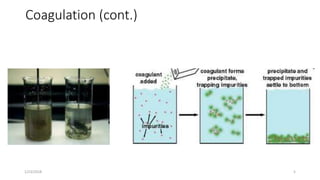
• Definition
Destabilisation of colloid particles by the
addition of chemicals.
• Applications
Industrial waste containing colloidal and
suspended solids
Source: Bioremediation of Turbid Surface Water Using Seed Extract from
Moringa Oleifera Lam, (Drumstick) Tree. In: Current Protocols in
Microbiology
1/23/2018 4
Coagulation (cont.)
1/23/2018 5
Coagulant
• Metal coagulants
aluminum-based coagulants, Ferro-based coagulants magnesium chloride (MgCl2)
• Organic polymer coagulants
Polyacrylamide, Chitosan, Moringa olifeira Alginates (brown seaweed extracts)
Source: Bioremediation of Turbid Surface Water Using Seed Extract from Moringa Oleifera Lam, (Drumstick) Tree. In: Current Protocols in
Microbiology
1/23/2018 6
Coagulant (Cont.)
Other Coagulants
• Lime
• Sodium Aluminate
• Aluminum Chloride
• Chromic Chloride
• Titanium Tetrachloride
Source: Coagulation and Flocculation in Water Treatment J(Hans) van Leeuwen
1/23/2018 7
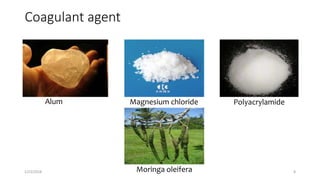
Coagulant agent
Alum Magnesium chloride Polyacrylamide
Moringa oleifera1/23/2018 8
Chemical Formula
PRIMARY COAGULANT
o Aluminum sulfate (Alum) Al2(SO4)3
o Ferrous sulfate FeSO4
o Ferric sulfate Fe2(SO4)3
o Ferric chloride FeCl3
Source: Coagulation and Flocculation in Water Treatment J(Hans) van Leeuwen
1/23/2018 9
ALUM
• Alum can be bought in liquid form with a concentration of 8.3%, or in dry form
with a concentration of 17%.
• It reacts with the water and results in positively charged ions.
Source: COAGULATION IN WASTEWATER TREATMENT BY GARRET P. WESTERHOFF
1/23/2018 10
Advantages & Disadvantages of Alum
ADVANTAGES
• It readily dissolves with water,
• It does not cause the unsightly reddish
brown staining of floors, walls and
equipment like ferric-sulphate
Source: COAGULATION IN WASTEWATER TREATMENT BY GARRET P.
WESTERHOFF
DISADVANTAGES
• It is effective only at certain pH
range
• good flocculation may not be
possible with alum in some waters
1/23/2018 11
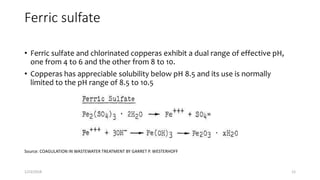
Ferric sulfate
• Ferric sulfate and chlorinated copperas exhibit a dual range of effective pH,
one from 4 to 6 and the other from 8 to 10.
• Copperas has appreciable solubility below pH 8.5 and its use is normally
limited to the pH range of 8.5 to 10.5
Source: COAGULATION IN WASTEWATER TREATMENT BY GARRET P. WESTERHOFF
1/23/2018 12
Advantages of Ferrous sulphate
• Ferric hydroxide is formed at low pH values, so that coagulation is possible
with ferric sulphate at pH values as low as 4.0
• Ferric hydroxide is insoluble over a wide range of pH values than aluminum
hydroxide except for the zone of 7.0 to 8.5
• The floc formed with ferric coagulants is heavier than alum floc
• The ferric hydroxide floc does not dissolve at high pH values
• Ferric coagulants may be used in color removal at the high pH values required
for the removal of iron and manganese and in softening of water.
Source: CHEMICAL CLARIFICATION – COAGULATION METHODS by Michigan Department of Environmental Quality Operator Training and
Certification Unit
1/23/2018 13
Coagulant Aids
• Accelerates the process of coagulation and flocculation by producing quick
forming, dense and rapid-settling flocs
• Coagulant aids when added increase the density to slow-settling flocs and
toughness to the flocs so that they will not break up during the mixing and
settling processes.
Source: lecture- HAZARDOUS WASTE TREATMENT TECHNOLOGIES
1/23/2018 14
Common Coagulant Aid
• Activated silica
• Polymer
• Polyelectrolytes
• Calcium carbonate
Source: wastewater management lecture 12- Coagulation and Flocculation
1/23/2018 15
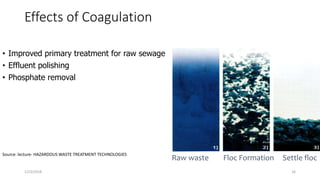
Effects of Coagulation
• Improved primary treatment for raw sewage
• Effluent polishing
• Phosphate removal
Source: lecture- HAZARDOUS WASTE TREATMENT TECHNOLOGIES
Raw waste Floc Formation Settle floc
1/23/2018 16
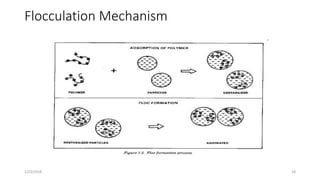
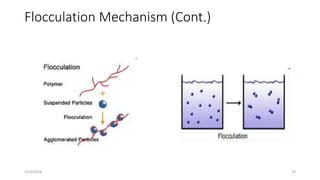
Flocculation
Forming aggregate of flocs to form larger settle able particle.
The process can be described as follows;
• Mutual collision of small floc resulting in bigger size.
• Usually slow speed or gentle mixing is used so as not to break the large
flocs due to shear.
• Polymer or large molecular wt. compound is added to enhance floc build
up. Most of them are proprietary chemicals
Source: WHO (1996): Coagulation Flocculation and Clarification. In: Fact Sheet on Environmental Sanitation. ABU HASSAN, M.A, LI, T.P.; NOOR,
Z.Z. (2009)
1/23/2018 17
Flocculation Mechanism
1/23/2018 18
Flocculation Mechanism (Cont.)
1/23/2018 19
Effects of Flocculation
The benefits of flocculation are:
• To improve settling of particles in sedimentation tank
• To increase removal of suspended solids and BOD
• To improve performance of settling tanks
Source: Coagulation and Flocculation of Wastewater in Textile Industry using Chitosan. In: Journal of Chemical and Natural Resources
Engineering 4, 43-53. APOSTOL, G.; KOUACHI, R.; CONSTANTINESCU, I. (2011)
1/23/2018 20
Differences
• Coagulation: is a chemical technique which is
directed towards the destabilization of the
charged colloidal particles.
• Flocculation: is the slow mixing technique which
promotes the agglomeration of the stabilized
particles.
Source: Coagulation and Flocculation of Wastewater in Textile Industry using Chitosan. In:
Journal of Chemical and Natural Resources Engineering 4, 43-53. APOSTOL, G.; KOUACHI, R.;
CONSTANTINESCU, I. (2011)
1/23/2018 21