ENVIRONMENTAL CHEMISTRY
DEFINITION
Environmental chemistry deals with the chemicals
and other pollutants in the environment. In this we
study the sources, reactions, transportation of the
chemicals and other toxic substances especially
created by human activity in the environment and
their adverse effects on human beings.
INTERRELATION
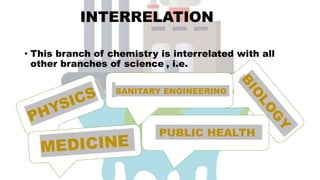
• This branch of chemistry is interrelated with all
other branches of science , i.e.
PUBLIC HEALTH
SANITARY ENGINEERING
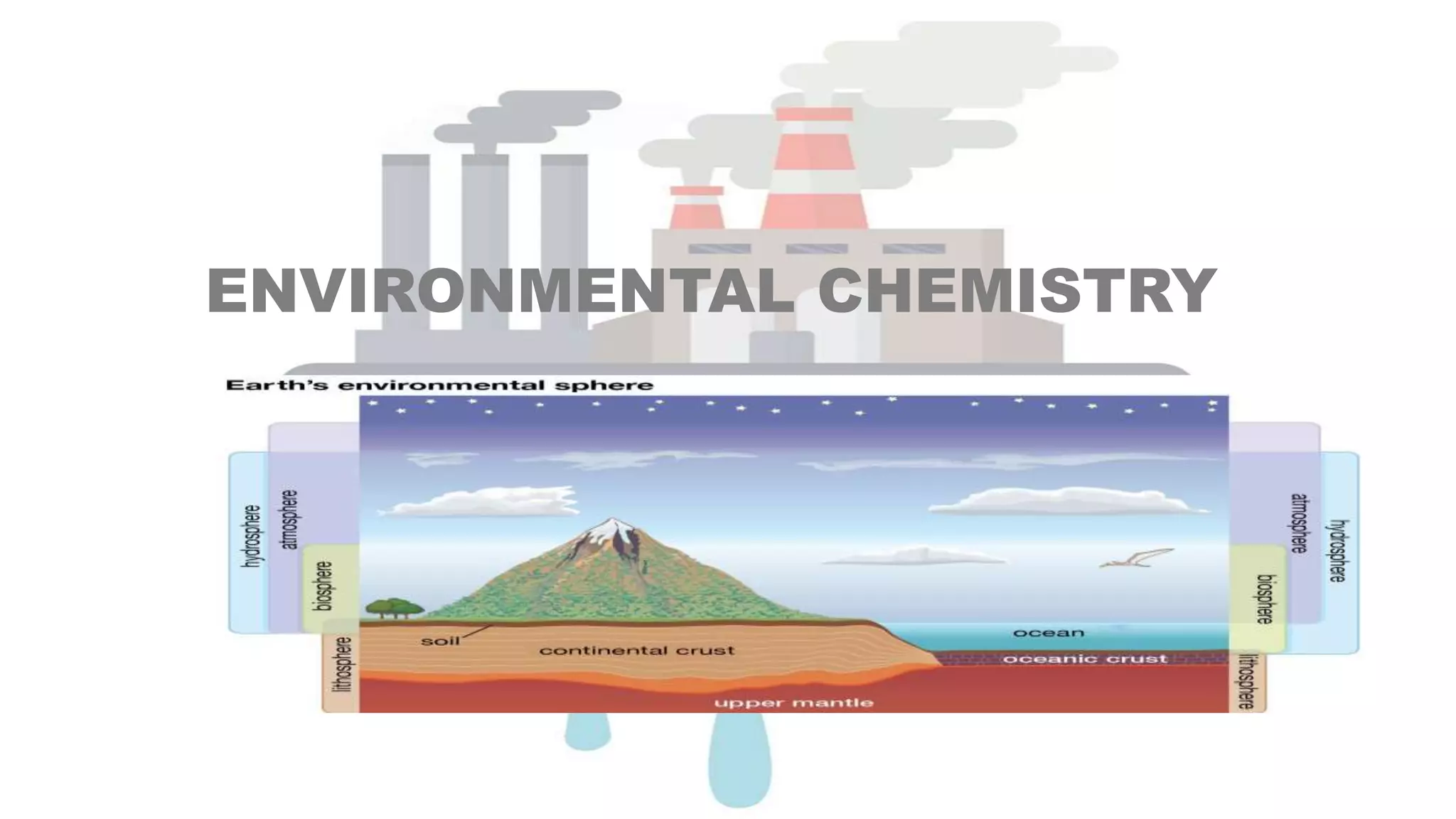
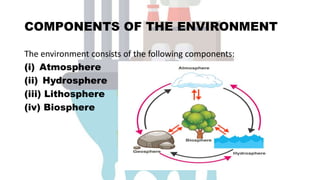
COMPONENTS OF THE ENVIRONMENT
The environment consists of the following components:
(i) Atmosphere
(ii) Hydrosphere
(iii) Lithosphere
(iv) Biosphere
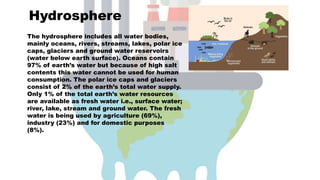
Hydrosphere
The hydrosphere includes all water bodies,
mainly oceans, rivers, streams, lakes, polar ice
caps, glaciers and ground water reservoirs
(water below earth surface). Oceans contain
97% of earth’s water but because of high salt
contents this water cannot be used for human
consumption. The polar ice caps and glaciers
consist of 2% of the earth’s total water supply.
Only 1% of the total earth’s water resources
are available as fresh water i.e., surface water;
river, lake, stream and ground water. The fresh
water is being used by agriculture (69%),
industry (23%) and for domestic purposes
(8%).
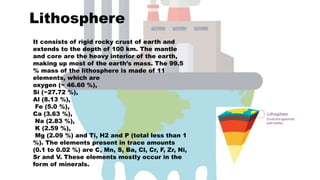
Lithosphere
It consists of rigid rocky crust of earth and
extends to the depth of 100 km. The mantle
and core are the heavy interior of the earth,
making up most of the earth’s mass. The 99.5
% mass of the lithosphere is made of 11
elements, which are
oxygen (~ 46.60 %),
Si (~27.72 %),
Al (8.13 %),
Fe (5.0 %),
Ca (3.63 %),
Na (2.83 %),
K (2.59 %),
Mg (2.09 %) and Ti, H2 and P (total less than 1
%). The elements present in trace amounts
(0.1 to 0.02 %) are C, Mn, S, Ba, Cl, Cr, F, Zr, Ni,
Sr and V. These elements mostly occur in the
form of minerals.
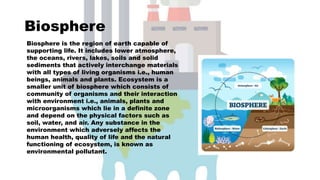
Biosphere
Biosphere is the region of earth capable of
supporting life. It includes lower atmosphere,
the oceans, rivers, lakes, soils and solid
sediments that actively interchange materials
with all types of living organisms i.e., human
beings, animals and plants. Ecosystem is a
smaller unit of biosphere which consists of
community of organisms and their interaction
with environment i.e., animals, plants and
microorganisms which lie in a definite zone
and depend on the physical factors such as
soil, water, and air. Any substance in the
environment which adversely affects the
human health, quality of life and the natural
functioning of ecosystem, is known as
environmental pollutant.
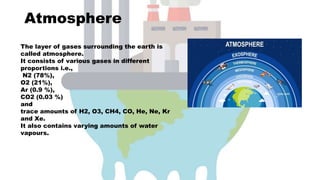
Atmosphere
The layer of gases surrounding the earth is
called atmosphere.
It consists of various gases in different
proportions i.e.,
N2 (78%),
O2 (21%),
Ar (0.9 %),
CO2 (0.03 %)
and
trace amounts of H2, O3, CH4, CO, He, Ne, Kr
and Xe.
It also contains varying amounts of water
vapours.
THANK YOU

Environmental chemistry

  • 1.
  • 2.
    DEFINITION Environmental chemistry dealswith the chemicals and other pollutants in the environment. In this we study the sources, reactions, transportation of the chemicals and other toxic substances especially created by human activity in the environment and their adverse effects on human beings.
  • 3.
    INTERRELATION • This branchof chemistry is interrelated with all other branches of science , i.e. PUBLIC HEALTH SANITARY ENGINEERING
  • 4.
    COMPONENTS OF THEENVIRONMENT The environment consists of the following components: (i) Atmosphere (ii) Hydrosphere (iii) Lithosphere (iv) Biosphere
  • 5.
    Hydrosphere The hydrosphere includesall water bodies, mainly oceans, rivers, streams, lakes, polar ice caps, glaciers and ground water reservoirs (water below earth surface). Oceans contain 97% of earth’s water but because of high salt contents this water cannot be used for human consumption. The polar ice caps and glaciers consist of 2% of the earth’s total water supply. Only 1% of the total earth’s water resources are available as fresh water i.e., surface water; river, lake, stream and ground water. The fresh water is being used by agriculture (69%), industry (23%) and for domestic purposes (8%).
  • 6.
    Lithosphere It consists ofrigid rocky crust of earth and extends to the depth of 100 km. The mantle and core are the heavy interior of the earth, making up most of the earth’s mass. The 99.5 % mass of the lithosphere is made of 11 elements, which are oxygen (~ 46.60 %), Si (~27.72 %), Al (8.13 %), Fe (5.0 %), Ca (3.63 %), Na (2.83 %), K (2.59 %), Mg (2.09 %) and Ti, H2 and P (total less than 1 %). The elements present in trace amounts (0.1 to 0.02 %) are C, Mn, S, Ba, Cl, Cr, F, Zr, Ni, Sr and V. These elements mostly occur in the form of minerals.
  • 7.
    Biosphere Biosphere is theregion of earth capable of supporting life. It includes lower atmosphere, the oceans, rivers, lakes, soils and solid sediments that actively interchange materials with all types of living organisms i.e., human beings, animals and plants. Ecosystem is a smaller unit of biosphere which consists of community of organisms and their interaction with environment i.e., animals, plants and microorganisms which lie in a definite zone and depend on the physical factors such as soil, water, and air. Any substance in the environment which adversely affects the human health, quality of life and the natural functioning of ecosystem, is known as environmental pollutant.
  • 8.
    Atmosphere The layer ofgases surrounding the earth is called atmosphere. It consists of various gases in different proportions i.e., N2 (78%), O2 (21%), Ar (0.9 %), CO2 (0.03 %) and trace amounts of H2, O3, CH4, CO, He, Ne, Kr and Xe. It also contains varying amounts of water vapours.
  • 9.