Environmental Pollution- Causes, Effects and Control Measures 
Prepared by 
M.SHANMUGARAJ M.E., 
V.S.V.N Polytechnic College, 
Virudhunagar 
Tamil Nadu 
India
Definition 
“Pollution is the effect of undesirable changes in our surroundings that have harmful effects on plants, animals and human beings”.
Pollutant 
Any thing (solid, liquid or gas) that cause pollution is called pollutant 
Eg. Lead, sulphuric acid, carbon monoxide,
Types of PollutionDegradable 
Non-degradable
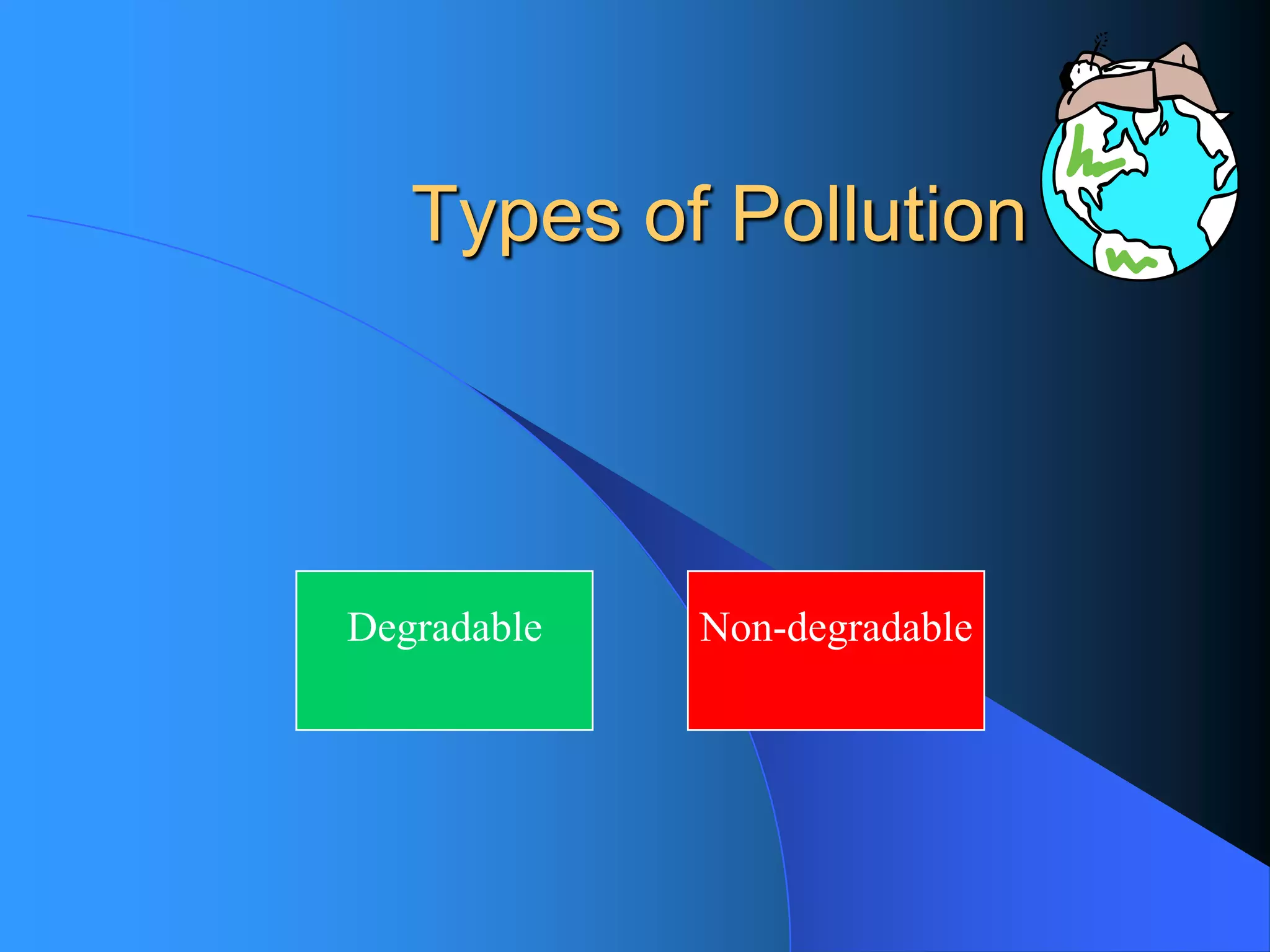
Degradable: Those can be readily broken down by natural processesEg. Discarded vegetablesNon-degradable: Those can not be degraded by natural processes Eg.plastics
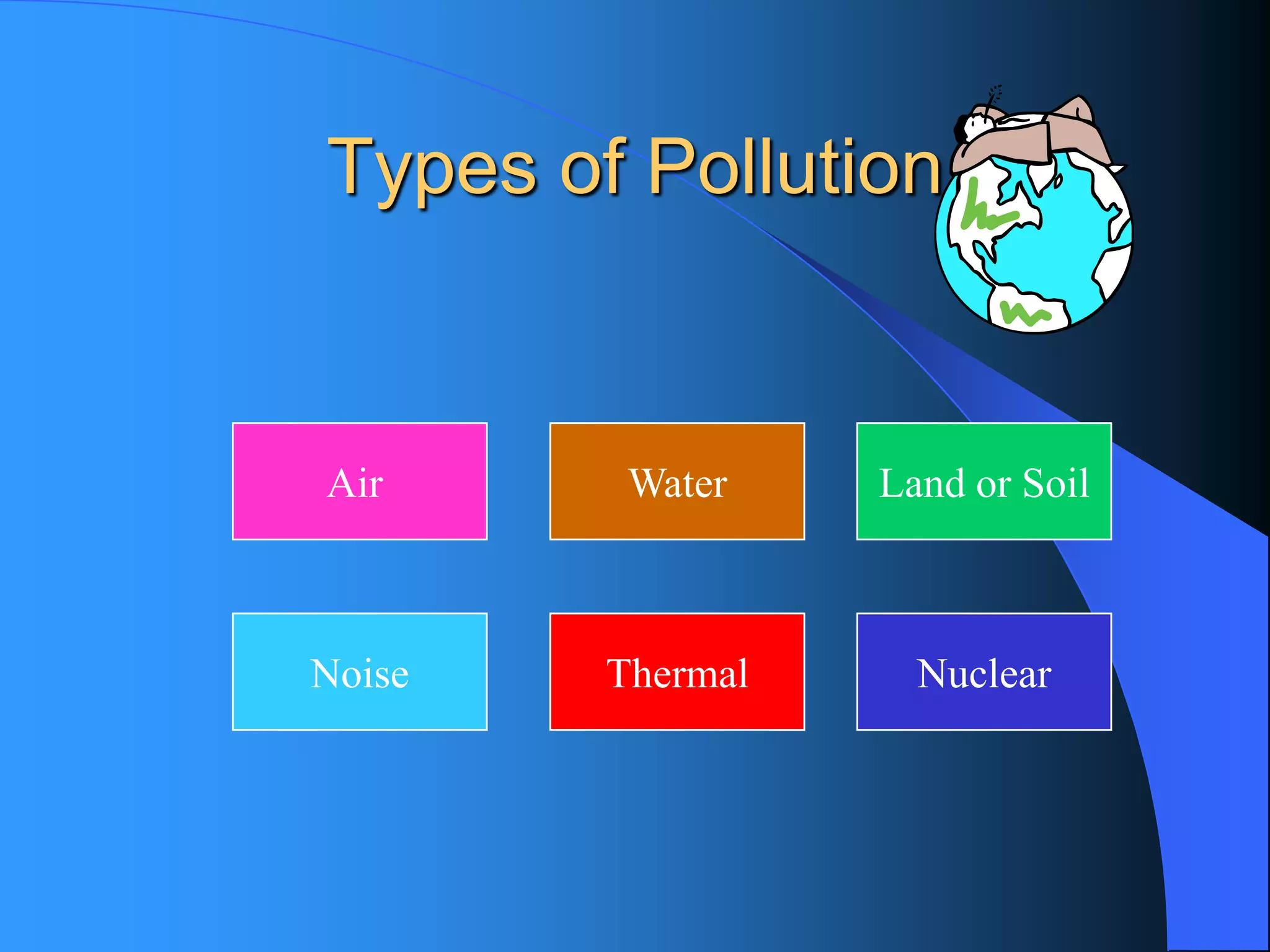
Types of Pollution 
NoiseAir 
Water 
Land or SoilThermal 
Nuclear
Air Pollution 
Air pollution occurs due to the presence of undesirable solid or gaseous particles in the air in quantities that are harmful to human health and environment
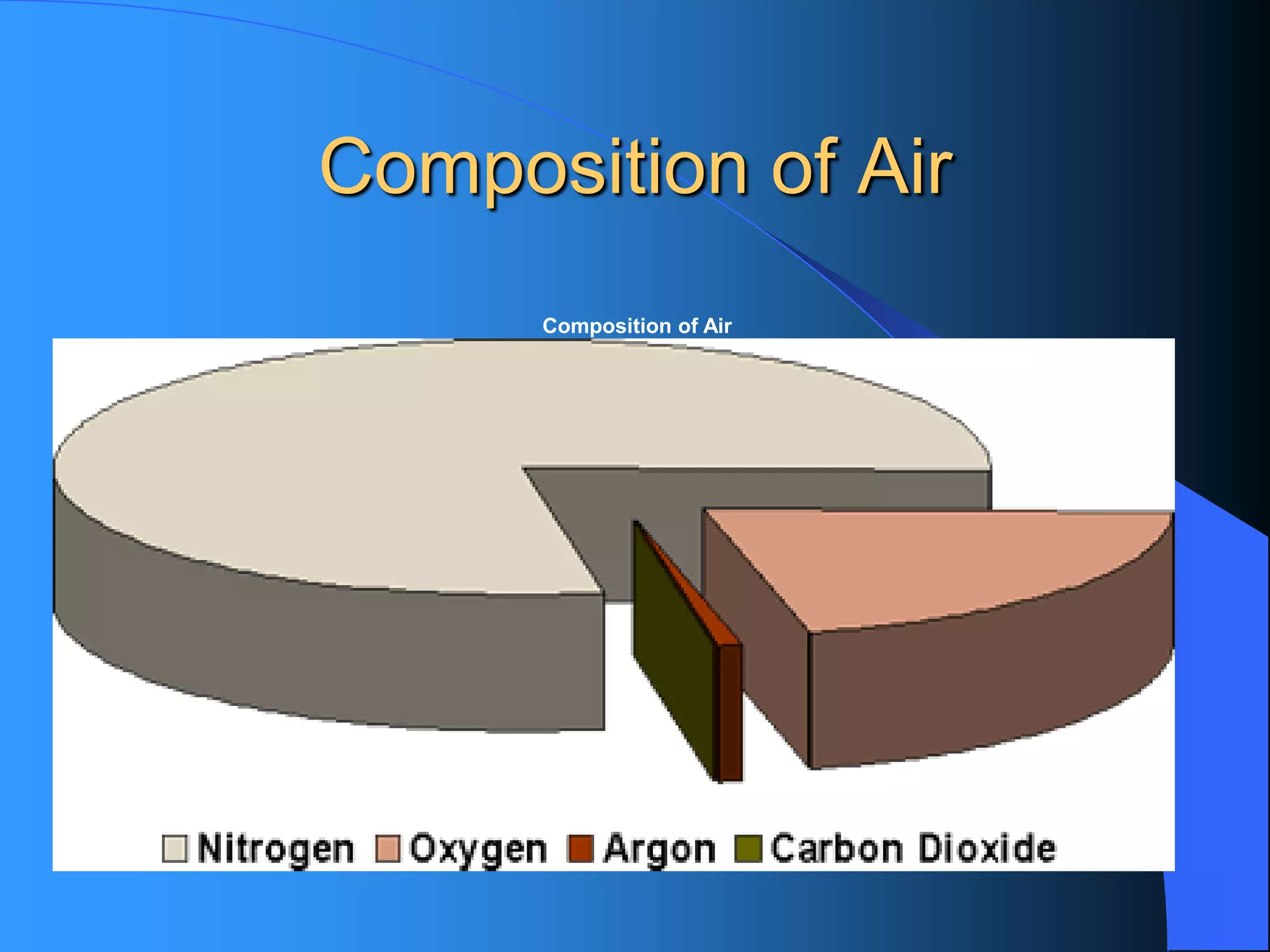
Composition of Air 
Composition of Air
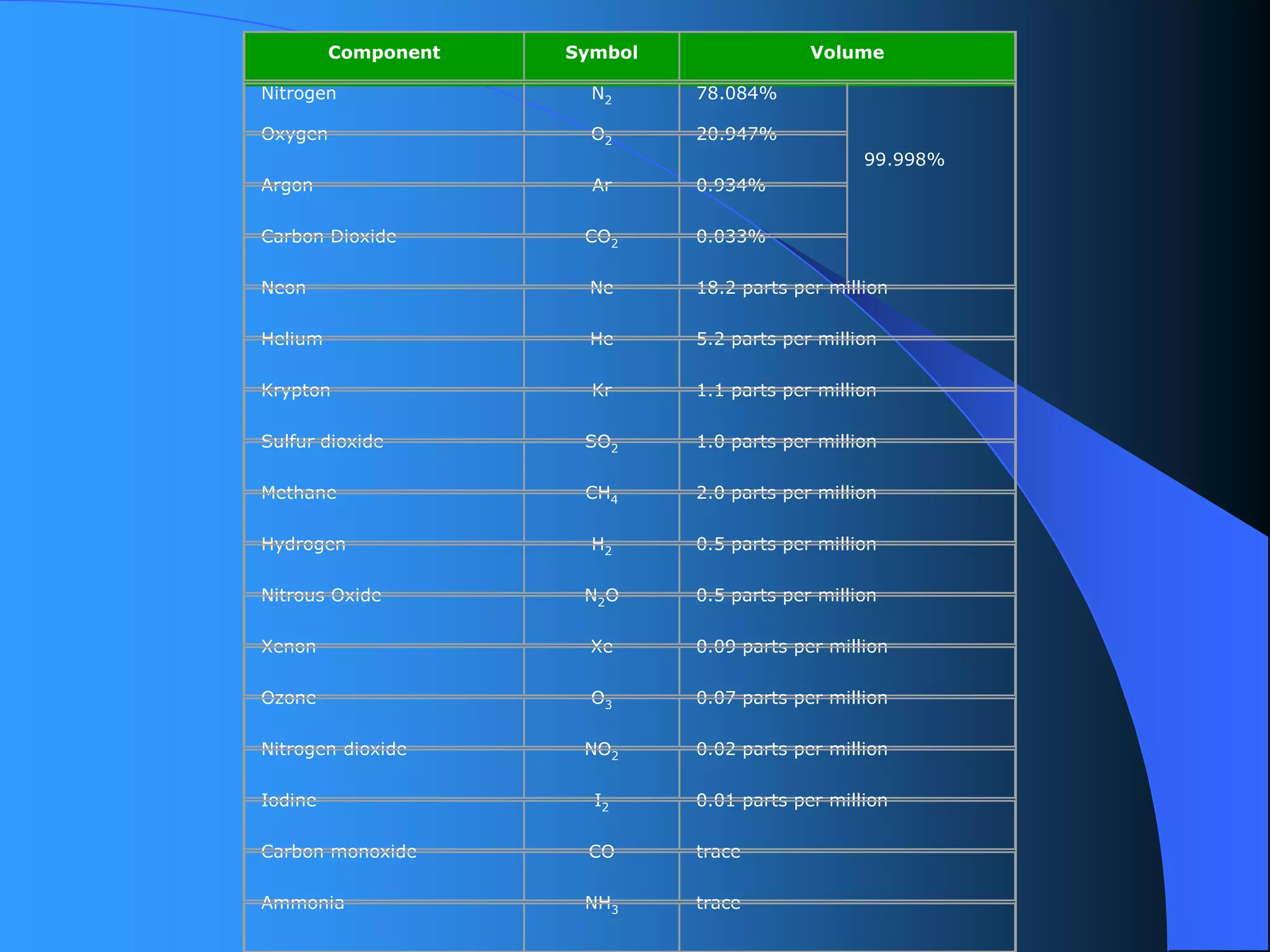
ComponentSymbol 
VolumeNitrogenN2 
78.084% 99.998% 
Oxygen 
O220.947% 
Argon 
Ar 
0.934% 
Carbon Dioxide 
CO2 
0.033% NeonNe 
18.2 parts per millionHeliumHe 
5.2 parts per millionKrypton 
Kr 
1.1 parts per millionSulfur dioxide 
SO2 
1.0 parts per million 
Methane 
CH4 
2.0 parts per million 
HydrogenH20.5 parts per million 
Nitrous OxideN2O0.5 parts per million 
XenonXe 
0.09 parts per million 
OzoneO3 
0.07 parts per million 
Nitrogen dioxide 
NO2 
0.02 parts per million 
Iodine 
I20.01 parts per millionCarbon monoxide 
COtraceAmmonia 
NH3trace
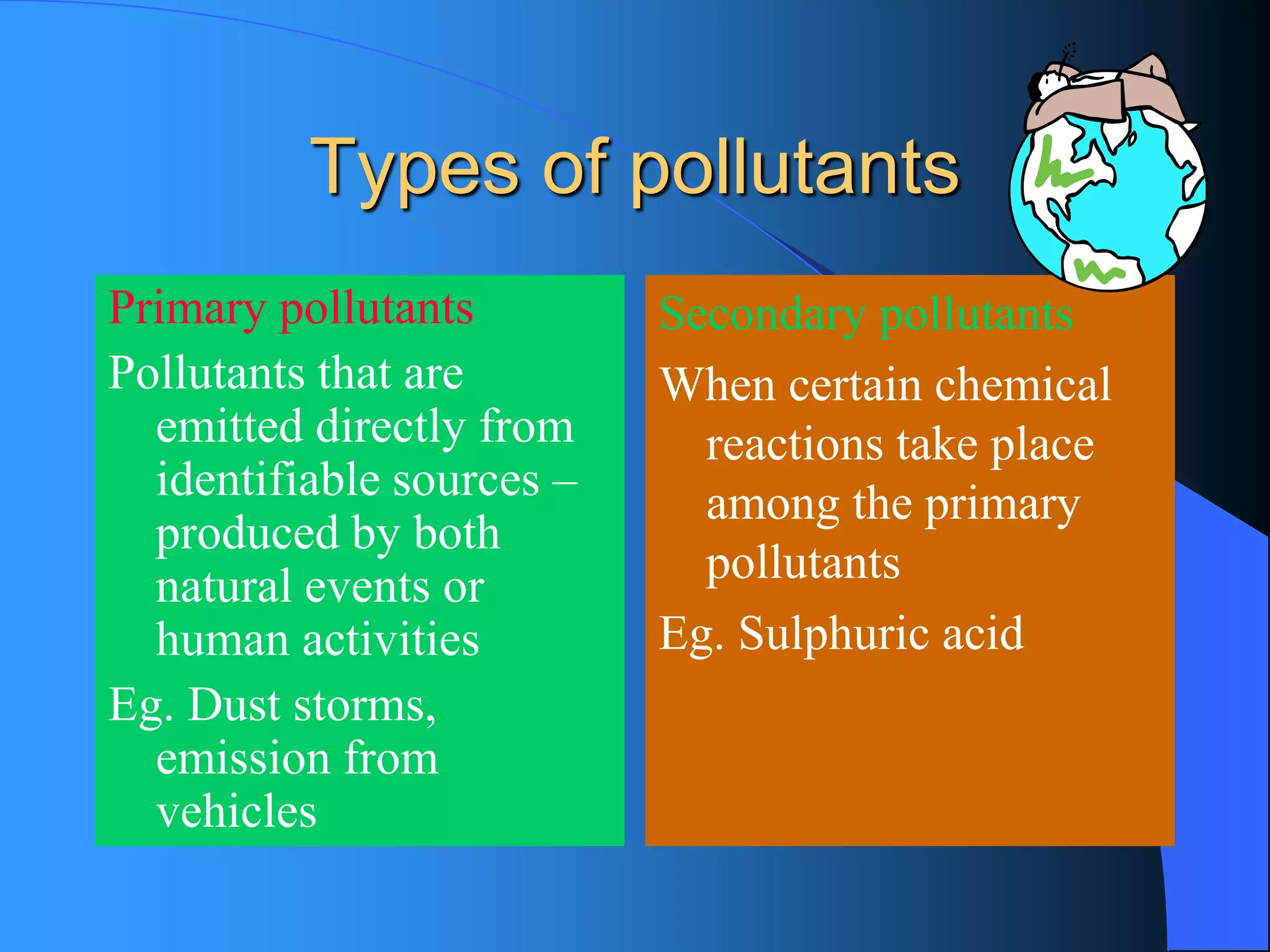
Types of pollutants 
Primary pollutants 
Pollutants that are emitted directly from identifiable sources – produced by both natural events or human activities 
Eg. Dust storms, emission from vehicles 
Secondary pollutants 
When certain chemical reactions take place among the primary pollutants 
Eg. Sulphuric acid
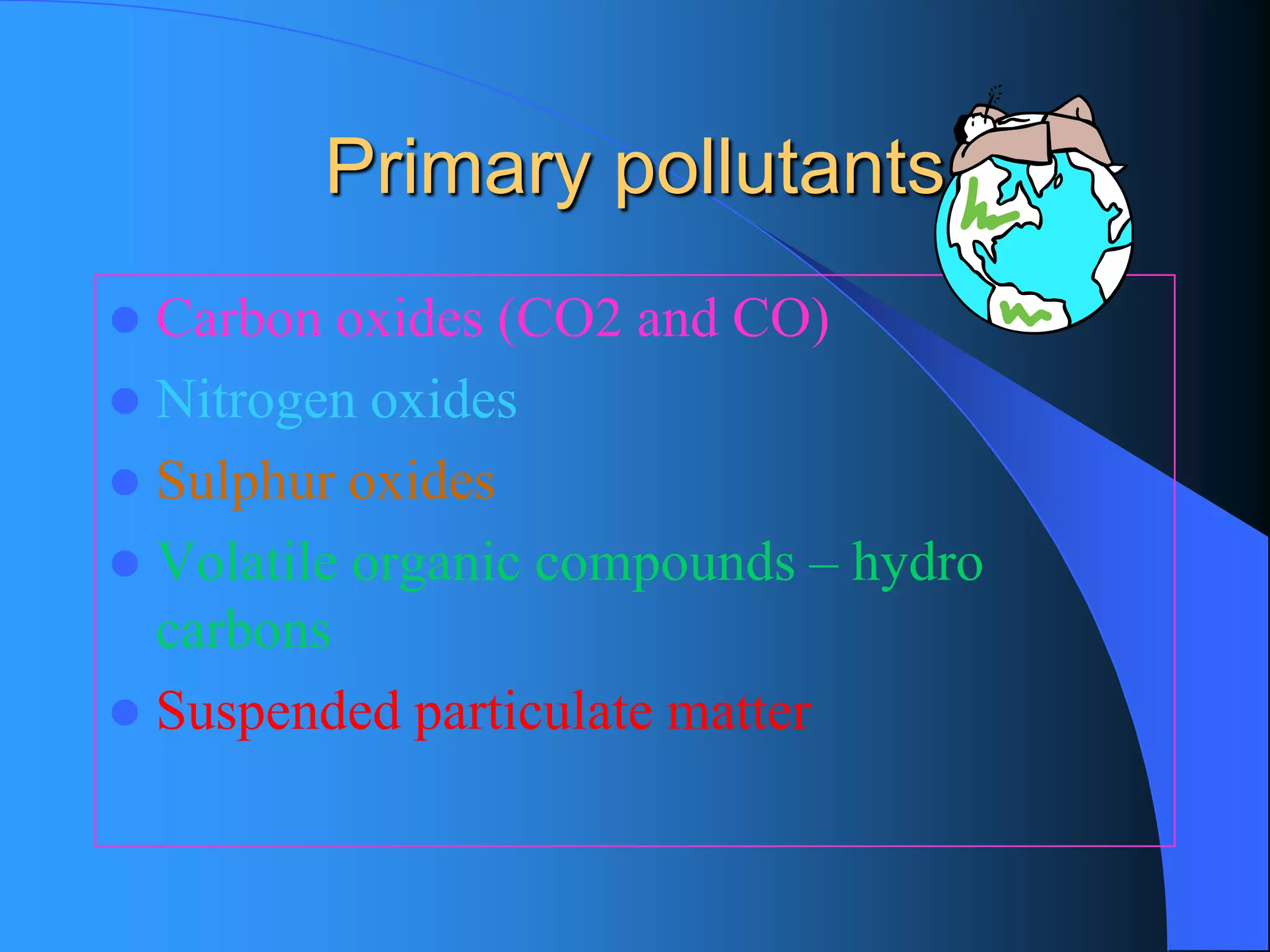
Primary pollutants 
Carbon oxides (CO2 and CO) 
Nitrogen oxides 
Sulphur oxides 
Volatile organic compounds –hydro carbons 
Suspended particulate matter
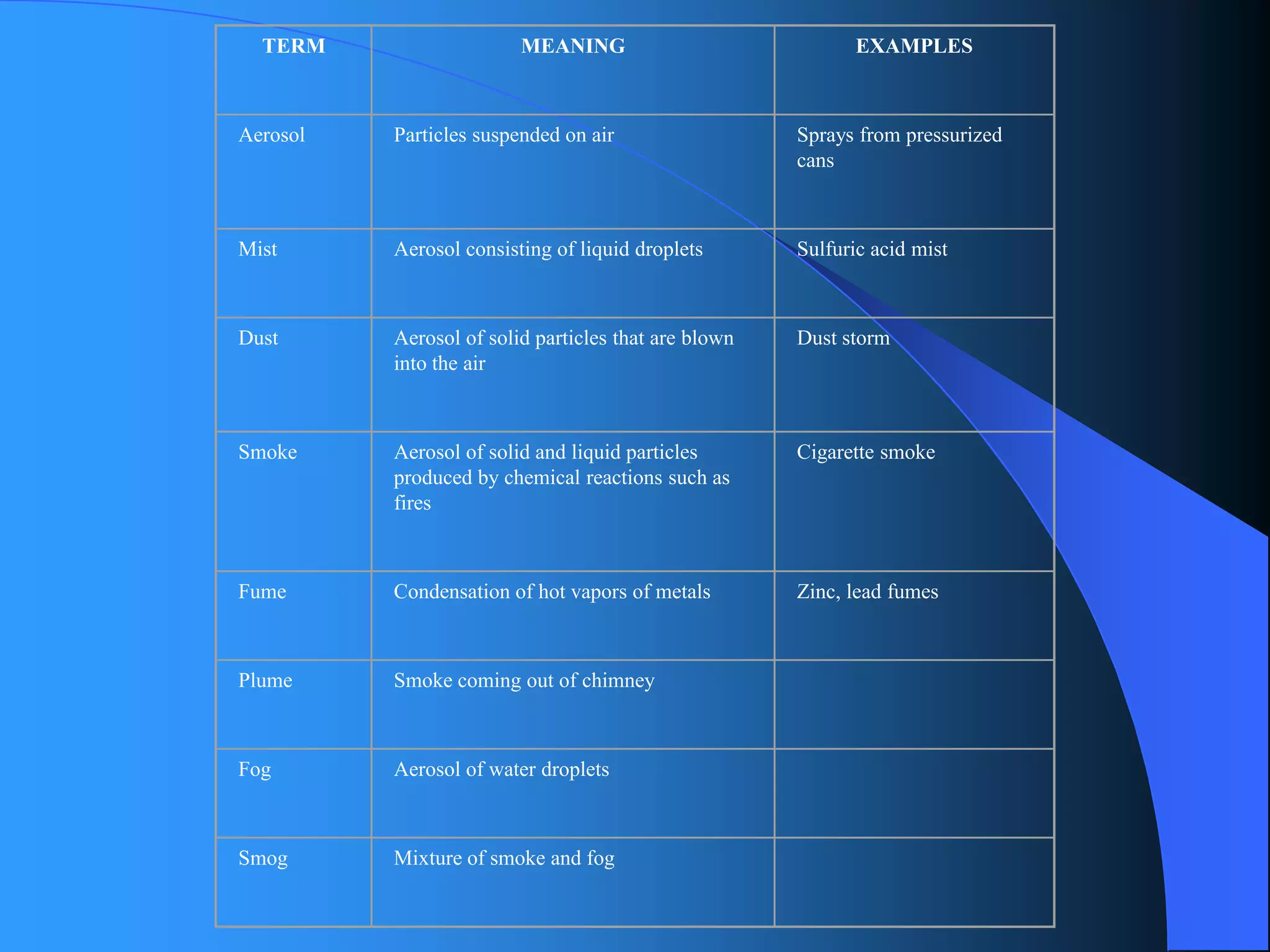
TERM 
MEANING 
EXAMPLES 
AerosolParticles suspended on airSprays from pressurized cans 
MistAerosol consisting of liquid dropletsSulfuric acid mist 
DustAerosol of solid particles that are blown into the air 
Dust storm 
Smoke 
Aerosol of solid and liquid particles produced by chemical reactions such as fires 
Cigarette smokeFume 
Condensation of hot vapors of metals 
Zinc, lead fumes 
Plume 
Smoke coming out of chimneyFog 
Aerosol of water dropletsSmog 
Mixture of smoke and fog
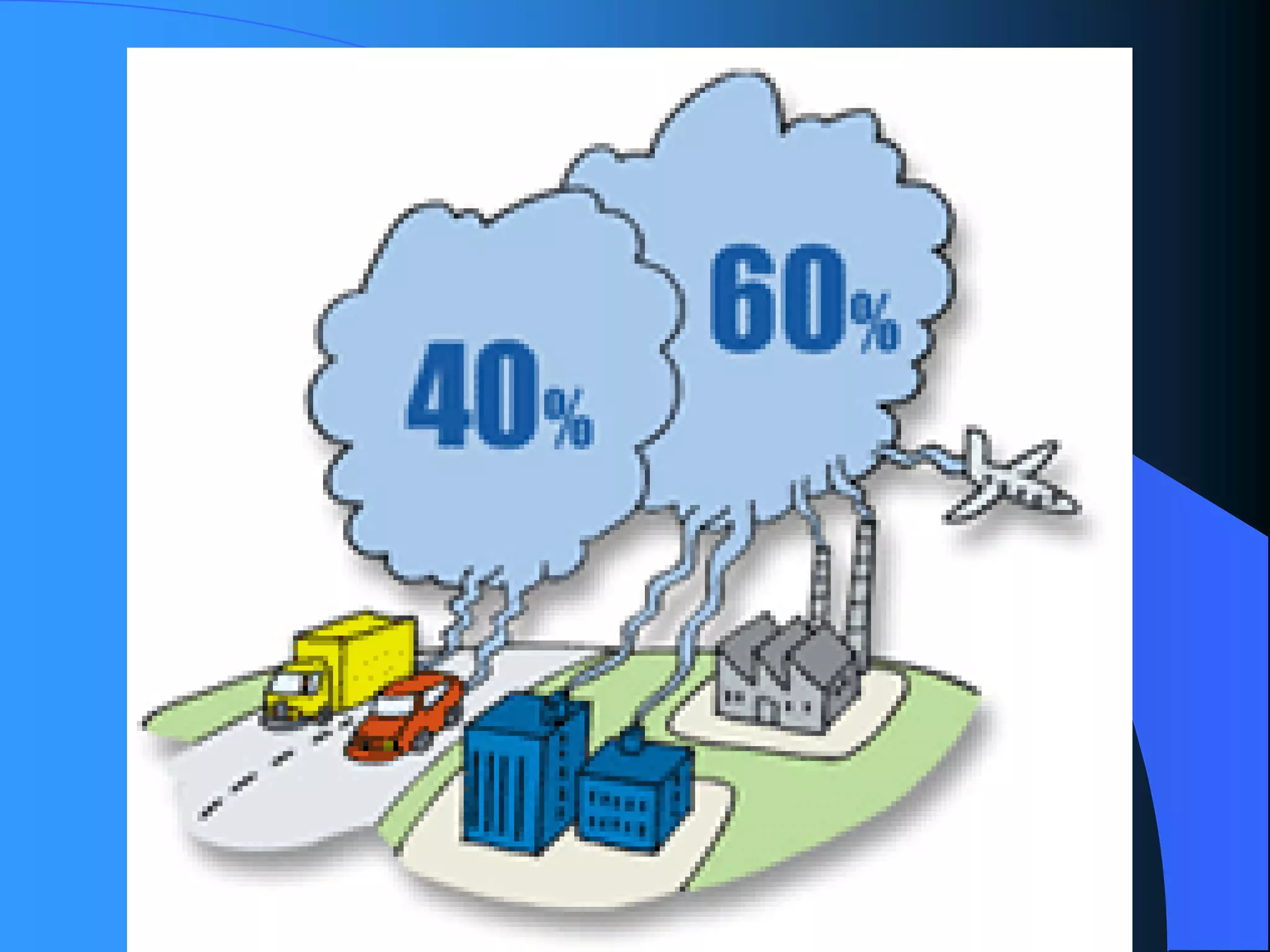
Sources of Air Pollution 
Vehicles 
Industries 
Dust and storm 
Air crafts, jet
Effects of air pollution 
Prolonged smoking or exposure to air pollutants can overload or break down the natural defenses such as hair in our nose, sticky mucas in the lining of the upper respiratory tract causing diseases like lung cancer, asthma, chronic bronchitis etc.,
Cigarette smoking is responsible for the greatest exposure to carbon monoxide.Exposure to air containing even 0.001% of carbon monoxide for several hours can cause collapse, coma and even death. 
CO is attached to blood hemoglobin for a long time, it accumulates and reduces the oxygen carrying capacity of blood. This impairs perception and thinking, slows reflexes and causes headaches, drowsiness, dizziness and nausea and blurred vision.
Nitrogen oxides and suspended particles both can irritate lungs, aggravate asthma or chronic bronchitis and increase respiratory infections. 
Many volatile organic compounds such as benzene and formaldehyde and toxic particulates such as lead and cadmium can cause mutations, reproductive problems and cancer, breathlessness and irritation of the eye, nose and throat.
Sulphur dioxide irritates respiratory tissues, chronic exposure causes a condition similar to bronchitis. 
It also reacts with water, oxygen and other materials to form sulphur containing acids – The acids can become attached to particles which when inhaled are very corrosive to the lung.
Chronic exposure of the leaves to air pollutants can break down the waxy coating that helps prevent excessive water loss and leads to damage from diseases, pests, drought and frost. 
It also affects photosynthesis, respiration and other metabolisms.
Ozone depletion 
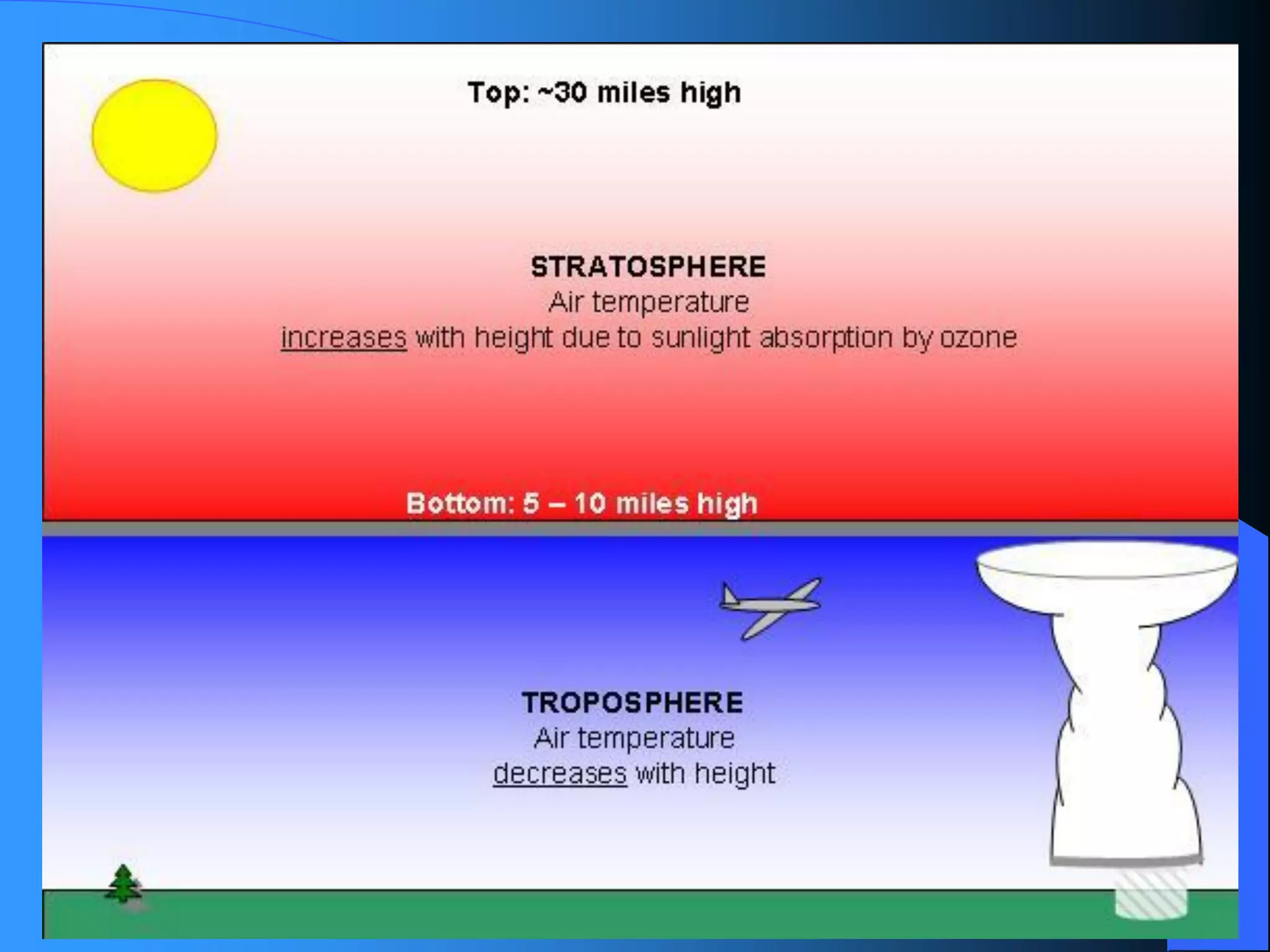
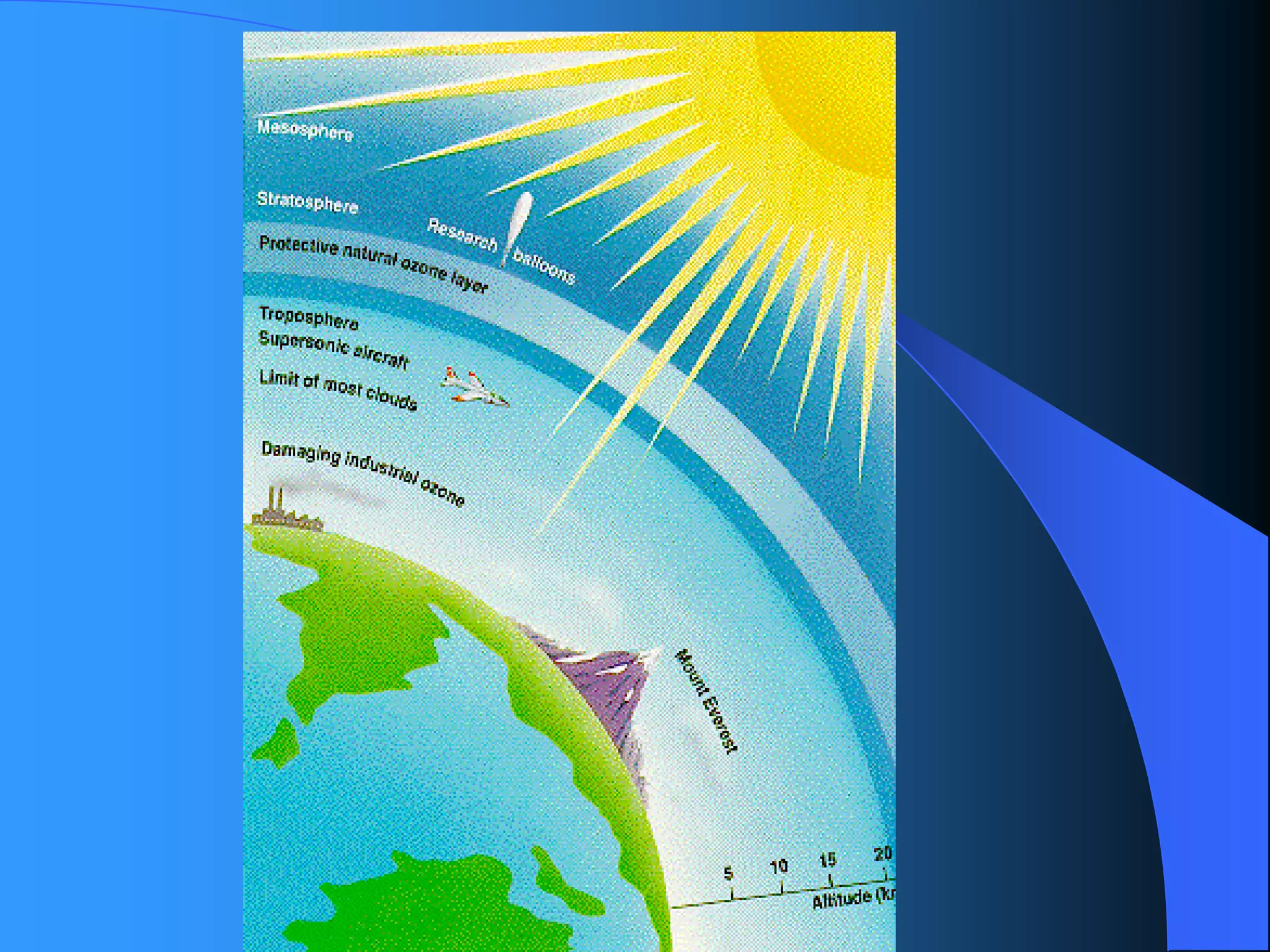
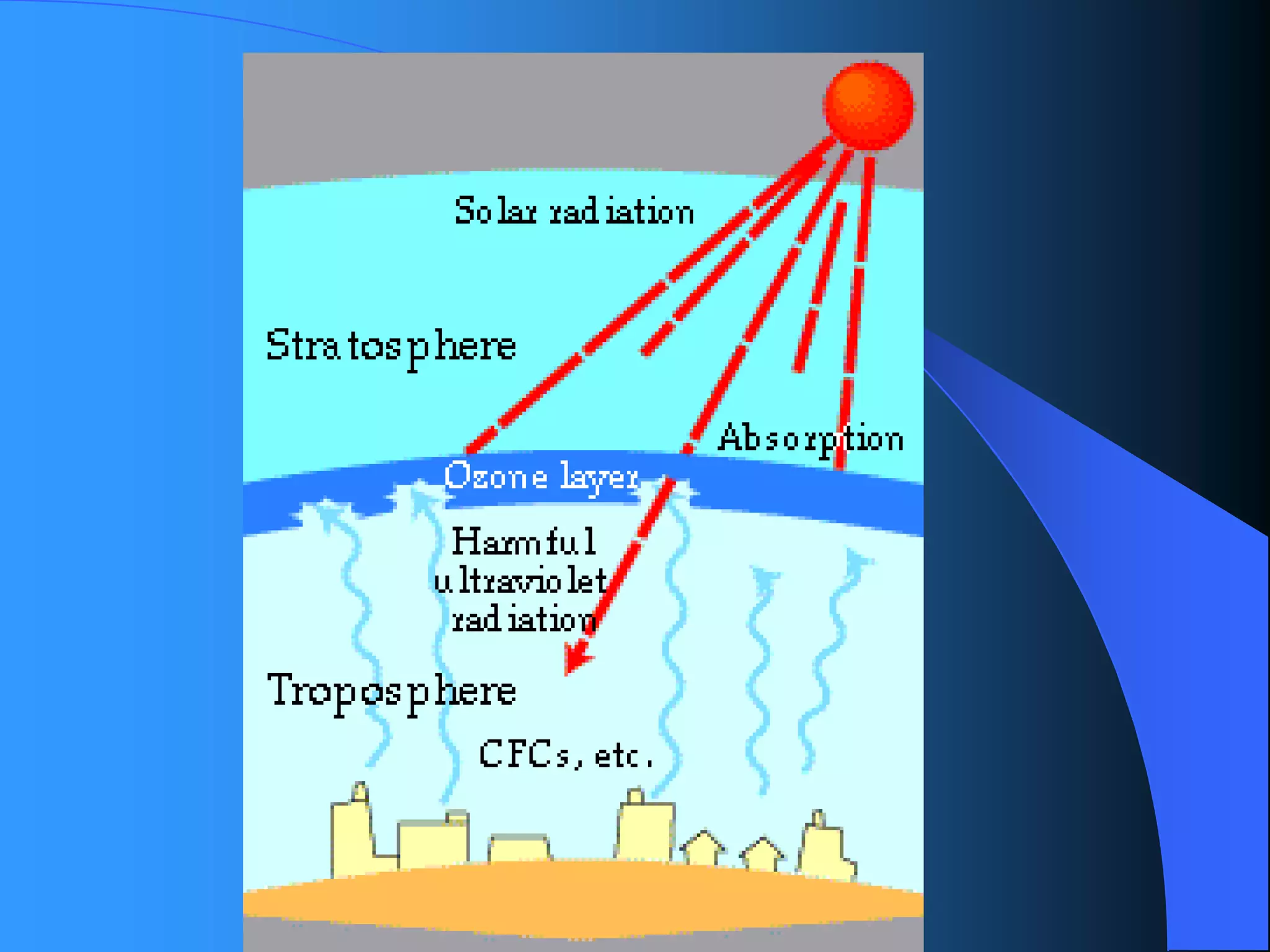
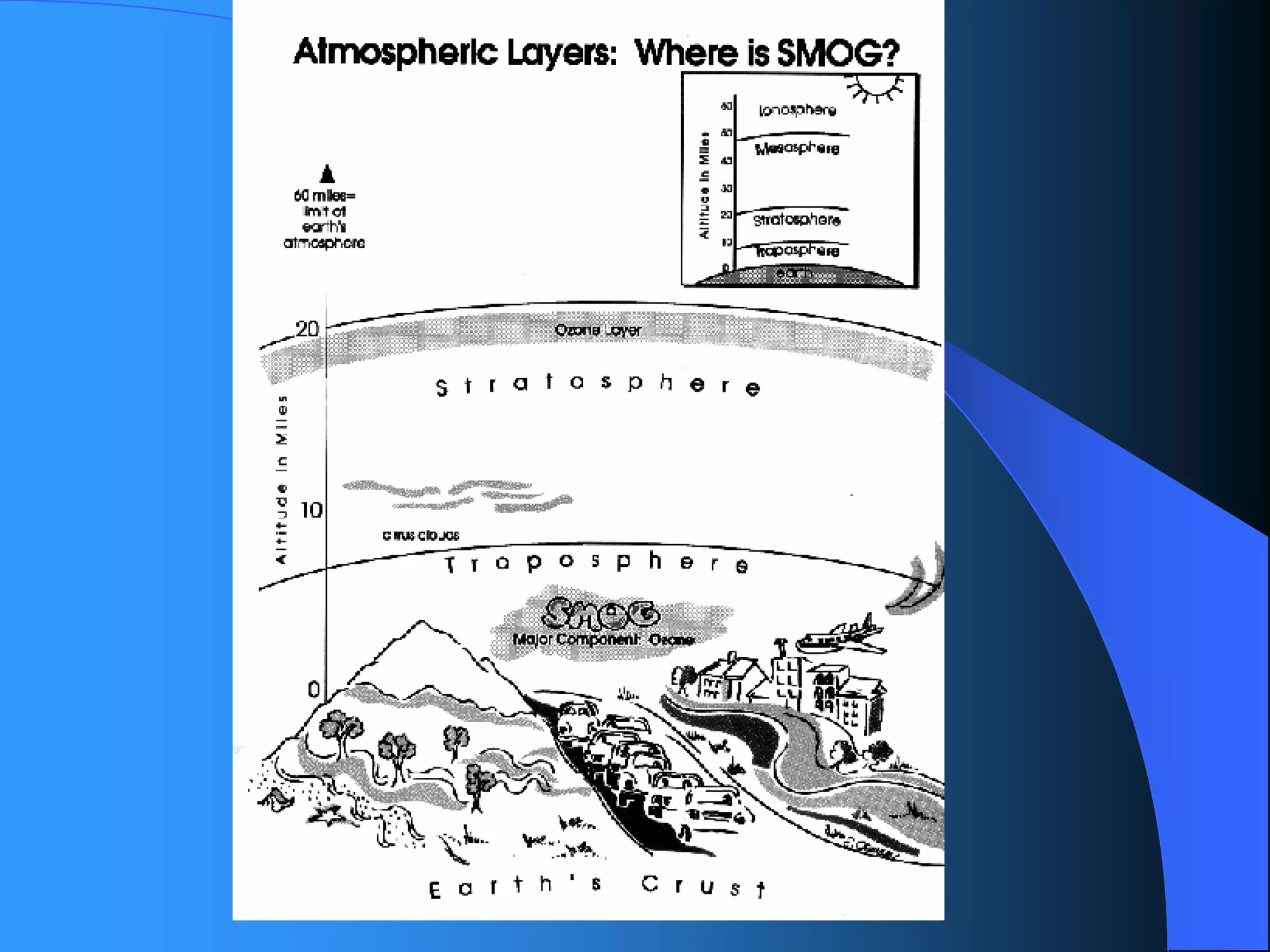
The upper stratosphere consists of considerable amounts of ozone which works as an effective screen for UV light.
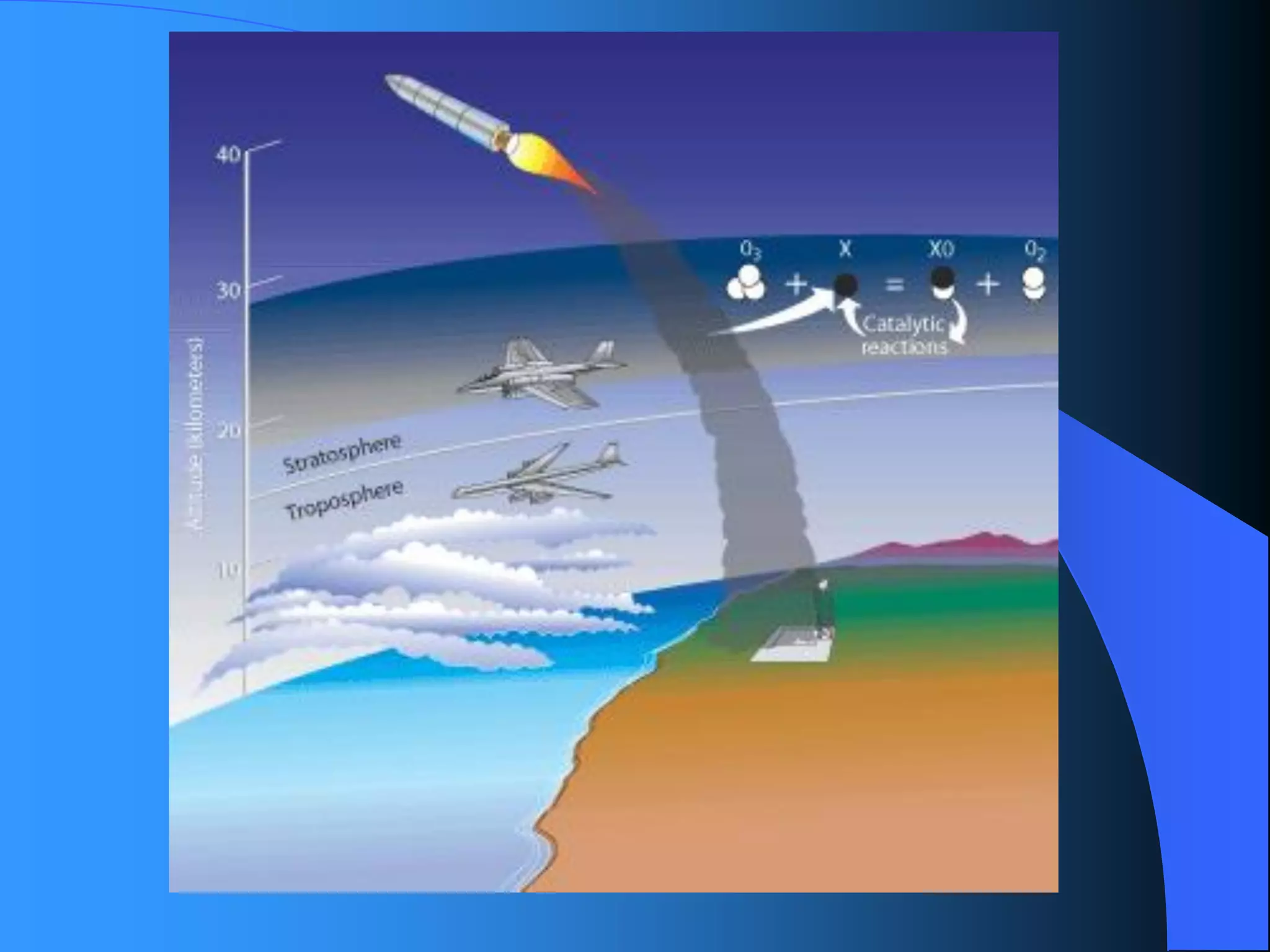
The ozone thus formed is constantly broken down by naturally occurring processes that maintain its balance in the ozone layer. But the presence of certain pollutants can accelerate the breakdown of ozone. (chloroflurocarbons, halons) 
The Chloro-fluro-carbons (CFCs) are extremely stable, non-flammable, non-toxic and harmless to handle. It is ideal for air conditioners, refrigerators and fire extinguishers etc. 
Halons are similar to the CFCs dangerous to ozone layer.
The CFCs and Halons migrate into the upper atmosphere after they are released. As they are heavier than air, they are carried by air currents and reach upper atmosphere. This is a slow process and even take few to many years. 
In the stratosphere unfiltered UV radiation severs the chemical bonds releasing chlorine from CFCs. 
This attacks the ozone molecule resulting in its splitting into oxygen molecule and an oxygen atom. 
Thus leading to ozone depletion.
Effects of ozone depletion 
On human-sunburn, cataract, skin cancer, weakens the immune system 
Food production –uv radiation causes reduction in photosynthesis –reduces nutrient contents and the growth of plants 
On materials-damages paints and fabrics causing them to fade faster. 
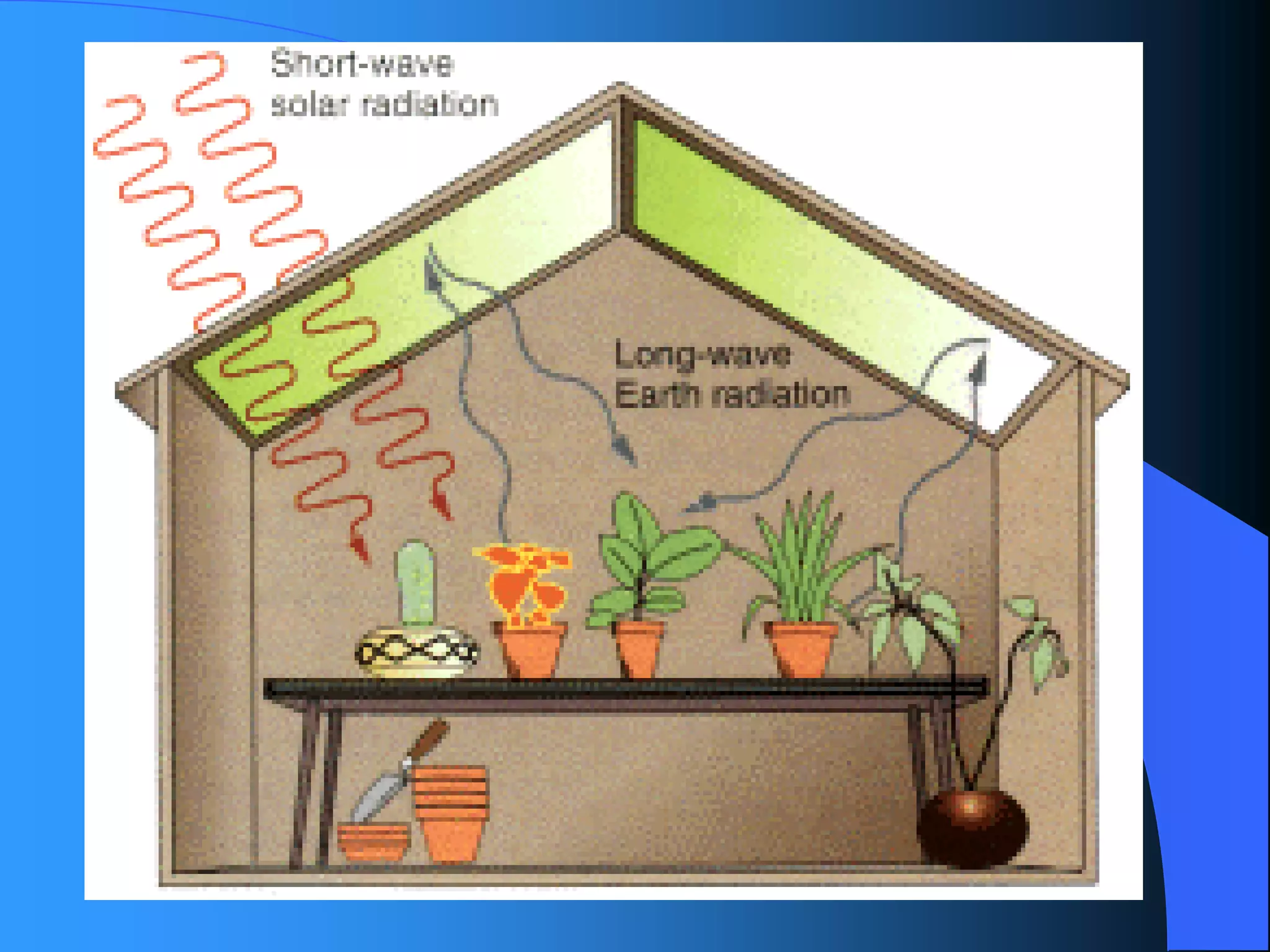
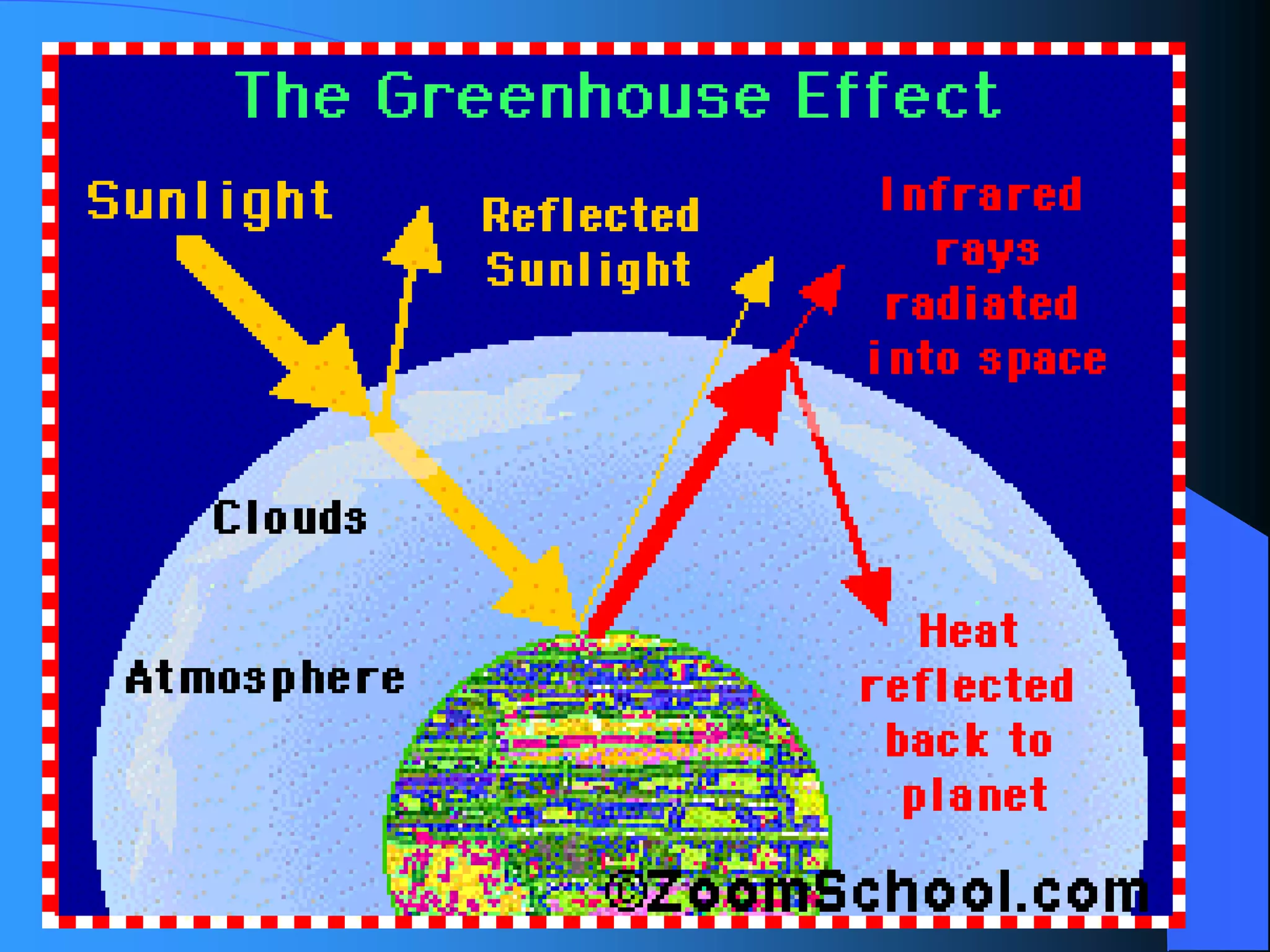
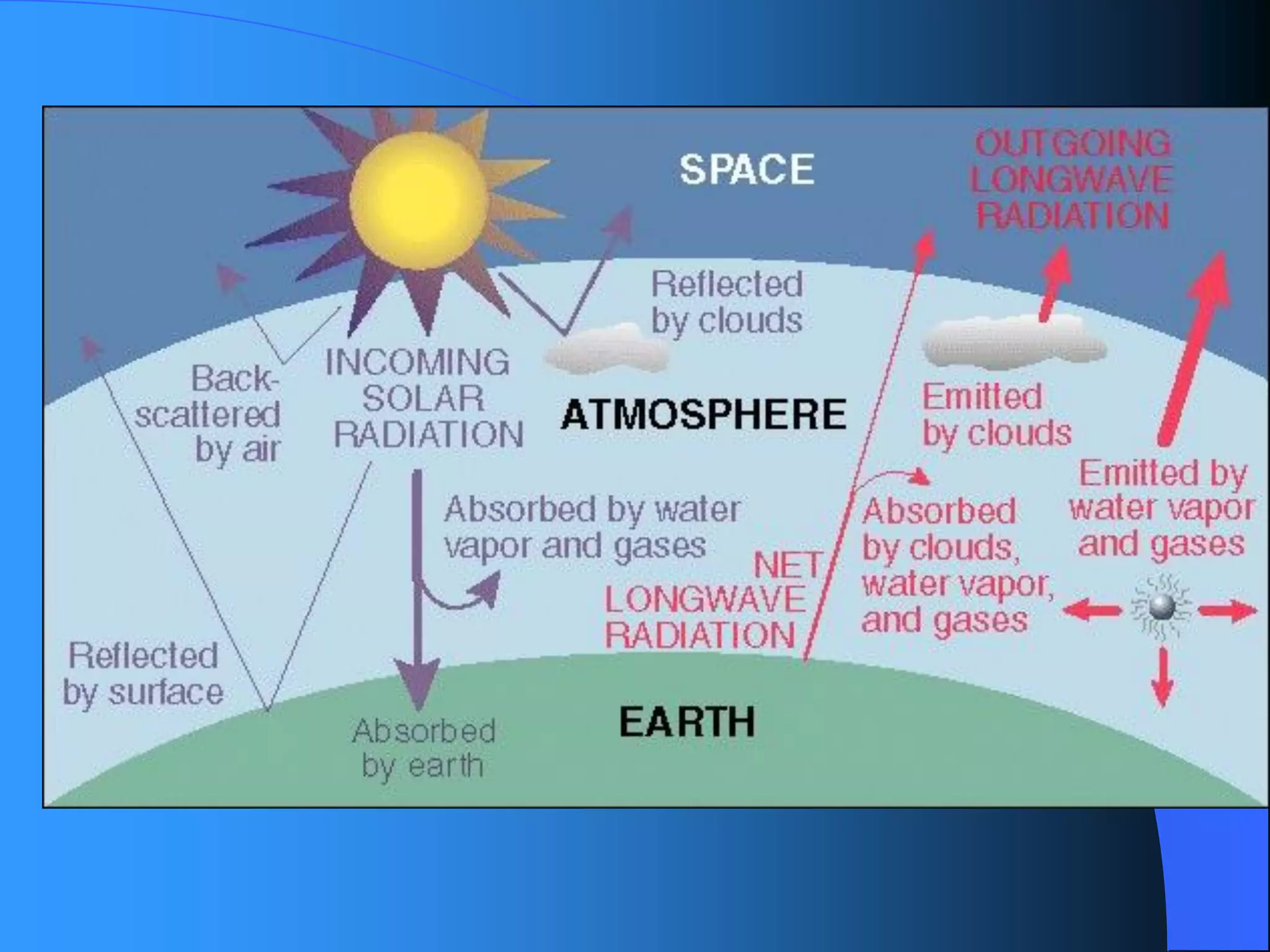
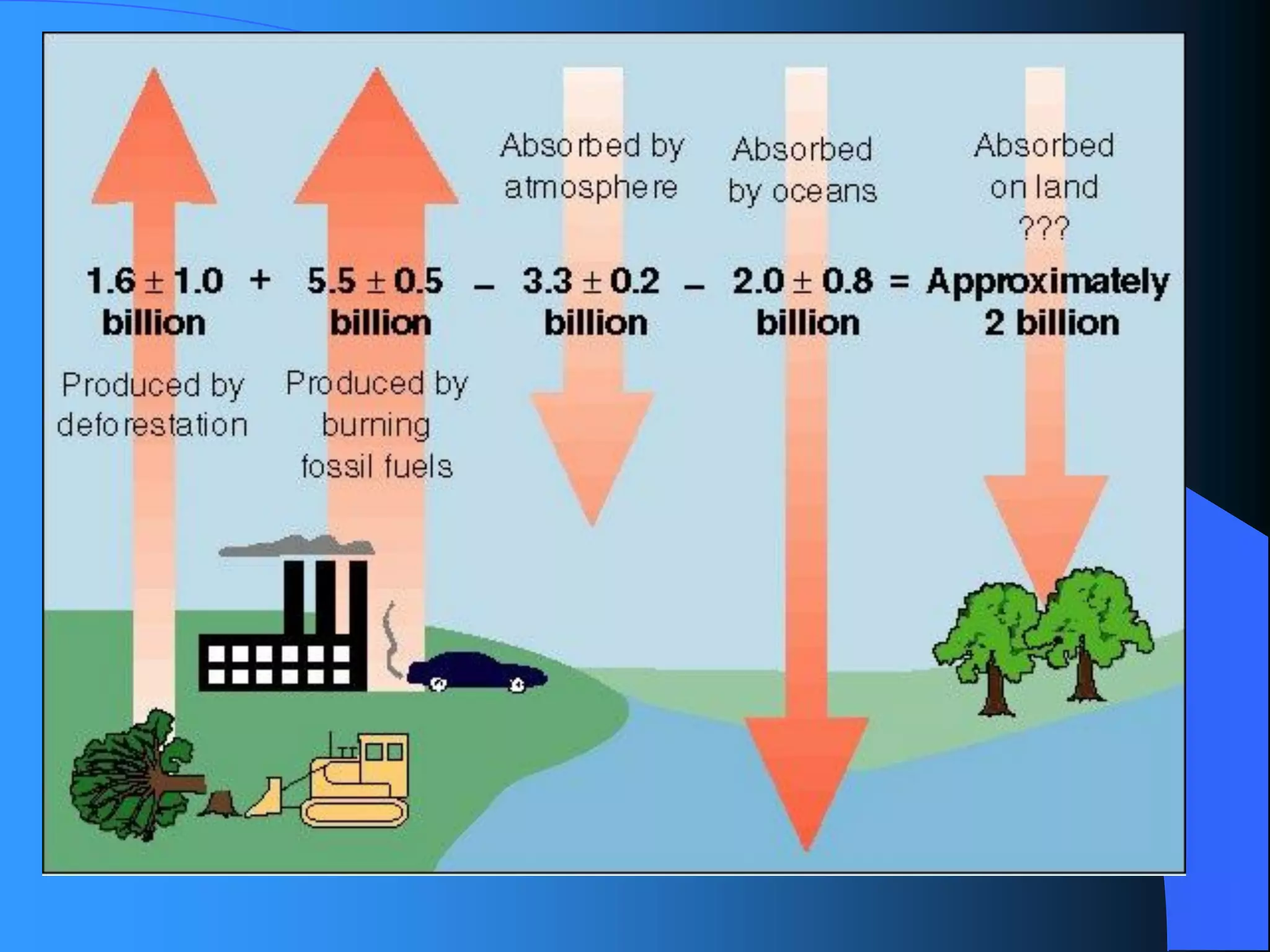
On climate-global warming –Green house effect- 
increase in concentration of certain gases like carbon di oxide, nitrogen oxides, methane, CFCs trap heat in the form of infra red radiation near the earth’s surface-Green house effect
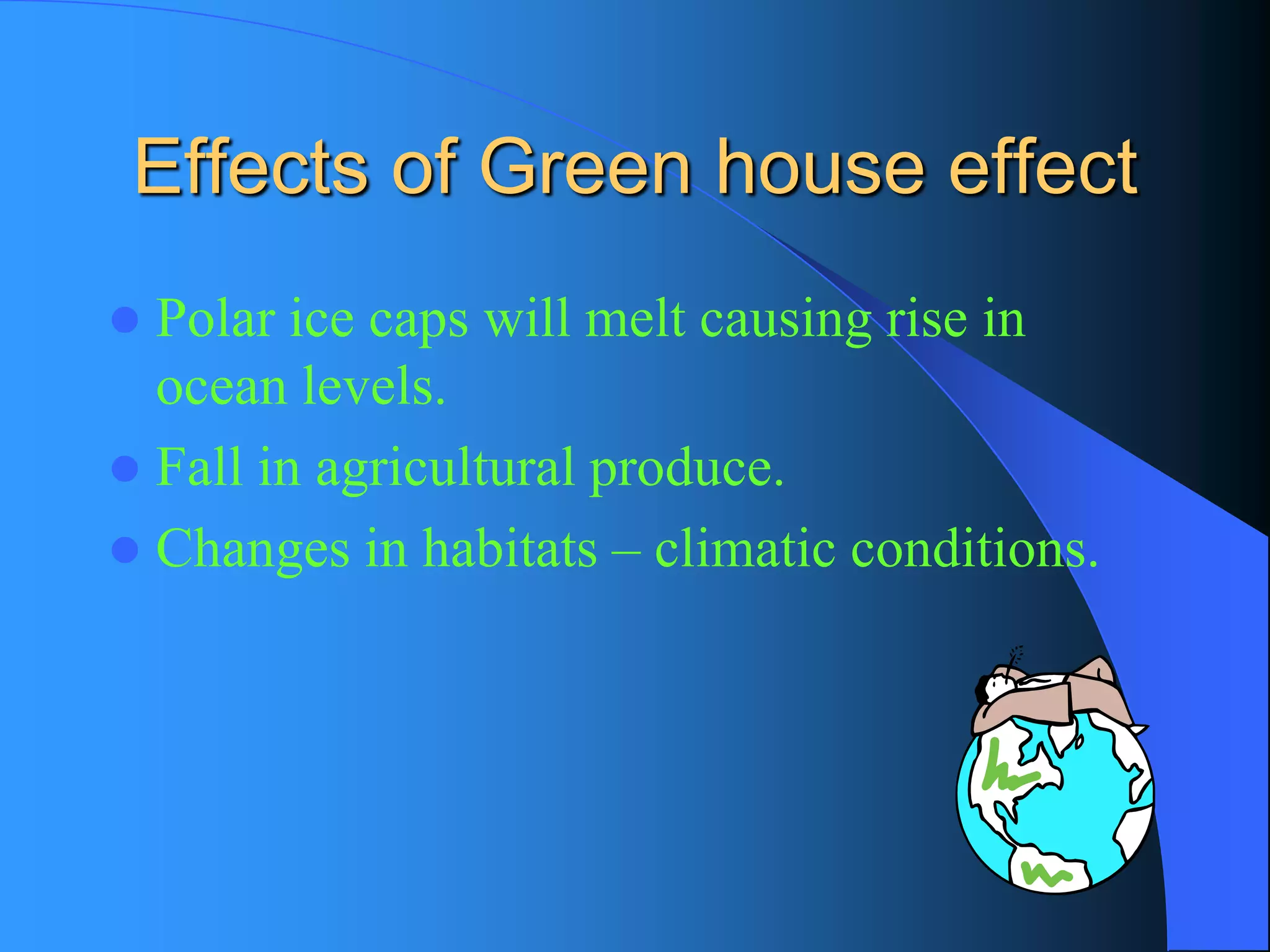
Effects of Green house effect 
Polar ice caps will melt causing rise in ocean levels. 
Fall in agricultural produce. 
Changes in habitats –climatic conditions.
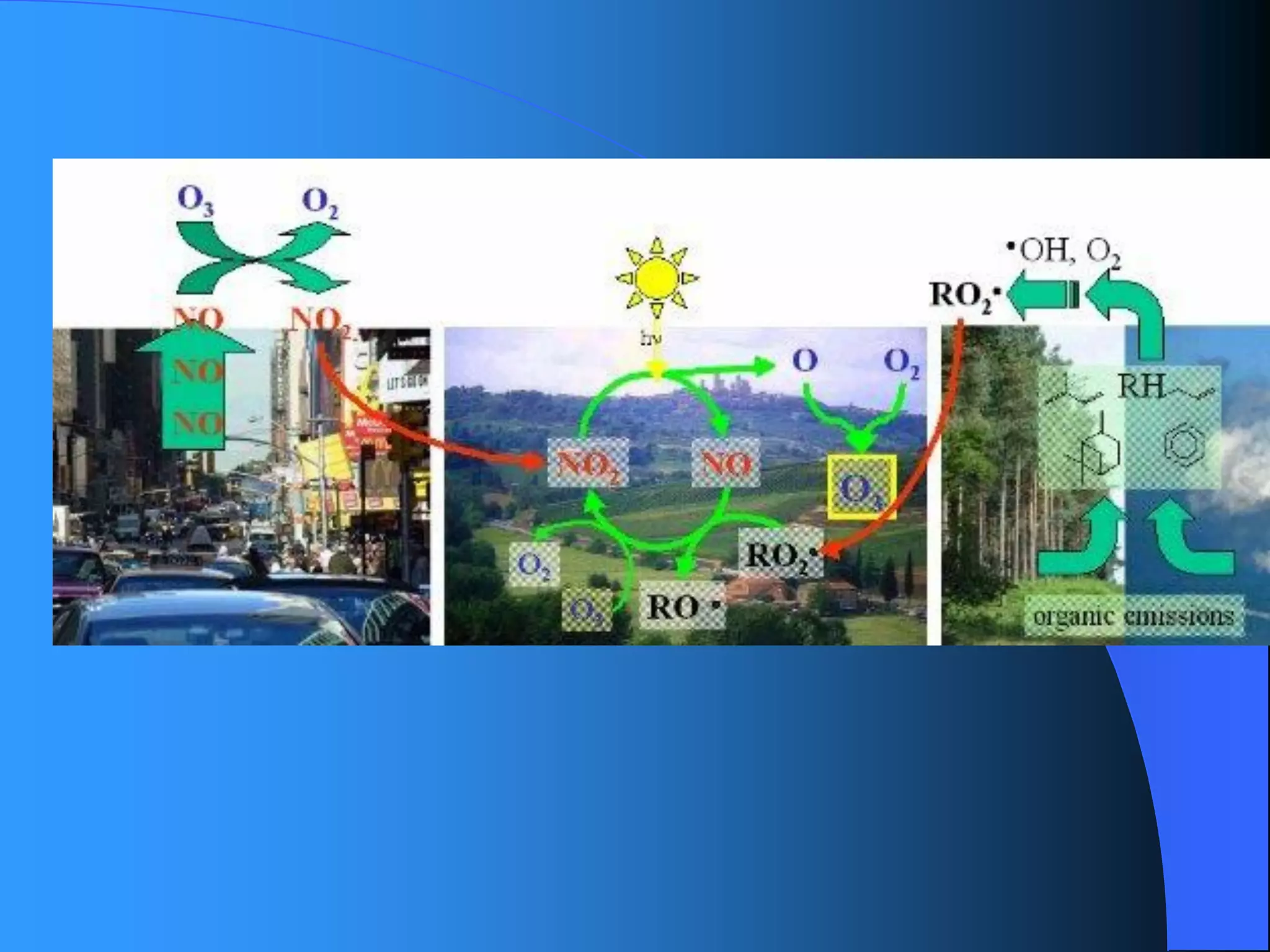
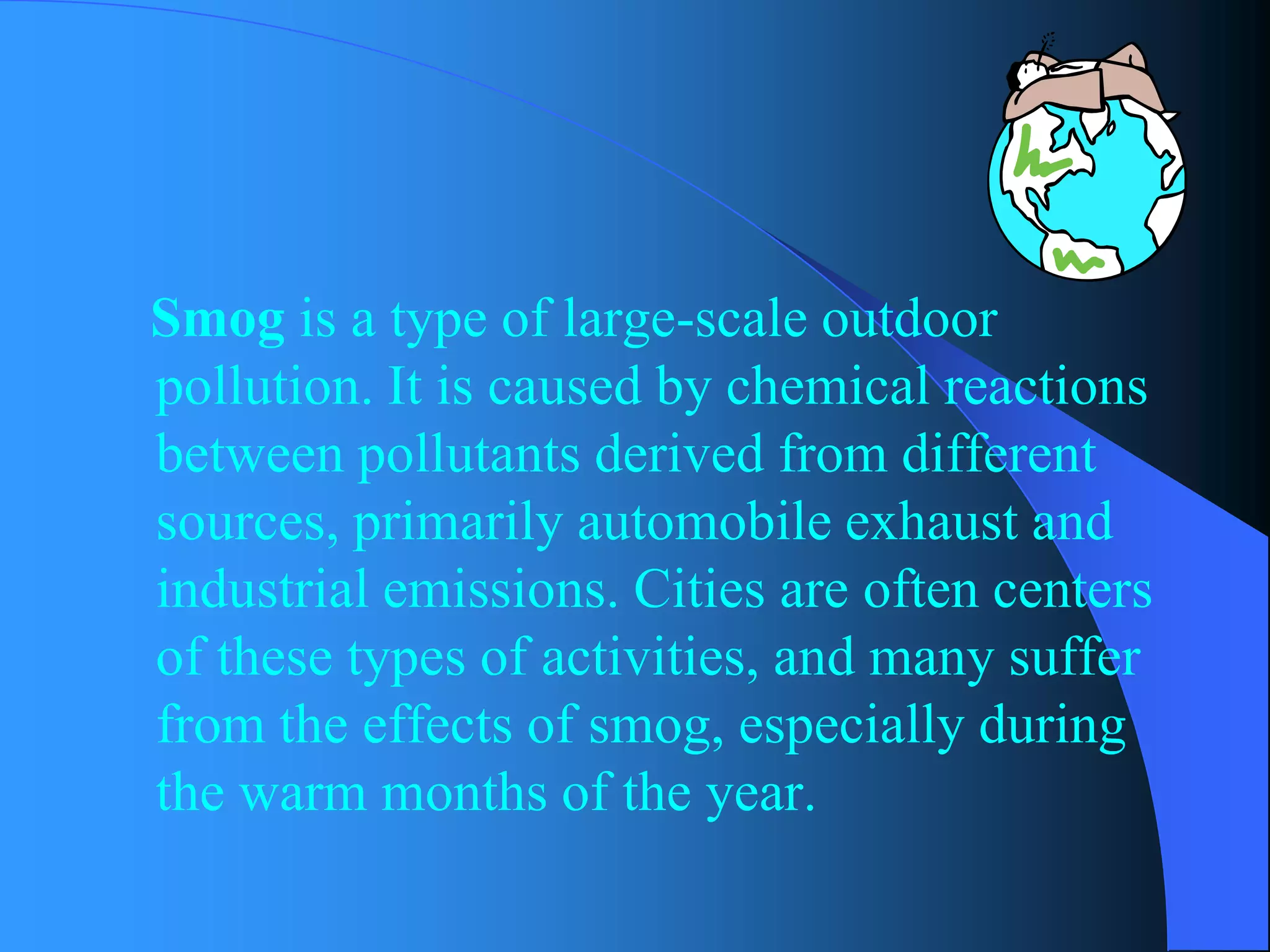
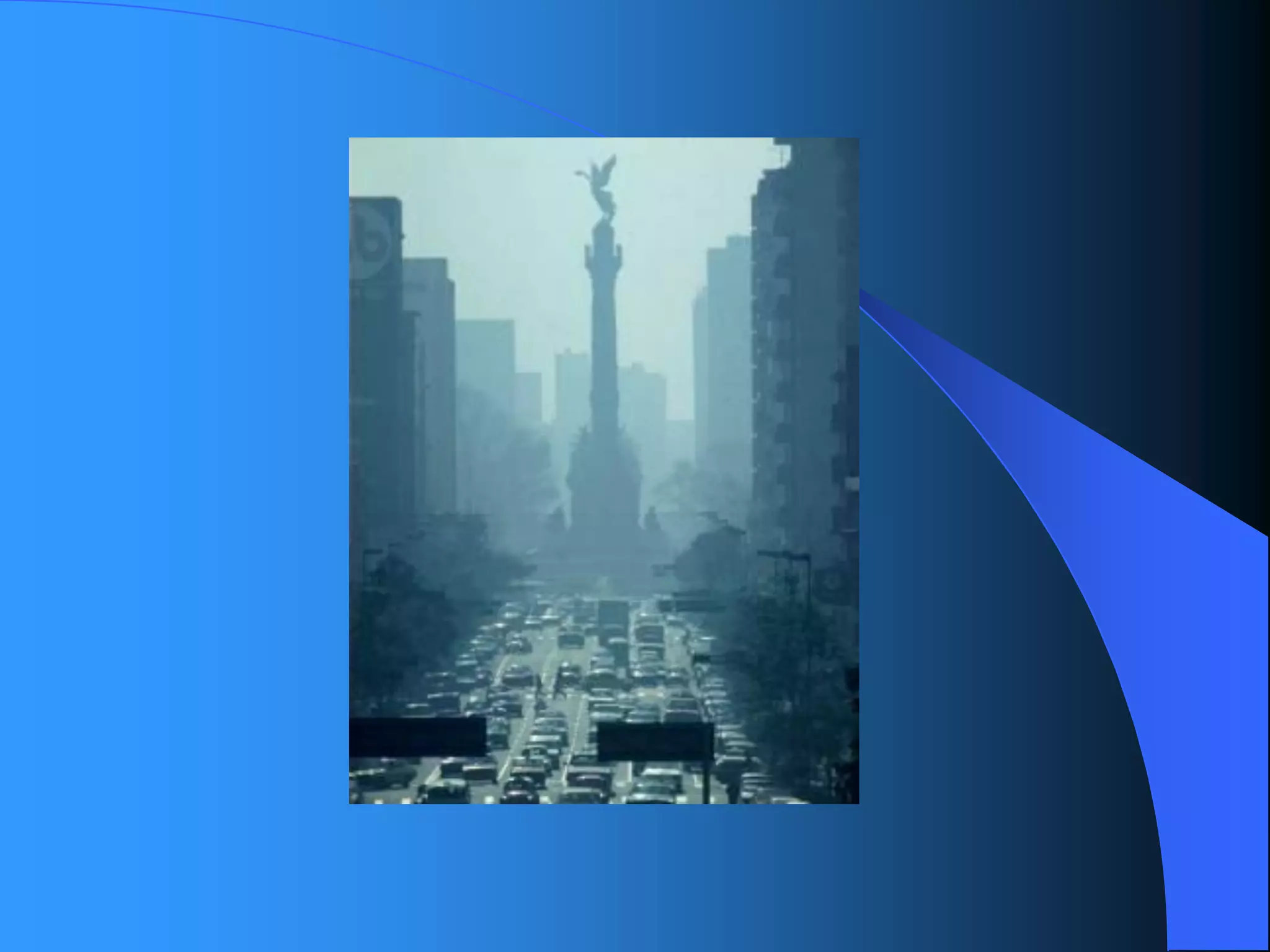
Smogis a type of large-scale outdoor pollution. It is caused by chemical reactions between pollutants derived from different sources, primarily automobile exhaust and industrial emissions. Cities are often centers of these types of activities, and many suffer from the effects of smog, especially during the warm months of the year.
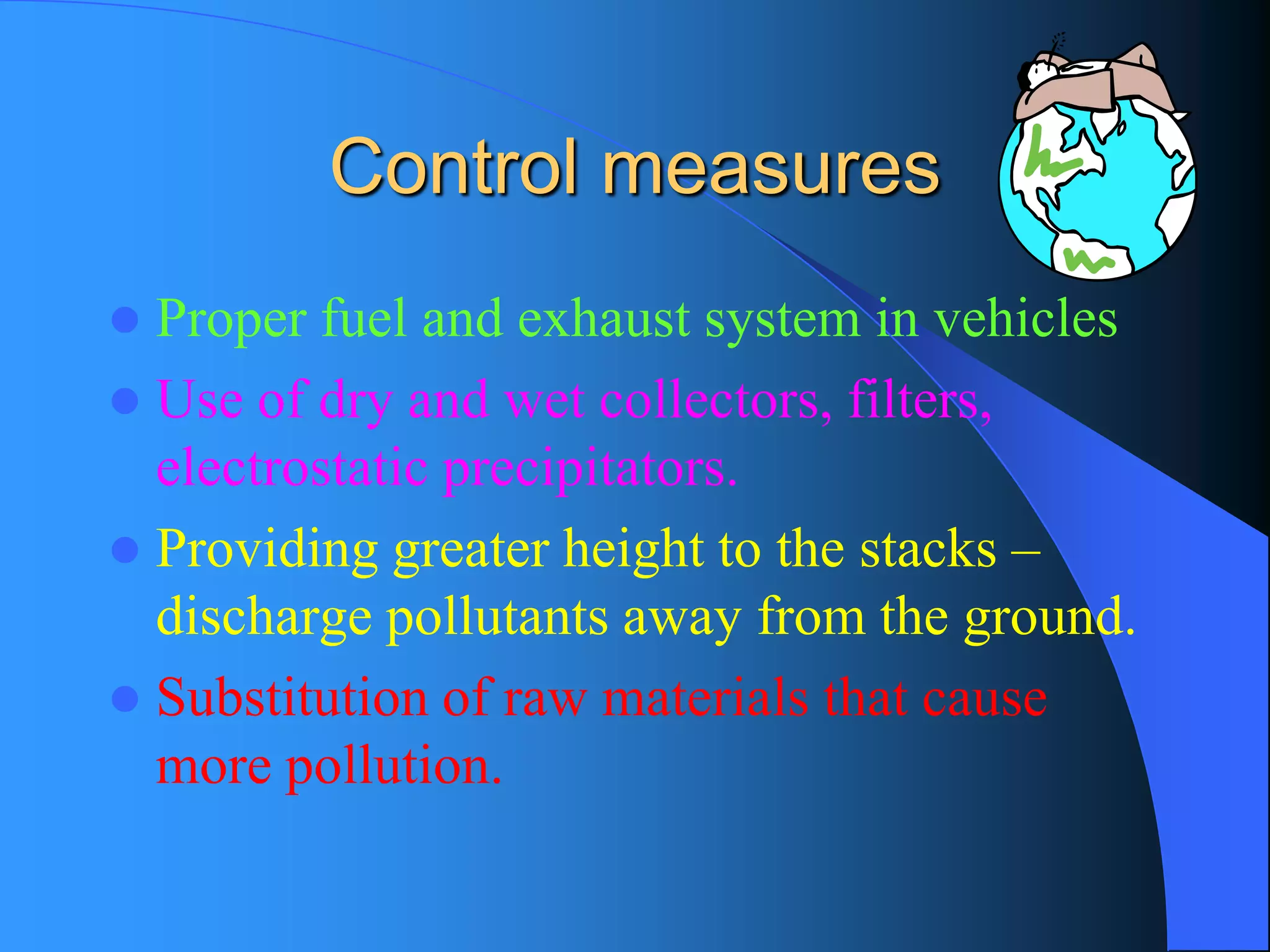
Control measures 
Proper fuel and exhaust system in vehicles 
Use of dry and wet collectors, filters, electrostatic precipitators. 
Providing greater height to the stacks – discharge pollutants away from the ground. 
Substitution of raw materials that cause more pollution.
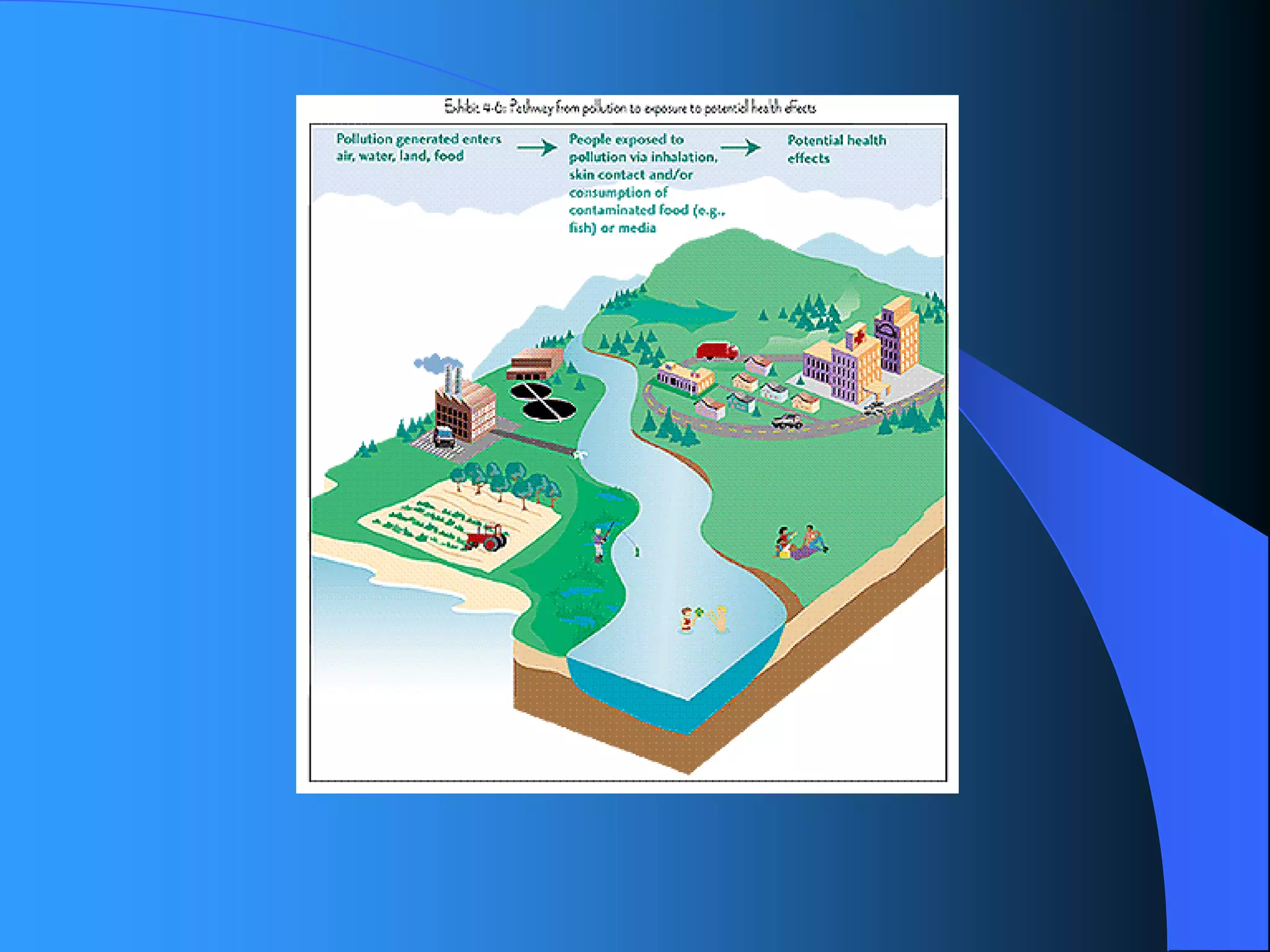
Water pollution 
71% of earth’s surface is covered by water-but only a tiny fraction is available as fresh water. 
97% of total water is found in oceans and 3% is fresh water. 
Out of this 2.997% is locked in ice caps. The only 0.003% of total volume is available as soil moisture, ground water, water vapour, water in lakes, streams, rivers and wetlands.
Definition 
When the quality or composition of water changes directly or indirectly as a result of man’s activities such that it becomes unfit for any purpose it is said to be polluted.
Types of water 
Surface water-water found in streams, rivers and lakes etc. 
Ground water-that percolates into ground 
Aquifers-porous water-saturated layers of sand, gravel or bedrock through which ground water flows. It is replenished naturally by rainfall.
Point source –source is known- 
eg. Municipal and industrial discharge pipes 
Non-point source-source is unknown- eg.agricultural runoff, acid rain
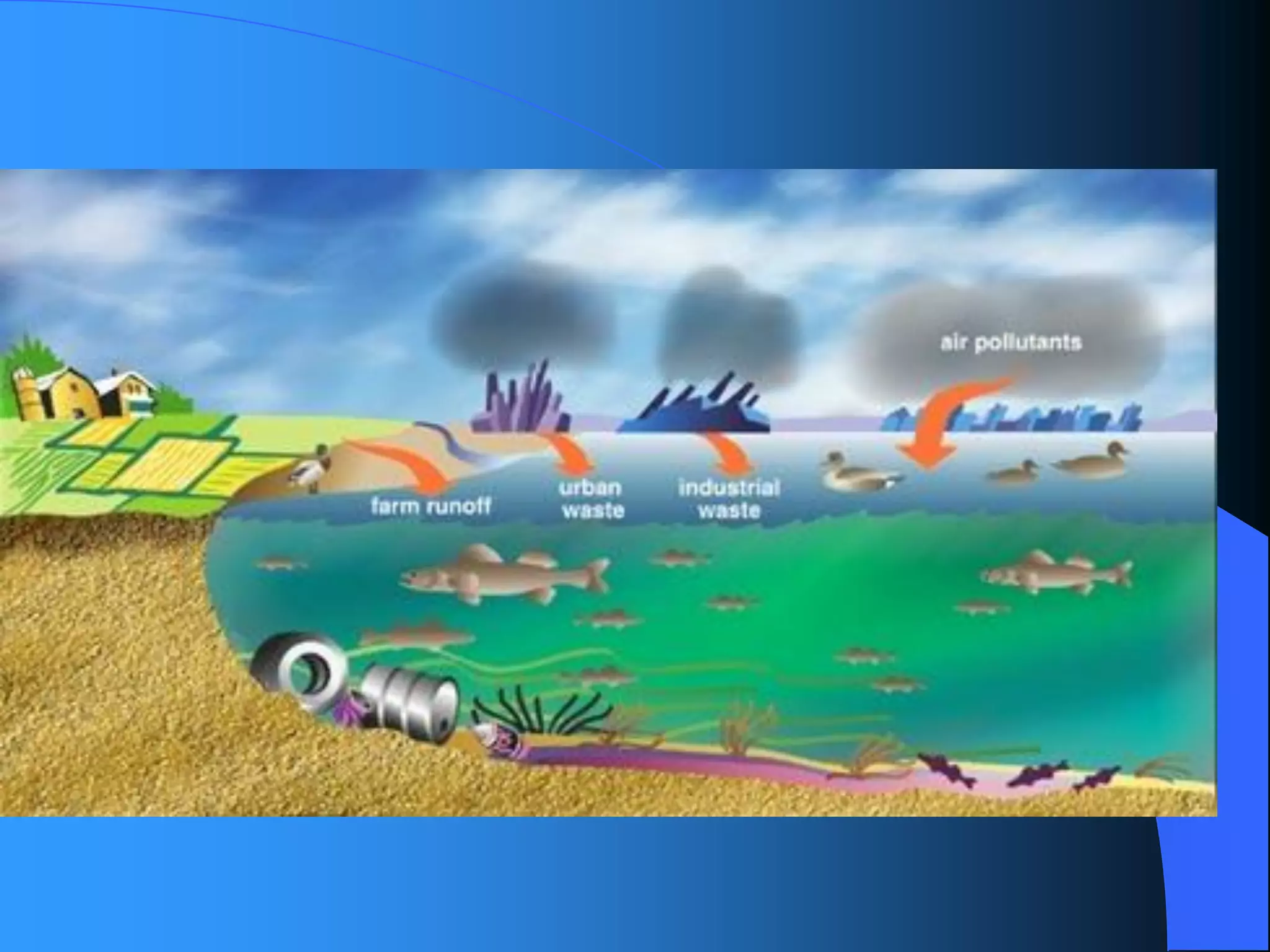
Sources of WaterPollution 
Water soluble radioactive isoptopes – radioactive wastes-ionizing radiation cause birth defects, cancer and genetic disorders. 
Hot water-thermal plants, nuclear power stations, power plants release water- 
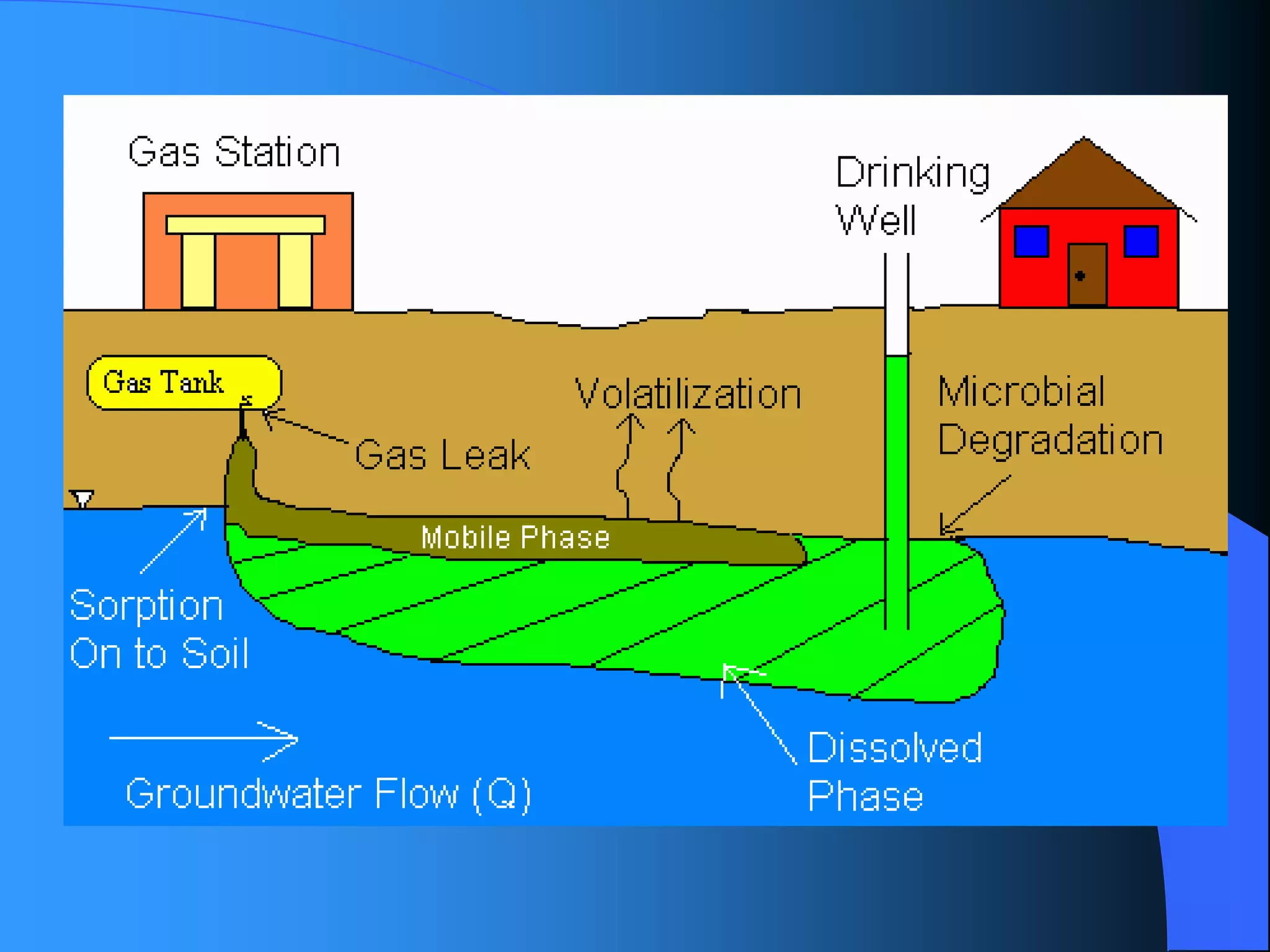
Oil-leakage
Water soluble inorganic chemicals-acids, salts and compounds of toxic metals such as mercury and lead. 
Organic compounds-oil, gaseoline, plastics, pesticides, cleaning solvents, detergents etc. 
Sediment of suspended water-insoluble particles of soil and other solids that become suspended in water
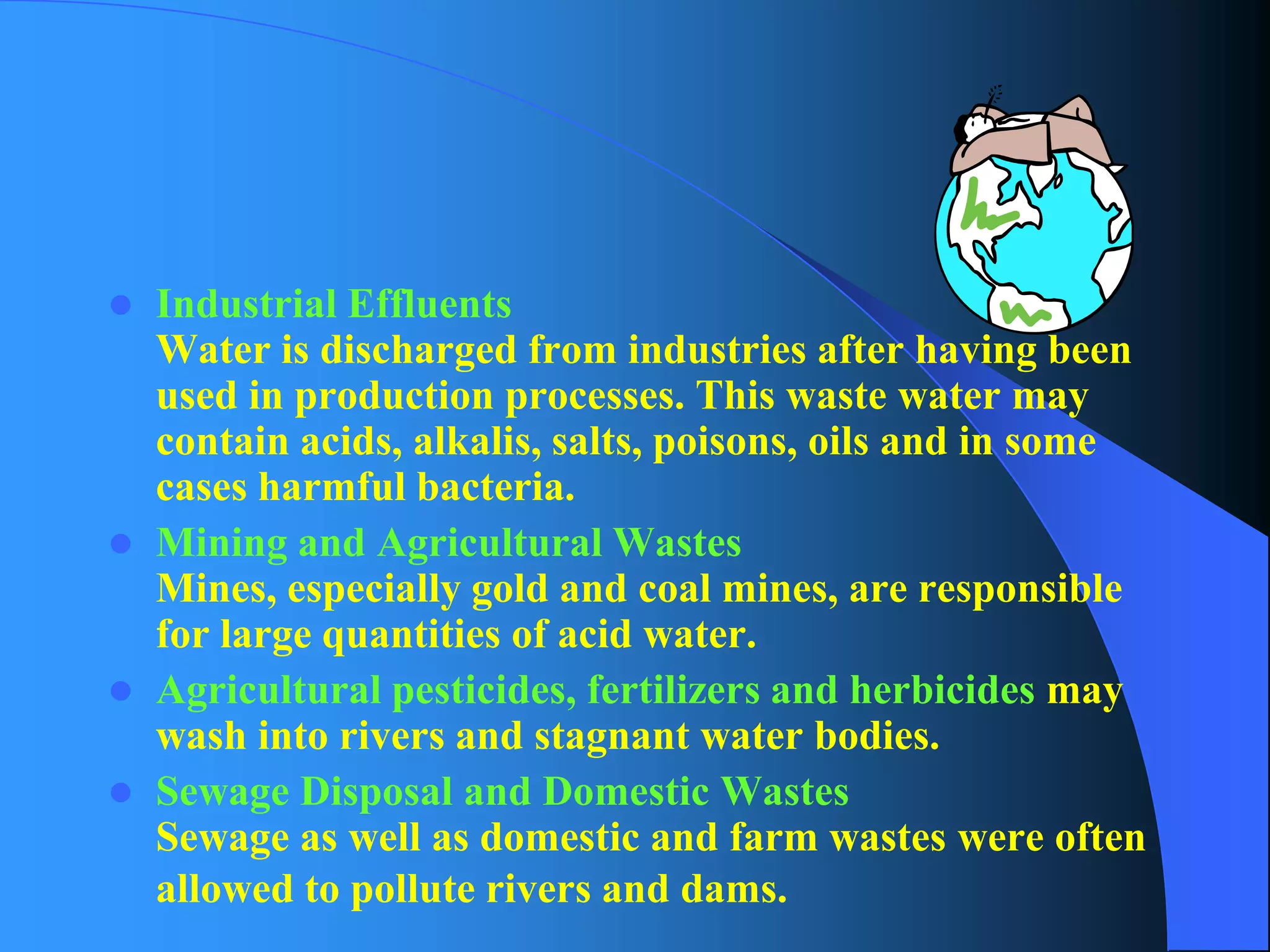
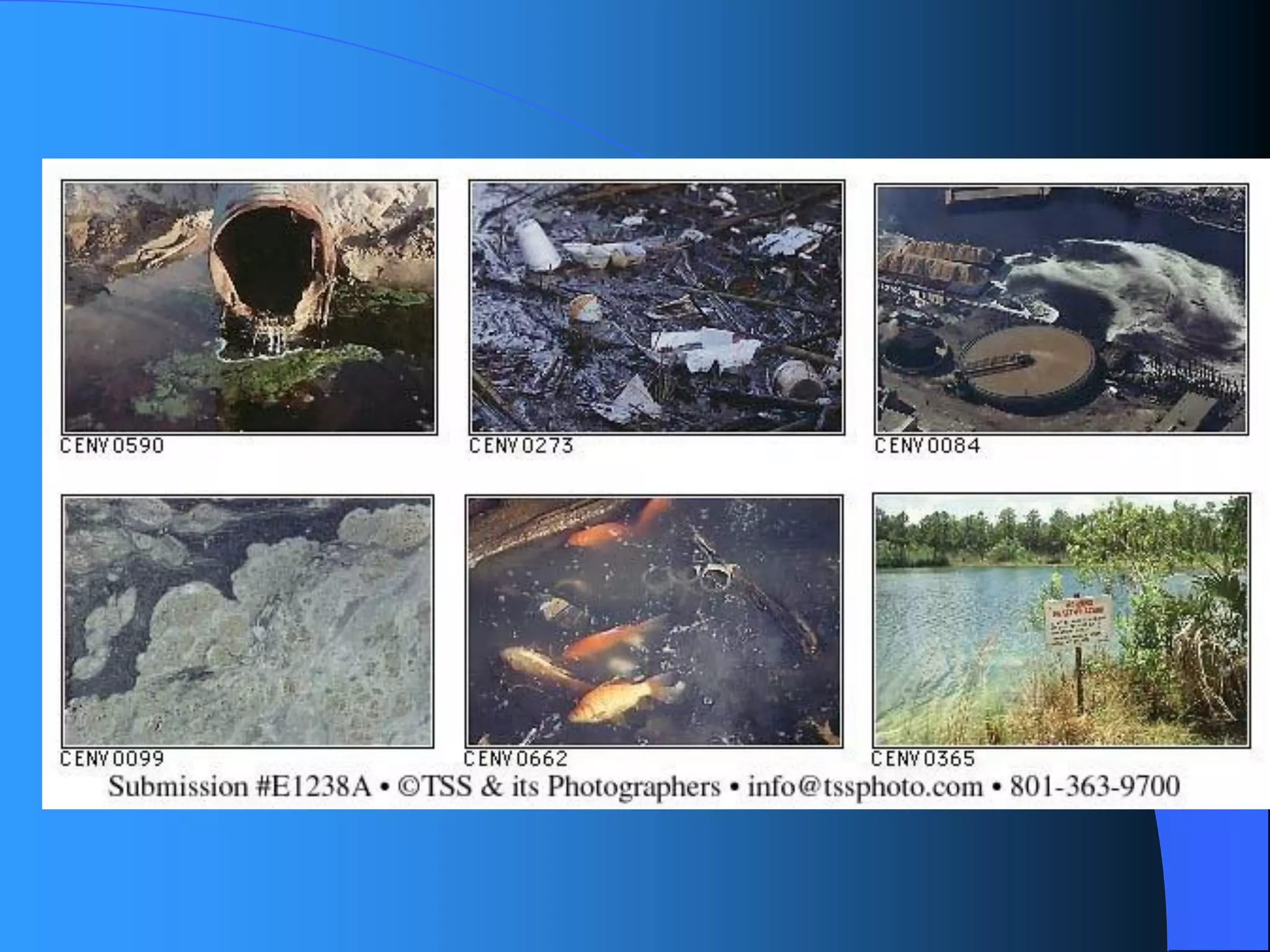
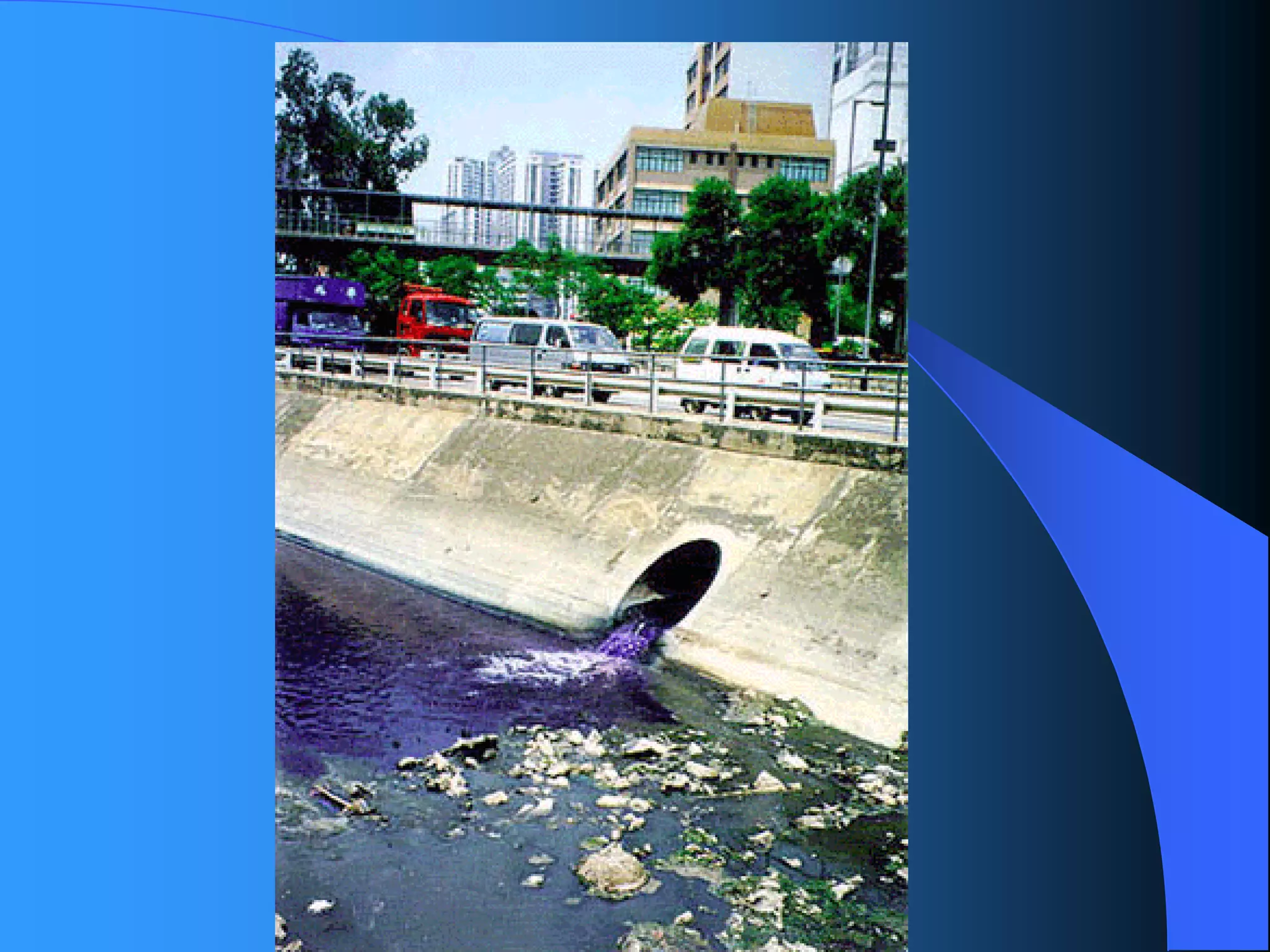
Industrial EffluentsWater is discharged from industries after having been used in production processes. This waste water may contain acids, alkalis, salts, poisons, oils and in some cases harmful bacteria. 
Mining and Agricultural WastesMines, especially gold and coal mines, are responsible for large quantities of acid water. 
Agricultural pesticides, fertilizers and herbicidesmay wash into rivers and stagnant water bodies. 
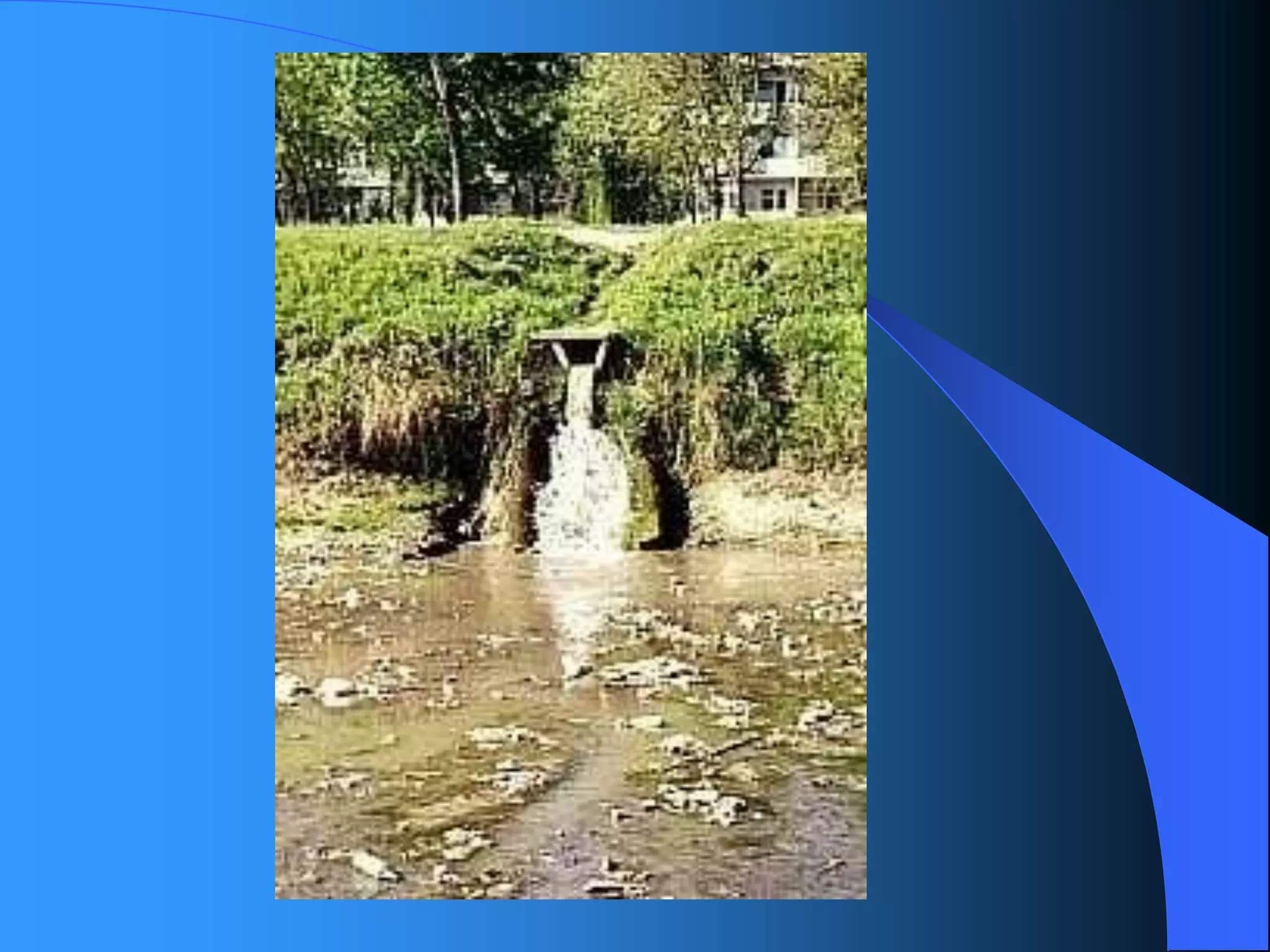
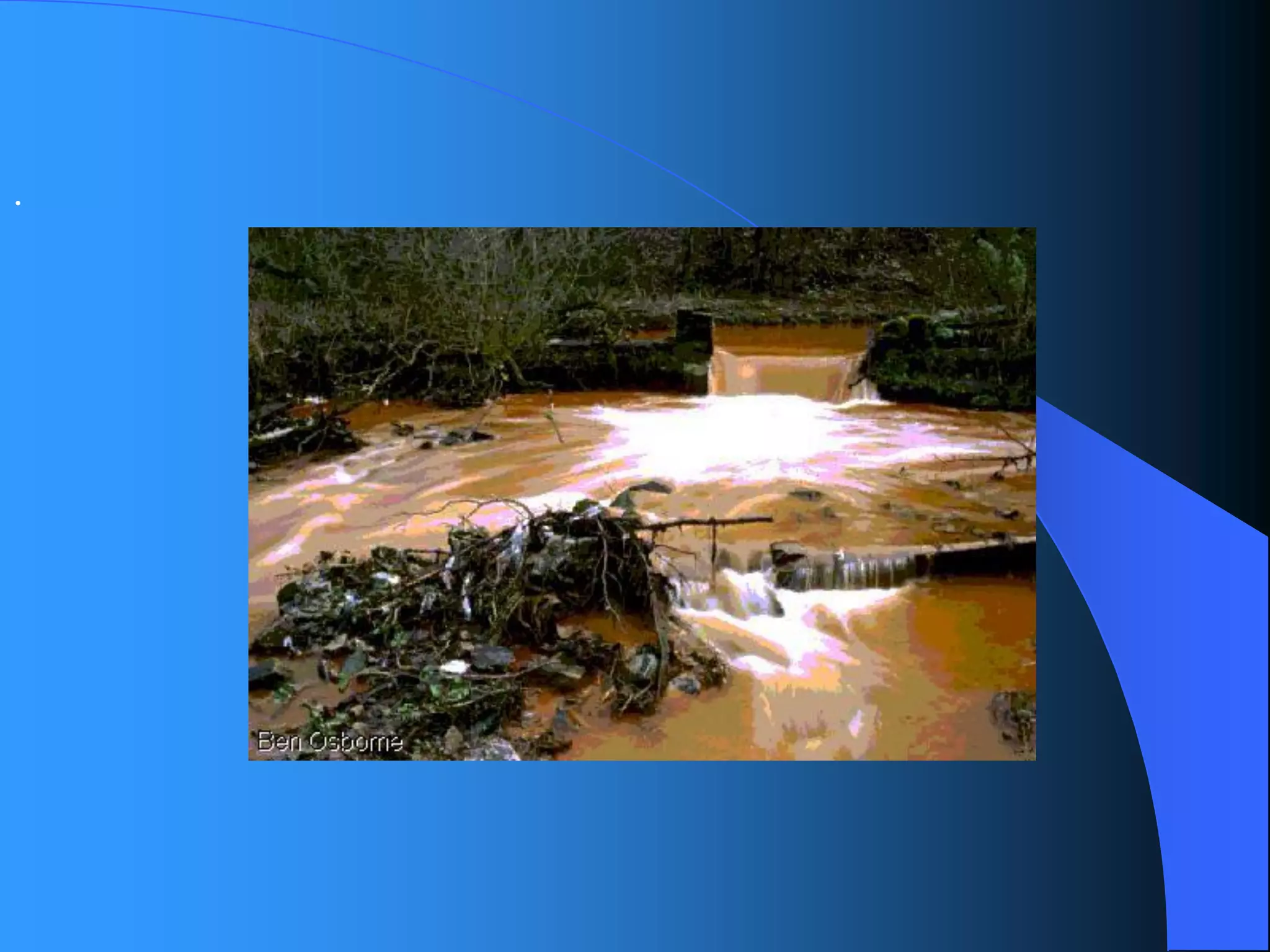
Sewage Disposal and Domestic WastesSewage as well as domestic and farm wastes were often allowed to pollute rivers and dams.
.
Causes of water pollution 
Disease causing agents –bacteria, viruses, protozoa and parasitic worms enter water from domestic sewage and untreated human and animal wastes. 
Oxygen depleting wastes-large populations of bacteria use up the oxygen present in water to degrade wastes. The amount of oxygen required to break down a certain amount of organic matter is called Biological Oxygen Demand(BOD).
If too much organic waste is added, all the available oxygen is used up and causes organisms like fish to die. 
Anaerobic bacteria begin to break down the wastes producing chemicals that have a foul and unpleasant odour.
Inorganic plant nutrients-water soluble nitrates and phosphates that cause excessive growth of algae and other aquatic plants-called eutrophication. 
Biomagnification-pesticides-reach water- phytoplanktons-herbivorous fish-carnivorous fish- water birds-animals-human beings. 
At each stage the chemicals are concentrated resulting biomagnifiction. Eg.DDT
Control measures 
Prevention 
Setting up treatment plants 
Root Zone Process –using reefs
.
.
Soil pollution 
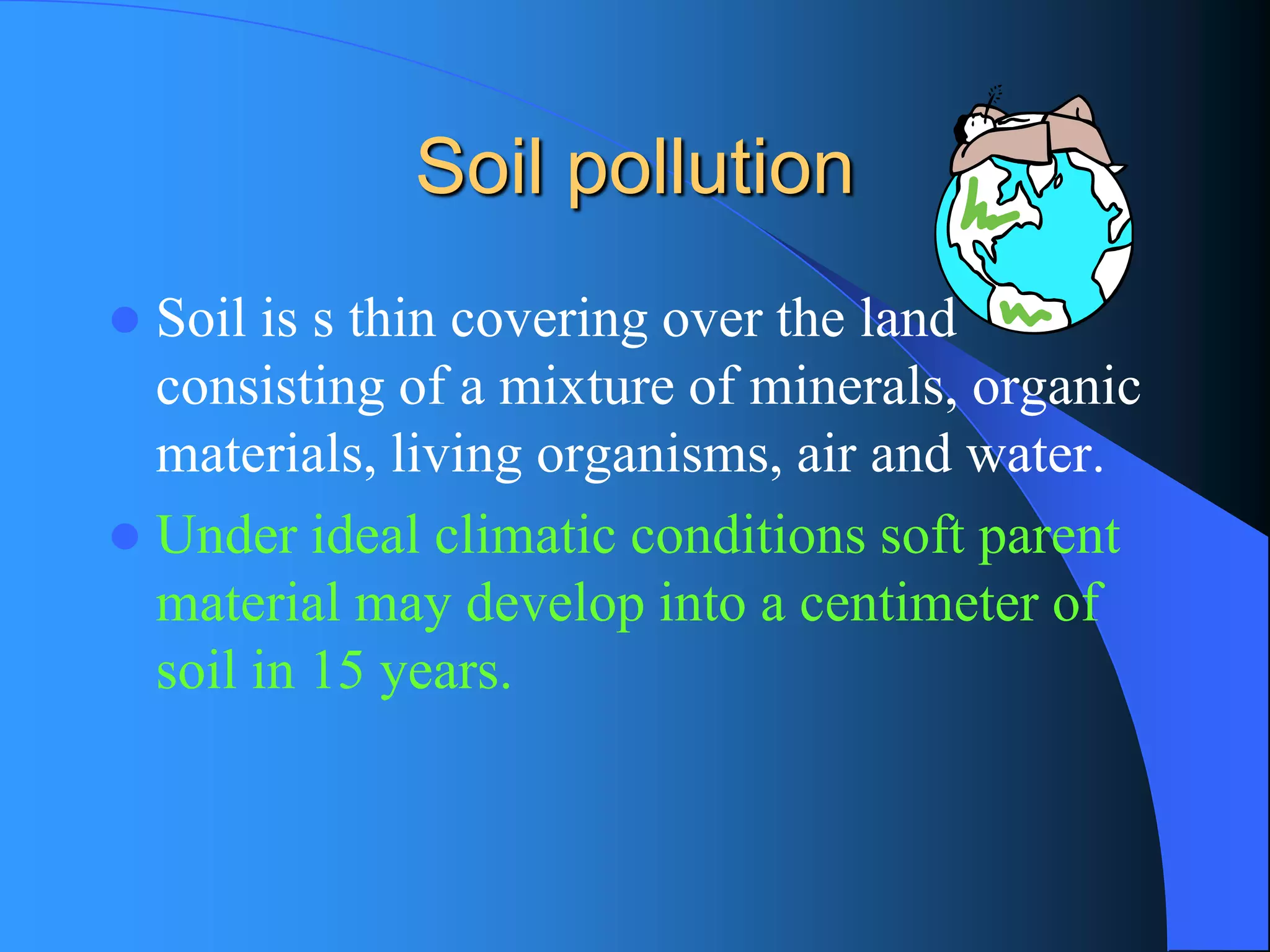
Soil is s thin covering over the land consisting of a mixture of minerals, organic materials, living organisms, air and water. 
Under ideal climatic conditions soft parent material may develop into a centimeter of soil in 15 years.
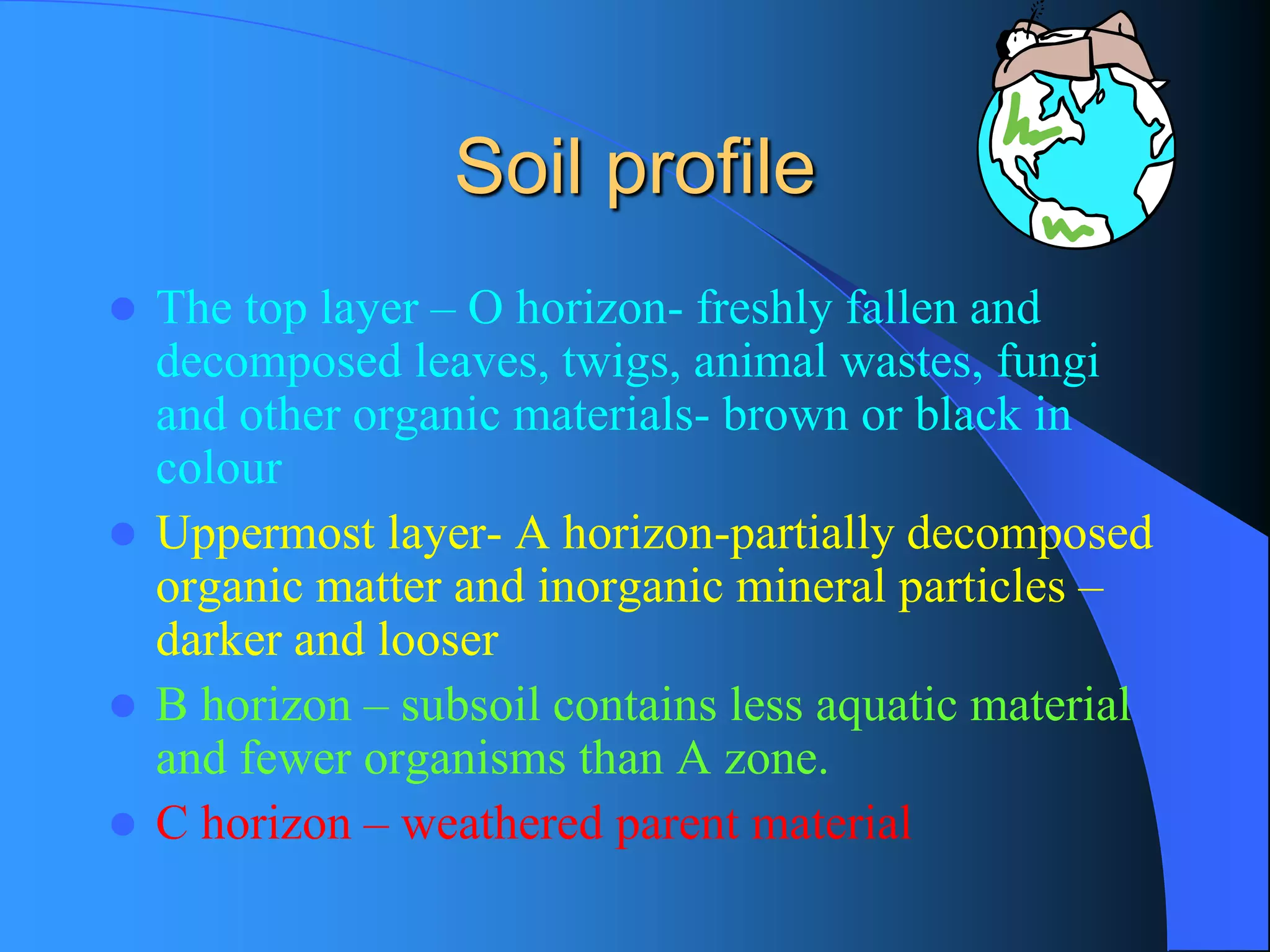
Soil profile 
The top layer –O horizon-freshly fallen and decomposed leaves, twigs, animal wastes, fungi and other organic materials-brown or black in colour 
Uppermost layer-A horizon-partially decomposed organic matter and inorganic mineral particles – darker and looser 
B horizon –subsoil contains less aquatic material and fewer organisms than A zone. 
C horizon –weathered parent material
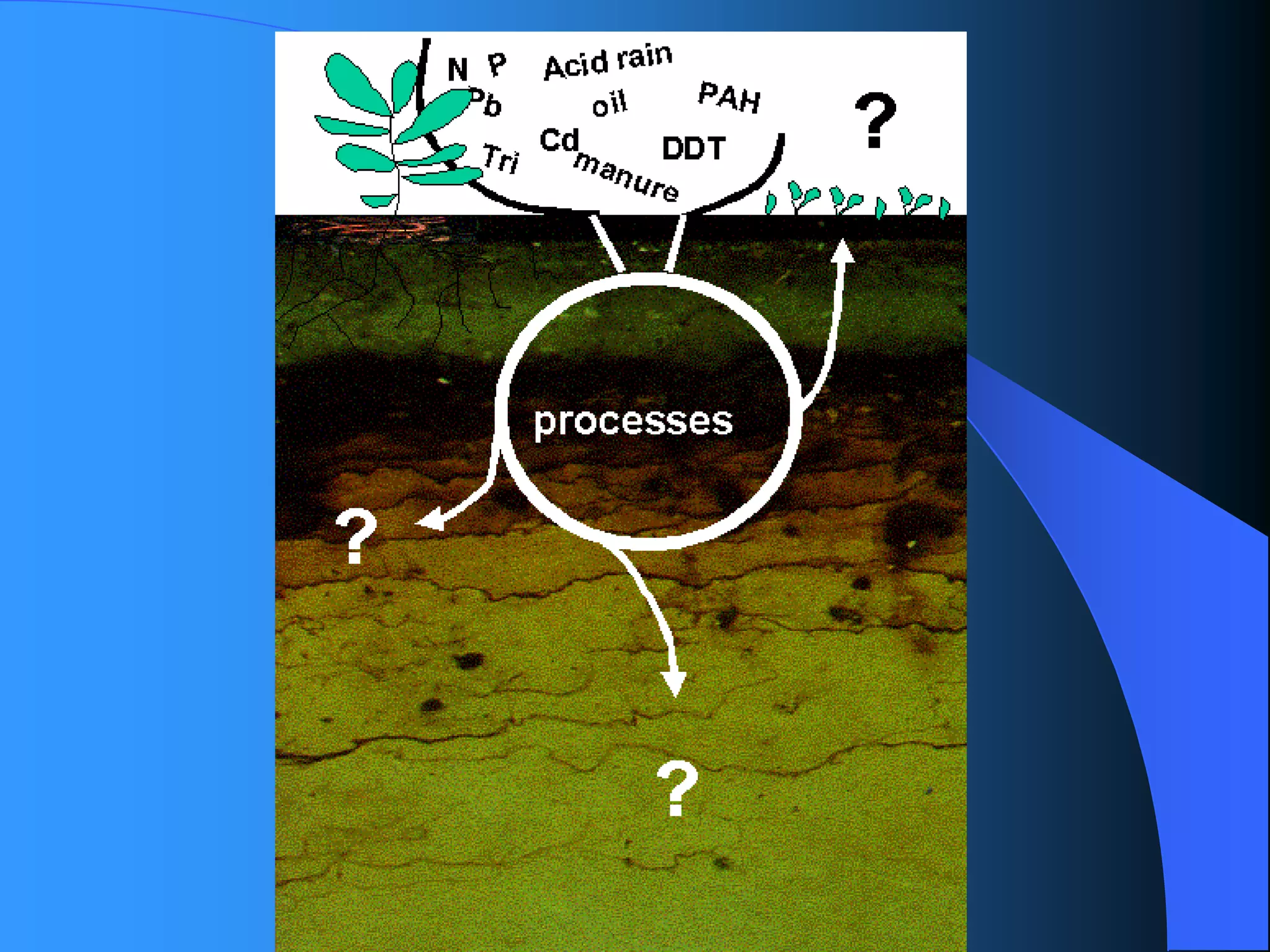
Causes of soil degradation 
Erosion 
By wind and water accelerated by human activities such as farming, construction, overgrazing by livestock, burning of grass cover, deforestation.
Excess use of fertilizers 
Fertilizers, insecticides, herbicides, pesticides, fungicides, rodenticides 
Soil fertility is lost 
Kill beneficial insects
Integrated Treatment Methods 
Continuous contour trenches or benches 
Live check dams –planting grass, shrubs and trees etc. 
Bund constructed out of stones. 
Earthen check bund-local soil,across the stream
Integrated Pest Management 
Organic farming 
Use of biofertilzers 
Earthworms-vermicomposting 
Pest control through microbes –Bacillus thrungiensis, Azadirachta indica-Neem
Marine Pollution 
The introduction of substances to the marine environment directly or indirectly by man resulting in adverse effects
Causes 
Direct discharge of wastes into sea – sewage 
Washed off materials-fertilizers, pesticides 
Petroleum, oils washed off from roads 
Spill of Toxic substances from ships 
Offshore oil exploration and extraction
Effects of marine pollution 
Eutrophication-phytoplankton blooms 
Oil slick –affect plants and fish 
Destroys flora and fauna
Control Measures 
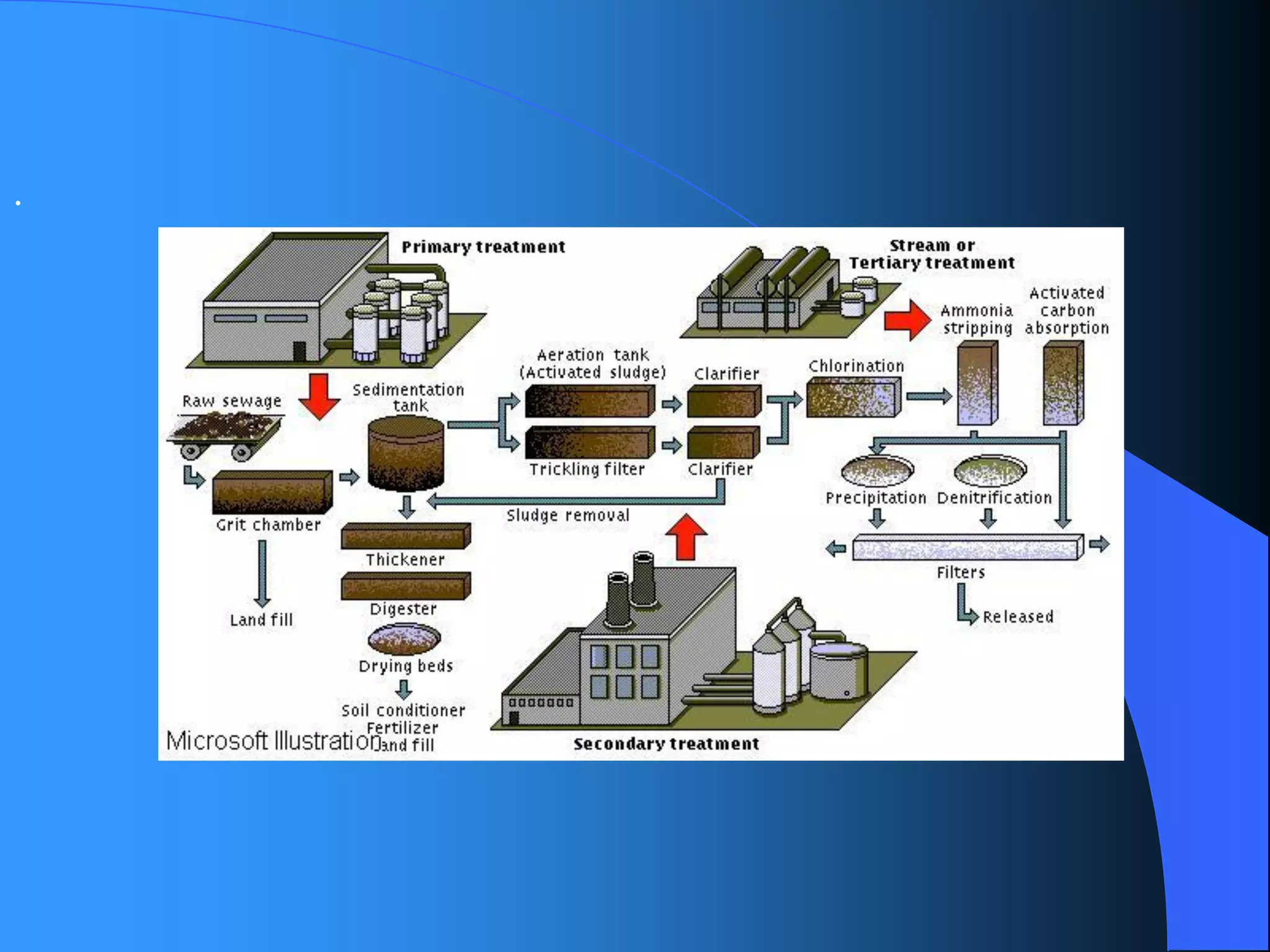
Introduction of sewage treatment plants 
Primary treatment-physical process such as screening and sedimentation to remove pollutants that will settle, float etc. 
Secondary treatment-to remove BOD
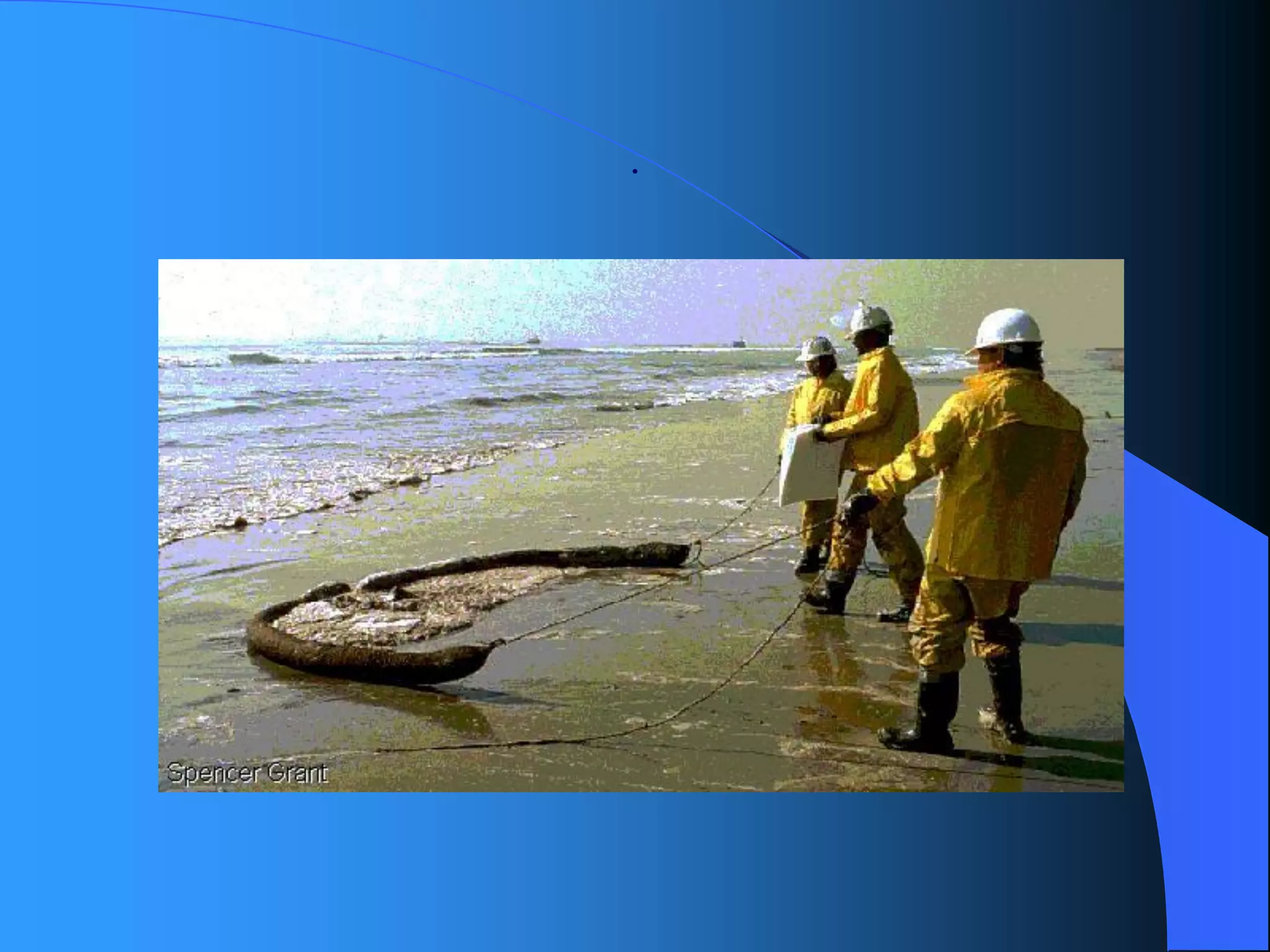
Control measures for oil pollution 
Process of emulsification through chemical dispersants-sprayed on the oil. 
Biological methods-use of bacteria
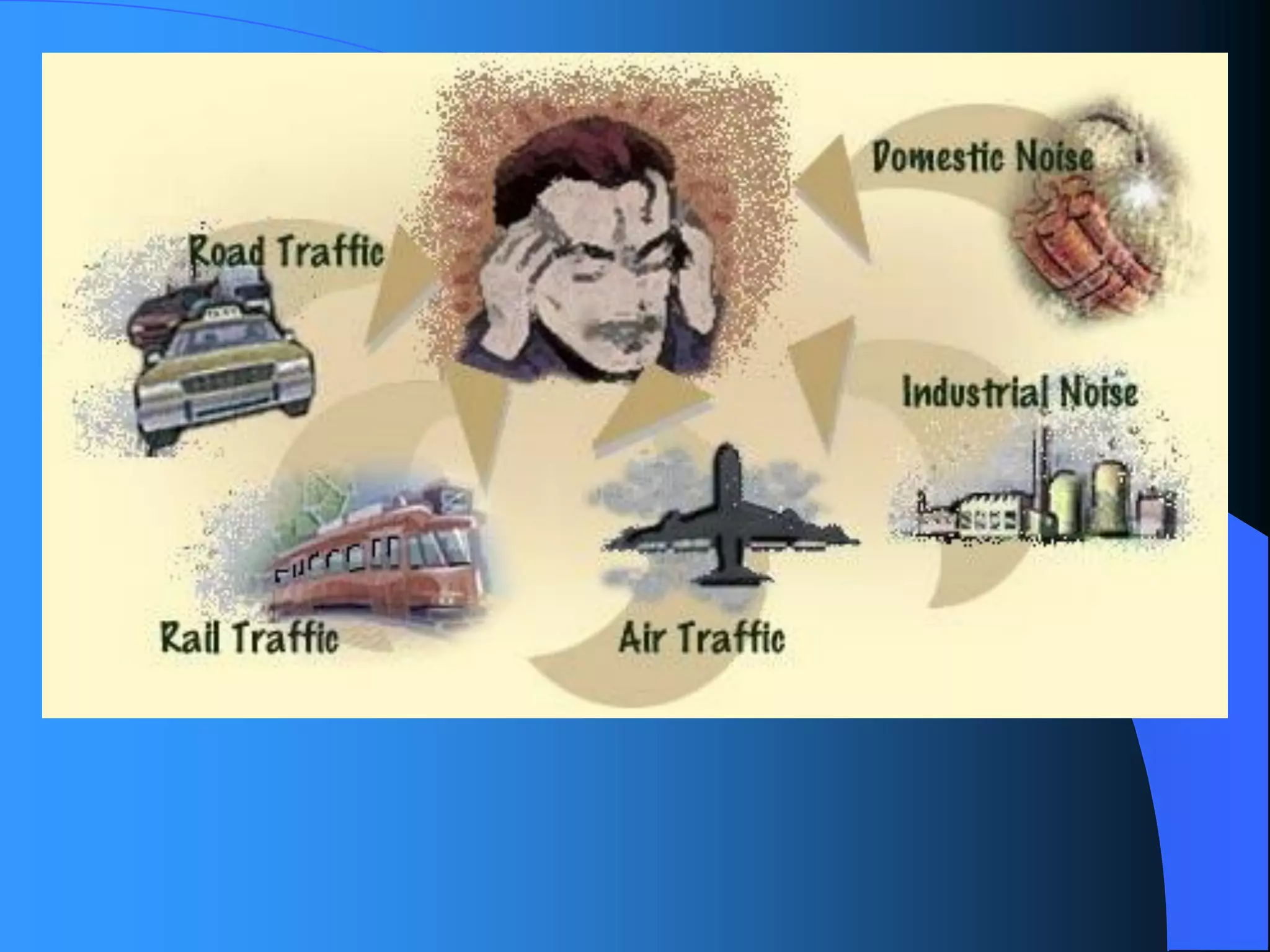
Noise Pollution 
Noise is unwanted and undesirable sound 
Permitted noise level is 125 decibels
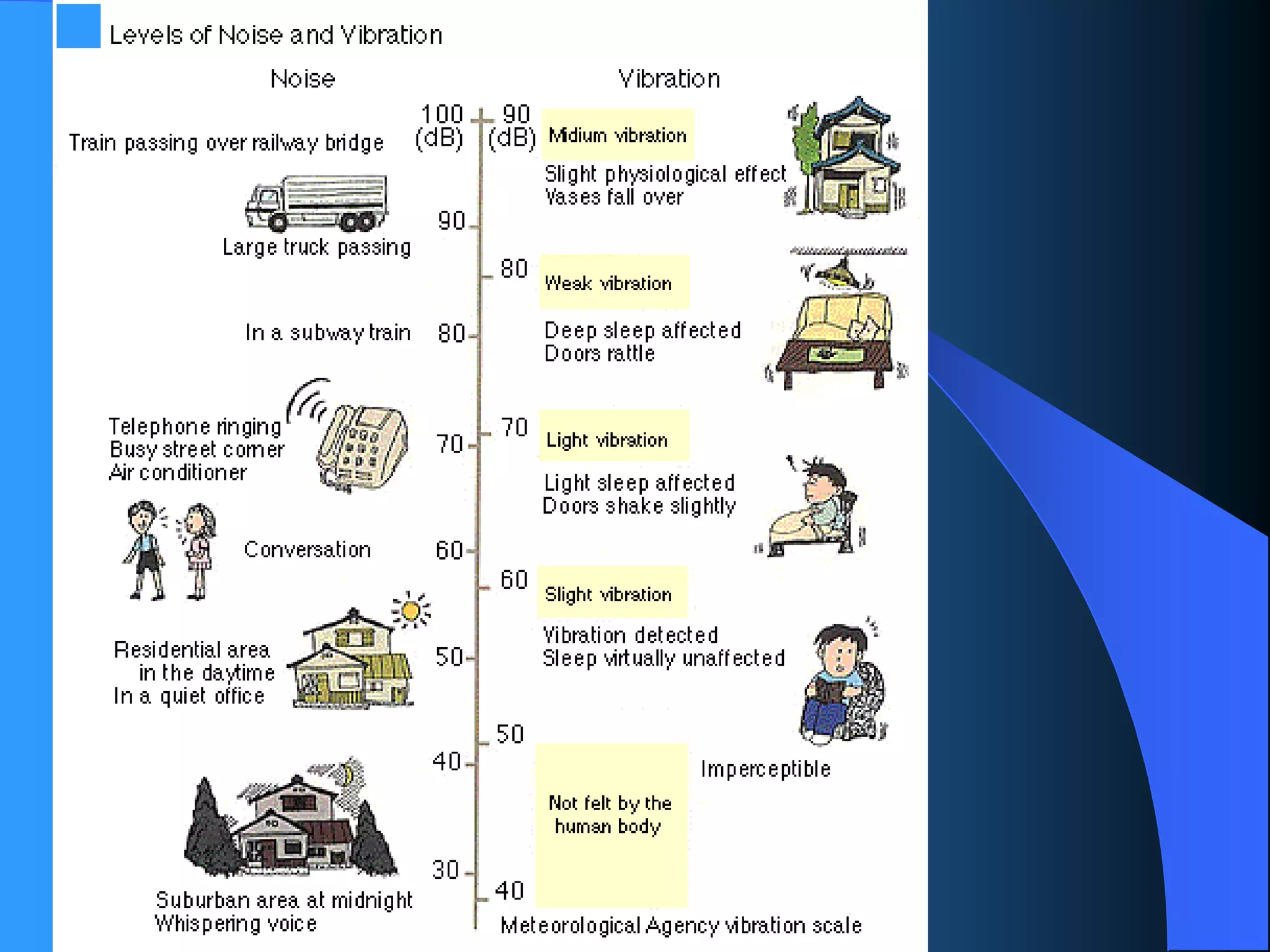
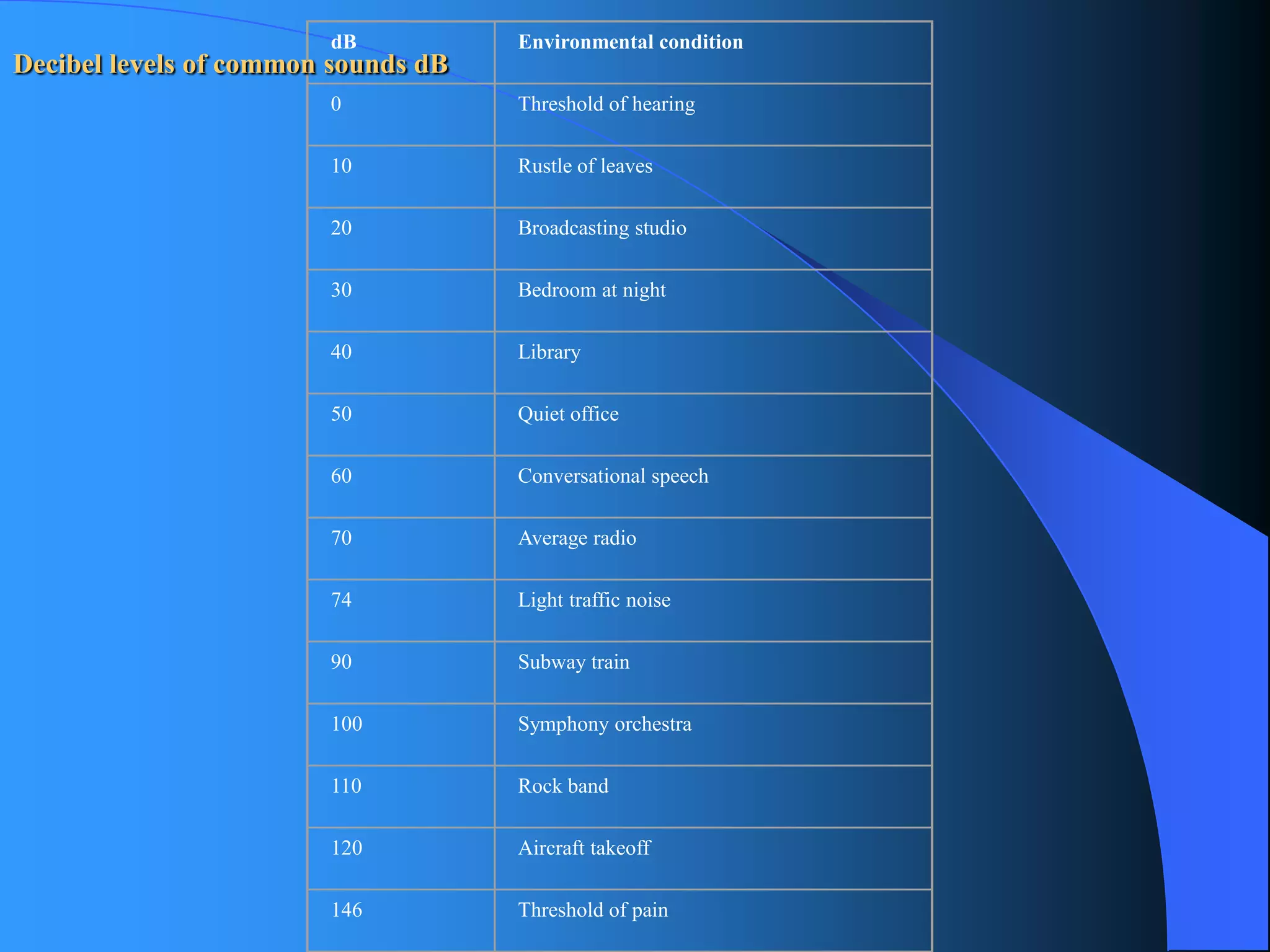
dBEnvironmental condition0Threshold of hearing10Rustle of leaves 
20 
Broadcasting studio30Bedroom at night40Library50Quiet office 
60 
Conversational speech70Average radio74Light traffic noise90Subway train 
100 
Symphony orchestra110Rock band120Aircraft takeoff146Threshold of painDecibel levels of common sounds dB
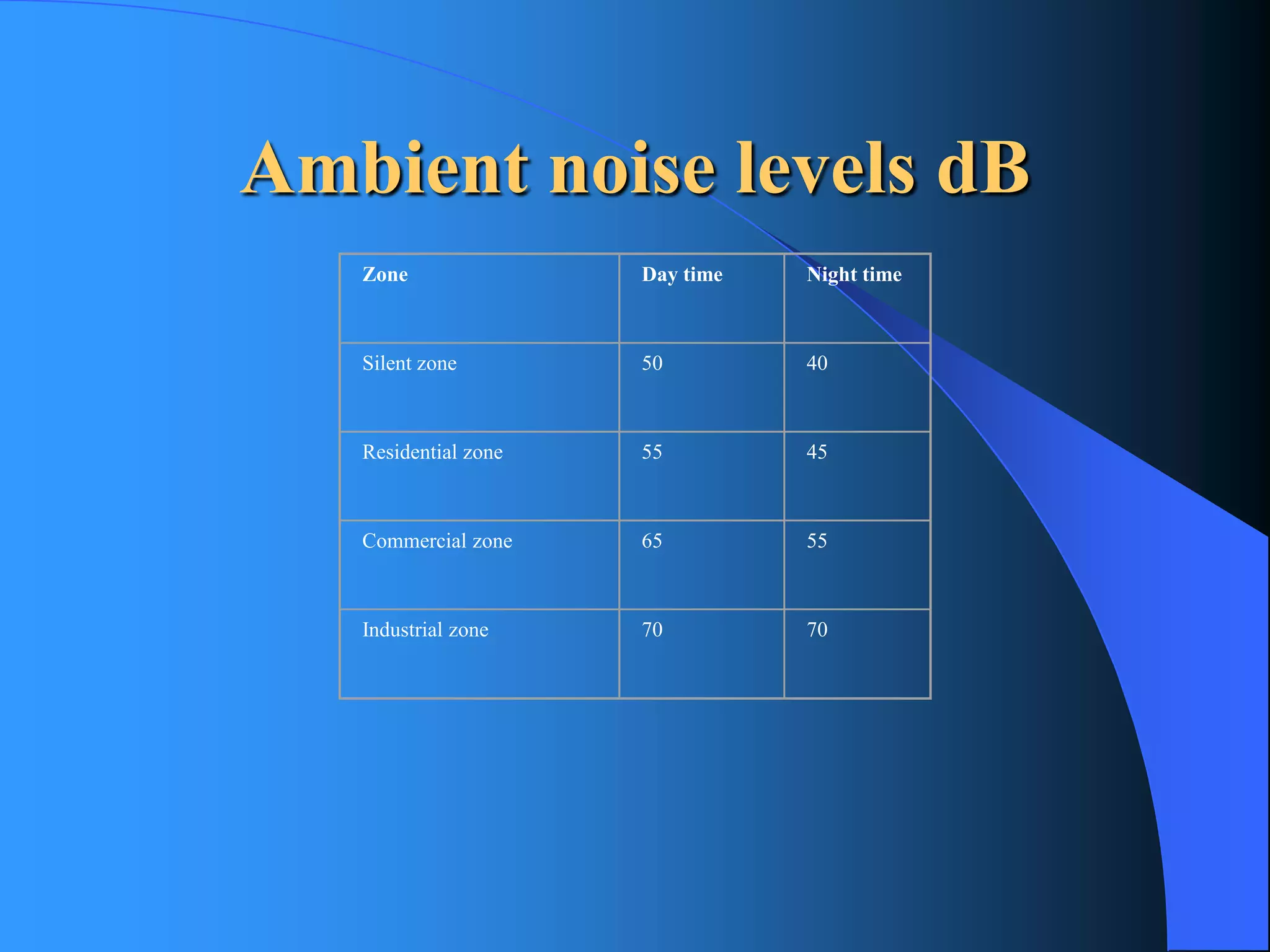
Ambient noise levels dB 
Zone 
Day timeNight time 
Silent zone5040 
Residential zone5545 
Commercial zone65 
55Industrial zone70 
70
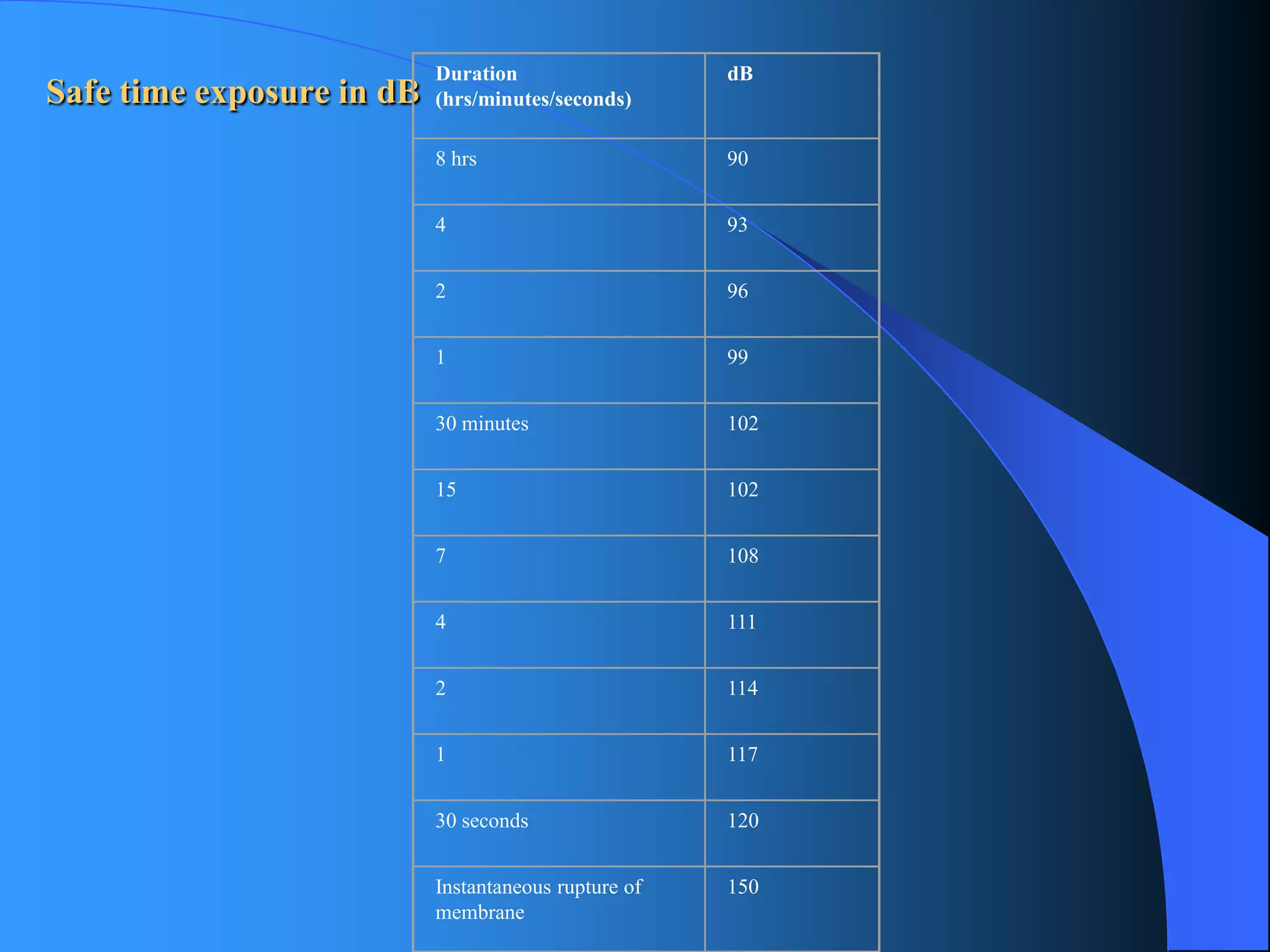
Safe time exposure in dB 
Duration (hrs/minutes/seconds) 
dB8 hrs 
90493 
2961 
9930 minutes 
10215102 
71084 
1112 
1141117 
30 seconds120Instantaneous rupture of membrane 
150
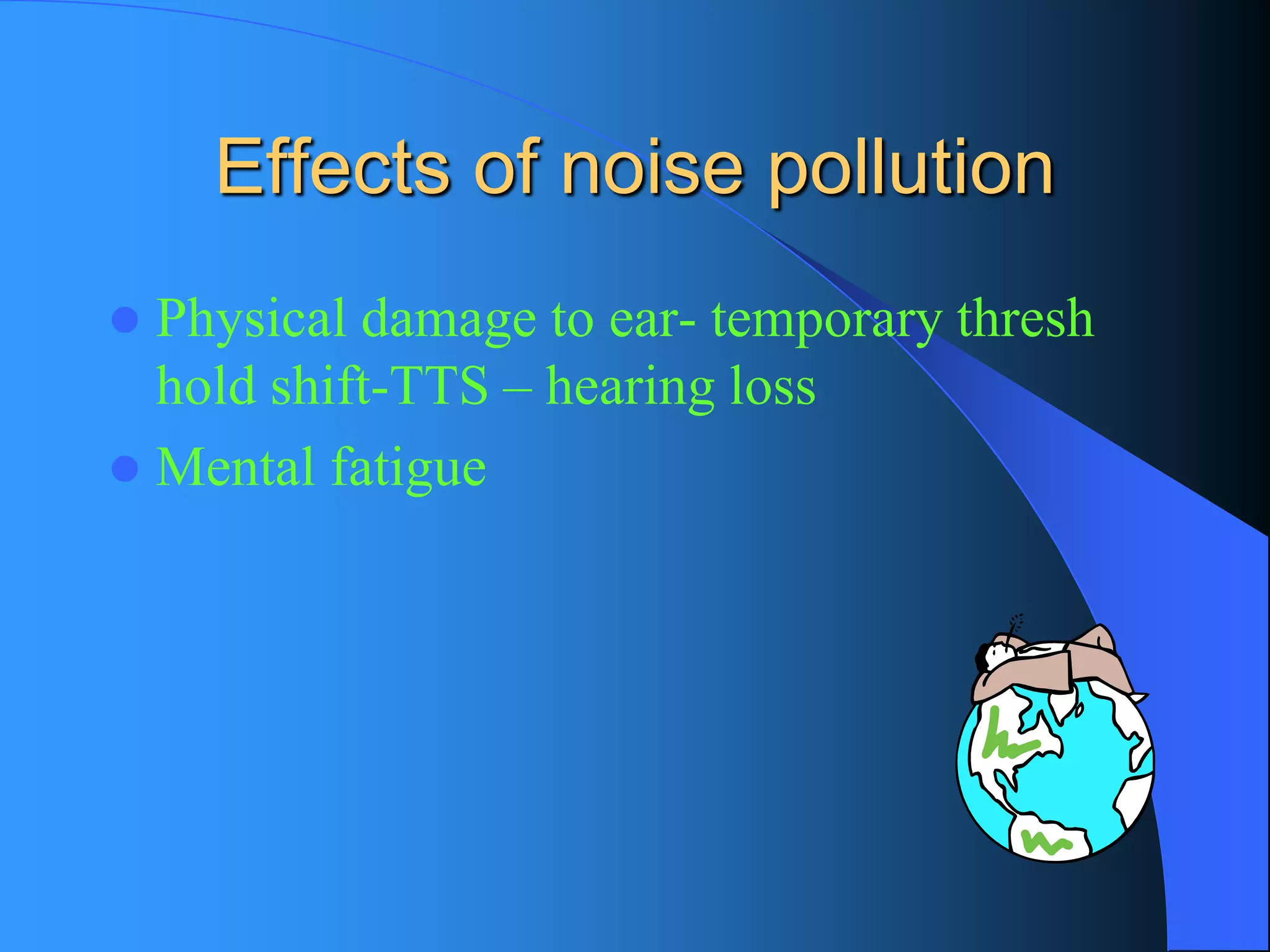
Effects of noise pollution 
Physical damage to ear-temporary thresh hold shift-TTS –hearing loss 
Mental fatigue
Control techniques 
Reduce noise at source 
Block the path of noise 
Increase the path length and 
protect the recipient
Thermal Pollution 
Sources-discharge of warm water into river 
Effects-changes the ecological balance of river 
Death of fish 
Effect on plants 
Control-passing the heated water through a cooling pond or cooling tower after it leaves the condenser
Nuclear hazards 
Nuclear fission –splitting of the nucleus of the atom –resulting energy is used for a variety of purposes 
Hot water 
Uranium waste –ionizing material
Effects of nuclear pollution 
Lethal 
Mutation 
Plants and animals 
Marine organisms-fish 
Skin diseases, cancer, eye disorders etc.,
Control measures 
Away from the cities 
Proper disposal mechanisms 
Safety measures
Role of an individual in prevention of pollution 
Develop respect to all forms of life 
Try to plant trees where ever you can 
Reduce the use of paper and wood products where ever possible –use recycled paper 
Do not buy furniture, doors etc., made from teak –forest based 
Help in restoring a degraded area 
Join in an aforestation program
Advocate organic forming 
Avoid use of pesticides 
Reduce fossil fuel –coal, petrol etc. save petrol 
Shut of the lights and fans when not needed-save electricity 
Do not use aerosol spray products 
do not pour chemicals, paints pesticides in the drain
Use rechargeable batteries 
Do not use cans, avoid plastics –plastic carry bags 
Recycle paper, aluminum, plastics 
Set up compost bin in your garden 
Start community composting 
Keep you and your place clean
Environmental protection 
begins with 
YOU!!!
Thank you

Environmental Pollution - Causes, Effects and Control Measures

  • 1.
    Environmental Pollution- Causes,Effects and Control Measures Prepared by M.SHANMUGARAJ M.E., V.S.V.N Polytechnic College, Virudhunagar Tamil Nadu India
  • 2.
    Definition “Pollution isthe effect of undesirable changes in our surroundings that have harmful effects on plants, animals and human beings”.
  • 3.
    Pollutant Any thing(solid, liquid or gas) that cause pollution is called pollutant Eg. Lead, sulphuric acid, carbon monoxide,
  • 4.
  • 5.
    Degradable: Those canbe readily broken down by natural processesEg. Discarded vegetablesNon-degradable: Those can not be degraded by natural processes Eg.plastics
  • 6.
    Types of Pollution NoiseAir Water Land or SoilThermal Nuclear
  • 7.
    Air Pollution Airpollution occurs due to the presence of undesirable solid or gaseous particles in the air in quantities that are harmful to human health and environment
  • 8.
    Composition of Air Composition of Air
  • 9.
    ComponentSymbol VolumeNitrogenN2 78.084%99.998% Oxygen O220.947% Argon Ar 0.934% Carbon Dioxide CO2 0.033% NeonNe 18.2 parts per millionHeliumHe 5.2 parts per millionKrypton Kr 1.1 parts per millionSulfur dioxide SO2 1.0 parts per million Methane CH4 2.0 parts per million HydrogenH20.5 parts per million Nitrous OxideN2O0.5 parts per million XenonXe 0.09 parts per million OzoneO3 0.07 parts per million Nitrogen dioxide NO2 0.02 parts per million Iodine I20.01 parts per millionCarbon monoxide COtraceAmmonia NH3trace
  • 10.
    Types of pollutants Primary pollutants Pollutants that are emitted directly from identifiable sources – produced by both natural events or human activities Eg. Dust storms, emission from vehicles Secondary pollutants When certain chemical reactions take place among the primary pollutants Eg. Sulphuric acid
  • 11.
    Primary pollutants Carbonoxides (CO2 and CO) Nitrogen oxides Sulphur oxides Volatile organic compounds –hydro carbons Suspended particulate matter
  • 12.
    TERM MEANING EXAMPLES AerosolParticles suspended on airSprays from pressurized cans MistAerosol consisting of liquid dropletsSulfuric acid mist DustAerosol of solid particles that are blown into the air Dust storm Smoke Aerosol of solid and liquid particles produced by chemical reactions such as fires Cigarette smokeFume Condensation of hot vapors of metals Zinc, lead fumes Plume Smoke coming out of chimneyFog Aerosol of water dropletsSmog Mixture of smoke and fog
  • 13.
    Sources of AirPollution Vehicles Industries Dust and storm Air crafts, jet
  • 14.
    Effects of airpollution Prolonged smoking or exposure to air pollutants can overload or break down the natural defenses such as hair in our nose, sticky mucas in the lining of the upper respiratory tract causing diseases like lung cancer, asthma, chronic bronchitis etc.,
  • 15.
    Cigarette smoking isresponsible for the greatest exposure to carbon monoxide.Exposure to air containing even 0.001% of carbon monoxide for several hours can cause collapse, coma and even death. CO is attached to blood hemoglobin for a long time, it accumulates and reduces the oxygen carrying capacity of blood. This impairs perception and thinking, slows reflexes and causes headaches, drowsiness, dizziness and nausea and blurred vision.
  • 16.
    Nitrogen oxides andsuspended particles both can irritate lungs, aggravate asthma or chronic bronchitis and increase respiratory infections. Many volatile organic compounds such as benzene and formaldehyde and toxic particulates such as lead and cadmium can cause mutations, reproductive problems and cancer, breathlessness and irritation of the eye, nose and throat.
  • 17.
    Sulphur dioxide irritatesrespiratory tissues, chronic exposure causes a condition similar to bronchitis. It also reacts with water, oxygen and other materials to form sulphur containing acids – The acids can become attached to particles which when inhaled are very corrosive to the lung.
  • 18.
    Chronic exposure ofthe leaves to air pollutants can break down the waxy coating that helps prevent excessive water loss and leads to damage from diseases, pests, drought and frost. It also affects photosynthesis, respiration and other metabolisms.
  • 24.
    Ozone depletion Theupper stratosphere consists of considerable amounts of ozone which works as an effective screen for UV light.
  • 29.
    The ozone thusformed is constantly broken down by naturally occurring processes that maintain its balance in the ozone layer. But the presence of certain pollutants can accelerate the breakdown of ozone. (chloroflurocarbons, halons) The Chloro-fluro-carbons (CFCs) are extremely stable, non-flammable, non-toxic and harmless to handle. It is ideal for air conditioners, refrigerators and fire extinguishers etc. Halons are similar to the CFCs dangerous to ozone layer.
  • 30.
    The CFCs andHalons migrate into the upper atmosphere after they are released. As they are heavier than air, they are carried by air currents and reach upper atmosphere. This is a slow process and even take few to many years. In the stratosphere unfiltered UV radiation severs the chemical bonds releasing chlorine from CFCs. This attacks the ozone molecule resulting in its splitting into oxygen molecule and an oxygen atom. Thus leading to ozone depletion.
  • 31.
    Effects of ozonedepletion On human-sunburn, cataract, skin cancer, weakens the immune system Food production –uv radiation causes reduction in photosynthesis –reduces nutrient contents and the growth of plants On materials-damages paints and fabrics causing them to fade faster. On climate-global warming –Green house effect- increase in concentration of certain gases like carbon di oxide, nitrogen oxides, methane, CFCs trap heat in the form of infra red radiation near the earth’s surface-Green house effect
  • 36.
    Effects of Greenhouse effect Polar ice caps will melt causing rise in ocean levels. Fall in agricultural produce. Changes in habitats –climatic conditions.
  • 37.
    Smogis a typeof large-scale outdoor pollution. It is caused by chemical reactions between pollutants derived from different sources, primarily automobile exhaust and industrial emissions. Cities are often centers of these types of activities, and many suffer from the effects of smog, especially during the warm months of the year.
  • 41.
    Control measures Properfuel and exhaust system in vehicles Use of dry and wet collectors, filters, electrostatic precipitators. Providing greater height to the stacks – discharge pollutants away from the ground. Substitution of raw materials that cause more pollution.
  • 42.
    Water pollution 71%of earth’s surface is covered by water-but only a tiny fraction is available as fresh water. 97% of total water is found in oceans and 3% is fresh water. Out of this 2.997% is locked in ice caps. The only 0.003% of total volume is available as soil moisture, ground water, water vapour, water in lakes, streams, rivers and wetlands.
  • 43.
    Definition When thequality or composition of water changes directly or indirectly as a result of man’s activities such that it becomes unfit for any purpose it is said to be polluted.
  • 44.
    Types of water Surface water-water found in streams, rivers and lakes etc. Ground water-that percolates into ground Aquifers-porous water-saturated layers of sand, gravel or bedrock through which ground water flows. It is replenished naturally by rainfall.
  • 45.
    Point source –sourceis known- eg. Municipal and industrial discharge pipes Non-point source-source is unknown- eg.agricultural runoff, acid rain
  • 46.
    Sources of WaterPollution Water soluble radioactive isoptopes – radioactive wastes-ionizing radiation cause birth defects, cancer and genetic disorders. Hot water-thermal plants, nuclear power stations, power plants release water- Oil-leakage
  • 47.
    Water soluble inorganicchemicals-acids, salts and compounds of toxic metals such as mercury and lead. Organic compounds-oil, gaseoline, plastics, pesticides, cleaning solvents, detergents etc. Sediment of suspended water-insoluble particles of soil and other solids that become suspended in water
  • 48.
    Industrial EffluentsWater isdischarged from industries after having been used in production processes. This waste water may contain acids, alkalis, salts, poisons, oils and in some cases harmful bacteria. Mining and Agricultural WastesMines, especially gold and coal mines, are responsible for large quantities of acid water. Agricultural pesticides, fertilizers and herbicidesmay wash into rivers and stagnant water bodies. Sewage Disposal and Domestic WastesSewage as well as domestic and farm wastes were often allowed to pollute rivers and dams.
  • 52.
  • 53.
    Causes of waterpollution Disease causing agents –bacteria, viruses, protozoa and parasitic worms enter water from domestic sewage and untreated human and animal wastes. Oxygen depleting wastes-large populations of bacteria use up the oxygen present in water to degrade wastes. The amount of oxygen required to break down a certain amount of organic matter is called Biological Oxygen Demand(BOD).
  • 54.
    If too muchorganic waste is added, all the available oxygen is used up and causes organisms like fish to die. Anaerobic bacteria begin to break down the wastes producing chemicals that have a foul and unpleasant odour.
  • 55.
    Inorganic plant nutrients-watersoluble nitrates and phosphates that cause excessive growth of algae and other aquatic plants-called eutrophication. Biomagnification-pesticides-reach water- phytoplanktons-herbivorous fish-carnivorous fish- water birds-animals-human beings. At each stage the chemicals are concentrated resulting biomagnifiction. Eg.DDT
  • 58.
    Control measures Prevention Setting up treatment plants Root Zone Process –using reefs
  • 59.
  • 60.
  • 61.
    Soil pollution Soilis s thin covering over the land consisting of a mixture of minerals, organic materials, living organisms, air and water. Under ideal climatic conditions soft parent material may develop into a centimeter of soil in 15 years.
  • 62.
    Soil profile Thetop layer –O horizon-freshly fallen and decomposed leaves, twigs, animal wastes, fungi and other organic materials-brown or black in colour Uppermost layer-A horizon-partially decomposed organic matter and inorganic mineral particles – darker and looser B horizon –subsoil contains less aquatic material and fewer organisms than A zone. C horizon –weathered parent material
  • 64.
    Causes of soildegradation Erosion By wind and water accelerated by human activities such as farming, construction, overgrazing by livestock, burning of grass cover, deforestation.
  • 65.
    Excess use offertilizers Fertilizers, insecticides, herbicides, pesticides, fungicides, rodenticides Soil fertility is lost Kill beneficial insects
  • 66.
    Integrated Treatment Methods Continuous contour trenches or benches Live check dams –planting grass, shrubs and trees etc. Bund constructed out of stones. Earthen check bund-local soil,across the stream
  • 67.
    Integrated Pest Management Organic farming Use of biofertilzers Earthworms-vermicomposting Pest control through microbes –Bacillus thrungiensis, Azadirachta indica-Neem
  • 68.
    Marine Pollution Theintroduction of substances to the marine environment directly or indirectly by man resulting in adverse effects
  • 69.
    Causes Direct dischargeof wastes into sea – sewage Washed off materials-fertilizers, pesticides Petroleum, oils washed off from roads Spill of Toxic substances from ships Offshore oil exploration and extraction
  • 70.
    Effects of marinepollution Eutrophication-phytoplankton blooms Oil slick –affect plants and fish Destroys flora and fauna
  • 71.
    Control Measures Introductionof sewage treatment plants Primary treatment-physical process such as screening and sedimentation to remove pollutants that will settle, float etc. Secondary treatment-to remove BOD
  • 72.
    Control measures foroil pollution Process of emulsification through chemical dispersants-sprayed on the oil. Biological methods-use of bacteria
  • 73.
    Noise Pollution Noiseis unwanted and undesirable sound Permitted noise level is 125 decibels
  • 76.
    dBEnvironmental condition0Threshold ofhearing10Rustle of leaves 20 Broadcasting studio30Bedroom at night40Library50Quiet office 60 Conversational speech70Average radio74Light traffic noise90Subway train 100 Symphony orchestra110Rock band120Aircraft takeoff146Threshold of painDecibel levels of common sounds dB
  • 77.
    Ambient noise levelsdB Zone Day timeNight time Silent zone5040 Residential zone5545 Commercial zone65 55Industrial zone70 70
  • 78.
    Safe time exposurein dB Duration (hrs/minutes/seconds) dB8 hrs 90493 2961 9930 minutes 10215102 71084 1112 1141117 30 seconds120Instantaneous rupture of membrane 150
  • 79.
    Effects of noisepollution Physical damage to ear-temporary thresh hold shift-TTS –hearing loss Mental fatigue
  • 80.
    Control techniques Reducenoise at source Block the path of noise Increase the path length and protect the recipient
  • 81.
    Thermal Pollution Sources-dischargeof warm water into river Effects-changes the ecological balance of river Death of fish Effect on plants Control-passing the heated water through a cooling pond or cooling tower after it leaves the condenser
  • 82.
    Nuclear hazards Nuclearfission –splitting of the nucleus of the atom –resulting energy is used for a variety of purposes Hot water Uranium waste –ionizing material
  • 83.
    Effects of nuclearpollution Lethal Mutation Plants and animals Marine organisms-fish Skin diseases, cancer, eye disorders etc.,
  • 84.
    Control measures Awayfrom the cities Proper disposal mechanisms Safety measures
  • 85.
    Role of anindividual in prevention of pollution Develop respect to all forms of life Try to plant trees where ever you can Reduce the use of paper and wood products where ever possible –use recycled paper Do not buy furniture, doors etc., made from teak –forest based Help in restoring a degraded area Join in an aforestation program
  • 86.
    Advocate organic forming Avoid use of pesticides Reduce fossil fuel –coal, petrol etc. save petrol Shut of the lights and fans when not needed-save electricity Do not use aerosol spray products do not pour chemicals, paints pesticides in the drain
  • 87.
    Use rechargeable batteries Do not use cans, avoid plastics –plastic carry bags Recycle paper, aluminum, plastics Set up compost bin in your garden Start community composting Keep you and your place clean
  • 88.
  • 89.