2
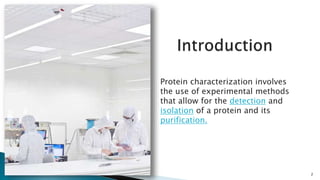
Protein characterization involves
the use of experimental methods
that allow for the detection and
isolation of a protein and its
purification.
Different techniques for purification of Protein with
their principles.
3
•Separate proteins with exposed Hydrophobic Regions
Detergents
•Separate Particles and Molecules That Differ in Mass or Density
Centrifugation
•Separates Molecules according to Their Charge : Mass Ratio
Electrophoresis
•Resolves Proteins by Mass, Charge, or Binding Affinity
Liquid
Chromatography
•Can Detect Individual Proteins
Enzyme and
Antibody Assays
4
 Transmembrane proteins have
hydrophobic groups exposed
outside.
 Such proteins can be solubilized
by detergents, which have affinity
both for hydrophobic groups and
for water.
 The hydrophobic part of a
detergent molecule is attracted to
hydrocarbons and mingles with
them readily; the hydrophilic part
is strongly attracted to water.
1. Detergents
5
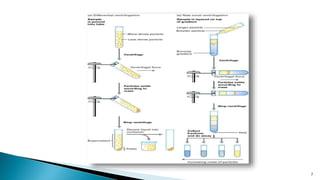
The principle behind centrifugation
is that two particles in suspension
(cells, organelles, or molecules),
having different masses or
densities will settle to the bottom
of a tube at different rates.
Differential Centrifugation Rate-Zonal Centrifugation
 Differential centrifugation
separates a mixture of particles
(macromolecules, cell organ-
elles, and cells) that differ in
mass or density.
 The most dense particles
collect at the bottom of the tube
as a pellet. The least dense
particles remain in the liquid
supernatant, which can be
transferred to another tube.
 Rate-zonal centrifugation
separates particles or molecules
that differ in mass but may be
similar in shape and density
(e.g. Protein polymers).
 Here two particles of different
mass separate into two zones.
 Sucrose solution is used in it.
6
7
8
Electrophoresis separates charged
particles in a fluid using a field of
electrical charge. It is most often
used in life sciences to separate
protein molecules or DNA and can be
achieved through several different
procedures depending on the type
and size of the molecules.
Principle:
 The principle of SDS-PAGE
states that a charged molecule
migrates to the electrode with
the opposite sign when placed
in an electric field. The
separation of the charged
molecules depends upon the
relative mobility of charged
species. The smaller molecules
migrate faster due to less
resistance during
electrophoresis.
9
Principle:
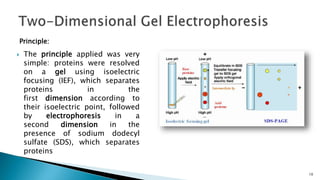
 The principle applied was very
simple: proteins were resolved
on a gel using isoelectric
focusing (IEF), which separates
proteins in the
first dimension according to
their isoelectric point, followed
by electrophoresis in a
second dimension in the
presence of sodium dodecyl
sulfate (SDS), which separates
proteins
10
11
It is based on the principle that
molecules dissolved in a solution will
interact (bind and dissociate) with a
solid surface. If the solution is allowed
to flow across the surface, then
molecules that interact frequently with
the surface will spend more time
bound to the surface and thus move
more slowly than molecules that
interact infrequently with the surface.
Principle:
 Gel filtration chromatography
separates proteins that differ in
size. A mixture of proteins is
carefully layered on the top of a
glass cylinder packed with porous
beads. Smaller proteins travel
through the column more slowly
than larger proteins. Thus different
proteins have different elution
volumes and can be collected in
separate liquid fractions from the
bottom.
12
Principle:
 Separates proteins that differ in net charge
in columns packed with special beads that
carry either a positive charge (shown here)
or a negative charge. Proteins having the
same net charge as the beads are repelled
and flow through the column, whereas
proteins having the opposite charge bind
to the beads. Bound proteins, in this case
negatively charged, are eluted by passing
a salt gradient (usually of NaCl or KCl)
through the column. As the ions bind to
the beads, they desorb the protein.
13
Principle:
 In this method, a specific
antibody is covalently attached
to beads packed in a column.
Only protein with high affinity
for the antibody is retained by
the column; all the nonbinding
proteins flow through. The
bound protein is eluted with an
acidic solution, which disrupts
the antigen-antibody
complexes.
14
15
Highly Specific Enzyme and
Antibody Assays Can Detect
Individual Proteins
Principle:
 Western blotting technique is used
for identification of particular
protein from the mixture of
protein.
 In this method labelled antibody
against particular protein is used
identify the desired protein, so it
is a specific test. Western blotting
is also known as immunoblotting
because it uses antibodies to
detect the protein.
16
The primary structure of a protein is characterized in two ways:
1. Amino acid composition
2. Amino acid sequence
Method for determining the primary structure:
1. Edman degradation
19

Characterization of proteins

  • 2.
    2 Protein characterization involves theuse of experimental methods that allow for the detection and isolation of a protein and its purification.
  • 3.
    Different techniques forpurification of Protein with their principles. 3 •Separate proteins with exposed Hydrophobic Regions Detergents •Separate Particles and Molecules That Differ in Mass or Density Centrifugation •Separates Molecules according to Their Charge : Mass Ratio Electrophoresis •Resolves Proteins by Mass, Charge, or Binding Affinity Liquid Chromatography •Can Detect Individual Proteins Enzyme and Antibody Assays
  • 4.
    4  Transmembrane proteinshave hydrophobic groups exposed outside.  Such proteins can be solubilized by detergents, which have affinity both for hydrophobic groups and for water.  The hydrophobic part of a detergent molecule is attracted to hydrocarbons and mingles with them readily; the hydrophilic part is strongly attracted to water. 1. Detergents
  • 5.
    5 The principle behindcentrifugation is that two particles in suspension (cells, organelles, or molecules), having different masses or densities will settle to the bottom of a tube at different rates.
  • 6.
    Differential Centrifugation Rate-ZonalCentrifugation  Differential centrifugation separates a mixture of particles (macromolecules, cell organ- elles, and cells) that differ in mass or density.  The most dense particles collect at the bottom of the tube as a pellet. The least dense particles remain in the liquid supernatant, which can be transferred to another tube.  Rate-zonal centrifugation separates particles or molecules that differ in mass but may be similar in shape and density (e.g. Protein polymers).  Here two particles of different mass separate into two zones.  Sucrose solution is used in it. 6
  • 7.
  • 8.
    8 Electrophoresis separates charged particlesin a fluid using a field of electrical charge. It is most often used in life sciences to separate protein molecules or DNA and can be achieved through several different procedures depending on the type and size of the molecules.
  • 9.
    Principle:  The principleof SDS-PAGE states that a charged molecule migrates to the electrode with the opposite sign when placed in an electric field. The separation of the charged molecules depends upon the relative mobility of charged species. The smaller molecules migrate faster due to less resistance during electrophoresis. 9
  • 10.
    Principle:  The principleapplied was very simple: proteins were resolved on a gel using isoelectric focusing (IEF), which separates proteins in the first dimension according to their isoelectric point, followed by electrophoresis in a second dimension in the presence of sodium dodecyl sulfate (SDS), which separates proteins 10
  • 11.
    11 It is basedon the principle that molecules dissolved in a solution will interact (bind and dissociate) with a solid surface. If the solution is allowed to flow across the surface, then molecules that interact frequently with the surface will spend more time bound to the surface and thus move more slowly than molecules that interact infrequently with the surface.
  • 12.
    Principle:  Gel filtrationchromatography separates proteins that differ in size. A mixture of proteins is carefully layered on the top of a glass cylinder packed with porous beads. Smaller proteins travel through the column more slowly than larger proteins. Thus different proteins have different elution volumes and can be collected in separate liquid fractions from the bottom. 12
  • 13.
    Principle:  Separates proteinsthat differ in net charge in columns packed with special beads that carry either a positive charge (shown here) or a negative charge. Proteins having the same net charge as the beads are repelled and flow through the column, whereas proteins having the opposite charge bind to the beads. Bound proteins, in this case negatively charged, are eluted by passing a salt gradient (usually of NaCl or KCl) through the column. As the ions bind to the beads, they desorb the protein. 13
  • 14.
    Principle:  In thismethod, a specific antibody is covalently attached to beads packed in a column. Only protein with high affinity for the antibody is retained by the column; all the nonbinding proteins flow through. The bound protein is eluted with an acidic solution, which disrupts the antigen-antibody complexes. 14
  • 15.
    15 Highly Specific Enzymeand Antibody Assays Can Detect Individual Proteins
  • 16.
    Principle:  Western blottingtechnique is used for identification of particular protein from the mixture of protein.  In this method labelled antibody against particular protein is used identify the desired protein, so it is a specific test. Western blotting is also known as immunoblotting because it uses antibodies to detect the protein. 16
  • 17.
    The primary structureof a protein is characterized in two ways: 1. Amino acid composition 2. Amino acid sequence
  • 18.
    Method for determiningthe primary structure: 1. Edman degradation
  • 19.