TASAWAR ABBAS (25)
TOPIC
ICATTECHNIQUE
OUTLINE OF LECTURE
1.Introduction
2.Need for gel-free based quantitative proteomics
3. Advantages of ICAT
4. Principle of ICAT
5. ICAT reagent
6. Working protocol of ICAT
INTRODUCTION
Definition
ICAT:
Isotope Coded Affinity tagging –
ICAT is an in vitro labeling technique that modifies
peptides or proteins specifically at the cysteine
amino acid residue and can be used for accurate
determination of quantifation as well as expression
of complex protein mixtures.
Terminology
Light ICAT label:
The light ICAT reagent consists of a Cys-reactive group,
an ICAT linker consisting of hydrogen atoms and a biotin tag.
The chemically reactive group forms covalent bonds with
peptides or proteins while the affinity tag enables the protein to
be isolated by affinity chromatography in a single step.
Heavy ICAT label:
The heavy ICAT label consists of a Cys-reactive
group, an ICAT linker consisting of heavy deuterium
isotope and a biotin tag.
Affinity purification:
A chromatographic purification procedure that
makes use of specific interactions between the
analyte of interest and the capture reagent
immobilized on the column. In ICAT, streptaavidin
affinity chromatography is employed due to its
specificity of interaction with biotin.
2. NEED FOR GEL-FREE BASED QUANTITATIVE
PROTEOMICS
Gel-based proteomics(2DE) faces the following drawbacks:
a) Inability to characterize entire proteome
b) Fairly insensitive to low copy proteins
c) Membrane proteins get under- represention
d) costly
3.Principle of ICAT
4. ICAT REAGENTS
The ICAT reagent consists of three parts
a) Iodoacetamide residue (chemically reactive group), which
binds to cysteine thiol group.
b) Linker region, containing hydrogen or deuterium, imparting
the increase in mass.
c) Biotin residue, which helps in the enrichment of peptides using
Streptavidine assisted affinity chromatography.
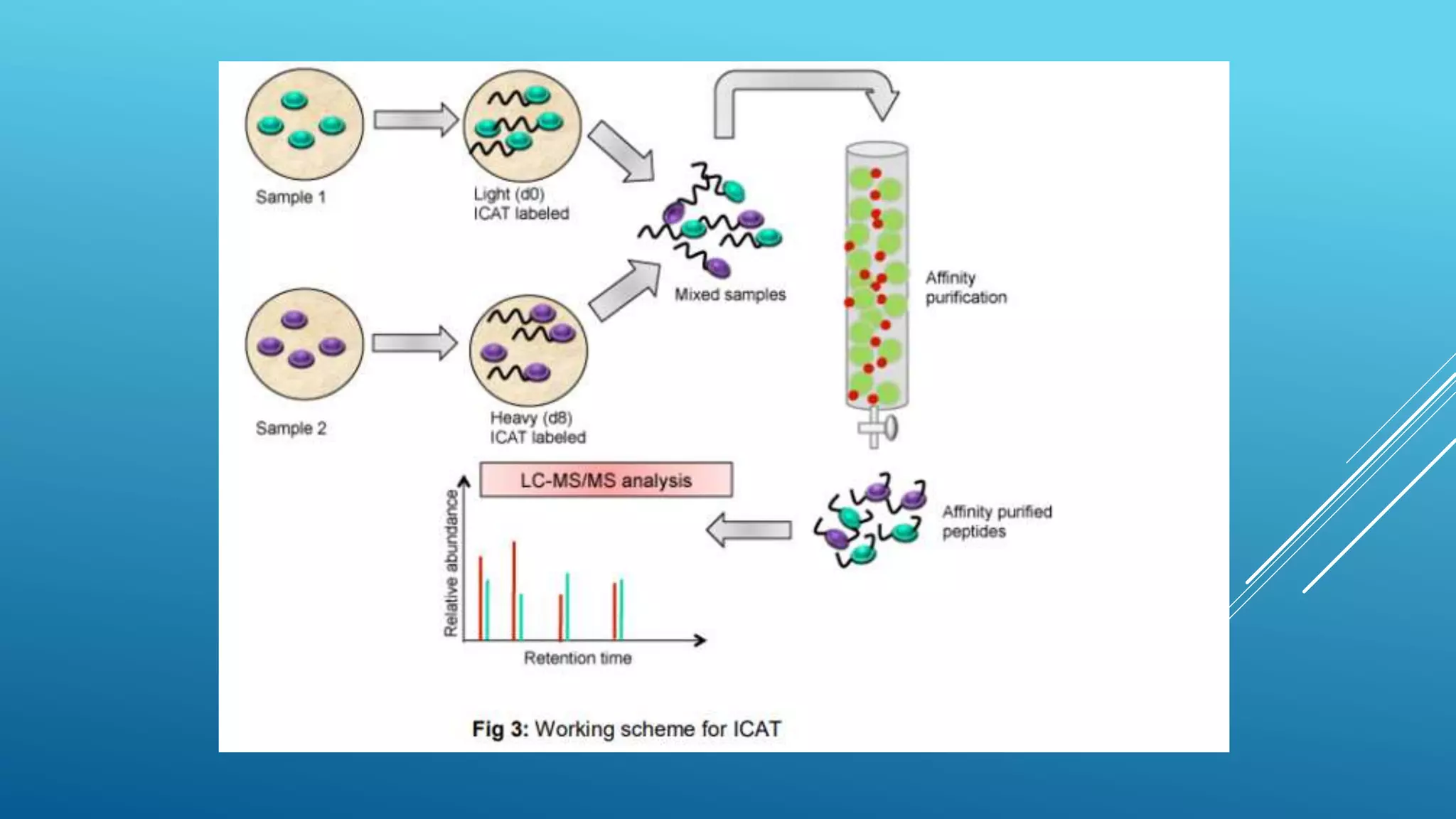
5. WORKING PROTOCOL OF ICAT
ICAT is not only used for quantifying proteins but also
for studying the degree of expression of proteins
subject to external stimuli.
Ideally, the isolated proteins are first treated with the
ICAT reagent in either of the two ways:
a) Control with ICAT reagent having no deuterium
and treated with ICAT reagent containing eight
deuterium.
b) Tag swapping Ideally, both the type of
tagging should be done to reproduce the
data so obtained.
The tagged proteins are then trypsinized.
Since the ICAT tag also contains a biotin
residue, using Streptavidine based affinity
chromatography; the peptides are
enriched and then subjected to MS
analysis and MS/MS analysis for
identification.
c). The ratio of the peaks of the control
and the treated peptides is a measure of
the differential expression of the protein.
t h a n k u

ICAT Technique in Proteomics

  • 1.
  • 2.
    OUTLINE OF LECTURE 1.Introduction 2.Needfor gel-free based quantitative proteomics 3. Advantages of ICAT 4. Principle of ICAT 5. ICAT reagent 6. Working protocol of ICAT
  • 3.
    INTRODUCTION Definition ICAT: Isotope Coded Affinitytagging – ICAT is an in vitro labeling technique that modifies peptides or proteins specifically at the cysteine amino acid residue and can be used for accurate determination of quantifation as well as expression of complex protein mixtures.
  • 4.
    Terminology Light ICAT label: Thelight ICAT reagent consists of a Cys-reactive group, an ICAT linker consisting of hydrogen atoms and a biotin tag. The chemically reactive group forms covalent bonds with peptides or proteins while the affinity tag enables the protein to be isolated by affinity chromatography in a single step.
  • 5.
    Heavy ICAT label: Theheavy ICAT label consists of a Cys-reactive group, an ICAT linker consisting of heavy deuterium isotope and a biotin tag. Affinity purification: A chromatographic purification procedure that makes use of specific interactions between the analyte of interest and the capture reagent immobilized on the column. In ICAT, streptaavidin affinity chromatography is employed due to its specificity of interaction with biotin.
  • 6.
    2. NEED FORGEL-FREE BASED QUANTITATIVE PROTEOMICS Gel-based proteomics(2DE) faces the following drawbacks: a) Inability to characterize entire proteome b) Fairly insensitive to low copy proteins c) Membrane proteins get under- represention d) costly
  • 8.
  • 9.
    4. ICAT REAGENTS TheICAT reagent consists of three parts a) Iodoacetamide residue (chemically reactive group), which binds to cysteine thiol group. b) Linker region, containing hydrogen or deuterium, imparting the increase in mass. c) Biotin residue, which helps in the enrichment of peptides using Streptavidine assisted affinity chromatography.
  • 10.
    5. WORKING PROTOCOLOF ICAT ICAT is not only used for quantifying proteins but also for studying the degree of expression of proteins subject to external stimuli. Ideally, the isolated proteins are first treated with the ICAT reagent in either of the two ways: a) Control with ICAT reagent having no deuterium and treated with ICAT reagent containing eight deuterium.
  • 11.
    b) Tag swappingIdeally, both the type of tagging should be done to reproduce the data so obtained. The tagged proteins are then trypsinized. Since the ICAT tag also contains a biotin residue, using Streptavidine based affinity chromatography; the peptides are enriched and then subjected to MS analysis and MS/MS analysis for identification. c). The ratio of the peaks of the control and the treated peptides is a measure of the differential expression of the protein.
  • 13.
    t h an k u