Subject training
on
Computational Tools for Animal Genome Resource Data Analysis
Dec 02-13, 2013

DiGE
Dr Karan Veer Singh
Scientist
National Bureau of Animal Genetic Resources
Karnal
2-D gel electrophoresis
2D analysis experiments commonly address questions like Protein level
Differences caused by
disease state
drug treatment
life-cycle stage
Some protein level differences studied are small and the results are affected
by experimental variation originating both from the system and from inherent
biological variation

Misdiagnosis is dangerous
Limitations of conventional 2D gel
1. Only one dye can be used at a time for one gel

6 gels made from the very same sample, run in
parallel (SYPRO Ruby)

2. We run as many gel as many samples are there
3. Cannot control the variation in loss of proteins for
each gel
4. Differential analysis is difficult
5. Statistical confidence is less
6.

Proteins with PI beyond the pH limits of strips cannot be
focused on strips
Conventional 2-D
control

gel 1
Differences??

treated

gel 2

Are spot differences real?
Variation in 2D gel
System related variations
1. Gel-to-gel variation, which can result from differences in electrophoretic
conditions between first dimension strips or second dimension gels, gel
distortions, sample application variation and user-to-user variation.
2. Variation due to user-specific editing and interpretation when using the data
analysis software.

Inherent biological variation
Inherent biological variation arises from intrinsic differences that occur within a
population. For example, differences from animal-to-animal, plant-to-plant or
culture-to-culture which have been subjected to identical conditions

Induced biological change
1. Differences due to disease state, drug treatment, life cycle stage
What we want ???
Least gel to gel variation
Normalization of biological variation
Least number of gels run
Differential expression analysis
Statistical confidence in presenting our result
How to avoid uncontrolled protein loss

Is there any way out
What is DIGE and why is it needed
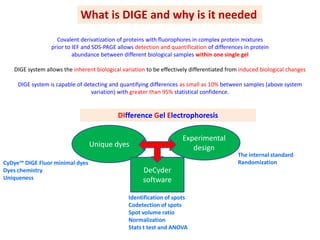
Covalent derivatization of proteins with fluorophores in complex protein mixtures
prior to IEF and SDS-PAGE allows detection and quantification of differences in protein
abundance between different biological samples within one single gel
DIGE system allows the inherent biological variation to be effectively differentiated from induced biological changes
DIGE system is capable of detecting and quantifying differences as small as 10% between samples (above system
variation) with greater than 95% statistical confidence.

DIfference Gel Electrophoresis

Experimental
design

Unique dyes
CyDye™ DIGE Fluor minimal dyes
Dyes chemistry
Uniqueness

DeCyder
software
Identification of spots
Codetection of spots
Spot volume ratio
Normalization
Stats t test and ANOVA

The internal standard
Randomization
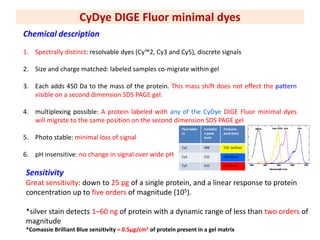
CyDye DIGE Fluor minimal dyes
Chemical description
1. Spectrally distinct: resolvable dyes (Cy™2, Cy3 and Cy5), discrete signals
2. Size and charge matched: labeled samples co-migrate within gel
3. Each adds 450 Da to the mass of the protein. This mass shift does not effect the pattern
visible on a second dimension SDS PAGE gel.
4. multiplexing possible: A protein labeled with any of the CyDye DIGE Fluor minimal dyes
will migrate to the same position on the second dimension SDS PAGE gel
Emission
peak (nm)

488

520 (yellow)

Cy3

532

580 (Blue)

Cy5

6. pH insensitive: no change in signal over wide pH

Excitatio
n peak
(nm)

Cy2

5. Photo stable: minimal loss of signal

Fluoropho
re

633

670 (Red)

Sensitivity
Great sensitivity: down to 25 pg of a single protein, and a linear response to protein
concentration up to five orders of magnitude (105).
*silver stain detects 1–60 ng of protein with a dynamic range of less than two orders of
magnitude
*Comassie Brilliant Blue sensitivity = 0.5µg/cm2 of protein present in a gel matrix
Protein labeling
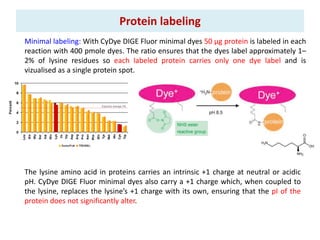
Minimal labeling: With CyDye DIGE Fluor minimal dyes 50 μg protein is labeled in each
reaction with 400 pmole dyes. The ratio ensures that the dyes label approximately 1–
2% of lysine residues so each labeled protein carries only one dye label and is
vizualised as a single protein spot.

The lysine amino acid in proteins carries an intrinsic +1 charge at neutral or acidic
pH. CyDye DIGE Fluor minimal dyes also carry a +1 charge which, when coupled to
the lysine, replaces the lysine’s +1 charge with its own, ensuring that the pI of the
protein does not significantly alter.
Experimental design

1. Inclusion of an internal standard sample on each gel

2. The requirement for biological replicates such as multiple
cultures, tissue etc.
3. Randomization of samples to produce unbiased results, thus
conforming with best experimental practice
4. No gel replicates of the same sample is needed
Randomization
Conditional bias
Are we applying specific dyes to specific sample inadvertently
Biological replicates (sampling bias)
Good experimental practice

A1

A2

A3

A4

B1

B2

B3

B4

C1

C2

C3

C4

Randomize - within each group
Label half of each group with Cy™3 and half
with Cy5

Randomization of samples
Randomization of samples across gels removes any bias from the experiments such as experimental
conditions, sample handling and labeling
Even if the system related result variation is low using DIGE System it is good laboratory practice to
distribute individual experimental samples evenly between different CyDye DIGE Fluor dyes and
different gels to avoid systematic errors.
Using internal standard
The internal standard is used to match and normalize the protein patterns across
different gels thereby negating the problem of inter-gel variation, a common
problem in standard “one sample per gel” 2D electrophoresis experiments
The internal standard allows accurate quantization of differences between samples

Benefits of the internal standard
Gel-to-gel (system) variation is eliminated
The internal standard appears on all gels and contains all spots (average)
Easier gel-to-gel matching (between identical spot maps)
2-D DIGE is the only protein 2-D approach which allows multiplexing

2-D DIGE is the only 2-D approach enabling use of an internal standard
DeCyder™ 2-D Differential Analysis Software is designed to work with an internal standard
Internal standard
Advantages of using an
internal standard
Are spot
difference
real

Accurate quantification and
accurate spot statistics
between gels
Increased confidence in
matching between gels

Flexibility of statistical
analysis depending on the
relationship between samples
Separation of induced
biological change from
system variation and inherent
biological variation
A comparison between classical 2-D and 2-D DIGE

Experimental design 1 color 2 D

1-color 2-D
No automation (complex)
Slow
Poor accuracy
24 gels,
labor intensive

Experimental design 2D DIGE

DeCyder™ Differential Analysis
Analysis automated
Rapid data analysis
High accuracy for Quantification
/trend mapping
12 gels
Analysis fast and highly automated
How to use internal standard
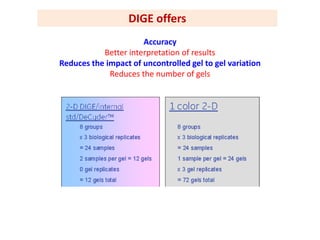
DIGE offers
Accuracy
Better interpretation of results
Reduces the impact of uncontrolled gel to gel variation
Reduces the number of gels
DeCyder 2D
Co-detects image pairs
Removes background
Removes dust particles
Normalises images
Matches up to 500 image pairs
t-test and ANOVA calculated for each spot
Data displayed as Trend analysis graph
low user interaction,
high throughput and low experimental variation

To compare protein spot volumes across a range of experimental samples and
gels, two distinct steps are required
• Intra-gel co-detection of sample and internal standard protein spots
• Inter-gel matching of internal standard samples across all gels within the
experiment
Intra gel co-detection
Inter-gel matching
It is important to ensure that the same protein spots are compared between gels.
Master image
Spot map species
Protein abundance/Differential expression
Direct comparison of spot volume or compare the ratio of spot volume of sample to
the internal standard???
Differences in spot intensity that may arise due to experimental factors during the process of
2D electrophoresis, such as protein loss during sample transfer, will be the same for each
sample within a single gel, including the internal standard.
Statistical tests of protein abundance in DeCyder 2D
Student’s T-test and ANOVA. The statistical tests compare the average
ratio and variation within each group to the average ratio and variation
in the other groups to see if any change between the groups is
significant.

Extended Data Analysis (EDA) module of DeCyder 2D

Multivariate statistical analyses such as
Principal Component Analysis (PCA),
Pattern Analysis
Discriminant Analysis
Image analysis
DeCyder 2D with or without EDA
ImageMaster 2D Platinum
These dedicated 2D software products use the internal standard to minimize gel togel result variation. A detection of less than 10% difference between samples can
be made with more than 95% statistical confidence

Six modules in DeCyder

1. Image Loader
2. Batch Processor
3. DIA (Differential In-gel Analysis): background subtraction, in-gel normalization and gel artifact
removal.
4. BVA (Biological Variation Analysis): Matching of multiple images from different gels to provide
statistical data on differential protein abundance levels between multiple groups
5. XML Toolbox: Extraction of user specific data from XML files generated in either the Batch, DIA or
BVA modules. This data can be saved in either text or html format enabling users to access data
from DeCyder 2D workspaces in other applications
6. EDA (Extended Data Analysis): Multivariate analysis of data from several BVA workspaces. EDA is
an add-on module for the DeCyder 2D software and can handle up to 1000 spot maps
Principal Component Analysis
Pattern analysis
Discriminant analysis
Interpretation
Image loading
Naming gel images
Gel 01 Standard Cy2.gel,
Gel 01 (Time1_Dose2) Cy3.gel
Gel 01 (Time2_Dose2) Cy5.gel

Differential In-Gel Analysis (DIA)
- performs spot co-detection (up to 10,000)
-spot quantification by normalization and ratio calculation
-Contrast adjustment (~65000 vs 256 grey scale)

Biological Variation Analysis (BVA)
- processes multiple gel images
- performs gel to gel matching of spots
- allowing quantitative comparisons of protein expression across multiple gels
Analytical experiments design
DIGE summary
3 different CyDye DIGE fluors are available
Complete system approach from sample preparation to
MS ID
Sample multiplexing - up to 3 samples on each gel

Fluorescence detection with wide dynamic range
Automated high throughput image analysis platform

Statistics associated with results

DiGE....2-D gel electrophoresis

  • 1.
    Subject training on Computational Toolsfor Animal Genome Resource Data Analysis Dec 02-13, 2013 DiGE Dr Karan Veer Singh Scientist National Bureau of Animal Genetic Resources Karnal
  • 2.
    2-D gel electrophoresis 2Danalysis experiments commonly address questions like Protein level Differences caused by disease state drug treatment life-cycle stage Some protein level differences studied are small and the results are affected by experimental variation originating both from the system and from inherent biological variation Misdiagnosis is dangerous
  • 3.
    Limitations of conventional2D gel 1. Only one dye can be used at a time for one gel 6 gels made from the very same sample, run in parallel (SYPRO Ruby) 2. We run as many gel as many samples are there 3. Cannot control the variation in loss of proteins for each gel 4. Differential analysis is difficult 5. Statistical confidence is less 6. Proteins with PI beyond the pH limits of strips cannot be focused on strips Conventional 2-D control gel 1 Differences?? treated gel 2 Are spot differences real?
  • 4.
    Variation in 2Dgel System related variations 1. Gel-to-gel variation, which can result from differences in electrophoretic conditions between first dimension strips or second dimension gels, gel distortions, sample application variation and user-to-user variation. 2. Variation due to user-specific editing and interpretation when using the data analysis software. Inherent biological variation Inherent biological variation arises from intrinsic differences that occur within a population. For example, differences from animal-to-animal, plant-to-plant or culture-to-culture which have been subjected to identical conditions Induced biological change 1. Differences due to disease state, drug treatment, life cycle stage
  • 5.
    What we want??? Least gel to gel variation Normalization of biological variation Least number of gels run Differential expression analysis Statistical confidence in presenting our result How to avoid uncontrolled protein loss Is there any way out
  • 6.
    What is DIGEand why is it needed Covalent derivatization of proteins with fluorophores in complex protein mixtures prior to IEF and SDS-PAGE allows detection and quantification of differences in protein abundance between different biological samples within one single gel DIGE system allows the inherent biological variation to be effectively differentiated from induced biological changes DIGE system is capable of detecting and quantifying differences as small as 10% between samples (above system variation) with greater than 95% statistical confidence. DIfference Gel Electrophoresis Experimental design Unique dyes CyDye™ DIGE Fluor minimal dyes Dyes chemistry Uniqueness DeCyder software Identification of spots Codetection of spots Spot volume ratio Normalization Stats t test and ANOVA The internal standard Randomization
  • 7.
    CyDye DIGE Fluorminimal dyes Chemical description 1. Spectrally distinct: resolvable dyes (Cy™2, Cy3 and Cy5), discrete signals 2. Size and charge matched: labeled samples co-migrate within gel 3. Each adds 450 Da to the mass of the protein. This mass shift does not effect the pattern visible on a second dimension SDS PAGE gel. 4. multiplexing possible: A protein labeled with any of the CyDye DIGE Fluor minimal dyes will migrate to the same position on the second dimension SDS PAGE gel Emission peak (nm) 488 520 (yellow) Cy3 532 580 (Blue) Cy5 6. pH insensitive: no change in signal over wide pH Excitatio n peak (nm) Cy2 5. Photo stable: minimal loss of signal Fluoropho re 633 670 (Red) Sensitivity Great sensitivity: down to 25 pg of a single protein, and a linear response to protein concentration up to five orders of magnitude (105). *silver stain detects 1–60 ng of protein with a dynamic range of less than two orders of magnitude *Comassie Brilliant Blue sensitivity = 0.5µg/cm2 of protein present in a gel matrix
  • 8.
    Protein labeling Minimal labeling:With CyDye DIGE Fluor minimal dyes 50 μg protein is labeled in each reaction with 400 pmole dyes. The ratio ensures that the dyes label approximately 1– 2% of lysine residues so each labeled protein carries only one dye label and is vizualised as a single protein spot. The lysine amino acid in proteins carries an intrinsic +1 charge at neutral or acidic pH. CyDye DIGE Fluor minimal dyes also carry a +1 charge which, when coupled to the lysine, replaces the lysine’s +1 charge with its own, ensuring that the pI of the protein does not significantly alter.
  • 9.
    Experimental design 1. Inclusionof an internal standard sample on each gel 2. The requirement for biological replicates such as multiple cultures, tissue etc. 3. Randomization of samples to produce unbiased results, thus conforming with best experimental practice 4. No gel replicates of the same sample is needed
  • 10.
    Randomization Conditional bias Are weapplying specific dyes to specific sample inadvertently Biological replicates (sampling bias) Good experimental practice A1 A2 A3 A4 B1 B2 B3 B4 C1 C2 C3 C4 Randomize - within each group Label half of each group with Cy™3 and half with Cy5 Randomization of samples Randomization of samples across gels removes any bias from the experiments such as experimental conditions, sample handling and labeling Even if the system related result variation is low using DIGE System it is good laboratory practice to distribute individual experimental samples evenly between different CyDye DIGE Fluor dyes and different gels to avoid systematic errors.
  • 11.
    Using internal standard Theinternal standard is used to match and normalize the protein patterns across different gels thereby negating the problem of inter-gel variation, a common problem in standard “one sample per gel” 2D electrophoresis experiments The internal standard allows accurate quantization of differences between samples Benefits of the internal standard Gel-to-gel (system) variation is eliminated The internal standard appears on all gels and contains all spots (average) Easier gel-to-gel matching (between identical spot maps) 2-D DIGE is the only protein 2-D approach which allows multiplexing 2-D DIGE is the only 2-D approach enabling use of an internal standard DeCyder™ 2-D Differential Analysis Software is designed to work with an internal standard
  • 12.
    Internal standard Advantages ofusing an internal standard Are spot difference real Accurate quantification and accurate spot statistics between gels Increased confidence in matching between gels Flexibility of statistical analysis depending on the relationship between samples Separation of induced biological change from system variation and inherent biological variation
  • 13.
    A comparison betweenclassical 2-D and 2-D DIGE Experimental design 1 color 2 D 1-color 2-D No automation (complex) Slow Poor accuracy 24 gels, labor intensive Experimental design 2D DIGE DeCyder™ Differential Analysis Analysis automated Rapid data analysis High accuracy for Quantification /trend mapping 12 gels Analysis fast and highly automated
  • 14.
    How to useinternal standard
  • 15.
    DIGE offers Accuracy Better interpretationof results Reduces the impact of uncontrolled gel to gel variation Reduces the number of gels
  • 16.
    DeCyder 2D Co-detects imagepairs Removes background Removes dust particles Normalises images Matches up to 500 image pairs t-test and ANOVA calculated for each spot Data displayed as Trend analysis graph low user interaction, high throughput and low experimental variation To compare protein spot volumes across a range of experimental samples and gels, two distinct steps are required • Intra-gel co-detection of sample and internal standard protein spots • Inter-gel matching of internal standard samples across all gels within the experiment
  • 17.
  • 18.
    Inter-gel matching It isimportant to ensure that the same protein spots are compared between gels. Master image Spot map species
  • 19.
    Protein abundance/Differential expression Directcomparison of spot volume or compare the ratio of spot volume of sample to the internal standard??? Differences in spot intensity that may arise due to experimental factors during the process of 2D electrophoresis, such as protein loss during sample transfer, will be the same for each sample within a single gel, including the internal standard.
  • 20.
    Statistical tests ofprotein abundance in DeCyder 2D Student’s T-test and ANOVA. The statistical tests compare the average ratio and variation within each group to the average ratio and variation in the other groups to see if any change between the groups is significant. Extended Data Analysis (EDA) module of DeCyder 2D Multivariate statistical analyses such as Principal Component Analysis (PCA), Pattern Analysis Discriminant Analysis
  • 21.
    Image analysis DeCyder 2Dwith or without EDA ImageMaster 2D Platinum These dedicated 2D software products use the internal standard to minimize gel togel result variation. A detection of less than 10% difference between samples can be made with more than 95% statistical confidence Six modules in DeCyder 1. Image Loader 2. Batch Processor 3. DIA (Differential In-gel Analysis): background subtraction, in-gel normalization and gel artifact removal. 4. BVA (Biological Variation Analysis): Matching of multiple images from different gels to provide statistical data on differential protein abundance levels between multiple groups 5. XML Toolbox: Extraction of user specific data from XML files generated in either the Batch, DIA or BVA modules. This data can be saved in either text or html format enabling users to access data from DeCyder 2D workspaces in other applications 6. EDA (Extended Data Analysis): Multivariate analysis of data from several BVA workspaces. EDA is an add-on module for the DeCyder 2D software and can handle up to 1000 spot maps Principal Component Analysis Pattern analysis Discriminant analysis Interpretation
  • 22.
    Image loading Naming gelimages Gel 01 Standard Cy2.gel, Gel 01 (Time1_Dose2) Cy3.gel Gel 01 (Time2_Dose2) Cy5.gel Differential In-Gel Analysis (DIA) - performs spot co-detection (up to 10,000) -spot quantification by normalization and ratio calculation -Contrast adjustment (~65000 vs 256 grey scale) Biological Variation Analysis (BVA) - processes multiple gel images - performs gel to gel matching of spots - allowing quantitative comparisons of protein expression across multiple gels
  • 23.
  • 24.
    DIGE summary 3 differentCyDye DIGE fluors are available Complete system approach from sample preparation to MS ID Sample multiplexing - up to 3 samples on each gel Fluorescence detection with wide dynamic range Automated high throughput image analysis platform Statistics associated with results

Editor's Notes

  • #7 The 2D DIGE technology with two different samples and an internal standard per gel labelled with CyDye™ DIGE Fluor minimal dyes, significantly reduces the required number of gels compared to conventional 2D electrophoresis. The internal standard significantly reduces the gel to gel variation and thereby improves statistical validity.
  • #8 CyDye DIGE Fluor minimal dyes are three spectrally resolvable dyes (Cy™2, Cy3 and Cy5) matched for mass and charge. Each CyDye DIGE Fluor minimal dye, when coupled to a protein, will add 450 Da to the mass of the protein. This mass shift does not effect the pattern visible on a second dimension SDS PAGE gel. A protein labeled with any of the CyDye DIGE Fluor minimal dyes will migrate to the same position on the second dimension SDS PAGE gel, thus making multiplexing possible.
  • #17 DeCyder 2D contains proprietary algorithms that perform co-detection of differently labeled samples within the same gel. DeCyder 2D also permits automated detection, background subtraction, quantitation, normalization, internal standardization and inter-gel matching. The benefits are low user interaction, high throughput and low experimental variation.
  • #19 Experimental design ensures that each gel contains the same internal standard. This enables inter-gel comparisons of spot abundance. Before this can be done, it is important to ensure that the same protein spots are compared between gels. DeCyder 2D achieves this using the internal standard to match the position of each protein across all gels within the experiment. The internal standard image with the most detected spots is assigned as the 'Master'. Following co-detection, each image has a spot map species. The spot map species for the internal standard assigned as the Master, is used as a template to which all remaining spot map species for the other internal standards (intrinsically linked to their codetectedsample images) are matched