2D-PAGE & DIGE
Nixon Mendez
Department of Bioinformatics
• Study the acidic and basic properties of amino acids
• Determine pKa values
• To recognize the unknown amino acid.
Titration curve of amino acids
• Amino acids in aqueous solution exist predominantly in
isoelectric form.
• The characteristic pH at which the net electric charge is
zero is called the isoelectric point (pI).
• So, an amino acid has a net negative charge at any pH
above its pI, and has a net positive charge at any pH below
its pI.
• Each amino acid has its own pI value.
• The Ionizable groups of amino acids act as weak acids or
bases, giving off or taking on protons when the pH is
altered.
• Titration curves are produced by monitoring the pH of
given volume of a sample solution after successive addition
of acid or alkali.
Titration Curve for
glycine:
The shaded boxes,
centered at about
pK1=2.34 & pK2 = 9.60
indicates the regions of
greatest buffering
power.
• Proteins are separated according to molecular mass.
• This is good for simple samples.
Drawback:
• Based on only one property
ie. Molecular mass.
1D-Gel electrophoresis
• 2D-PAGE is a form of gel electrophoresis used for
1. Separation
2. Identification
• Principle:
2D-PAGE separates proteins according to their isoelectric point
first and molecular mass.
What is 2D-PAGE ??
of proteins in a complex
biological sample.
• This method is used for the separation and identification of
proteins in a complex mixture using two separate dimensions that
are run perpendicular to one another.
• Based on two properties (IEF and molecular mass)
• This allows a complex biological sample to be separated over a
larger area, increasing the resolution of each component.
Why 2D-PAGE?
• IPG strips are used.
• Immobilized pH gradient (IPG) gels.
• IPGs are the acrylamide gel matrix co-polymerized with
the pH gradient, which result in completely stable
gradients
2D-PAGE
1. SAMPLE PREPARATION
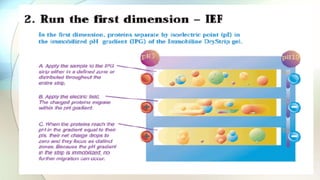
2. RUN FIRST DIMENSION – IEF
3. RUN SECOND DIMENSION – SDS-PAGE
4. VISUALIZE AND ANALYZE
How to perform 2D-PAGE?
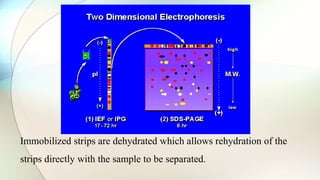
Immobilized strips are dehydrated which allows rehydration of the
strips directly with the sample to be separated.
• Detect separated proteins by staining or
immunodetection after blotting onto a membrane.
• Powerful tools and techniques are used to compare the
samples & identify the protein of interest.
4. Visualize And Analyze
Image analysis
Image analysis
1. Spot number:
• 10,000-150,000 gene products in a cell.
• PTM makes it difficult to predict real number.
• It’s impossible to display all proteins in one single gel.
Challenges for 2-DE
2. Molecular weights:
• Protein > 250 kDa do not enter 2nd SDS-PAGE properly.
3. Reproducibility:
• Variation most comes from sample preparation.
4. Less sensitivity (lower resolution)
Challenges for 2-DE
• Two dimensional difference in gel electrophoresis
• 2D-DIGE is an advanced version of classical two-dimensional gel
electrophoresis (2D-PAGE).
• The protein samples are labeled with fluorescent dyes and then
separated by 2D-PAGE.
2D-DIGE
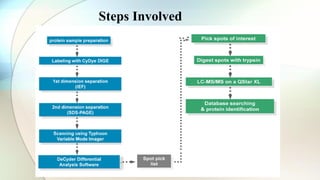
Steps Involved
• Solves the Gel-to-gel variations problem in 2D PAGE,
by enabling the multiple samples in single gels
• Sensitivity improved due to use of fluorescent dye and
laser.
Advantages
THANK YOU

2D-PAGE & DIGE

  • 1.
    2D-PAGE & DIGE NixonMendez Department of Bioinformatics
  • 2.
    • Study theacidic and basic properties of amino acids • Determine pKa values • To recognize the unknown amino acid. Titration curve of amino acids
  • 3.
    • Amino acidsin aqueous solution exist predominantly in isoelectric form. • The characteristic pH at which the net electric charge is zero is called the isoelectric point (pI). • So, an amino acid has a net negative charge at any pH above its pI, and has a net positive charge at any pH below its pI. • Each amino acid has its own pI value. • The Ionizable groups of amino acids act as weak acids or bases, giving off or taking on protons when the pH is altered. • Titration curves are produced by monitoring the pH of given volume of a sample solution after successive addition of acid or alkali.
  • 4.
    Titration Curve for glycine: Theshaded boxes, centered at about pK1=2.34 & pK2 = 9.60 indicates the regions of greatest buffering power.
  • 6.
    • Proteins areseparated according to molecular mass. • This is good for simple samples. Drawback: • Based on only one property ie. Molecular mass. 1D-Gel electrophoresis
  • 7.
    • 2D-PAGE isa form of gel electrophoresis used for 1. Separation 2. Identification • Principle: 2D-PAGE separates proteins according to their isoelectric point first and molecular mass. What is 2D-PAGE ?? of proteins in a complex biological sample.
  • 8.
    • This methodis used for the separation and identification of proteins in a complex mixture using two separate dimensions that are run perpendicular to one another. • Based on two properties (IEF and molecular mass) • This allows a complex biological sample to be separated over a larger area, increasing the resolution of each component. Why 2D-PAGE?
  • 9.
    • IPG stripsare used. • Immobilized pH gradient (IPG) gels. • IPGs are the acrylamide gel matrix co-polymerized with the pH gradient, which result in completely stable gradients 2D-PAGE
  • 10.
    1. SAMPLE PREPARATION 2.RUN FIRST DIMENSION – IEF 3. RUN SECOND DIMENSION – SDS-PAGE 4. VISUALIZE AND ANALYZE How to perform 2D-PAGE?
  • 12.
    Immobilized strips aredehydrated which allows rehydration of the strips directly with the sample to be separated.
  • 15.
    • Detect separatedproteins by staining or immunodetection after blotting onto a membrane. • Powerful tools and techniques are used to compare the samples & identify the protein of interest. 4. Visualize And Analyze
  • 16.
  • 17.
  • 18.
    1. Spot number: •10,000-150,000 gene products in a cell. • PTM makes it difficult to predict real number. • It’s impossible to display all proteins in one single gel. Challenges for 2-DE
  • 19.
    2. Molecular weights: •Protein > 250 kDa do not enter 2nd SDS-PAGE properly. 3. Reproducibility: • Variation most comes from sample preparation. 4. Less sensitivity (lower resolution) Challenges for 2-DE
  • 20.
    • Two dimensionaldifference in gel electrophoresis • 2D-DIGE is an advanced version of classical two-dimensional gel electrophoresis (2D-PAGE). • The protein samples are labeled with fluorescent dyes and then separated by 2D-PAGE. 2D-DIGE
  • 21.
  • 23.
    • Solves theGel-to-gel variations problem in 2D PAGE, by enabling the multiple samples in single gels • Sensitivity improved due to use of fluorescent dye and laser. Advantages
  • 24.