Protein Identification
Peptide Mass Fingerprinting
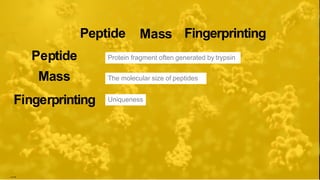
Protein fragment often generated by trypsin
….
The molecular size of peptides
Uniqueness
Mass
Peptide Fingerprinting
Peptide
Mass
Fingerprinting
Introduction
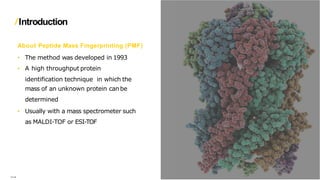
About Peptide Mass Fingerprinting (PMF)
• The method was developed in 1993
• A high throughput protein
identification technique in which the
mass of an unknown protein can be
determined
• Usually with a mass spectrometer such
as MALDI-TOF or ESI-TOF
….
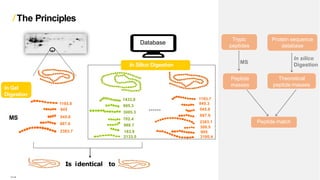
The Principles
Is identical to
In Gel
Digestion
MS
1193.8
845
545.6
887.6
2383.7
In Silico Digestion
Database
1433.8
805.3
3005.3
702.4
988.7
183.9
2133.5
……
1193.7
845.3
545.8
887.8
2383.1
308.5
995
3100.4
Protein sequence
database
Theoretical
peptide masses
In silico
Digestion
Peptide match
Trypic
peptides
MS
Peptide
masses
….
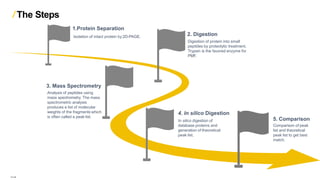
1.Protein Separation
Isolation of intact protein by 2D-PAGE. 2. Digestion
Digestion of protein into small
peptides by proteolytic treatment.
Trypsin is the favored enzyme for
PMF.
3. Mass Spectrometry
Analysis of peptides using
mass spectrometry. The mass
spectrometric analysis
produces a list of molecular
weights of the fragments which
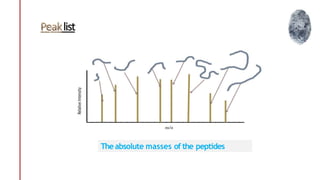
is often called a peak list.
4. In silico Digestion
In silico digestion of
database proteins and
generation of theoretical
peak list.
5. Comparison
Comparison of peak
list and theoretical
peak list to get best
match.
The Steps
….
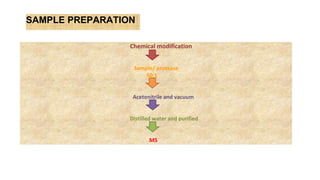
SAMPLE PREPARATION
Chemical modification
Sample/ protease
50:1
Acetonitrile and vacuum
Distilled water and purified
MS
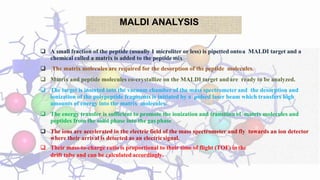
MALDI ANALYSIS
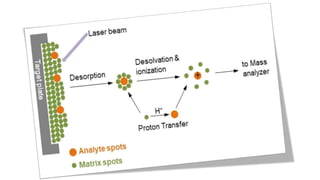
 A small fraction of the peptide (usually 1 microliter or less) is pipetted ontoa MALDI target and a
chemical called a matrix is added to the peptide mix
 The matrix molecules are required for the desorption of the peptide molecules.
 Matrix and peptide molecules co-crystallize on the MALDI target and are ready to be analyzed.
 The target is inserted into the vacuum chamber of the mass spectrometer and the desorption and
ionization of the polypeptide fragments is initiated by a pulsed laser beam which transfers high
amounts of energy into the matrix molecules.
 The energy transfer is sufficient to promote the ionization and transitionof matrix molecules and
peptides from the solid phase into the gas phase
 The ions are accelerated in the electric field of the mass spectrometer and fly towards an ion detector
where their arrival is detected as an electricsignal.
 Their mass-to-charge ratio is proportional to their time of flight (TOF) in the
drift tube and can be calculated accordingly.
list
Theabsolute masses of the peptides
Advantages
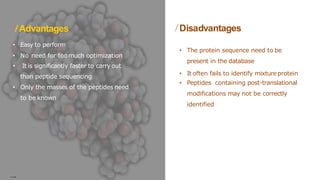
• Easy to perform
• No need for toomuch optimization
• It is significantly faster to carry out
than peptide sequencing
• Only the masses of the peptides need
to be known
• The protein sequence need to be
present in the database
• It often fails to identify mixture protein
• Peptides containing post-translational
modifications may not be correctly
identified
Disadvantages
….
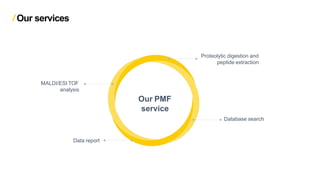
Our PMF
service
MALDI/ESI TOF
analysis
Proteolytic digestion and
peptide extraction
Data report
Database search
Our services
Peptide Mass Fingerprinting

Peptide Mass Fingerprinting

  • 1.
  • 2.
    Protein fragment oftengenerated by trypsin …. The molecular size of peptides Uniqueness Mass Peptide Fingerprinting Peptide Mass Fingerprinting
  • 3.
    Introduction About Peptide MassFingerprinting (PMF) • The method was developed in 1993 • A high throughput protein identification technique in which the mass of an unknown protein can be determined • Usually with a mass spectrometer such as MALDI-TOF or ESI-TOF ….
  • 4.
    The Principles Is identicalto In Gel Digestion MS 1193.8 845 545.6 887.6 2383.7 In Silico Digestion Database 1433.8 805.3 3005.3 702.4 988.7 183.9 2133.5 …… 1193.7 845.3 545.8 887.8 2383.1 308.5 995 3100.4 Protein sequence database Theoretical peptide masses In silico Digestion Peptide match Trypic peptides MS Peptide masses ….
  • 5.
    1.Protein Separation Isolation ofintact protein by 2D-PAGE. 2. Digestion Digestion of protein into small peptides by proteolytic treatment. Trypsin is the favored enzyme for PMF. 3. Mass Spectrometry Analysis of peptides using mass spectrometry. The mass spectrometric analysis produces a list of molecular weights of the fragments which is often called a peak list. 4. In silico Digestion In silico digestion of database proteins and generation of theoretical peak list. 5. Comparison Comparison of peak list and theoretical peak list to get best match. The Steps ….
  • 6.
    SAMPLE PREPARATION Chemical modification Sample/protease 50:1 Acetonitrile and vacuum Distilled water and purified MS
  • 7.
    MALDI ANALYSIS  Asmall fraction of the peptide (usually 1 microliter or less) is pipetted ontoa MALDI target and a chemical called a matrix is added to the peptide mix  The matrix molecules are required for the desorption of the peptide molecules.  Matrix and peptide molecules co-crystallize on the MALDI target and are ready to be analyzed.  The target is inserted into the vacuum chamber of the mass spectrometer and the desorption and ionization of the polypeptide fragments is initiated by a pulsed laser beam which transfers high amounts of energy into the matrix molecules.  The energy transfer is sufficient to promote the ionization and transitionof matrix molecules and peptides from the solid phase into the gas phase  The ions are accelerated in the electric field of the mass spectrometer and fly towards an ion detector where their arrival is detected as an electricsignal.  Their mass-to-charge ratio is proportional to their time of flight (TOF) in the drift tube and can be calculated accordingly.
  • 9.
  • 10.
    Advantages • Easy toperform • No need for toomuch optimization • It is significantly faster to carry out than peptide sequencing • Only the masses of the peptides need to be known • The protein sequence need to be present in the database • It often fails to identify mixture protein • Peptides containing post-translational modifications may not be correctly identified Disadvantages ….
  • 11.
    Our PMF service MALDI/ESI TOF analysis Proteolyticdigestion and peptide extraction Data report Database search Our services