25/11/2017
Introduction
Purpose
include the preparation of commercial
products such as enzymes (e.g. lactase),
nutritional proteins (e.g. soy protein
isolate),
certain biopharmaceuticals (e.g. insulin).
research or analytical purposes,
 including identification,
 quantification,
and studies of the protein's structure,
 post-translational modifications and
function.
Separation:-
Extracellular:-
•No need for cell disruption
•Secreted soluble proteins can be collected
in the cell supernatant after centrifugation
•Membrane-bound proteins might be
released from the cell simply using
detergents
Need cell disruption
•Detergents lysis
•Enzymatic lysis
•Osmotic lysis
•Ultrasonication
Intracellular
Purification:-
oDifferential centrifugation:-
Force Time sediment
1000g 5min Eu. cell
4,000g 10min Chl,cell debris,
nuclei
15,000 20min Bacteria, mito
30,000 30min Small
organelle
200,000 1hr Small vesicle
100,000 3-10hrs Ribosome
200,000 10-24hrs Membrane
sheets
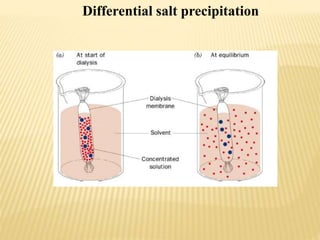
Differential salt precipitation
oDifferent chromatography
Column Chromatography :-
•Most common and best approach to purifying
larger amounts of proteins
•Achieves highest level of purity and largest
amount
•Requires low effort
•Lowest likelihood to damage the protein
product
•Standard method for pharmaceutical industry
Size-Exclusion (or molecular
exclusion) Chromatography
•Molecules are separated
according to differences in their
size as they pass through a
hydrophilic polymer
•Polymer beads composed of
cross-linked dextran (dextrose)
which is highly and uniformly
porous (like Swiss cheese)
•Large proteins come out first
(can’t fit in pores), small proteins
come out last (get stuck in the
pores)
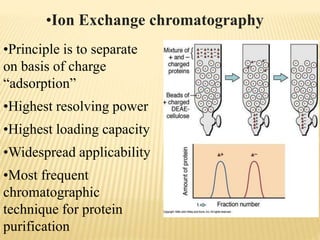
•Principle is to separate
on basis of charge
“adsorption”
•Highest resolving power
•Highest loading capacity
•Widespread applicability
•Most frequent
chromatographic
technique for protein
purification
•Ion Exchange chromatography
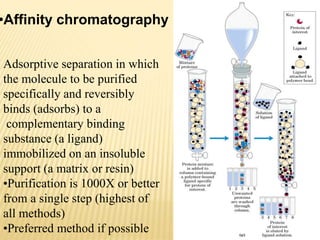
Adsorptive separation in which
the molecule to be purified
specifically and reversibly
binds (adsorbs) to a
complementary binding
substance (a ligand)
immobilized on an insoluble
support (a matrix or resin)
•Purification is 1000X or better
from a single step (highest of
all methods)
•Preferred method if possible
•Affinity chromatography
Polyacrylamide Gel Electrophoresis
oElectrophoresis separates proteins based on their size using electrical current
protein are usually soluble in water solution
because they have hydrophilic amino acids
on their surface that attract water molecules
and interact with them.
Conclusion
Reference:-
•Bioanalytical techniques, M. L.
Srivastava(2008), Narosa Publication House,
ISBN 978-81-7319-852-6
•Principles of Biochemistry, David L. Nelson
And Michael M. Cox (2008), W H FREEMAN
And Company, ISBN-10: 0-7167-7108-X
•Molecular Cell Biology, LODISH And et.al.
(2016), W H FREEMAN And Company,
ISBN10:1-4641-8339-2

PPT protein separation and purification

  • 1.
  • 3.
  • 4.
    Purpose include the preparationof commercial products such as enzymes (e.g. lactase), nutritional proteins (e.g. soy protein isolate), certain biopharmaceuticals (e.g. insulin). research or analytical purposes,  including identification,  quantification, and studies of the protein's structure,  post-translational modifications and function.
  • 5.
    Separation:- Extracellular:- •No need forcell disruption •Secreted soluble proteins can be collected in the cell supernatant after centrifugation •Membrane-bound proteins might be released from the cell simply using detergents
  • 7.
    Need cell disruption •Detergentslysis •Enzymatic lysis •Osmotic lysis •Ultrasonication Intracellular
  • 8.
    Purification:- oDifferential centrifugation:- Force Timesediment 1000g 5min Eu. cell 4,000g 10min Chl,cell debris, nuclei 15,000 20min Bacteria, mito 30,000 30min Small organelle 200,000 1hr Small vesicle 100,000 3-10hrs Ribosome 200,000 10-24hrs Membrane sheets
  • 9.
  • 10.
    oDifferent chromatography Column Chromatography:- •Most common and best approach to purifying larger amounts of proteins •Achieves highest level of purity and largest amount •Requires low effort •Lowest likelihood to damage the protein product •Standard method for pharmaceutical industry
  • 11.
    Size-Exclusion (or molecular exclusion)Chromatography •Molecules are separated according to differences in their size as they pass through a hydrophilic polymer •Polymer beads composed of cross-linked dextran (dextrose) which is highly and uniformly porous (like Swiss cheese) •Large proteins come out first (can’t fit in pores), small proteins come out last (get stuck in the pores)
  • 12.
    •Principle is toseparate on basis of charge “adsorption” •Highest resolving power •Highest loading capacity •Widespread applicability •Most frequent chromatographic technique for protein purification •Ion Exchange chromatography
  • 13.
    Adsorptive separation inwhich the molecule to be purified specifically and reversibly binds (adsorbs) to a complementary binding substance (a ligand) immobilized on an insoluble support (a matrix or resin) •Purification is 1000X or better from a single step (highest of all methods) •Preferred method if possible •Affinity chromatography
  • 14.
    Polyacrylamide Gel Electrophoresis oElectrophoresisseparates proteins based on their size using electrical current
  • 16.
    protein are usuallysoluble in water solution because they have hydrophilic amino acids on their surface that attract water molecules and interact with them. Conclusion
  • 17.
    Reference:- •Bioanalytical techniques, M.L. Srivastava(2008), Narosa Publication House, ISBN 978-81-7319-852-6 •Principles of Biochemistry, David L. Nelson And Michael M. Cox (2008), W H FREEMAN And Company, ISBN-10: 0-7167-7108-X •Molecular Cell Biology, LODISH And et.al. (2016), W H FREEMAN And Company, ISBN10:1-4641-8339-2