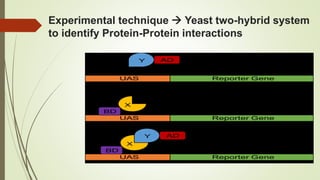
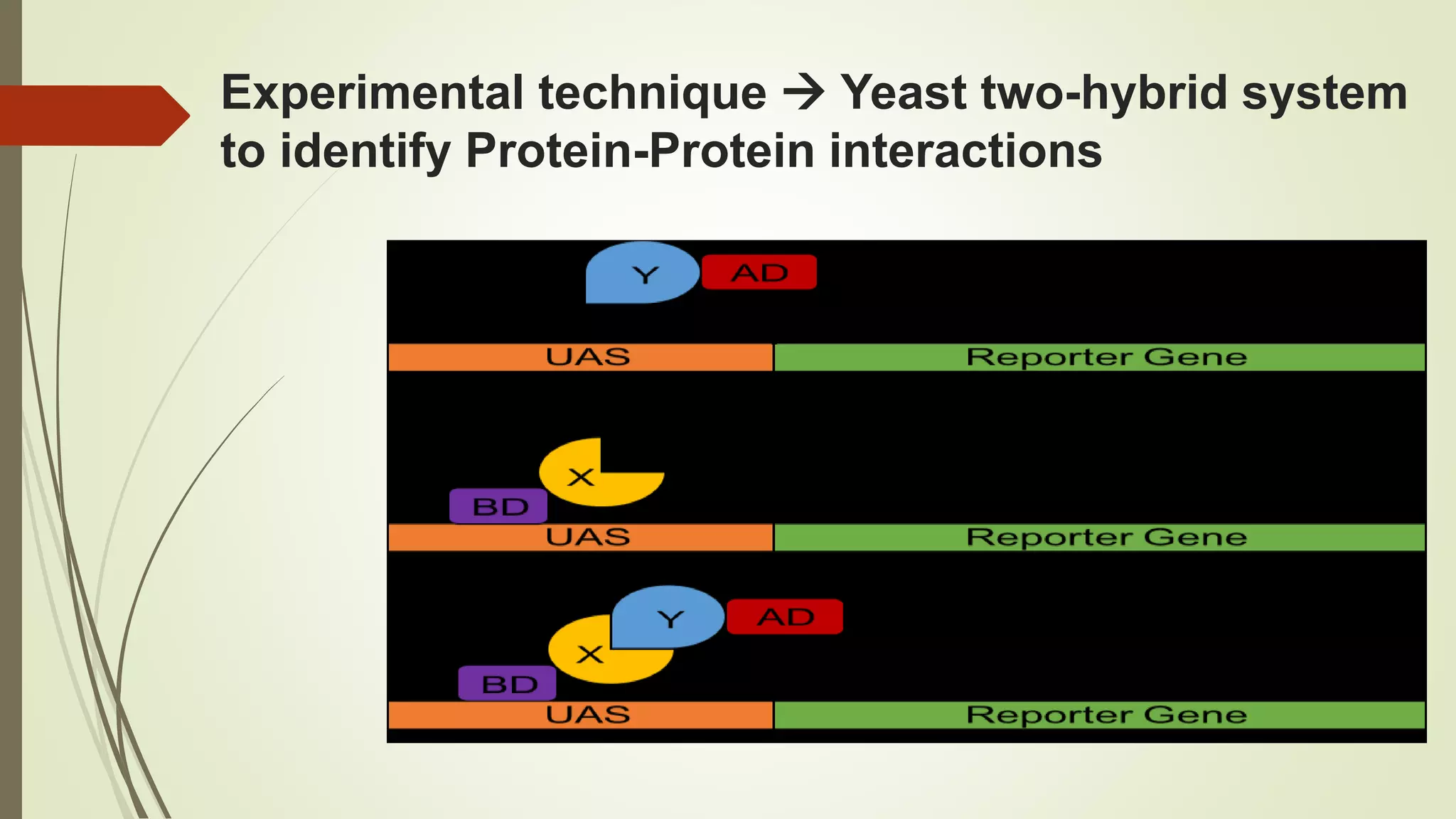
Experimental technique  Yeast two-hybrid system
to identify Protein-Protein interactions
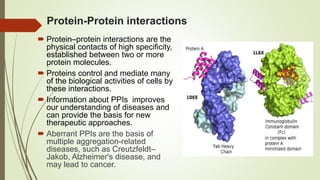
Protein-Protein interactions
 Protein–protein interactions are the
physical contacts of high specificity,
established between two or more
protein molecules.
 Proteins control and mediate many
of the biological activities of cells by
these interactions.
 Information about PPIs improves
our understanding of diseases and
can provide the basis for new
therapeutic approaches.
 Aberrant PPIs are the basis of
multiple aggregation-related
diseases, such as Creutzfeldt–
Jakob, Alzheimer's disease, and
may lead to cancer.
Examples of protein-protein interactions
Signal Transduction: activity of cells is regulated
through this way in form of extracellular signals
Transport across cell membrane: a protein may be
carrying another protein
Cell metabolism: In many metabolic pathways
different proteins interact to perform a specific
function.
Muscles contraction: myosin filaments act as
molecular motors and by binding to actin enable
filament sliding.
What is
Yeast Two
Hybrid
system?
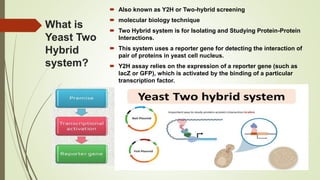
 Also known as Y2H or Two-hybrid screening
 molecular biology technique
 Two Hybrid system is for Isolating and Studying Protein-Protein
Interactions.
 This system uses a reporter gene for detecting the interaction of
pair of proteins in yeast cell nucleus.
 Y2H assay relies on the expression of a reporter gene (such as
lacZ or GFP), which is activated by the binding of a particular
transcription factor.
Why Yeast Two Hybrid system
 The yeast two hybrid system has a clear advantage
over classical biochemical or genetic methods
 It is an in vivo technique that uses the yeast cell as a
living test-tube.
 It bears a greater resemblance to higher eukaryotic
systems than a system based on a bacterial host.
 With regards to classical biochemical approaches,
which can require high quantities of purified proteins
or good quality anti- bodies, the two Hybrid system
has minimal requirements to initiate screening, since
only the cDNA of the gene of interest is needed.
How Yeast Two Hybrid
system works?
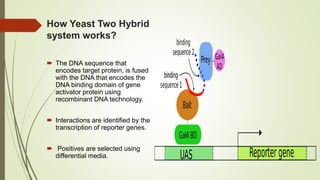
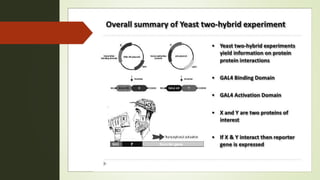
 The DNA sequence that
encodes target protein, is fused
with the DNA that encodes the
DNA binding domain of gene
activator protein using
recombinant DNA technology.
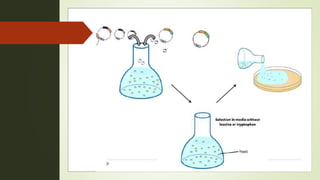
 Interactions are identified by the
transcription of reporter genes.
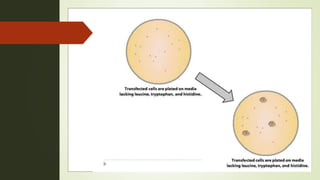
 Positives are selected using
differential media.
The classical Yeast Two Hybrid system
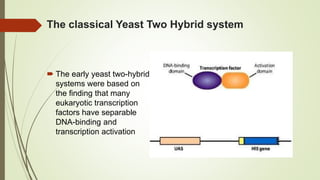
 The early yeast two-hybrid
systems were based on
the finding that many
eukaryotic transcription
factors have separable
DNA-binding and
transcription activation
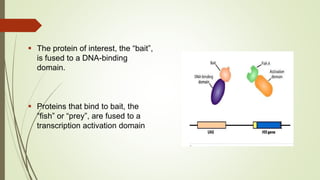
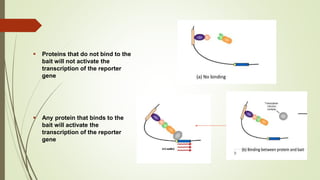
 The protein of interest, the “bait”,
is fused to a DNA-binding
domain.
 Proteins that bind to bait, the
“fish” or “prey”, are fused to a
transcription activation domain
 Proteins that do not bind to the
bait will not activate the
transcription of the reporter
gene
 Any protein that binds to the
bait will activate the
transcription of the reporter
gene
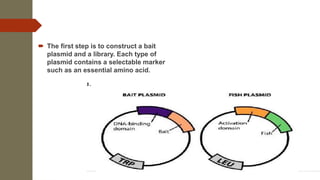
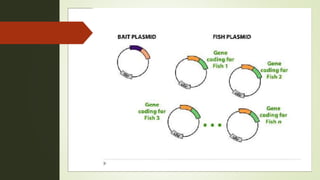
 The first step is to construct a bait
plasmid and a library. Each type of
plasmid contains a selectable marker
such as an essential amino acid.
Advantages
 Immediate availability of the cloned gene of the interacting protein
 Only a single plasmid construction is required
 Interactions are detected in vivo
 Weak, transient interactions can be detected
 Can accumulate a weak signal over time
 Protein purification not necessary
 No antibodies requires
Disadvantages
 False positives are the largest problem with the yeast two-hybrid system. Can be
caused by the ability of bait to induce transcription without interaction with the bait
 Possible incorrect protein folding in yeast
 gene encoding target protein must be available
 failed to detect some know interactions
 Elimination of False Positives
 Sequence Analysis
 Retransformation of both strain with bait plasmid and strain without bait plasmid
 Test for interaction with an unrelated protein as bait
Conclusion:
 The predictive power of the interactome model allows us to examine
the organization and coordination of multiple complex cellular
processes and determine how they are organized into pathways.
 The interactome model can be used to predict poorly characterized
proteins into their functional context according to their interacting
partners within a module.
 One-to-many relationship can be used for pathway discovery.

Yeast two hybrid system

  • 1.
    Experimental technique Yeast two-hybrid system to identify Protein-Protein interactions
  • 2.
    Protein-Protein interactions  Protein–proteininteractions are the physical contacts of high specificity, established between two or more protein molecules.  Proteins control and mediate many of the biological activities of cells by these interactions.  Information about PPIs improves our understanding of diseases and can provide the basis for new therapeutic approaches.  Aberrant PPIs are the basis of multiple aggregation-related diseases, such as Creutzfeldt– Jakob, Alzheimer's disease, and may lead to cancer.
  • 3.
    Examples of protein-proteininteractions Signal Transduction: activity of cells is regulated through this way in form of extracellular signals Transport across cell membrane: a protein may be carrying another protein Cell metabolism: In many metabolic pathways different proteins interact to perform a specific function. Muscles contraction: myosin filaments act as molecular motors and by binding to actin enable filament sliding.
  • 4.
    What is Yeast Two Hybrid system? Also known as Y2H or Two-hybrid screening  molecular biology technique  Two Hybrid system is for Isolating and Studying Protein-Protein Interactions.  This system uses a reporter gene for detecting the interaction of pair of proteins in yeast cell nucleus.  Y2H assay relies on the expression of a reporter gene (such as lacZ or GFP), which is activated by the binding of a particular transcription factor.
  • 5.
    Why Yeast TwoHybrid system  The yeast two hybrid system has a clear advantage over classical biochemical or genetic methods  It is an in vivo technique that uses the yeast cell as a living test-tube.  It bears a greater resemblance to higher eukaryotic systems than a system based on a bacterial host.  With regards to classical biochemical approaches, which can require high quantities of purified proteins or good quality anti- bodies, the two Hybrid system has minimal requirements to initiate screening, since only the cDNA of the gene of interest is needed.
  • 6.
    How Yeast TwoHybrid system works?  The DNA sequence that encodes target protein, is fused with the DNA that encodes the DNA binding domain of gene activator protein using recombinant DNA technology.  Interactions are identified by the transcription of reporter genes.  Positives are selected using differential media.
  • 7.
    The classical YeastTwo Hybrid system  The early yeast two-hybrid systems were based on the finding that many eukaryotic transcription factors have separable DNA-binding and transcription activation
  • 8.
     The proteinof interest, the “bait”, is fused to a DNA-binding domain.  Proteins that bind to bait, the “fish” or “prey”, are fused to a transcription activation domain
  • 9.
     Proteins thatdo not bind to the bait will not activate the transcription of the reporter gene  Any protein that binds to the bait will activate the transcription of the reporter gene
  • 10.
     The firststep is to construct a bait plasmid and a library. Each type of plasmid contains a selectable marker such as an essential amino acid.
  • 15.
    Advantages  Immediate availabilityof the cloned gene of the interacting protein  Only a single plasmid construction is required  Interactions are detected in vivo  Weak, transient interactions can be detected  Can accumulate a weak signal over time  Protein purification not necessary  No antibodies requires
  • 16.
    Disadvantages  False positivesare the largest problem with the yeast two-hybrid system. Can be caused by the ability of bait to induce transcription without interaction with the bait  Possible incorrect protein folding in yeast  gene encoding target protein must be available  failed to detect some know interactions  Elimination of False Positives  Sequence Analysis  Retransformation of both strain with bait plasmid and strain without bait plasmid  Test for interaction with an unrelated protein as bait
  • 17.
    Conclusion:  The predictivepower of the interactome model allows us to examine the organization and coordination of multiple complex cellular processes and determine how they are organized into pathways.  The interactome model can be used to predict poorly characterized proteins into their functional context according to their interacting partners within a module.  One-to-many relationship can be used for pathway discovery.