Protein Purification techniques
based on molecular size
 - dialysis and ultrafiltration
 - density gradient centrifugation
 - size-exclusion chromatography
based on solubility of proteins
 - isoelectric precipitation
 - salting out
based on electric charge
 - ion-exchange chromatography
 - electrophoresis
Separation procedures based on
molecular size
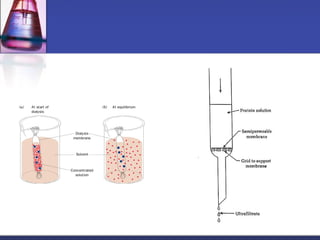
 Procedures that separate proteins from small solutes.
 Mermbane enclosing the protein solution is
semipermeable.
 Allows the exchange of water and small solutes
(glucose, salts) that pass through the membrane freely
but protein do not.
 Molecules migrate through a semi permeable membrane
under pressure or centrifugal force.
Density gradient (zonal)
centrifugation
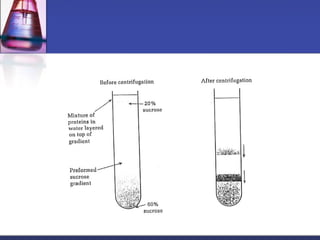
 the rate of sedimentation is determined by
weight, density and shape of macromolecule..
proteins in solution tend to sediment at high
centrifugal fields.
 in continuous density gradient of sucrose
macromolecule sediment down at its own rate.
Chromatography
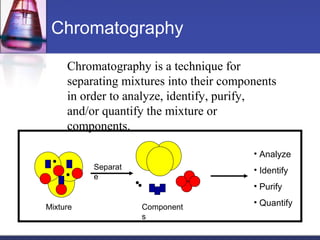
Chromatography is a technique for
separating mixtures into their components
in order to analyze, identify, purify,
and/or quantify the mixture or
components.
Separat
e
• Analyze
• Identify
• Purify
• QuantifyComponent
s
Mixture
• Liquid Chromatography – separates liquid
samples with a liquid solvent (mobile phase) and a
column composed of solid beads (stationary phase)
• Gas Chromatography – separates vaporized
samples with a carrier gas (mobile phase) and a
column composed of a liquid or of solid beads
(stationary phase)
Types of Chromatography
•Paper Chromatography – separates dried liquid
samples with a liquid solvent (mobile phase) and a
paper strip (stationary phase)
• Thin-Layer Chromatography – separates dried
liquid samples with a liquid solvent (mobile phase)
and a glass plate covered with a thin layer of
alumina or silica gel (stationary phase)
Types of Chromatography
Principles of Paper Chromatography
 Capillary Action – the movement of liquid within
the spaces of a porous material is due to the
forces of adhesion, cohesion, and surface
tension. The liquid is able to move up the filter
paper because its attraction to itself is stronger
than the force of gravity.
 Solubility – the degree to which a material
(solute) dissolves into a solvent. Solutes
dissolve into solvents that have similar
properties. (Like dissolves like) This allows
different solutes to be separated by different
combinations of solvents.
Principles of Paper Chromatography
Separation of components depends on both
their solubility in the mobile phase and their
differential affinity to the mobile phase and the
stationary phase.
Column chromatography
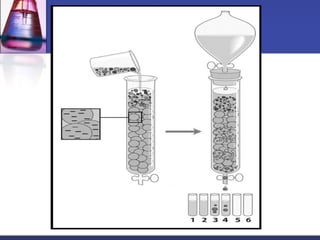
Chromatographic column (plastic or glass) include a
solid, porous material (matrix) supported inside –
stationary phase.
A solution – the mobile phase - flows through the matrix
(stationary phase).
The solution that pass out of the bottom is constantly
replaced from a reservoir.
The protein solution migrates through column.
They are retarded to different degrees by their
interactions with the matrix material.
Gel-filtration chromatography
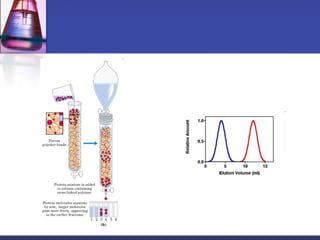
Method uses porous particles to separate molecules of different
size.
 proteins passed over a column filled with a hydrated porous
beads made of a carbohydrate or polyacrylamide polymer.
mixture of proteins dissolved in suitable buffer, is allowed to flow
by gravity down a column.
 column is packed with beads of inert polymeric material.
 very large molecules cannot penetrate into the pores of the beads,
the small molecules enter the pores.
large molecules are excluded and small proteins are retarded
[large molecules exit (elute) first] .
Ion-exchange chromatography:
 separation of proteins over a column filled with
charged polymer beads (bead +charge =anion-
exchange; bead -charge = cation exchange).
 Positively charged proteins bind to beads of
negative charge & vice versa. Bound proteins are
eluted with salt. Least charged proteins will elute
first.
Affinity chromatography:
 proteins are passed through a column of beads
containing a covalently bound high affinity group
for the protein of interest. Bound protein is eluted
by free high affinity group.
 When a solution is passed the protein to be
separated gets attached to substrate or enzyme.
 It is then separated and obtained in pure form.
Affinity chromatography
Example:
 immunoaffinity chromatography: an antibody specific for a
protein is immobilized on the column and used to affinity purify
the specific protein.
 Buffers containing a high concentration of salts and/or low pH are
often used to disrupt the non covalent interactions between
antibodies and antigen. A denaturing agent, such as 8 M urea,
will also break the interaction by altering the configuration of the
antigen-binding site of the antibody molecule.
High Pressure Liquid
Chromatography (HPLC)
 sample is vaporized and injected;
 moves through a column containing stationary phase
under high pressure;
 separates mixture into compounds according to their
affinity for the stationary phase
 Short time procedure
2. Separation procedures based
on solubility
 Isoelectric precipitation
 Protein itself can be either positively or negatively
charged overall due to the terminal amine -NH2
and
carboxyl (-COOH) groups and the groups on the side
chain.
 Protein is positively charged at low pH and negatively
charged at high pH. The intermediate pH at which a
protein molecule has a net charge of zero is called the
isoelectric point of that protein - pI

 Protein is the least soluble when the pH of the
solution is at its isoelectric point.
 Different proteins have different pI values and
can be separated by isoelectric precipitation
Salting out
 Neutral salts influence the solubility of globular proteins.
 Hydrophilic amino acid interact with the molecules of
H2O, allow proteins to form hydrogen bonds with the
surrounding water molecules.
 Increasing salt concentration which decreases the number
of water molecules available to interact with protein.
 Increasing ionic strength decrease solubility of a protein.
 In general:
a) small proteins more soluble than large proteins
b) the larger the number of charged side chains, the more
soluble the protein
c) Proteins are usually least soluble at their isoelectric
points.
 Sufficiently high ionic strength completely precipitate a
protein from solution.
 Divalent salts [MgCl2, (NH4)SO4] are far more effective
than monovalent (NaCl).
Separation procedures
based on electric charge
 Methods depend on acid-base properties, determined by
number and types of ionizable groups of amino acids.
 Each protein has distinctive acid-base properties related
to amino acid composition.
 Ionizing side chain groups:
 R-COOH (Glu, Asp)
 imidazole (His)
 phenolic OH (Tyr)
 e-amino (Lys)
 guanidinyl (Arg)
Process of electrophoresis
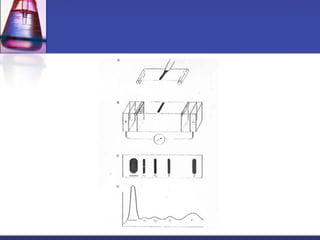
 1. sample application
 2. adjustment of voltage or current - DIRECT
CURRENT (gel-electrophoresis about 70 - 100 volts)
 3. separation time: minutes
(e.g. gel-electrophoresis of serum proteins 30 min.)
 4. electrophoresis in supporting medium: fixation,
staining and destaining
 5. evaluation:

qualitative (standards)

quantitative (densitometry)
Electrophoretic method
 negatively charged proteins move towards the anode
 positively charged proteins move towards the cathode
 much simple
 much greater resolution
 require small sample
 Protein solution on the buffer (pH 8.6) is immobilized in
a solid support (inert material like cellulose acetate)
 Major protein components separate into discrete zones
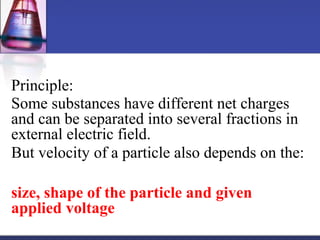
Principle:
Some substances have different net charges
and can be separated into several fractions in
external electric field.
But velocity of a particle also depends on the:
size, shape of the particle and given
applied voltage
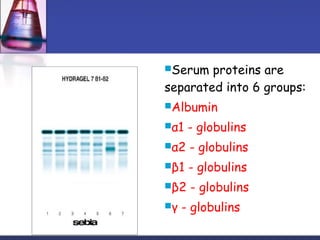
Serum proteins are
separated into 6 groups:
Albumin
α1 - globulins
α2 - globulins
β1 - globulins
β2 - globulins
γ - globulins
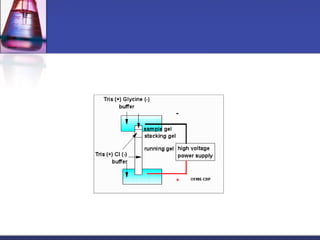
Gel electrophoresis
 Gel electrophoresis is a method that separates
macromolecules (proteins, nucleic acids) on the basis of
size, and electric charge.
 Polyacryl amide or agarose gels are stabilizing media.
 SDS (sodium dodecyl sulfate) – ionic surfactant, anionic
substance.
 Anions of SDS bind to peptide chain and protein is
negatively charged, moves to cathode.
Principle:
Serum proteins are negative charged at pH 8.6 (a
buffer helps to maintain a constant pH) and they
move toward the cathode at the rate dependent on
their net charge.
The separated proteins are fixed and stained by
amidoblack solution.
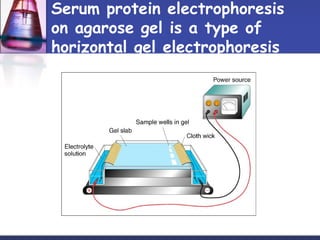
Serum protein electrophoresis
on agarose gel is a type of
horizontal gel electrophoresis
The use of protein electrophoresis
in diagnosis of diseases
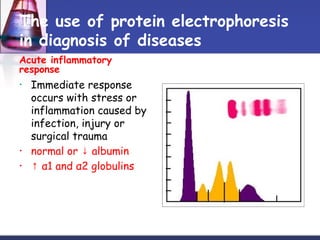
Acute inflammatory
response
• Immediate response
occurs with stress or
inflammation caused by
infection, injury or
surgical trauma
• normal or albumin↓
• ↑ α1 and α2 globulins
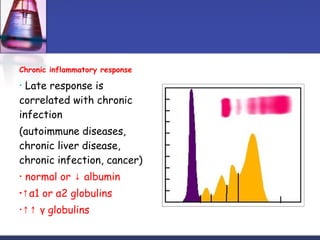
Chronic inflammatory response
• Late response is
correlated with chronic
infection
(autoimmune diseases,
chronic liver disease,
chronic infection, cancer)
• normal or albumin↓
•↑α1 or α2 globulins
•↑↑ γ globulins
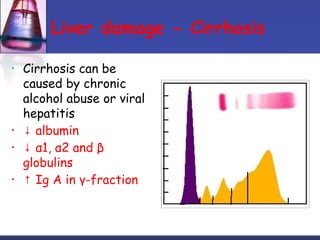
Liver damage - Cirrhosis
• Cirrhosis can be
caused by chronic
alcohol abuse or viral
hepatitis
• ↓ albumin
• ↓ α1, α2 and β
globulins
• ↑ Ig A in γ-fraction
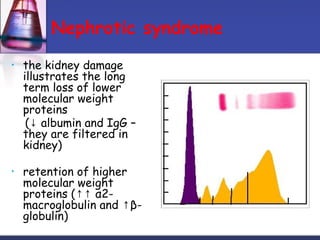
Nephrotic syndrome
• the kidney damage
illustrates the long
term loss of lower
molecular weight
proteins
(↓ albumin and IgG –
they are filtered in
kidney)
• retention of higher
molecular weight
proteins (↑↑ α2-
macroglobulin and ↑β-
globulin)
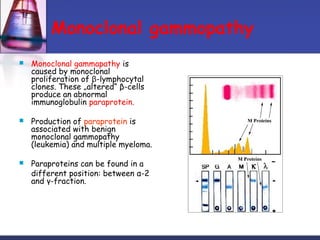
Monoclonal gammopathy
 Monoclonal gammapathy is
caused by monoclonal
proliferation of β-lymphocytal
clones. These „altered“ β-cells
produce an abnormal
immunoglobulin paraprotein.
 Production of paraprotein is
associated with benign
monoclonal gammopathy
(leukemia) and multiple myeloma.
 Paraproteins can be found in a
different position: between α-2
and γ-fraction.

Purification techniques

  • 1.
  • 2.
    based on molecularsize  - dialysis and ultrafiltration  - density gradient centrifugation  - size-exclusion chromatography based on solubility of proteins  - isoelectric precipitation  - salting out based on electric charge  - ion-exchange chromatography  - electrophoresis
  • 3.
    Separation procedures basedon molecular size  Procedures that separate proteins from small solutes.  Mermbane enclosing the protein solution is semipermeable.  Allows the exchange of water and small solutes (glucose, salts) that pass through the membrane freely but protein do not.  Molecules migrate through a semi permeable membrane under pressure or centrifugal force.
  • 5.
    Density gradient (zonal) centrifugation the rate of sedimentation is determined by weight, density and shape of macromolecule.. proteins in solution tend to sediment at high centrifugal fields.  in continuous density gradient of sucrose macromolecule sediment down at its own rate.
  • 7.
    Chromatography Chromatography is atechnique for separating mixtures into their components in order to analyze, identify, purify, and/or quantify the mixture or components. Separat e • Analyze • Identify • Purify • QuantifyComponent s Mixture
  • 8.
    • Liquid Chromatography– separates liquid samples with a liquid solvent (mobile phase) and a column composed of solid beads (stationary phase) • Gas Chromatography – separates vaporized samples with a carrier gas (mobile phase) and a column composed of a liquid or of solid beads (stationary phase) Types of Chromatography
  • 9.
    •Paper Chromatography –separates dried liquid samples with a liquid solvent (mobile phase) and a paper strip (stationary phase) • Thin-Layer Chromatography – separates dried liquid samples with a liquid solvent (mobile phase) and a glass plate covered with a thin layer of alumina or silica gel (stationary phase) Types of Chromatography
  • 10.
    Principles of PaperChromatography  Capillary Action – the movement of liquid within the spaces of a porous material is due to the forces of adhesion, cohesion, and surface tension. The liquid is able to move up the filter paper because its attraction to itself is stronger than the force of gravity.  Solubility – the degree to which a material (solute) dissolves into a solvent. Solutes dissolve into solvents that have similar properties. (Like dissolves like) This allows different solutes to be separated by different combinations of solvents.
  • 11.
    Principles of PaperChromatography Separation of components depends on both their solubility in the mobile phase and their differential affinity to the mobile phase and the stationary phase.
  • 12.
    Column chromatography Chromatographic column(plastic or glass) include a solid, porous material (matrix) supported inside – stationary phase. A solution – the mobile phase - flows through the matrix (stationary phase). The solution that pass out of the bottom is constantly replaced from a reservoir. The protein solution migrates through column. They are retarded to different degrees by their interactions with the matrix material.
  • 14.
    Gel-filtration chromatography Method usesporous particles to separate molecules of different size.  proteins passed over a column filled with a hydrated porous beads made of a carbohydrate or polyacrylamide polymer. mixture of proteins dissolved in suitable buffer, is allowed to flow by gravity down a column.  column is packed with beads of inert polymeric material.  very large molecules cannot penetrate into the pores of the beads, the small molecules enter the pores. large molecules are excluded and small proteins are retarded [large molecules exit (elute) first] .
  • 15.
    Ion-exchange chromatography:  separationof proteins over a column filled with charged polymer beads (bead +charge =anion- exchange; bead -charge = cation exchange).  Positively charged proteins bind to beads of negative charge & vice versa. Bound proteins are eluted with salt. Least charged proteins will elute first.
  • 17.
    Affinity chromatography:  proteinsare passed through a column of beads containing a covalently bound high affinity group for the protein of interest. Bound protein is eluted by free high affinity group.  When a solution is passed the protein to be separated gets attached to substrate or enzyme.  It is then separated and obtained in pure form.
  • 18.
    Affinity chromatography Example:  immunoaffinitychromatography: an antibody specific for a protein is immobilized on the column and used to affinity purify the specific protein.  Buffers containing a high concentration of salts and/or low pH are often used to disrupt the non covalent interactions between antibodies and antigen. A denaturing agent, such as 8 M urea, will also break the interaction by altering the configuration of the antigen-binding site of the antibody molecule.
  • 19.
    High Pressure Liquid Chromatography(HPLC)  sample is vaporized and injected;  moves through a column containing stationary phase under high pressure;  separates mixture into compounds according to their affinity for the stationary phase  Short time procedure
  • 20.
    2. Separation proceduresbased on solubility  Isoelectric precipitation  Protein itself can be either positively or negatively charged overall due to the terminal amine -NH2 and carboxyl (-COOH) groups and the groups on the side chain.  Protein is positively charged at low pH and negatively charged at high pH. The intermediate pH at which a protein molecule has a net charge of zero is called the isoelectric point of that protein - pI 
  • 21.
     Protein isthe least soluble when the pH of the solution is at its isoelectric point.  Different proteins have different pI values and can be separated by isoelectric precipitation
  • 22.
    Salting out  Neutralsalts influence the solubility of globular proteins.  Hydrophilic amino acid interact with the molecules of H2O, allow proteins to form hydrogen bonds with the surrounding water molecules.  Increasing salt concentration which decreases the number of water molecules available to interact with protein.  Increasing ionic strength decrease solubility of a protein.
  • 23.
     In general: a)small proteins more soluble than large proteins b) the larger the number of charged side chains, the more soluble the protein c) Proteins are usually least soluble at their isoelectric points.  Sufficiently high ionic strength completely precipitate a protein from solution.  Divalent salts [MgCl2, (NH4)SO4] are far more effective than monovalent (NaCl).
  • 24.
    Separation procedures based onelectric charge  Methods depend on acid-base properties, determined by number and types of ionizable groups of amino acids.  Each protein has distinctive acid-base properties related to amino acid composition.  Ionizing side chain groups:  R-COOH (Glu, Asp)  imidazole (His)  phenolic OH (Tyr)  e-amino (Lys)  guanidinyl (Arg)
  • 25.
    Process of electrophoresis 1. sample application  2. adjustment of voltage or current - DIRECT CURRENT (gel-electrophoresis about 70 - 100 volts)  3. separation time: minutes (e.g. gel-electrophoresis of serum proteins 30 min.)  4. electrophoresis in supporting medium: fixation, staining and destaining  5. evaluation:  qualitative (standards)  quantitative (densitometry)
  • 26.
    Electrophoretic method  negativelycharged proteins move towards the anode  positively charged proteins move towards the cathode  much simple  much greater resolution  require small sample  Protein solution on the buffer (pH 8.6) is immobilized in a solid support (inert material like cellulose acetate)  Major protein components separate into discrete zones
  • 27.
    Principle: Some substances havedifferent net charges and can be separated into several fractions in external electric field. But velocity of a particle also depends on the: size, shape of the particle and given applied voltage
  • 28.
    Serum proteins are separatedinto 6 groups: Albumin α1 - globulins α2 - globulins β1 - globulins β2 - globulins γ - globulins
  • 30.
    Gel electrophoresis  Gelelectrophoresis is a method that separates macromolecules (proteins, nucleic acids) on the basis of size, and electric charge.  Polyacryl amide or agarose gels are stabilizing media.  SDS (sodium dodecyl sulfate) – ionic surfactant, anionic substance.  Anions of SDS bind to peptide chain and protein is negatively charged, moves to cathode.
  • 31.
    Principle: Serum proteins arenegative charged at pH 8.6 (a buffer helps to maintain a constant pH) and they move toward the cathode at the rate dependent on their net charge. The separated proteins are fixed and stained by amidoblack solution.
  • 33.
    Serum protein electrophoresis onagarose gel is a type of horizontal gel electrophoresis
  • 34.
    The use ofprotein electrophoresis in diagnosis of diseases Acute inflammatory response • Immediate response occurs with stress or inflammation caused by infection, injury or surgical trauma • normal or albumin↓ • ↑ α1 and α2 globulins
  • 35.
    Chronic inflammatory response •Late response is correlated with chronic infection (autoimmune diseases, chronic liver disease, chronic infection, cancer) • normal or albumin↓ •↑α1 or α2 globulins •↑↑ γ globulins
  • 36.
    Liver damage -Cirrhosis • Cirrhosis can be caused by chronic alcohol abuse or viral hepatitis • ↓ albumin • ↓ α1, α2 and β globulins • ↑ Ig A in γ-fraction
  • 37.
    Nephrotic syndrome • thekidney damage illustrates the long term loss of lower molecular weight proteins (↓ albumin and IgG – they are filtered in kidney) • retention of higher molecular weight proteins (↑↑ α2- macroglobulin and ↑β- globulin)
  • 38.
    Monoclonal gammopathy  Monoclonalgammapathy is caused by monoclonal proliferation of β-lymphocytal clones. These „altered“ β-cells produce an abnormal immunoglobulin paraprotein.  Production of paraprotein is associated with benign monoclonal gammopathy (leukemia) and multiple myeloma.  Paraproteins can be found in a different position: between α-2 and γ-fraction.