Isolation of Protein
http://irfanchemist.wordpress.com/2009/04/19/isolation-of-protein /
Ultra-centrifugation
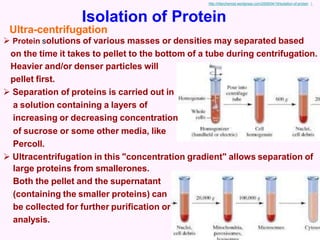
 Protein solutions of various masses or densities may separated based
on the time it takes to pellet to the bottom of a tube during centrifugation.
Heavier and/or denser particles will
pellet first.
 Separation of proteins is carried out in
a solution containing a layers of
increasing or decreasing concentration
of sucrose or some other media, like
Percoll.
 Ultracentrifugation in this "concentration gradient" allows separation of
large proteins from smallerones.
Both the pellet and the supernatant
(containing the smaller proteins) can
be collected for further purification or
analysis.
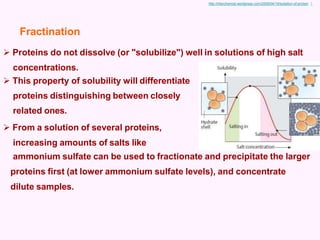
 Proteins do not dissolve (or "solubilize") well in solutions of high salt
concentrations.
 This property of solubility will differentiate
proteins distinguishing between closely
related ones.
 From a solution of several proteins,
increasing amounts of salts like
ammonium sulfate can be used to fractionate and precipitate the larger
proteins first (at lower ammonium sulfate levels), and concentrate
dilute samples.
http://irfanchemist.wordpress.com/2009/04/19/isolation-of-protein /
Fractination
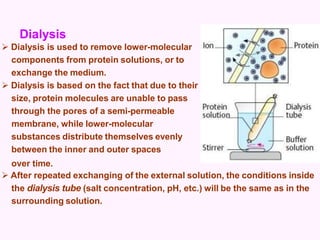
 Dialysis is used to remove lower-molecular
components from protein solutions, or to
exchange the medium.
 Dialysis is based on the fact that due to their
size, protein molecules are unable to pass
through the pores of a semi-permeable
membrane, while lower-molecular
substances distribute themselves evenly
between the inner and outer spaces
over time.
 After repeated exchanging of the external solution, the conditions inside
the dialysis tube (salt concentration, pH, etc.) will be the same as in the
surrounding solution.
Dialysis
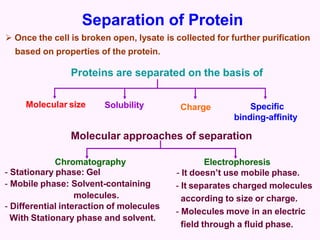
Separation of Protein
Chromatography
- Stationary phase: Gel
- Mobile phase: Solvent-containing
molecules.
- Differential interaction of molecules
With Stationary phase and solvent.
Molecular approaches of separation
Electrophoresis
- It doesn’t use mobile phase.
- It separates charged molecules
according to size or charge.
- Molecules move in an electric
field through a fluid phase.
 Once the cell is broken open, lysate is collected for further purification
based on properties of the protein.
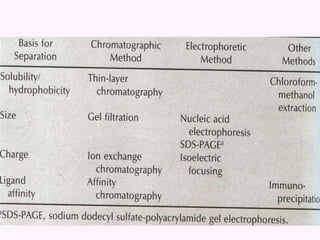
Proteins are separated on the basis of
Molecular size Solubility Specific
binding-affinity
Charge
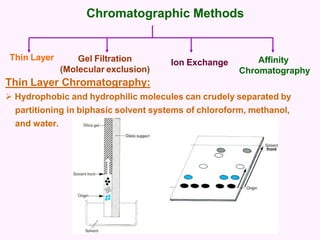
Chromatographic Methods
Thin Layer Gel Filtration
(Molecular exclusion)
Ion Exchange Affinity
Chromatography
Thin Layer Chromatography:
 Hydrophobic and hydrophilic molecules can crudely separated by
partitioning in biphasic solvent systems of chloroform, methanol,
and water.
front
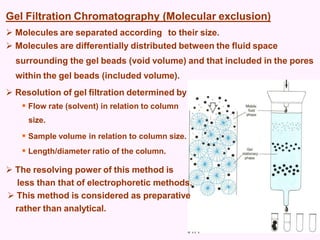
Gel Filtration Chromatography (Molecular exclusion)
:
 Molecules are separated according to their size.
 Molecules are differentially distributed between the fluid space
surrounding the gel beads (void volume) and that included in the pores
within the gel beads (included volume).
 Resolution of gel filtration determined by
 Flow rate (solvent) in relation to column
size.
 Sample volume in relation to column size.
 Length/diameter ratio of the column.
 The resolving power of this method is
less than that of electrophoretic methods.
 This method is considered as preparative
rather than analytical.
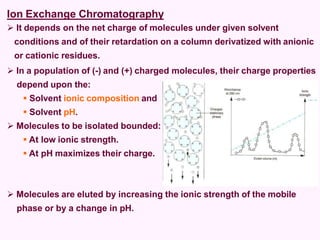
Ion Exchange Chromatography
 It depends on the net charge of molecules under given solvent
conditions and of their retardation on a column derivatized with anionic
or cationic residues.
 In a population of (-) and (+) charged molecules, their charge properties
depend upon the:
 Solvent ionic composition and
 Solvent pH.
 Molecules to be isolated bounded:
 At low ionic strength.
 At pH maximizes their charge.
 Molecules are eluted by increasing the ionic strength of the mobile
phase or by a change in pH.
Affinity Chromatography
 Is based on highly specific interaction between the molecule to be
purified and a ligand bound to the stationary phase.
Ex. Antigen - Antibody & Enzyme - Substrate &
Receptor protein- its ligand &
Glycosylated protein - Specific lectin
 In immunoaffinity, dissociation of antibody - antigen
complex can be achieved by gradual dropping pH of
the mobile phase down to 2.7.
 In receptor - ligand binding, elution is accomplished by
addition of large excess of free ligand
Once the appropriate ligands are available; affinity
chromatography considered as powerful method and can
isolate a rare proteins from heterogeneous mixture.
Electrophoretic Methods
 Molecules’ mobility in solution is proportional to the net number of
charges on them, inversely proportional to the particle radius and the
viscosity of the medium.
 Equal size Charge & Equal charge Size.
 Gel matrix consisting of either plant polysaccharide agarose or
synthetic polymer polyacrylamide.
Electrophoretic Methods
For separation of
Nucleic Acids
 Nucleic acids are repeated units
of equally charge/size ratio.
 They can be effectively separated
according to their size on agarose
gel or polyacrylamide gel.
Sizing of Proteins
 Proteins can be separated
according to molecular mass.
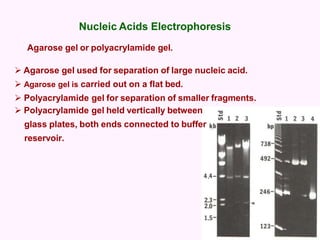
Nucleic Acids Electrophoresis
Agarose gel or polyacrylamide gel.
 Agarose gel used for separation of large nucleic acid.
 Agarose gel is carried out on a flat bed.
 Polyacrylamide gel for separation of smaller fragments.
 Polyacrylamide gel held vertically between
glass plates, both ends connected to buffer
reservoir.
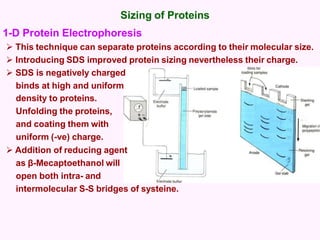
Sizing of Proteins
1-D Protein Electrophoresis
 This technique can separate proteins according to their molecular size.
 Introducing SDS improved protein sizing nevertheless their charge.
 SDS is negatively charged
binds at high and uniform
density to proteins.
Unfolding the proteins,
and coating them with
uniform (-ve) charge.
 Addition of reducing agent
as β-Mecaptoethanol will
open both intra- and
intermolecular S-S bridges of systeine.
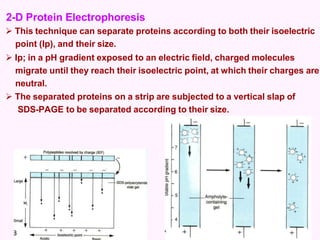
2-D Protein Electrophoresis
 This technique can separate proteins according to both their isoelectric
point (Ip), and their size.
 Ip; in a pH gradient exposed to an electric field, charged molecules
migrate until they reach their isoelectric point, at which their charges are
neutral.
 The separated proteins on a strip are subjected to a vertical slap of
SDS-PAGE to be separated according to their size.
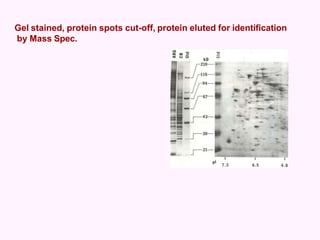
Gel stained, protein spots cut-off, protein eluted for identification
by Mass Spec.

02 Protein Isolation02 Protein Isolation

  • 1.
    Isolation of Protein http://irfanchemist.wordpress.com/2009/04/19/isolation-of-protein/ Ultra-centrifugation  Protein solutions of various masses or densities may separated based on the time it takes to pellet to the bottom of a tube during centrifugation. Heavier and/or denser particles will pellet first.  Separation of proteins is carried out in a solution containing a layers of increasing or decreasing concentration of sucrose or some other media, like Percoll.  Ultracentrifugation in this "concentration gradient" allows separation of large proteins from smallerones. Both the pellet and the supernatant (containing the smaller proteins) can be collected for further purification or analysis.
  • 2.
     Proteins donot dissolve (or "solubilize") well in solutions of high salt concentrations.  This property of solubility will differentiate proteins distinguishing between closely related ones.  From a solution of several proteins, increasing amounts of salts like ammonium sulfate can be used to fractionate and precipitate the larger proteins first (at lower ammonium sulfate levels), and concentrate dilute samples. http://irfanchemist.wordpress.com/2009/04/19/isolation-of-protein / Fractination
  • 3.
     Dialysis isused to remove lower-molecular components from protein solutions, or to exchange the medium.  Dialysis is based on the fact that due to their size, protein molecules are unable to pass through the pores of a semi-permeable membrane, while lower-molecular substances distribute themselves evenly between the inner and outer spaces over time.  After repeated exchanging of the external solution, the conditions inside the dialysis tube (salt concentration, pH, etc.) will be the same as in the surrounding solution. Dialysis
  • 4.
    Separation of Protein Chromatography -Stationary phase: Gel - Mobile phase: Solvent-containing molecules. - Differential interaction of molecules With Stationary phase and solvent. Molecular approaches of separation Electrophoresis - It doesn’t use mobile phase. - It separates charged molecules according to size or charge. - Molecules move in an electric field through a fluid phase.  Once the cell is broken open, lysate is collected for further purification based on properties of the protein. Proteins are separated on the basis of Molecular size Solubility Specific binding-affinity Charge
  • 6.
    Chromatographic Methods Thin LayerGel Filtration (Molecular exclusion) Ion Exchange Affinity Chromatography Thin Layer Chromatography:  Hydrophobic and hydrophilic molecules can crudely separated by partitioning in biphasic solvent systems of chloroform, methanol, and water. front
  • 7.
    Gel Filtration Chromatography(Molecular exclusion) :  Molecules are separated according to their size.  Molecules are differentially distributed between the fluid space surrounding the gel beads (void volume) and that included in the pores within the gel beads (included volume).  Resolution of gel filtration determined by  Flow rate (solvent) in relation to column size.  Sample volume in relation to column size.  Length/diameter ratio of the column.  The resolving power of this method is less than that of electrophoretic methods.  This method is considered as preparative rather than analytical.
  • 8.
    Ion Exchange Chromatography It depends on the net charge of molecules under given solvent conditions and of their retardation on a column derivatized with anionic or cationic residues.  In a population of (-) and (+) charged molecules, their charge properties depend upon the:  Solvent ionic composition and  Solvent pH.  Molecules to be isolated bounded:  At low ionic strength.  At pH maximizes their charge.  Molecules are eluted by increasing the ionic strength of the mobile phase or by a change in pH.
  • 9.
    Affinity Chromatography  Isbased on highly specific interaction between the molecule to be purified and a ligand bound to the stationary phase. Ex. Antigen - Antibody & Enzyme - Substrate & Receptor protein- its ligand & Glycosylated protein - Specific lectin  In immunoaffinity, dissociation of antibody - antigen complex can be achieved by gradual dropping pH of the mobile phase down to 2.7.  In receptor - ligand binding, elution is accomplished by addition of large excess of free ligand Once the appropriate ligands are available; affinity chromatography considered as powerful method and can isolate a rare proteins from heterogeneous mixture.
  • 10.
    Electrophoretic Methods  Molecules’mobility in solution is proportional to the net number of charges on them, inversely proportional to the particle radius and the viscosity of the medium.  Equal size Charge & Equal charge Size.  Gel matrix consisting of either plant polysaccharide agarose or synthetic polymer polyacrylamide. Electrophoretic Methods For separation of Nucleic Acids  Nucleic acids are repeated units of equally charge/size ratio.  They can be effectively separated according to their size on agarose gel or polyacrylamide gel. Sizing of Proteins  Proteins can be separated according to molecular mass.
  • 11.
    Nucleic Acids Electrophoresis Agarosegel or polyacrylamide gel.  Agarose gel used for separation of large nucleic acid.  Agarose gel is carried out on a flat bed.  Polyacrylamide gel for separation of smaller fragments.  Polyacrylamide gel held vertically between glass plates, both ends connected to buffer reservoir.
  • 12.
    Sizing of Proteins 1-DProtein Electrophoresis  This technique can separate proteins according to their molecular size.  Introducing SDS improved protein sizing nevertheless their charge.  SDS is negatively charged binds at high and uniform density to proteins. Unfolding the proteins, and coating them with uniform (-ve) charge.  Addition of reducing agent as β-Mecaptoethanol will open both intra- and intermolecular S-S bridges of systeine.
  • 13.
    2-D Protein Electrophoresis This technique can separate proteins according to both their isoelectric point (Ip), and their size.  Ip; in a pH gradient exposed to an electric field, charged molecules migrate until they reach their isoelectric point, at which their charges are neutral.  The separated proteins on a strip are subjected to a vertical slap of SDS-PAGE to be separated according to their size.
  • 14.
    Gel stained, proteinspots cut-off, protein eluted for identification by Mass Spec.