PROTEIN STRUCTURE AND
FUNCTION 2
Dr Ndagire Dorothy
Protein separation and purification
• Understanding protein structure and
function has been derived from the
study of many individual proteins
• To study a protein in details, a
researcher must be able to separate it
from other proteins in pure form & must
have the techniques to determine its
properties.
Protein purification
• A protein in biological fluids requires some
degree of purification be4 it is specifically
measured, studied or used.
Why purify proteins???????
• Pure proteins are required;
1. To study enzyme function
2.For structural analysis (x-ray crystallography,
NMR, spectroscopy)
3.To obtain amino acid sequence
• Protein separation is important for
Diagnostic and therapeutic purposes;
- Clinical labs routinely separate proteins
for diagnostic purposes.
- Plasma proteins are routinely examined by
gel electrophoresis
- Similar techniques are used to purify
proteins for therapeutic purposes
• Separation of a protein from other
proteins and molecules is achieved by
applying a combination of methods
based on;
–Solubility
–Molecular size
–Molecular charge
–Specific binding of a protein to a
specific substance
• Purification of proteins in their native
state (form in which they function in the
cell) relies on the methods below;
• The source of the protein is generally
tissue or microbial cells
-The first step in any protein purification is;
to break open these cells, releasing their
proteins into a solution called a crude
extract
- sometimes differential centrifugation is
applied
Differential Centrifugation
tissue
homogenate
1000 g
Pellet
unbroken cells
nuclei
chloroplast
transfer
supernatant
transfer
supernatant
transfer
supernatant
10,000 g 100,000 g
Pellet
mitochondria
Pellet
microsomal
Fraction
(ER, golgi,
lysosomes,
peroxisomes)
Super.
Cytosol,
Soluble
enzymes
Protein separation procedures
1. Protein solubility is influenced by the salt conc’n
of the solution.
a) Salting out- adding salts, like ammonium
sulphate, to a solution of a protein mixture
precipitates some proteins at a given salt
concentration but not others
This type of separation is performed to increase
amt of a given protein in a fraction of a highly
complex mixture eg blood sample
b) Salting in, some proteins require
inorganic ions for water solubility.
Extensive dialysis against a solution with a
low salt concentration may therefore
cause certain proteins from a mixture
to precipitate out of solution.
2. Separation on basis of molecular
size
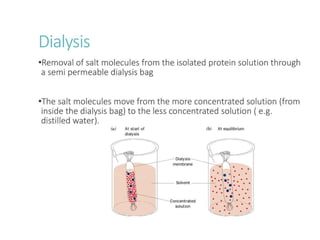
a) Dialysis - a mixture of proteins and
small solutes can be separated by
dialysis through a semi permeable
membrane. (the separation of particles in a
liquid on the basis of differences in their
ability to pass through a membrane.)
The point at which molecules are
excluded or prevented from passing
through the membrane depends on the
pore size of the dialysis membrane.
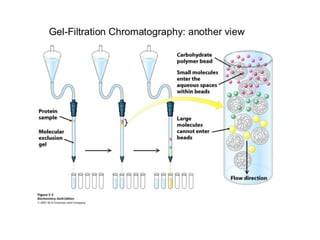
b) Gel filtration (molecular exclusion
chromatography, molecular sizing)
Separate proteins based on molecular size.
Utilizes a column of insoluble carbohydrate
polymers in form of porous beads
- Proteins smaller than the average size of the
beads enter and penetrate the matrix filling
much of the internal volume of the beads so
are retarded as they move thru the beads
- Note that a protein will enter & migrate thru
many of the beads
- large molecules are eluted faster
c. Ultracentrifugation
• High speed centrifugation can separate
a protein solution into components
– The rate at which the protein sediments in
a centrifugal field depends on its size and
shape
– Data from an ultracentrifugation study are
often expressed in terms of svedburg units
(S) related to the rate of sedimentation of
the protein in the centrifugal field
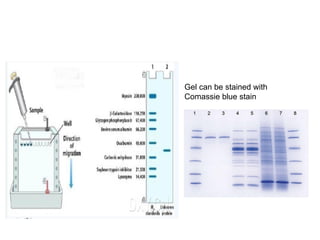
d. Sodium dodecyl sulfate (SDS)
polyacrylamide gel electrophoresis
• Is done on a cross-linked polyacrylamide
gel in the presence of SDS and a
reducing agent, such as β-
mecarptoethanol, separates proteins on
basis of their molecular weight
Polyacrylamide gel electrophoresis
3. Separation on basis of
molecular charge
a) Ion-exchange chromatography;
– a column of insoluble ion-exchange material
carrying their polyanionic or polycationic groups is
used. At appropriate pH, these gps bind
oppositely charged gps by ionic interaction
– Proteins are eluted from the exchanger by
washing with a solution containing salts that
disrupts the electrostatic interactions of the
protein and ion-exchange
– if a gradually increasing salt [] (salt gradient) is
applied to the column, weakly bound proteins are
eluted before tightly bound proteins
b. High performance Liquid
chromatography
• HPLC is similar to ion exchange
chromatography and other
chromatographic mtds in that solutions
of proteins are passed thru special
resins that have attached side groups
High-performance liquid
chromatography or high-
pressure liquid
chromatography (HPLC) is a
chromatographic method that is
used to separate a mixture of
compounds in analytical
chemistry and biochemistry so as
to identify, quantify or purify the
individual components of the
mixture
c. Electrophoresis
• A method utilizing an electric field to drive the
movement of any molecule with a net charge
• Charged molecules move in an electric field at a
rate determined by their charge to mass ratio
• In the electric field, proteins migrate in a
direction determined by the net charge on the
molecule
• The net charge is determined by nature of
ionizing gps and prevailing pH
• Each protein has an pI (pH at no net
charge) and no mv’t in electric field
• At acidic pH (below pI), proteins
behaves like a cation and vise versa
Electrophoretic procedures
1. Gel electrophoresis-
- This is a laboratory method used to separate mixtures
of DNA, RNA, or proteins according to molecular
size. In gel electrophoresis, the molecules to be
separated are pushed by an electrical field through
a gel that contains small pores.
• Plasma proteins for diagnostic purposes can be
separated. The sample is layered on a matrix and is
electrophoresed (agarose or polyacrylamide)
through matrix
• These proteins are stained and at end of
electrophoresis, there are different zones (bands)
depending on over all charge, size and shape
1. Gel electrophoresis
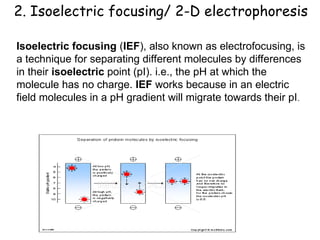
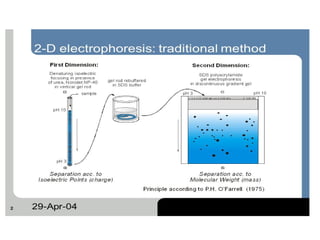
2. Isoelectric focusing/ 2-D electrophoresis
Isoelectric focusing (IEF), also known as electrofocusing, is
a technique for separating different molecules by differences
in their isoelectric point (pI). i.e., the pH at which the
molecule has no charge. IEF works because in an electric
field molecules in a pH gradient will migrate towards their pI.
3. SDS polyacrylamide gel electrophoresis –
separates proteins based on molecular size
• Polyacrylamide gel electrophoresis is a technique widely used
in biochemistry, forensic chemistry, genetics, molecular biology
and biotechnology to separate biological macromolecules,
usually proteins or nucleic acids, according to their
electrophoretic mobility.
Gel can be stained with
Comassie blue stain
Separation by specific affinity binding
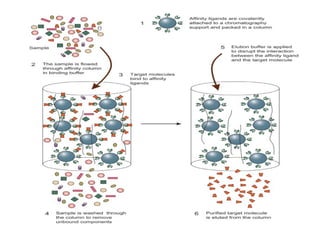
a) Affinity (absorption) chromatography.
Affinity chromatography is a technique in which the
difference in absorption depends on the specific
affinity between a substance fixed in the separation
material (the absorbent) and the desired
component in the mixture (the ligand)
Based on the property of some proteins having
specific non covalent bonding
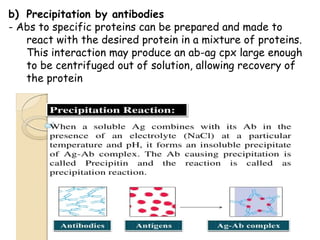
b) Precipitation by antibodies
- Abs to specific proteins can be prepared and made to
react with the desired protein in a mixture of proteins.
This interaction may produce an ab-ag cpx large enough
to be centrifuged out of solution, allowing recovery of
the protein

PROTEIN TECHNIQUES LECTURE AND PURIFICATION2(3).ppt

  • 1.
    PROTEIN STRUCTURE AND FUNCTION2 Dr Ndagire Dorothy
  • 2.
    Protein separation andpurification • Understanding protein structure and function has been derived from the study of many individual proteins • To study a protein in details, a researcher must be able to separate it from other proteins in pure form & must have the techniques to determine its properties.
  • 3.
    Protein purification • Aprotein in biological fluids requires some degree of purification be4 it is specifically measured, studied or used. Why purify proteins??????? • Pure proteins are required; 1. To study enzyme function 2.For structural analysis (x-ray crystallography, NMR, spectroscopy) 3.To obtain amino acid sequence
  • 4.
    • Protein separationis important for Diagnostic and therapeutic purposes; - Clinical labs routinely separate proteins for diagnostic purposes. - Plasma proteins are routinely examined by gel electrophoresis - Similar techniques are used to purify proteins for therapeutic purposes
  • 5.
    • Separation ofa protein from other proteins and molecules is achieved by applying a combination of methods based on; –Solubility –Molecular size –Molecular charge –Specific binding of a protein to a specific substance
  • 6.
    • Purification ofproteins in their native state (form in which they function in the cell) relies on the methods below; • The source of the protein is generally tissue or microbial cells -The first step in any protein purification is; to break open these cells, releasing their proteins into a solution called a crude extract - sometimes differential centrifugation is applied
  • 7.
    Differential Centrifugation tissue homogenate 1000 g Pellet unbrokencells nuclei chloroplast transfer supernatant transfer supernatant transfer supernatant 10,000 g 100,000 g Pellet mitochondria Pellet microsomal Fraction (ER, golgi, lysosomes, peroxisomes) Super. Cytosol, Soluble enzymes
  • 8.
    Protein separation procedures 1.Protein solubility is influenced by the salt conc’n of the solution. a) Salting out- adding salts, like ammonium sulphate, to a solution of a protein mixture precipitates some proteins at a given salt concentration but not others This type of separation is performed to increase amt of a given protein in a fraction of a highly complex mixture eg blood sample
  • 9.
    b) Salting in,some proteins require inorganic ions for water solubility. Extensive dialysis against a solution with a low salt concentration may therefore cause certain proteins from a mixture to precipitate out of solution.
  • 10.
    2. Separation onbasis of molecular size a) Dialysis - a mixture of proteins and small solutes can be separated by dialysis through a semi permeable membrane. (the separation of particles in a liquid on the basis of differences in their ability to pass through a membrane.) The point at which molecules are excluded or prevented from passing through the membrane depends on the pore size of the dialysis membrane.
  • 12.
    b) Gel filtration(molecular exclusion chromatography, molecular sizing) Separate proteins based on molecular size. Utilizes a column of insoluble carbohydrate polymers in form of porous beads - Proteins smaller than the average size of the beads enter and penetrate the matrix filling much of the internal volume of the beads so are retarded as they move thru the beads - Note that a protein will enter & migrate thru many of the beads - large molecules are eluted faster
  • 14.
    c. Ultracentrifugation • Highspeed centrifugation can separate a protein solution into components – The rate at which the protein sediments in a centrifugal field depends on its size and shape – Data from an ultracentrifugation study are often expressed in terms of svedburg units (S) related to the rate of sedimentation of the protein in the centrifugal field
  • 15.
    d. Sodium dodecylsulfate (SDS) polyacrylamide gel electrophoresis • Is done on a cross-linked polyacrylamide gel in the presence of SDS and a reducing agent, such as β- mecarptoethanol, separates proteins on basis of their molecular weight
  • 16.
  • 17.
    3. Separation onbasis of molecular charge a) Ion-exchange chromatography; – a column of insoluble ion-exchange material carrying their polyanionic or polycationic groups is used. At appropriate pH, these gps bind oppositely charged gps by ionic interaction – Proteins are eluted from the exchanger by washing with a solution containing salts that disrupts the electrostatic interactions of the protein and ion-exchange – if a gradually increasing salt [] (salt gradient) is applied to the column, weakly bound proteins are eluted before tightly bound proteins
  • 19.
    b. High performanceLiquid chromatography • HPLC is similar to ion exchange chromatography and other chromatographic mtds in that solutions of proteins are passed thru special resins that have attached side groups
  • 20.
    High-performance liquid chromatography orhigh- pressure liquid chromatography (HPLC) is a chromatographic method that is used to separate a mixture of compounds in analytical chemistry and biochemistry so as to identify, quantify or purify the individual components of the mixture
  • 21.
    c. Electrophoresis • Amethod utilizing an electric field to drive the movement of any molecule with a net charge • Charged molecules move in an electric field at a rate determined by their charge to mass ratio • In the electric field, proteins migrate in a direction determined by the net charge on the molecule • The net charge is determined by nature of ionizing gps and prevailing pH
  • 22.
    • Each proteinhas an pI (pH at no net charge) and no mv’t in electric field • At acidic pH (below pI), proteins behaves like a cation and vise versa
  • 23.
    Electrophoretic procedures 1. Gelelectrophoresis- - This is a laboratory method used to separate mixtures of DNA, RNA, or proteins according to molecular size. In gel electrophoresis, the molecules to be separated are pushed by an electrical field through a gel that contains small pores. • Plasma proteins for diagnostic purposes can be separated. The sample is layered on a matrix and is electrophoresed (agarose or polyacrylamide) through matrix • These proteins are stained and at end of electrophoresis, there are different zones (bands) depending on over all charge, size and shape
  • 24.
  • 25.
    2. Isoelectric focusing/2-D electrophoresis Isoelectric focusing (IEF), also known as electrofocusing, is a technique for separating different molecules by differences in their isoelectric point (pI). i.e., the pH at which the molecule has no charge. IEF works because in an electric field molecules in a pH gradient will migrate towards their pI.
  • 27.
    3. SDS polyacrylamidegel electrophoresis – separates proteins based on molecular size • Polyacrylamide gel electrophoresis is a technique widely used in biochemistry, forensic chemistry, genetics, molecular biology and biotechnology to separate biological macromolecules, usually proteins or nucleic acids, according to their electrophoretic mobility.
  • 28.
    Gel can bestained with Comassie blue stain
  • 29.
    Separation by specificaffinity binding a) Affinity (absorption) chromatography. Affinity chromatography is a technique in which the difference in absorption depends on the specific affinity between a substance fixed in the separation material (the absorbent) and the desired component in the mixture (the ligand) Based on the property of some proteins having specific non covalent bonding
  • 31.
    b) Precipitation byantibodies - Abs to specific proteins can be prepared and made to react with the desired protein in a mixture of proteins. This interaction may produce an ab-ag cpx large enough to be centrifuged out of solution, allowing recovery of the protein