A
ar·che·type
ˈärkəˌtīp/
noun
noun: archetype; plural noun: archetypes
1.a very typical example of a certain person or thing.
"the book is a perfect archetype of the genre"
•an original that has been imitated.
"the archetype of faith is Abraham"
•a recurrent symbol or motif in literature, art, or mythology.
"mythological archetypes of good and evil"
•PSYCHOANALYSIS
(in Jungian psychology) a primitive mental image inherited from the earliest human ancestors, and
supposed to be present in the collective unconscious.
Situational Archetypes-
The Quest—describes the search for someone or some talisman which when
found and brought back, will restore balance in a community, life to the
waste land, or a person’s health. The ultimate end.
The Task—refers to what superhuman feat must be accomplished in order to
fulfill the ultimate goal. Specific test of challenging actions.
The Journey—sends the hero in search for some truth of information
necessary to restore life, justice, and/ or harmony to the kingdom. The
journey includes a series of trials and tribulations the hero/ heroine face
along the way. Usually, he/ she descends into a real or psychological hell and
is forced to discover the blackest truths, quite often concerning his/ her own
faults. Once the hero/ heroine is at this lowest level, he/ she must accept
personal responsibility to return to the world of the living.
The Initiation—refers to a moment, usually psychological, in which an
individual comes into maturity. She/ he gains a new awareness into the
nature of circumstances and problems and understands his or her
responsibility for trying to solve the dilemma. Typically, a her/ heroine
receives a calling, a message, or signal that he or she must make sacrifices
and become responsible for “getting involved” in the problem. Often a hero/
heroine will deny and questions the calling and ultimately, in the Initiation,
will accept responsibility.
sit·u·a·tion
ˌsiCHəˈwāSH(ə)n/
noun
a set of circumstances in which one finds oneself; a state of affairs.
"the situation between her and Jake had come to a head"
the location and surroundings of a place.
"the situation of the town is pleasant"
Situational Archetypes-
The Fall—not to be confused with The Initiation, this archetype describes a
descent in action from a higher
to a lower state of being, an experience which might involve defilement,
moral imperfection, and/ or loss of innocence. This fall is often accompanied
by expulsion from a kind of paradise as a penalty for disobedience.
Death and Rebirth—the most common of all situational archetypes grows
out of the parallel between the cycle of nature and the cycle of life. It refers
to situations in which someone or something, concrete and or abstract dies,
yet is accompanied by some sign of birth or rebirth.
Battle between Good and Evil—forces that represent good and evil battle
against each other. Typically, good ultimately triumphs over evil despite great
odds.
The Unhealable Wound—this wound, physical or psychological, cannot be
healed fully. This would also indicate a loss of innocence and purity. Often
these wounds’ pains drive the sufferer to desperate measures of madness.
The Magic Weapon—sometimes connected with the Task, refers to a skilled
individual hero’s ability to use a piece of technology in order to combat evil,
continue a journey, or to prove his or her identity as a chosen individual.
Supernatural Intervention—the gods often intervene on the side of the
hero/ heroine.
sit·u·a·tion
ˌsiCHəˈwāSH(ə)n/
noun
a set of circumstances in which one finds oneself; a state of affairs.
"the situation between her and Jake had come to a head"
the location and surroundings of a place.
"the situation of the town is pleasant"
Symbolic Archetypes-
sym·bol·ic
simˈbälik
adjective
serving as a symbol.
"a repeating design symbolic of eternity“
involving the use of symbols or symbolism.
"the symbolic meaning of motifs and designs"
Light vs. Darkness—Light usually suggests hope, renewal, or
intellectual illumination; darkness implies the
unknown, ignorance, or despair.
Water vs. Desert—Because water (rain, river, etc.) is necessary
to life and growth, it commonly appears as
a birth or rebirth symbol. Water is used in baptism services,
which solemnizes spiritual births. Similarly, the appearance of
rain in a work can suggest a character’s spiritual birth.
Heaven vs. Hell—Humanity has traditionally associated parts
of the universe not accessible to it with dwelling places of evil
forces that govern the world. The skies and mountain tops
house its gods; below the earth contain diabolic forces that
inhabit its universe.
Haven vs. Wilderness—places of safety contrast sharply
against the dangerous wilderness. Heroes areoften sheltered
for a time to regain health and resources.
Fire vs. Ice—Fire represents knowledge, light, life, and rebirth
while ice like desert represents ignorance,darkness, sterility,
and death.
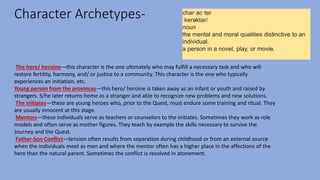
Character Archetypes- char·ac·ter
ˈkerəktər/
noun
the mental and moral qualities distinctive to an
individual.
a person in a novel, play, or movie.
The hero/ heroine—this character is the one ultimately who may fulfill a necessary task and who will
restore fertility, harmony, and/ or justice to a community. This character is the one who typically
experiences an initiation, etc.
Young person from the provinces—this hero/ heroine is taken away as an infant or youth and raised by
strangers. S/he later returns home as a stranger and able to recognize new problems and new solutions.
The initiates—these are young heroes who, prior to the Quest, must endure some training and ritual. They
are usually innocent at this stage.
Mentors—these individuals serve as teachers or counselors to the initiates. Sometimes they work as role
models and often serve as mother figures. They teach by example the skills necessary to survive the
Journey and the Quest.
Father-Son Conflict—tension often results from separation during childhood or from an external source
when the individuals meet as men and where the mentor often has a higher place in the affections of the
hero than the natural parent. Sometimes the conflict is resolved in atonement.
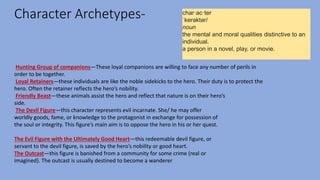
Character Archetypes- char·ac·ter
ˈkerəktər/
noun
the mental and moral qualities distinctive to an
individual.
a person in a novel, play, or movie.
Hunting Group of companions—These loyal companions are willing to face any number of perils in
order to be together.
Loyal Retainers—these individuals are like the noble sidekicks to the hero. Their duty is to protect the
hero. Often the retainer reflects the hero’s nobility.
Friendly Beast—these animals assist the hero and reflect that nature is on their hero’s
side.
The Devil Figure—this character represents evil incarnate. She/ he may offer
worldly goods, fame, or knowledge to the protagonist in exchange for possession of
the soul or integrity. This figure’s main aim is to oppose the hero in his or her quest.
The Evil Figure with the Ultimately Good Heart—this redeemable devil figure, or
servant to the devil figure, is saved by the hero’s nobility or good heart.
The Outcast—this figure is banished from a community for some crime (real or
imagined). The outcast is usually destined to become a wanderer
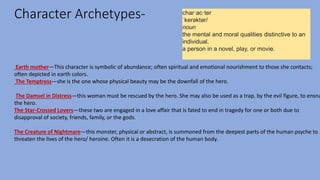
Character Archetypes- char·ac·ter
ˈkerəktər/
noun
the mental and moral qualities distinctive to an
individual.
a person in a novel, play, or movie.
Earth mother—This character is symbolic of abundance; often spiritual and emotional nourishment to those she contacts;
often depicted in earth colors.
The Temptress—she is the one whose physical beauty may be the downfall of the hero.
The Damsel in Distress—this woman must be rescued by the hero. She may also be used as a trap, by the evil figure, to ensna
the hero.
The Star-Crossed Lovers—these two are engaged in a love affair that is fated to end in tragedy for one or both due to
disapproval of society, friends, family, or the gods.
The Creature of Nightmare—this monster, physical or abstract, is summoned from the deepest parts of the human psyche to
threaten the lives of the hero/ heroine. Often it is a desecration of the human body.

Character archetype presentation

  • 1.
    A ar·che·type ˈärkəˌtīp/ noun noun: archetype; pluralnoun: archetypes 1.a very typical example of a certain person or thing. "the book is a perfect archetype of the genre" •an original that has been imitated. "the archetype of faith is Abraham" •a recurrent symbol or motif in literature, art, or mythology. "mythological archetypes of good and evil" •PSYCHOANALYSIS (in Jungian psychology) a primitive mental image inherited from the earliest human ancestors, and supposed to be present in the collective unconscious.
  • 2.
    Situational Archetypes- The Quest—describesthe search for someone or some talisman which when found and brought back, will restore balance in a community, life to the waste land, or a person’s health. The ultimate end. The Task—refers to what superhuman feat must be accomplished in order to fulfill the ultimate goal. Specific test of challenging actions. The Journey—sends the hero in search for some truth of information necessary to restore life, justice, and/ or harmony to the kingdom. The journey includes a series of trials and tribulations the hero/ heroine face along the way. Usually, he/ she descends into a real or psychological hell and is forced to discover the blackest truths, quite often concerning his/ her own faults. Once the hero/ heroine is at this lowest level, he/ she must accept personal responsibility to return to the world of the living. The Initiation—refers to a moment, usually psychological, in which an individual comes into maturity. She/ he gains a new awareness into the nature of circumstances and problems and understands his or her responsibility for trying to solve the dilemma. Typically, a her/ heroine receives a calling, a message, or signal that he or she must make sacrifices and become responsible for “getting involved” in the problem. Often a hero/ heroine will deny and questions the calling and ultimately, in the Initiation, will accept responsibility. sit·u·a·tion ˌsiCHəˈwāSH(ə)n/ noun a set of circumstances in which one finds oneself; a state of affairs. "the situation between her and Jake had come to a head" the location and surroundings of a place. "the situation of the town is pleasant"
  • 3.
    Situational Archetypes- The Fall—notto be confused with The Initiation, this archetype describes a descent in action from a higher to a lower state of being, an experience which might involve defilement, moral imperfection, and/ or loss of innocence. This fall is often accompanied by expulsion from a kind of paradise as a penalty for disobedience. Death and Rebirth—the most common of all situational archetypes grows out of the parallel between the cycle of nature and the cycle of life. It refers to situations in which someone or something, concrete and or abstract dies, yet is accompanied by some sign of birth or rebirth. Battle between Good and Evil—forces that represent good and evil battle against each other. Typically, good ultimately triumphs over evil despite great odds. The Unhealable Wound—this wound, physical or psychological, cannot be healed fully. This would also indicate a loss of innocence and purity. Often these wounds’ pains drive the sufferer to desperate measures of madness. The Magic Weapon—sometimes connected with the Task, refers to a skilled individual hero’s ability to use a piece of technology in order to combat evil, continue a journey, or to prove his or her identity as a chosen individual. Supernatural Intervention—the gods often intervene on the side of the hero/ heroine. sit·u·a·tion ˌsiCHəˈwāSH(ə)n/ noun a set of circumstances in which one finds oneself; a state of affairs. "the situation between her and Jake had come to a head" the location and surroundings of a place. "the situation of the town is pleasant"
  • 4.
    Symbolic Archetypes- sym·bol·ic simˈbälik adjective serving asa symbol. "a repeating design symbolic of eternity“ involving the use of symbols or symbolism. "the symbolic meaning of motifs and designs" Light vs. Darkness—Light usually suggests hope, renewal, or intellectual illumination; darkness implies the unknown, ignorance, or despair. Water vs. Desert—Because water (rain, river, etc.) is necessary to life and growth, it commonly appears as a birth or rebirth symbol. Water is used in baptism services, which solemnizes spiritual births. Similarly, the appearance of rain in a work can suggest a character’s spiritual birth. Heaven vs. Hell—Humanity has traditionally associated parts of the universe not accessible to it with dwelling places of evil forces that govern the world. The skies and mountain tops house its gods; below the earth contain diabolic forces that inhabit its universe. Haven vs. Wilderness—places of safety contrast sharply against the dangerous wilderness. Heroes areoften sheltered for a time to regain health and resources. Fire vs. Ice—Fire represents knowledge, light, life, and rebirth while ice like desert represents ignorance,darkness, sterility, and death.
  • 5.
    Character Archetypes- char·ac·ter ˈkerəktər/ noun themental and moral qualities distinctive to an individual. a person in a novel, play, or movie. The hero/ heroine—this character is the one ultimately who may fulfill a necessary task and who will restore fertility, harmony, and/ or justice to a community. This character is the one who typically experiences an initiation, etc. Young person from the provinces—this hero/ heroine is taken away as an infant or youth and raised by strangers. S/he later returns home as a stranger and able to recognize new problems and new solutions. The initiates—these are young heroes who, prior to the Quest, must endure some training and ritual. They are usually innocent at this stage. Mentors—these individuals serve as teachers or counselors to the initiates. Sometimes they work as role models and often serve as mother figures. They teach by example the skills necessary to survive the Journey and the Quest. Father-Son Conflict—tension often results from separation during childhood or from an external source when the individuals meet as men and where the mentor often has a higher place in the affections of the hero than the natural parent. Sometimes the conflict is resolved in atonement.
  • 6.
    Character Archetypes- char·ac·ter ˈkerəktər/ noun themental and moral qualities distinctive to an individual. a person in a novel, play, or movie. Hunting Group of companions—These loyal companions are willing to face any number of perils in order to be together. Loyal Retainers—these individuals are like the noble sidekicks to the hero. Their duty is to protect the hero. Often the retainer reflects the hero’s nobility. Friendly Beast—these animals assist the hero and reflect that nature is on their hero’s side. The Devil Figure—this character represents evil incarnate. She/ he may offer worldly goods, fame, or knowledge to the protagonist in exchange for possession of the soul or integrity. This figure’s main aim is to oppose the hero in his or her quest. The Evil Figure with the Ultimately Good Heart—this redeemable devil figure, or servant to the devil figure, is saved by the hero’s nobility or good heart. The Outcast—this figure is banished from a community for some crime (real or imagined). The outcast is usually destined to become a wanderer
  • 7.
    Character Archetypes- char·ac·ter ˈkerəktər/ noun themental and moral qualities distinctive to an individual. a person in a novel, play, or movie. Earth mother—This character is symbolic of abundance; often spiritual and emotional nourishment to those she contacts; often depicted in earth colors. The Temptress—she is the one whose physical beauty may be the downfall of the hero. The Damsel in Distress—this woman must be rescued by the hero. She may also be used as a trap, by the evil figure, to ensna the hero. The Star-Crossed Lovers—these two are engaged in a love affair that is fated to end in tragedy for one or both due to disapproval of society, friends, family, or the gods. The Creature of Nightmare—this monster, physical or abstract, is summoned from the deepest parts of the human psyche to threaten the lives of the hero/ heroine. Often it is a desecration of the human body.