Chapter 11
HISTORY
Medea: The Making of a Heroine
Classical Mythology in Context
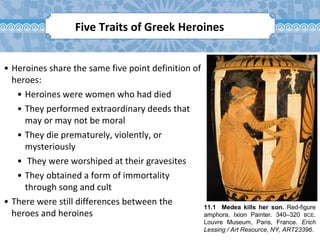
11.1 Medea kills her son. Red-figure
amphora. Ixion Painter. 340–320 BCE.
Louvre Museum, Paris, France. Erich
Lessing / Art Resource, NY, ART23396.
Five Traits of Greek Heroines
• Heroines share the same five point definition of
heroes:
• Heroines were women who had died
• They performed extraordinary deeds that
may or may not be moral
• They die prematurely, violently, or
mysteriously
• They were worshiped at their gravesites
• They obtained a form of immortality
through song and cult
• There were still differences between the
heroes and heroines
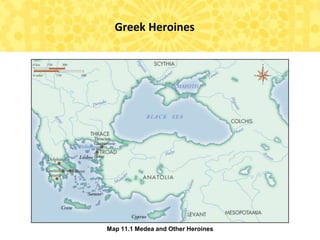
Map 11.1 Medea and Other Heroines
Greek Heroines
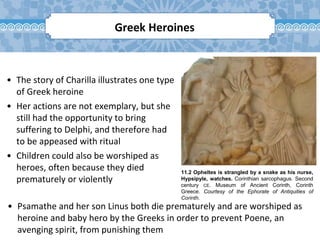
11.2 Opheltes is strangled by a snake as his nurse,
Hypsipyle, watches. Corinthian sarcophagus. Second
century CE. Museum of Ancient Corinth, Corinth
Greece. Courtesy of the Ephorate of Antiquities of
Corinth.
• The story of Charilla illustrates one type
of Greek heroine
• Her actions are not exemplary, but she
still had the opportunity to bring
suffering to Delphi, and therefore had
to be appeased with ritual
• Children could also be worshiped as
heroes, often because they died
prematurely or violently
Greek Heroines
• Psamathe and her son Linus both die prematurely and are worshiped as
heroine and baby hero by the Greeks in order to prevent Poene, an
avenging spirit, from punishing them
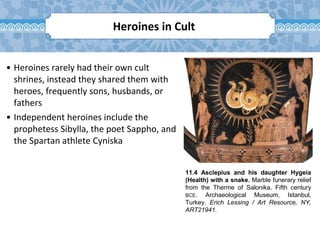
11.4 Asclepius and his daughter Hygeia
(Health) with a snake. Marble funerary relief
from the Therme of Salonika. Fifth century
BCE. Archaeological Museum, Istanbul,
Turkey. Erich Lessing / Art Resource, NY,
ART21941.
Heroines in Cult
• Heroines rarely had their own cult
shrines, instead they shared them with
heroes, frequently sons, husbands, or
fathers
• Independent heroines include the
prophetess Sibylla, the poet Sappho, and
the Spartan athlete Cyniska
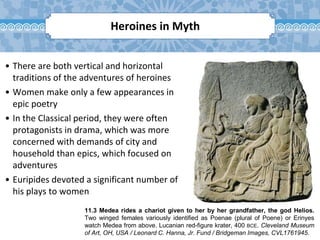
11.3 Medea rides a chariot given to her by her grandfather, the god Helios.
Two winged females variously identified as Poenae (plural of Poene) or Erinyes
watch Medea from above. Lucanian red-figure krater, 400 BCE. Cleveland Museum
of Art, OH, USA / Leonard C. Hanna, Jr. Fund / Bridgeman Images, CVL1761945.
Heroines in Myth
• There are both vertical and horizontal
traditions of the adventures of heroines
• Women make only a few appearances in
epic poetry
• In the Classical period, they were often
protagonists in drama, which was more
concerned with demands of city and
household than epics, which focused on
adventures
• Euripides devoted a significant number of
his plays to women
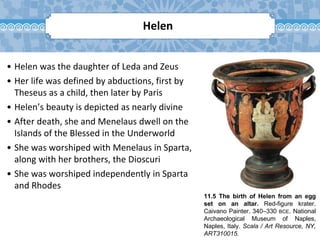
11.5 The birth of Helen from an egg
set on an altar. Red-figure krater.
Caivano Painter. 340–330 BCE. National
Archaeological Museum of Naples,
Naples, Italy. Scala / Art Resource, NY,
ART310015.
Helen
• Helen was the daughter of Leda and Zeus
• Her life was defined by abductions, first by
Theseus as a child, then later by Paris
• Helen’s beauty is depicted as nearly divine
• After death, she and Menelaus dwell on the
Islands of the Blessed in the Underworld
• She was worshiped with Menelaus in Sparta,
along with her brothers, the Dioscuri
• She was worshiped independently in Sparta
and Rhodes
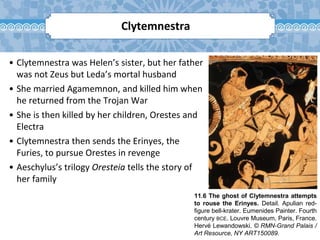
11.6 The ghost of Clytemnestra attempts
to rouse the Erinyes. Detail. Apulian red-
figure bell-krater. Eumenides Painter. Fourth
century BCE. Louvre Museum, Paris, France.
Hervé Lewandowski. © RMN-Grand Palais /
Art Resource, NY ART150089.
Clytemnestra
• Clytemnestra was Helen’s sister, but her father
was not Zeus but Leda’s mortal husband
• She married Agamemnon, and killed him when
he returned from the Trojan War
• She is then killed by her children, Orestes and
Electra
• Clytemnestra then sends the Erinyes, the
Furies, to pursue Orestes in revenge
• Aeschylus’s trilogy Oresteia tells the story of
her family
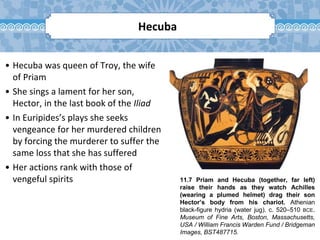
11.7 Priam and Hecuba (together, far left)
raise their hands as they watch Achilles
(wearing a plumed helmet) drag their son
Hector’s body from his chariot. Athenian
black-figure hydria (water jug). c. 520–510 BCE.
Museum of Fine Arts, Boston, Massachusetts,
USA / William Francis Warden Fund / Bridgeman
Images, BST487715.
Hecuba
• Hecuba was queen of Troy, the wife
of Priam
• She sings a lament for her son,
Hector, in the last book of the Iliad
• In Euripides’s plays she seeks
vengeance for her murdered children
by forcing the murderer to suffer the
same loss that she has suffered
• Her actions rank with those of
vengeful spirits
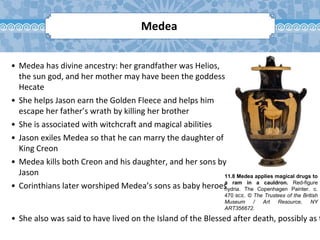
11.8 Medea applies magical drugs to
a ram in a cauldron. Red-figure
hydria. The Copenhagen Painter. c.
470 BCE. © The Trustees of the British
Museum / Art Resource, NY
ART356672.
Medea
• Medea has divine ancestry: her grandfather was Helios,
the sun god, and her mother may have been the goddess
Hecate
• She helps Jason earn the Golden Fleece and helps him
escape her father’s wrath by killing her brother
• She is associated with witchcraft and magical abilities
• Jason exiles Medea so that he can marry the daughter of
King Creon
• Medea kills both Creon and his daughter, and her sons by
Jason
• Corinthians later worshiped Medea’s sons as baby heroes
• She also was said to have lived on the Island of the Blessed after death, possibly as t
THEORY
Medea: The Making of a Heroine
Classical Mythology in Context
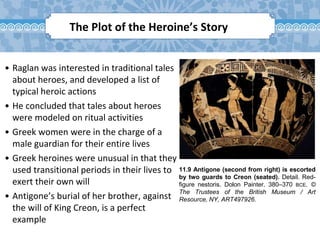
11.9 Antigone (second from right) is escorted
by two guards to Creon (seated). Detail. Red-
figure nestoris. Dolon Painter. 380–370 BCE. ©
The Trustees of the British Museum / Art
Resource, NY, ART497926.
The Plot of the Heroine’s Story
• Raglan was interested in traditional tales
about heroes, and developed a list of
typical heroic actions
• He concluded that tales about heroes
were modeled on ritual activities
• Greek women were in the charge of a
male guardian for their entire lives
• Greek heroines were unusual in that they
used transitional periods in their lives to
exert their own will
• Antigone’s burial of her brother, against
the will of King Creon, is a perfect
example
COMPARISON
Medea: The Making of a Heroine
Classical Mythology in Context
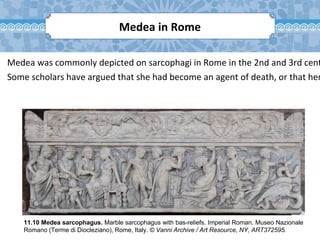
11.10 Medea sarcophagus. Marble sarcophagus with bas-reliefs. Imperial Roman. Museo Nazionale
Romano (Terme di Diocleziano), Rome, Italy. © Vanni Archive / Art Resource, NY, ART372595.
Medea in Rome
Medea was commonly depicted on sarcophagi in Rome in the 2nd and 3rd cent
Some scholars have argued that she had become an agent of death, or that her
• Seneca’s Medea depicts her as suffering because she failed to embody Stoic
ideals
• Her failure is in placing too high a value on Jason and her love for him,
therefore she cannot endure his betrayal
• In the Heroides, Ovid portrays Medea as a jilted lover begging Jason to
return to her
• She is shown as subdued and powerless, unlike the Metamorphoses, which
depicts her as a powerful sorceress
Medea in Rome
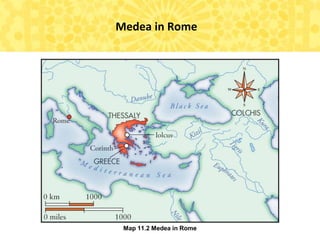
Map 11.2 Medea in Rome
Medea in Rome
RECEPTION
Medea: The Making of a Heroine
Classical Mythology in Context
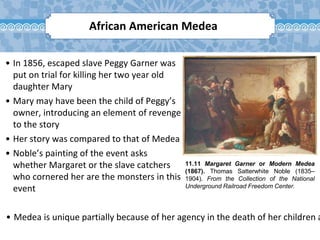
11.11 Margaret Garner or Modern Medea
(1867). Thomas Satterwhite Noble (1835–
1904). From the Collection of the National
Underground Railroad Freedom Center.
African American Medea
• In 1856, escaped slave Peggy Garner was
put on trial for killing her two year old
daughter Mary
• Mary may have been the child of Peggy’s
owner, introducing an element of revenge
to the story
• Her story was compared to that of Medea
• Noble’s painting of the event asks
whether Margaret or the slave catchers
who cornered her are the monsters in this
event
• Medea is unique partially because of her agency in the death of her children a
• Modern African American writers have linked Medea’s foreign identity to her
political oppression
• Countee Cullen was a poet of the Harlem Renaissance
• His Medea received mixed reviews at the time as black critics questioned whether
Medea’s experience offered any insight on the African American experience
• The text evokes the experience of a black Medea in white America, and also
explore the obligations of Jason and Medea to their children
• Do they have the right to dispose of them as a possession?
• Owen Dodson, head of the theater department at Howard University, wrote The
Garden of Time, an interpretation that takes Jason and Medea from ancient
Greece to Haiti and Georgia before the Civil War
• Toni Morrison’s Beloved is possibly the most famous treatment of Medea, which
portrays the life of a mother after she is forced to kill her own child
African American Medea

Maurizio chapter 11 slides

  • 1.
  • 2.
    HISTORY Medea: The Makingof a Heroine Classical Mythology in Context
  • 3.
    11.1 Medea killsher son. Red-figure amphora. Ixion Painter. 340–320 BCE. Louvre Museum, Paris, France. Erich Lessing / Art Resource, NY, ART23396. Five Traits of Greek Heroines • Heroines share the same five point definition of heroes: • Heroines were women who had died • They performed extraordinary deeds that may or may not be moral • They die prematurely, violently, or mysteriously • They were worshiped at their gravesites • They obtained a form of immortality through song and cult • There were still differences between the heroes and heroines
  • 4.
    Map 11.1 Medeaand Other Heroines Greek Heroines
  • 5.
    11.2 Opheltes isstrangled by a snake as his nurse, Hypsipyle, watches. Corinthian sarcophagus. Second century CE. Museum of Ancient Corinth, Corinth Greece. Courtesy of the Ephorate of Antiquities of Corinth. • The story of Charilla illustrates one type of Greek heroine • Her actions are not exemplary, but she still had the opportunity to bring suffering to Delphi, and therefore had to be appeased with ritual • Children could also be worshiped as heroes, often because they died prematurely or violently Greek Heroines • Psamathe and her son Linus both die prematurely and are worshiped as heroine and baby hero by the Greeks in order to prevent Poene, an avenging spirit, from punishing them
  • 6.
    11.4 Asclepius andhis daughter Hygeia (Health) with a snake. Marble funerary relief from the Therme of Salonika. Fifth century BCE. Archaeological Museum, Istanbul, Turkey. Erich Lessing / Art Resource, NY, ART21941. Heroines in Cult • Heroines rarely had their own cult shrines, instead they shared them with heroes, frequently sons, husbands, or fathers • Independent heroines include the prophetess Sibylla, the poet Sappho, and the Spartan athlete Cyniska
  • 7.
    11.3 Medea ridesa chariot given to her by her grandfather, the god Helios. Two winged females variously identified as Poenae (plural of Poene) or Erinyes watch Medea from above. Lucanian red-figure krater, 400 BCE. Cleveland Museum of Art, OH, USA / Leonard C. Hanna, Jr. Fund / Bridgeman Images, CVL1761945. Heroines in Myth • There are both vertical and horizontal traditions of the adventures of heroines • Women make only a few appearances in epic poetry • In the Classical period, they were often protagonists in drama, which was more concerned with demands of city and household than epics, which focused on adventures • Euripides devoted a significant number of his plays to women
  • 8.
    11.5 The birthof Helen from an egg set on an altar. Red-figure krater. Caivano Painter. 340–330 BCE. National Archaeological Museum of Naples, Naples, Italy. Scala / Art Resource, NY, ART310015. Helen • Helen was the daughter of Leda and Zeus • Her life was defined by abductions, first by Theseus as a child, then later by Paris • Helen’s beauty is depicted as nearly divine • After death, she and Menelaus dwell on the Islands of the Blessed in the Underworld • She was worshiped with Menelaus in Sparta, along with her brothers, the Dioscuri • She was worshiped independently in Sparta and Rhodes
  • 9.
    11.6 The ghostof Clytemnestra attempts to rouse the Erinyes. Detail. Apulian red- figure bell-krater. Eumenides Painter. Fourth century BCE. Louvre Museum, Paris, France. Hervé Lewandowski. © RMN-Grand Palais / Art Resource, NY ART150089. Clytemnestra • Clytemnestra was Helen’s sister, but her father was not Zeus but Leda’s mortal husband • She married Agamemnon, and killed him when he returned from the Trojan War • She is then killed by her children, Orestes and Electra • Clytemnestra then sends the Erinyes, the Furies, to pursue Orestes in revenge • Aeschylus’s trilogy Oresteia tells the story of her family
  • 10.
    11.7 Priam andHecuba (together, far left) raise their hands as they watch Achilles (wearing a plumed helmet) drag their son Hector’s body from his chariot. Athenian black-figure hydria (water jug). c. 520–510 BCE. Museum of Fine Arts, Boston, Massachusetts, USA / William Francis Warden Fund / Bridgeman Images, BST487715. Hecuba • Hecuba was queen of Troy, the wife of Priam • She sings a lament for her son, Hector, in the last book of the Iliad • In Euripides’s plays she seeks vengeance for her murdered children by forcing the murderer to suffer the same loss that she has suffered • Her actions rank with those of vengeful spirits
  • 11.
    11.8 Medea appliesmagical drugs to a ram in a cauldron. Red-figure hydria. The Copenhagen Painter. c. 470 BCE. © The Trustees of the British Museum / Art Resource, NY ART356672. Medea • Medea has divine ancestry: her grandfather was Helios, the sun god, and her mother may have been the goddess Hecate • She helps Jason earn the Golden Fleece and helps him escape her father’s wrath by killing her brother • She is associated with witchcraft and magical abilities • Jason exiles Medea so that he can marry the daughter of King Creon • Medea kills both Creon and his daughter, and her sons by Jason • Corinthians later worshiped Medea’s sons as baby heroes • She also was said to have lived on the Island of the Blessed after death, possibly as t
  • 12.
    THEORY Medea: The Makingof a Heroine Classical Mythology in Context
  • 13.
    11.9 Antigone (secondfrom right) is escorted by two guards to Creon (seated). Detail. Red- figure nestoris. Dolon Painter. 380–370 BCE. © The Trustees of the British Museum / Art Resource, NY, ART497926. The Plot of the Heroine’s Story • Raglan was interested in traditional tales about heroes, and developed a list of typical heroic actions • He concluded that tales about heroes were modeled on ritual activities • Greek women were in the charge of a male guardian for their entire lives • Greek heroines were unusual in that they used transitional periods in their lives to exert their own will • Antigone’s burial of her brother, against the will of King Creon, is a perfect example
  • 14.
    COMPARISON Medea: The Makingof a Heroine Classical Mythology in Context
  • 15.
    11.10 Medea sarcophagus.Marble sarcophagus with bas-reliefs. Imperial Roman. Museo Nazionale Romano (Terme di Diocleziano), Rome, Italy. © Vanni Archive / Art Resource, NY, ART372595. Medea in Rome Medea was commonly depicted on sarcophagi in Rome in the 2nd and 3rd cent Some scholars have argued that she had become an agent of death, or that her
  • 16.
    • Seneca’s Medeadepicts her as suffering because she failed to embody Stoic ideals • Her failure is in placing too high a value on Jason and her love for him, therefore she cannot endure his betrayal • In the Heroides, Ovid portrays Medea as a jilted lover begging Jason to return to her • She is shown as subdued and powerless, unlike the Metamorphoses, which depicts her as a powerful sorceress Medea in Rome
  • 17.
    Map 11.2 Medeain Rome Medea in Rome
  • 18.
    RECEPTION Medea: The Makingof a Heroine Classical Mythology in Context
  • 19.
    11.11 Margaret Garneror Modern Medea (1867). Thomas Satterwhite Noble (1835– 1904). From the Collection of the National Underground Railroad Freedom Center. African American Medea • In 1856, escaped slave Peggy Garner was put on trial for killing her two year old daughter Mary • Mary may have been the child of Peggy’s owner, introducing an element of revenge to the story • Her story was compared to that of Medea • Noble’s painting of the event asks whether Margaret or the slave catchers who cornered her are the monsters in this event • Medea is unique partially because of her agency in the death of her children a
  • 20.
    • Modern AfricanAmerican writers have linked Medea’s foreign identity to her political oppression • Countee Cullen was a poet of the Harlem Renaissance • His Medea received mixed reviews at the time as black critics questioned whether Medea’s experience offered any insight on the African American experience • The text evokes the experience of a black Medea in white America, and also explore the obligations of Jason and Medea to their children • Do they have the right to dispose of them as a possession? • Owen Dodson, head of the theater department at Howard University, wrote The Garden of Time, an interpretation that takes Jason and Medea from ancient Greece to Haiti and Georgia before the Civil War • Toni Morrison’s Beloved is possibly the most famous treatment of Medea, which portrays the life of a mother after she is forced to kill her own child African American Medea