ARCHETYPES
What is an archetype
■ an image, character, story, symbol, situation, or pattern that has
been used since the earliest times to represent a universal idea
throughout all human cultures
■ a universal symbol (a symbol is a concrete object used to represent
an abstract idea)
Who’s responsible for this?
■ The word is derived from the Greek “archetypos,” meaning “beginning or original
pattern from which later things are made.
■ ”The term was first used by the psychologist,Carl Jung, who spent much time
studying people’s dreams as well as myths and legends from around the world.
■ He recognized similarities in the types of symbols and stories that humans recalled.
These similarities led him to the conclusion that a “collective unconscious” existed – a
collection of inherited stories and images that exist in the subconscious of every
human being.
…but what does that all mean?
■ Basically, Carl Jung determined
that people everywhere can
recognize the same symbols, or
the same archetypes, because
they are concrete
representations of universal
human experiences.
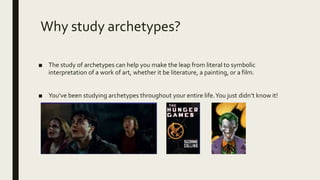
Why study archetypes?
■ The study of archetypes can help you make the leap from literal to symbolic
interpretation of a work of art, whether it be literature, a painting, or a film.
■ You’ve been studying archetypes throughout your entire life.You just didn’t know it!
Archetype Categories
■ There are 3 main categories of archetypes.
– Symbolic
– Character
– Situational
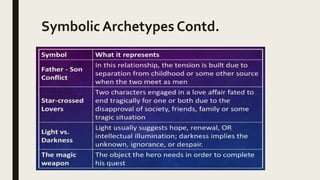
Symbolic Archetypes
Symbolic Archetypes Contd.
Character Archetypes
■ Characterized by self-
sacrifice, heroes will endure
separation and hardship for
the sake of their people must
pay a price to attain their
goals
Common Characteristics of the hero
archetype:
■ Born and raised in a rural setting away from cities
■ Is of mysterious origin or becomes orphaned at an early age and is raised by animals or a wise
guardian
■ Has a mentor or teacher
■ Loves and admires a beautiful lady
■ Must go on a journey, learn a lesson, change in some way
■ Is special, one of a kind
■ Is helped by divine, supernatural forces
■ Struggles for something valuable or important
■ Has a loyal band of companions
■ Is prepared to fight or die at any moment
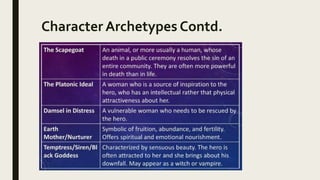
Character Archetypes
Character Archetypes Contd.
The Hero’s Journey
■ OrdinaryWorld: hero's normal life at the start of the story, before the adventure begins
■ Call to Adventure: hero is faced with something that makes them begin the adventure
(might be a problem or a challenge they need to overcome)Refusal or Acceptance of the
Call: hero may initially refuse but will ultimately accept the call by force, chance, mistake or
choice
■ Meeting the Mentor: encounters someone who can give advice and assistance, and ready
the hero for the journey ahead
■ Supernatural Aid: help from a source beyond the natural world; a mentor, magic, divine
intervention
■ Crossing theThreshold: hero leaves the ordinary world, entering the special world
(sometimes by defeating the guardian of the threshold)TheTask: the action which heroes
must perform in order to save the people
■ Allies: group of companions loyal to the hero; help the hero in the quest
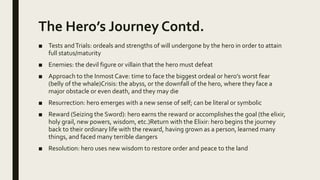
The Hero’s Journey Contd.
■ Tests andTrials: ordeals and strengths of will undergone by the hero in order to attain
full status/maturity
■ Enemies: the devil figure or villain that the hero must defeat
■ Approach to the Inmost Cave: time to face the biggest ordeal or hero’s worst fear
(belly of the whale)Crisis: the abyss, or the downfall of the hero, where they face a
major obstacle or even death, and they may die
■ Resurrection: hero emerges with a new sense of self; can be literal or symbolic
■ Reward (Seizing the Sword): hero earns the reward or accomplishes the goal (the elixir,
holy grail, new powers, wisdom, etc.)Return with the Elixir: hero begins the journey
back to their ordinary life with the reward, having grown as a person, learned many
things, and faced many terrible dangers
■ Resolution: hero uses new wisdom to restore order and peace to the land
Current ArchetypeTrend
■ Recently, in film, it has become very trendy to mock or satirize archetypes.
■ For example, movies like Shrek,The Princess Bride, and Enchanted all take fairy tale
concepts, characters, places and situations and exaggerate them for comedic effect.
■ You see?You’ve been studying archetypes since you started reading BOOKSAND
watchingTV/movies, and you didn’t even know it!
■ Now let’s see how many examples you can come up with:Think about examples we’ve
discussed in class, as well as others you can come up with.

Character Archetypes

  • 1.
  • 2.
    What is anarchetype ■ an image, character, story, symbol, situation, or pattern that has been used since the earliest times to represent a universal idea throughout all human cultures ■ a universal symbol (a symbol is a concrete object used to represent an abstract idea)
  • 3.
    Who’s responsible forthis? ■ The word is derived from the Greek “archetypos,” meaning “beginning or original pattern from which later things are made. ■ ”The term was first used by the psychologist,Carl Jung, who spent much time studying people’s dreams as well as myths and legends from around the world. ■ He recognized similarities in the types of symbols and stories that humans recalled. These similarities led him to the conclusion that a “collective unconscious” existed – a collection of inherited stories and images that exist in the subconscious of every human being.
  • 4.
    …but what doesthat all mean? ■ Basically, Carl Jung determined that people everywhere can recognize the same symbols, or the same archetypes, because they are concrete representations of universal human experiences.
  • 5.
    Why study archetypes? ■The study of archetypes can help you make the leap from literal to symbolic interpretation of a work of art, whether it be literature, a painting, or a film. ■ You’ve been studying archetypes throughout your entire life.You just didn’t know it!
  • 6.
    Archetype Categories ■ Thereare 3 main categories of archetypes. – Symbolic – Character – Situational
  • 7.
  • 8.
  • 9.
  • 10.
  • 11.
    Character Archetypes ■ Characterizedby self- sacrifice, heroes will endure separation and hardship for the sake of their people must pay a price to attain their goals
  • 12.
    Common Characteristics ofthe hero archetype: ■ Born and raised in a rural setting away from cities ■ Is of mysterious origin or becomes orphaned at an early age and is raised by animals or a wise guardian ■ Has a mentor or teacher ■ Loves and admires a beautiful lady ■ Must go on a journey, learn a lesson, change in some way ■ Is special, one of a kind ■ Is helped by divine, supernatural forces ■ Struggles for something valuable or important ■ Has a loyal band of companions ■ Is prepared to fight or die at any moment
  • 13.
  • 14.
  • 15.
  • 16.
    The Hero’s Journey ■OrdinaryWorld: hero's normal life at the start of the story, before the adventure begins ■ Call to Adventure: hero is faced with something that makes them begin the adventure (might be a problem or a challenge they need to overcome)Refusal or Acceptance of the Call: hero may initially refuse but will ultimately accept the call by force, chance, mistake or choice ■ Meeting the Mentor: encounters someone who can give advice and assistance, and ready the hero for the journey ahead ■ Supernatural Aid: help from a source beyond the natural world; a mentor, magic, divine intervention ■ Crossing theThreshold: hero leaves the ordinary world, entering the special world (sometimes by defeating the guardian of the threshold)TheTask: the action which heroes must perform in order to save the people ■ Allies: group of companions loyal to the hero; help the hero in the quest
  • 17.
    The Hero’s JourneyContd. ■ Tests andTrials: ordeals and strengths of will undergone by the hero in order to attain full status/maturity ■ Enemies: the devil figure or villain that the hero must defeat ■ Approach to the Inmost Cave: time to face the biggest ordeal or hero’s worst fear (belly of the whale)Crisis: the abyss, or the downfall of the hero, where they face a major obstacle or even death, and they may die ■ Resurrection: hero emerges with a new sense of self; can be literal or symbolic ■ Reward (Seizing the Sword): hero earns the reward or accomplishes the goal (the elixir, holy grail, new powers, wisdom, etc.)Return with the Elixir: hero begins the journey back to their ordinary life with the reward, having grown as a person, learned many things, and faced many terrible dangers ■ Resolution: hero uses new wisdom to restore order and peace to the land
  • 18.
    Current ArchetypeTrend ■ Recently,in film, it has become very trendy to mock or satirize archetypes. ■ For example, movies like Shrek,The Princess Bride, and Enchanted all take fairy tale concepts, characters, places and situations and exaggerate them for comedic effect.
  • 19.
    ■ You see?You’vebeen studying archetypes since you started reading BOOKSAND watchingTV/movies, and you didn’t even know it! ■ Now let’s see how many examples you can come up with:Think about examples we’ve discussed in class, as well as others you can come up with.