Chapter 3
3.1 Heracles (left) kills the eagle eating Prometheus’s liver. Detail
from a black-figure krater with lid. Nettos Painter, c. 610 BCE. National
Archaeological Museum, Athens, Greece. Gianni Dagli Orti / The Art
Archive at Art Resource, NY, AA389426.
Zeus and Hera
• Zeus was the center of
Greek mythology,
responsible for maintaining
order in the cosmos.
• Hera, his sister and wife
represents challenges to
his decrees
• The personalities of the
Greek gods are variable
• They are not good models
for human behavior
HISTORY
Zeus and Hera
Classical Mythology in Context
3.2 Zeus with a thunderbolt. Corinthian, bronze statuette.
Circa 530–520 BCE. Glyptothek, Munich, Germany. ©
Vanni Archive / Art Resource, NY, ART382686.
Cosmic Order: Thunder and Lightning
• Zeus is called ‘father of gods and mortals’ as a
symbol of his divine authority
• He is responsible for maintaining cosmic order
• As a sky-god, he is associated with thunder and
lightning, his weapons
• He was worshiped on mountaintops
• Greeks prayed to him for rain and storms to water
crops
Map 3.1 Zeus and Hera in Greece
Zeus and Hera
3.3 Votive relief for Zeus Meilichius. Circa fourth century
BCE. bpk, Berlin/Antikensammlung, Staatliche Museen, Berlin,
Germany / Ingrid Geske / Art Resource, NY, ART358210.
Human Order: Justice
• Zeus was responsible for judging human
actions
• He paid close attention to the actions of
princes
• Used his power over weather and storms to
punish those who did not act justly
• Zeus Meilichius (Mild One) was worshiped in
Athens to ensure a successful harvest
3.4 Sarpedon, Zeus’s son, is lifted by Hypnos and
Thanatos in the presence of Hermes. Red-figure calyx-
krater. Euphronius Painter, c. 515 BCE. National Museum of
the Villa Giulia, Rome, Italy. Scala/Minestero per I Beni e le
Attivita culturali/Art Resource, NY, ART407274.
Divine Order: Kingship
• Zeus has supreme power over
the Olympic gods, but is
constrained by his obligation
to lead by example
• His obligations to the other
gods sometimes prevent him
from answering human
prayers
3.5 Leda and the Swan. Marble relief. Fifth to fourth century BCE.
Greek National Archaeological Museum, Athens, Greece. Gianni
Dagli Orti/The Art Archive at Art Resource, NY, AA389421.
Violence and Grace
• Zeus is seen as a god who uses violence,
but who also gives grace to humanity
• The suffering caused by Zeus’ violence is
the only way humanity can learn
• In myth, Zeus impregnates Leda in the form
of a swan
3.6 Leda and the Swan. Marble Statue. Roman copy (second century CE)
after a Greek original attributed to Timotheos, c. 370 BCE. Yale University Art
Gallery / Art Resource, NY, ART325369.
Leda and the Swan
• The story of Leda is sometimes depicted as rape,
sometimes as seduction
• Either story suggests that humanity cannot escape
the will of Zeus, whether he uses violence or awe
to get what he wants
3.7 Colossal limestone head from the cult statue of Hera in
the Heraion of Olympia. 580 BCE. Archaeological Museum,
Olympia, Greece. Erich Lessing / Art Resource, NY, ART105413.
Hera
• The marriage of Zeus and Hera is
characterized by Hera’s fidelity and Zeus’
philandering
• Hera is depicted as subject to Zeus’ rule
• Her defining characteristic is her anger over
his infidelity
3.8 Model of a temple dedicated to Hera, from
Argos. Temple date is c. 700 BCE. National
Archaeological Museum, Athens, Greece.
Nimatallah / Art Resource, NY, ART85617.
Goddess of Heroes
• Hera’s temple at Argos reflected the
importance of her cult
• They celebrated the Hecatombaia in her
honor every year
• She protected the power of Argos and its
heroes
• She also protected women and children as
a fertility goddess
3.9 Three women in long dresses with two crouching
lions. Base of a marble basin from Hera’s temple on Samos,
Greece. Seventh century BCE. Staatliche Museen, Berlin,
Germany. Erich Lessing / Art Resource, NY, ART204850.
Goddess of Fertility and Protection
• Hera had a large and wealthy temple at
Samos, off the coast of Turkey
• Visitors from all over the Near East attended
her festivals
• The rituals there associate her with fertility
and the natural world
• Her role as a fertility goddess may have
been limited in later centuries to fertility in
marriage
3.10 The marriage of Zeus and Hera. Metope
from temple E at Selinunte. Fifth century BCE.
National Archaeological Museum in Palermo, Italy.
Erich Lessing / Art Resource, NY, ART200891.
Divine Consort of Zeus
• Hera may have originally been worshiped
independently of Zeus
• As they became associated as husband
and wife her cult became less
independent
• This may be reflected in her hostility
toward Zeus in many myths
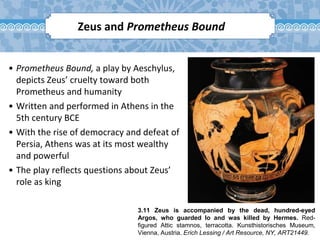
3.11 Zeus is accompanied by the dead, hundred-eyed
Argos, who guarded Io and was killed by Hermes. Red-
figured Attic stamnos, terracotta. Kunsthistorisches Museum,
Vienna, Austria. Erich Lessing / Art Resource, NY, ART21449.
Zeus and Prometheus Bound
• Prometheus Bound, a play by Aeschylus,
depicts Zeus’ cruelty toward both
Prometheus and humanity
• Written and performed in Athens in the
5th century BCE
• With the rise of democracy and defeat of
Persia, Athens was at its most wealthy
and powerful
• The play reflects questions about Zeus’
role as king
THEORY
Zeus and Hera
Classical Mythology in Context
3.12 Chart of Indo-European Languages.
Universal Questions Shape Myth
Modern scholars approach myths in two ways
• They study them within their unique historical contexts
• They study the shared features of myths from several societies
Wendy Doniger attempts to bridge these two approaches with her studies
of Hindu myths
• Argues that scholars must use a variety of approaches to myths in order to
understand the shared experiences behind them
• Uses historical linguistics to draw out similarities in myths from Indo-
European-speaking cultures
COMPARISON
Zeus and Hera
Classical Mythology in Context
3.13 The Flood and Noah’s Ark. The ark is at the top of the image; drowned people, giants, and animals
float in the waters below. From the Ashburnham Pentateuch (Pentateuch of Tours). Northern Africa, Spain,
or Italy. Circa fifth to sixth century CE. NAL 2334 Folio9. Bibliothèque Nationale de France (BnF), Paris,
France. © BnF, Dist. RMN-Grand Palais / Art Resource, NY, ART488780.
Levant: Flood Stories
• In the Ancient Near East, floods were
considered sacred
• They were signs of divine displeasure or
favor
• The Epic of Gilgamesh tells the story of
humanity being saved from a flood by
Utnapishtim, who was told by the god
Ea to build a boat
• The Babylonian Epic of Atrahasis tells a
similar story
Map 3.2 Floods and Flood Stories in the Ancient Near East
A Greek myth depicting
Zeus as the destroyer of
humanity and
Prometheus as its savior
has many similarities with
Near Eastern flood myths
In the flood story from
the Hebrew Bible, there is
no other god to save
them
The Ancient Near East
RECEPTION
Zeus and Hera
Classical Mythology in Context
3.14 Leda and the Swan, 1923. Marie Laurencin (1883–
1956). Oil on canvas, 26½ × 32 inches (67.3 × 81.3 cm). The
Philadelphia Museum of Art / Art Resource, NY, ART318651.
© Fondation Foujita / Artists Rights Society (ARS), New York
/ ADAGP, Paris 2015.
Leda and the Swan in Modernist Poetry
• Modern artist Marie Laurencin
conceived of the encounter
between Leda and the swan as
a gentle seduction
• Similar to the retelling of the
story in “Leda” by modernist
H.D.
• In contrast, William Butler
Yeats depicts the encounter as
a violent rape

Mythology in context chapter 3 slides

  • 1.
  • 2.
    3.1 Heracles (left)kills the eagle eating Prometheus’s liver. Detail from a black-figure krater with lid. Nettos Painter, c. 610 BCE. National Archaeological Museum, Athens, Greece. Gianni Dagli Orti / The Art Archive at Art Resource, NY, AA389426. Zeus and Hera • Zeus was the center of Greek mythology, responsible for maintaining order in the cosmos. • Hera, his sister and wife represents challenges to his decrees • The personalities of the Greek gods are variable • They are not good models for human behavior
  • 3.
    HISTORY Zeus and Hera ClassicalMythology in Context
  • 4.
    3.2 Zeus witha thunderbolt. Corinthian, bronze statuette. Circa 530–520 BCE. Glyptothek, Munich, Germany. © Vanni Archive / Art Resource, NY, ART382686. Cosmic Order: Thunder and Lightning • Zeus is called ‘father of gods and mortals’ as a symbol of his divine authority • He is responsible for maintaining cosmic order • As a sky-god, he is associated with thunder and lightning, his weapons • He was worshiped on mountaintops • Greeks prayed to him for rain and storms to water crops
  • 5.
    Map 3.1 Zeusand Hera in Greece Zeus and Hera
  • 6.
    3.3 Votive relieffor Zeus Meilichius. Circa fourth century BCE. bpk, Berlin/Antikensammlung, Staatliche Museen, Berlin, Germany / Ingrid Geske / Art Resource, NY, ART358210. Human Order: Justice • Zeus was responsible for judging human actions • He paid close attention to the actions of princes • Used his power over weather and storms to punish those who did not act justly • Zeus Meilichius (Mild One) was worshiped in Athens to ensure a successful harvest
  • 7.
    3.4 Sarpedon, Zeus’sson, is lifted by Hypnos and Thanatos in the presence of Hermes. Red-figure calyx- krater. Euphronius Painter, c. 515 BCE. National Museum of the Villa Giulia, Rome, Italy. Scala/Minestero per I Beni e le Attivita culturali/Art Resource, NY, ART407274. Divine Order: Kingship • Zeus has supreme power over the Olympic gods, but is constrained by his obligation to lead by example • His obligations to the other gods sometimes prevent him from answering human prayers
  • 8.
    3.5 Leda andthe Swan. Marble relief. Fifth to fourth century BCE. Greek National Archaeological Museum, Athens, Greece. Gianni Dagli Orti/The Art Archive at Art Resource, NY, AA389421. Violence and Grace • Zeus is seen as a god who uses violence, but who also gives grace to humanity • The suffering caused by Zeus’ violence is the only way humanity can learn • In myth, Zeus impregnates Leda in the form of a swan
  • 9.
    3.6 Leda andthe Swan. Marble Statue. Roman copy (second century CE) after a Greek original attributed to Timotheos, c. 370 BCE. Yale University Art Gallery / Art Resource, NY, ART325369. Leda and the Swan • The story of Leda is sometimes depicted as rape, sometimes as seduction • Either story suggests that humanity cannot escape the will of Zeus, whether he uses violence or awe to get what he wants
  • 10.
    3.7 Colossal limestonehead from the cult statue of Hera in the Heraion of Olympia. 580 BCE. Archaeological Museum, Olympia, Greece. Erich Lessing / Art Resource, NY, ART105413. Hera • The marriage of Zeus and Hera is characterized by Hera’s fidelity and Zeus’ philandering • Hera is depicted as subject to Zeus’ rule • Her defining characteristic is her anger over his infidelity
  • 11.
    3.8 Model ofa temple dedicated to Hera, from Argos. Temple date is c. 700 BCE. National Archaeological Museum, Athens, Greece. Nimatallah / Art Resource, NY, ART85617. Goddess of Heroes • Hera’s temple at Argos reflected the importance of her cult • They celebrated the Hecatombaia in her honor every year • She protected the power of Argos and its heroes • She also protected women and children as a fertility goddess
  • 12.
    3.9 Three womenin long dresses with two crouching lions. Base of a marble basin from Hera’s temple on Samos, Greece. Seventh century BCE. Staatliche Museen, Berlin, Germany. Erich Lessing / Art Resource, NY, ART204850. Goddess of Fertility and Protection • Hera had a large and wealthy temple at Samos, off the coast of Turkey • Visitors from all over the Near East attended her festivals • The rituals there associate her with fertility and the natural world • Her role as a fertility goddess may have been limited in later centuries to fertility in marriage
  • 13.
    3.10 The marriageof Zeus and Hera. Metope from temple E at Selinunte. Fifth century BCE. National Archaeological Museum in Palermo, Italy. Erich Lessing / Art Resource, NY, ART200891. Divine Consort of Zeus • Hera may have originally been worshiped independently of Zeus • As they became associated as husband and wife her cult became less independent • This may be reflected in her hostility toward Zeus in many myths
  • 14.
    3.11 Zeus isaccompanied by the dead, hundred-eyed Argos, who guarded Io and was killed by Hermes. Red- figured Attic stamnos, terracotta. Kunsthistorisches Museum, Vienna, Austria. Erich Lessing / Art Resource, NY, ART21449. Zeus and Prometheus Bound • Prometheus Bound, a play by Aeschylus, depicts Zeus’ cruelty toward both Prometheus and humanity • Written and performed in Athens in the 5th century BCE • With the rise of democracy and defeat of Persia, Athens was at its most wealthy and powerful • The play reflects questions about Zeus’ role as king
  • 15.
    THEORY Zeus and Hera ClassicalMythology in Context
  • 16.
    3.12 Chart ofIndo-European Languages. Universal Questions Shape Myth
  • 17.
    Universal Questions ShapeMyth Modern scholars approach myths in two ways • They study them within their unique historical contexts • They study the shared features of myths from several societies Wendy Doniger attempts to bridge these two approaches with her studies of Hindu myths • Argues that scholars must use a variety of approaches to myths in order to understand the shared experiences behind them • Uses historical linguistics to draw out similarities in myths from Indo- European-speaking cultures
  • 18.
  • 19.
    3.13 The Floodand Noah’s Ark. The ark is at the top of the image; drowned people, giants, and animals float in the waters below. From the Ashburnham Pentateuch (Pentateuch of Tours). Northern Africa, Spain, or Italy. Circa fifth to sixth century CE. NAL 2334 Folio9. Bibliothèque Nationale de France (BnF), Paris, France. © BnF, Dist. RMN-Grand Palais / Art Resource, NY, ART488780. Levant: Flood Stories • In the Ancient Near East, floods were considered sacred • They were signs of divine displeasure or favor • The Epic of Gilgamesh tells the story of humanity being saved from a flood by Utnapishtim, who was told by the god Ea to build a boat • The Babylonian Epic of Atrahasis tells a similar story
  • 20.
    Map 3.2 Floodsand Flood Stories in the Ancient Near East A Greek myth depicting Zeus as the destroyer of humanity and Prometheus as its savior has many similarities with Near Eastern flood myths In the flood story from the Hebrew Bible, there is no other god to save them The Ancient Near East
  • 21.
  • 22.
    3.14 Leda andthe Swan, 1923. Marie Laurencin (1883– 1956). Oil on canvas, 26½ × 32 inches (67.3 × 81.3 cm). The Philadelphia Museum of Art / Art Resource, NY, ART318651. © Fondation Foujita / Artists Rights Society (ARS), New York / ADAGP, Paris 2015. Leda and the Swan in Modernist Poetry • Modern artist Marie Laurencin conceived of the encounter between Leda and the swan as a gentle seduction • Similar to the retelling of the story in “Leda” by modernist H.D. • In contrast, William Butler Yeats depicts the encounter as a violent rape