Chapter 4
HISTORY
Demeter and Hades
Classical Mythology in Context
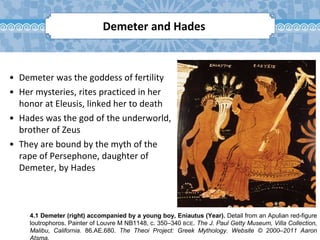
4.1 Demeter (right) accompanied by a young boy, Eniautus (Year). Detail from an Apulian red-figure
loutrophoros. Painter of Louvre M NB1148, c. 350–340 BCE. The J. Paul Getty Museum, Villa Collection,
Malibu, California. 86.AE.680. The Theoi Project: Greek Mythology. Website © 2000–2011 Aaron
Demeter and Hades
• Demeter was the goddess of fertility
• Her mysteries, rites practiced in her
honor at Eleusis, linked her to death
• Hades was the god of the underworld,
brother of Zeus
• They are bound by the myth of the
rape of Persephone, daughter of
Demeter, by Hades
4.2 Hades (right) and Persephone in a temple-like building. Detail
from a red-figure krater. Circa 350 BCE. Museo Archeologico
Nazionale, Naples, Italy. Erich Lessing/Art Resource, NY, ART200836.
Hades
• The other gods have an aversion to Hades
because of his association with death
• He was not the judge or punisher of the
dead, so not feared by humans
• Hades was associated with caves, but
there are no temples or festivals in his
honor
Map 4.1 Demeter and Hades in Greece
Greece
4.3 (left) and 4.4 (right) Charon (left) waits as Hermes (right) leads the soul of a
deceased person to his boat. White-ground lekythos (oil jug). Sabouroff Painter, c.
fifth century BCE. bpk, Berlin/Antikensammlung, Staatliche Museum, Berlin/Johannes
Laurentius/Art Resource, NY, ART301136 and ART301171.
The Underworld
• The Underworld was divided from the lands of
the living by five rivers
• Charon, the boatman, escorted souls across
them and into Hades
• Cerberus, the many-headed guard dog, also
prevents souls from leaving
• After death, souls wander eternally throughout
the Underworld
• Punishments are reserved for special cases; as
are rewards
4.5 Plaque of a funerary ritual (prosthesis). Black-figure plaque. Attributed to
the Burgon Group, c. 560–550 BCE. Louvre Museum, Paris, France. © RMN-
Grand Palais / Art Resource, NY, ART147733.
Funerary Rituals
• In Greece they served to help the soul of the dead reach the Underworld
• Women prepared the body for burial
• Burials were accompanied by mourning songs and a feast
• Offerings continued to be made to the dead for a month afterward
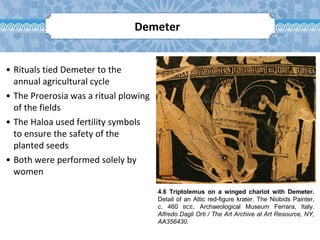
4.6 Triptolemus on a winged chariot with Demeter.
Detail of an Attic red-figure krater. The Niobids Painter,
c. 460 BCE. Archaeological Museum Ferrara, Italy.
Alfredo Dagli Orti / The Art Archive at Art Resource, NY,
AA356430.
Demeter
• Rituals tied Demeter to the
annual agricultural cycle
• The Proerosia was a ritual plowing
of the fields
• The Haloa used fertility symbols
to ensure the safety of the
planted seeds
• Both were performed solely by
women
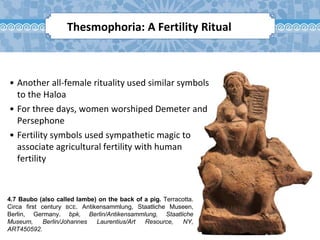
4.7 Baubo (also called Iambe) on the back of a pig. Terracotta.
Circa first century BCE. Antikensammlung, Staatliche Museen,
Berlin, Germany. bpk, Berlin/Antikensammlung, Staatliche
Museum, Berlin/Johannes Laurentius/Art Resource, NY,
ART450592.
Thesmophoria: A Fertility Ritual
• Another all-female rituality used similar symbols
to the Haloa
• For three days, women worshiped Demeter and
Persephone
• Fertility symbols used sympathetic magic to
associate agricultural fertility with human
fertility
4.8 The temple called the Telesterion at Eleusis, Greece.
The Solonic Telesterion was erected about 600 BCE. HIP/Art
Resource, NY, AR9146068.
The Eleusinian Mysteries
• Homer describes Demeter as
wandering to Eleusis in search of
Persephone
• She demands that a temple be built
for her, and Persephone’s return
from the Underworld symbolizes the
benefits that initiates in Demeter’s
mysteries will gain after death
• New members are initiated into the
mysteries yearly in a weeklong
festival
• Once initiated, they were able to take part in the secret rituals within the
temple itself
THEORY
Demeter and Hades
Classical Mythology in Context
4.9 Demeter, Triptolemus, and Persephone. Marble votive
relief from Eleusis. Circa 440–430 BCE. Museum of
Archaeology, Athens, Greece. Nimatallah / Art Resource, NY,
Myths Reinforce Social Norms
• ‘Goddess feminists’ are individuals who study
the spiritual dimensions of feminism
• ‘Matriarchy studies’ is the study of societies
where women held power
• Marija Gimbutas imagined a Neolithic Europe
of female-led egalitarian societies
• Classicist Helen P. Foley considers how women
were empowered by the worship of goddesses
like Demeter
• To Foley, myths like Demeter’s teach Greek
women to accept patriarchal rule
COMPARISON
Demeter and Hades
Classical Mythology in Context
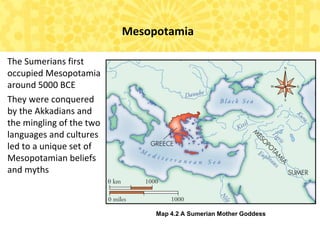
Map 4.2 A Sumerian Mother Goddess
Mesopotamia
The Sumerians first
occupied Mesopotamia
around 5000 BCE
They were conquered
by the Akkadians and
the mingling of the two
languages and cultures
led to a unique set of
Mesopotamian beliefs
and myths
4.10 Dumuzi the Shepherd. A clay impression or “printout” from a marble
cylinder seal. 3200–3000 BCE. bpk, Berlin/Vorderasiatisches Museum, Staatliche
Museen, Berlin, Germany/Olaf M.Teßmern/Art Resource, NY, ART497597.
Dying and Rising Gods
• Both the Sumerians and Akkadians have myths that describe a goddess
going to the Underworld in search of her lover
• Other gods like the Greek Adonis and the Phrygian Attis are believed to
annually descend to the Underworld and return
• Persephone is
unique as the only
female
RECEPTION
Demeter and Hades
Classical Mythology in Context
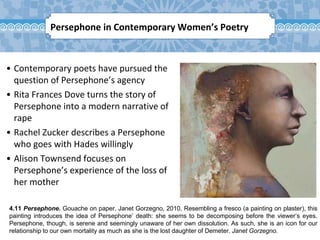
4.11 Persephone. Gouache on paper. Janet Gorzegno, 2010. Resembling a fresco (a painting on plaster), this
painting introduces the idea of Persephone’ death: she seems to be decomposing before the viewer’s eyes.
Persephone, though, is serene and seemingly unaware of her own dissolution. As such, she is an icon for our
relationship to our own mortality as much as she is the lost daughter of Demeter. Janet Gorzegno.
Persephone in Contemporary Women’s Poetry
• Contemporary poets have pursued the
question of Persephone’s agency
• Rita Frances Dove turns the story of
Persephone into a modern narrative of
rape
• Rachel Zucker describes a Persephone
who goes with Hades willingly
• Alison Townsend focuses on
Persephone’s experience of the loss of
her mother

Maurizio chapter 4 slides

  • 1.
  • 2.
  • 3.
    4.1 Demeter (right)accompanied by a young boy, Eniautus (Year). Detail from an Apulian red-figure loutrophoros. Painter of Louvre M NB1148, c. 350–340 BCE. The J. Paul Getty Museum, Villa Collection, Malibu, California. 86.AE.680. The Theoi Project: Greek Mythology. Website © 2000–2011 Aaron Demeter and Hades • Demeter was the goddess of fertility • Her mysteries, rites practiced in her honor at Eleusis, linked her to death • Hades was the god of the underworld, brother of Zeus • They are bound by the myth of the rape of Persephone, daughter of Demeter, by Hades
  • 4.
    4.2 Hades (right)and Persephone in a temple-like building. Detail from a red-figure krater. Circa 350 BCE. Museo Archeologico Nazionale, Naples, Italy. Erich Lessing/Art Resource, NY, ART200836. Hades • The other gods have an aversion to Hades because of his association with death • He was not the judge or punisher of the dead, so not feared by humans • Hades was associated with caves, but there are no temples or festivals in his honor
  • 5.
    Map 4.1 Demeterand Hades in Greece Greece
  • 6.
    4.3 (left) and4.4 (right) Charon (left) waits as Hermes (right) leads the soul of a deceased person to his boat. White-ground lekythos (oil jug). Sabouroff Painter, c. fifth century BCE. bpk, Berlin/Antikensammlung, Staatliche Museum, Berlin/Johannes Laurentius/Art Resource, NY, ART301136 and ART301171. The Underworld • The Underworld was divided from the lands of the living by five rivers • Charon, the boatman, escorted souls across them and into Hades • Cerberus, the many-headed guard dog, also prevents souls from leaving • After death, souls wander eternally throughout the Underworld • Punishments are reserved for special cases; as are rewards
  • 7.
    4.5 Plaque ofa funerary ritual (prosthesis). Black-figure plaque. Attributed to the Burgon Group, c. 560–550 BCE. Louvre Museum, Paris, France. © RMN- Grand Palais / Art Resource, NY, ART147733. Funerary Rituals • In Greece they served to help the soul of the dead reach the Underworld • Women prepared the body for burial • Burials were accompanied by mourning songs and a feast • Offerings continued to be made to the dead for a month afterward
  • 8.
    4.6 Triptolemus ona winged chariot with Demeter. Detail of an Attic red-figure krater. The Niobids Painter, c. 460 BCE. Archaeological Museum Ferrara, Italy. Alfredo Dagli Orti / The Art Archive at Art Resource, NY, AA356430. Demeter • Rituals tied Demeter to the annual agricultural cycle • The Proerosia was a ritual plowing of the fields • The Haloa used fertility symbols to ensure the safety of the planted seeds • Both were performed solely by women
  • 9.
    4.7 Baubo (alsocalled Iambe) on the back of a pig. Terracotta. Circa first century BCE. Antikensammlung, Staatliche Museen, Berlin, Germany. bpk, Berlin/Antikensammlung, Staatliche Museum, Berlin/Johannes Laurentius/Art Resource, NY, ART450592. Thesmophoria: A Fertility Ritual • Another all-female rituality used similar symbols to the Haloa • For three days, women worshiped Demeter and Persephone • Fertility symbols used sympathetic magic to associate agricultural fertility with human fertility
  • 10.
    4.8 The templecalled the Telesterion at Eleusis, Greece. The Solonic Telesterion was erected about 600 BCE. HIP/Art Resource, NY, AR9146068. The Eleusinian Mysteries • Homer describes Demeter as wandering to Eleusis in search of Persephone • She demands that a temple be built for her, and Persephone’s return from the Underworld symbolizes the benefits that initiates in Demeter’s mysteries will gain after death • New members are initiated into the mysteries yearly in a weeklong festival • Once initiated, they were able to take part in the secret rituals within the temple itself
  • 11.
  • 12.
    4.9 Demeter, Triptolemus,and Persephone. Marble votive relief from Eleusis. Circa 440–430 BCE. Museum of Archaeology, Athens, Greece. Nimatallah / Art Resource, NY, Myths Reinforce Social Norms • ‘Goddess feminists’ are individuals who study the spiritual dimensions of feminism • ‘Matriarchy studies’ is the study of societies where women held power • Marija Gimbutas imagined a Neolithic Europe of female-led egalitarian societies • Classicist Helen P. Foley considers how women were empowered by the worship of goddesses like Demeter • To Foley, myths like Demeter’s teach Greek women to accept patriarchal rule
  • 13.
  • 14.
    Map 4.2 ASumerian Mother Goddess Mesopotamia The Sumerians first occupied Mesopotamia around 5000 BCE They were conquered by the Akkadians and the mingling of the two languages and cultures led to a unique set of Mesopotamian beliefs and myths
  • 15.
    4.10 Dumuzi theShepherd. A clay impression or “printout” from a marble cylinder seal. 3200–3000 BCE. bpk, Berlin/Vorderasiatisches Museum, Staatliche Museen, Berlin, Germany/Olaf M.Teßmern/Art Resource, NY, ART497597. Dying and Rising Gods • Both the Sumerians and Akkadians have myths that describe a goddess going to the Underworld in search of her lover • Other gods like the Greek Adonis and the Phrygian Attis are believed to annually descend to the Underworld and return • Persephone is unique as the only female
  • 16.
  • 17.
    4.11 Persephone. Gouacheon paper. Janet Gorzegno, 2010. Resembling a fresco (a painting on plaster), this painting introduces the idea of Persephone’ death: she seems to be decomposing before the viewer’s eyes. Persephone, though, is serene and seemingly unaware of her own dissolution. As such, she is an icon for our relationship to our own mortality as much as she is the lost daughter of Demeter. Janet Gorzegno. Persephone in Contemporary Women’s Poetry • Contemporary poets have pursued the question of Persephone’s agency • Rita Frances Dove turns the story of Persephone into a modern narrative of rape • Rachel Zucker describes a Persephone who goes with Hades willingly • Alison Townsend focuses on Persephone’s experience of the loss of her mother