Chapter 2
HISTORY
Creation
Classical Mythology in Context
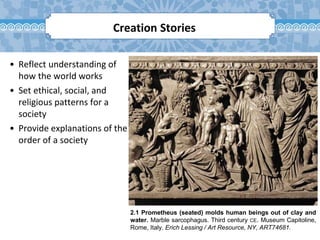
2.1 Prometheus (seated) molds human beings out of clay and
water. Marble sarcophagus. Third century CE. Museum Capitoline,
Rome, Italy. Erich Lessing / Art Resource, NY, ART74681.
Creation Stories
• Reflect understanding of
how the world works
• Set ethical, social, and
religious patterns for a
society
• Provide explanations of the
order of a society
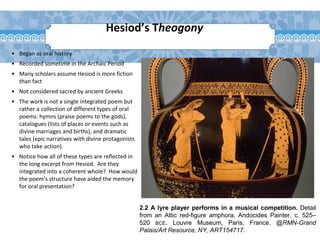
2.2 A lyre player performs in a musical competition. Detail
from an Attic red-figure amphora. Andocides Painter, c. 525–
520 BCE. Louvre Museum, Paris, France. @RMN-Grand
Palais/Art Resource, NY, ART154717.
Hesiod’s Theogony
• Began as oral history
• Recorded sometime in the Archaic Period
• Many scholars assume Hesiod is more fiction
than fact
• Not considered sacred by ancient Greeks
• The work is not a single integrated poem but
rather a collection of different types of oral
poems: hymns (praise poems to the gods),
catalogues (lists of places or events such as
divine marriages and births), and dramatic
tales (epic narratives with divine protagonists
who take action).
• Notice how all of these types are reflected in
the long excerpt from Hesiod. Are they
integrated into a coherent whole? How would
the poem’s structure have aided the memory
for oral presentation?
2.3a Plan of Mycenae’s Citadel.
2.3b Ruins of Mycenae today. © Florin
Stana/Shutterstock 194965928.
a
b
The Late Bronze Age: Mycenae
Mycenae was an important Bronze Age settlement in Greece
It was a fortified settlement,
probably the home of the king
(wanax), located on a hilltop
Map 2.1 Greece in the Mycenaean Age and the Archaic Period
Ancient Greece
2.4 A man with a plow pulling oxen. Terracotta
statue from Boeotia, Greece. Seventh to sixth
century BCE. Louvre Museum, Paris, France. Gianni
Dagli Orti/The Art Archive at Art Resource, NY,
AA379724.
• Communities had complex social
and economic networks
• Farmers and herders paid taxes in
kind
• All classes served in the army
• Slavery was common
• Bronze Age settlements disappear
soon after 1200 BCE
The Late Bronze Age: Mycenae
The Iron Age: Ascra
• The Iron Age is named after its use of iron for tools and weapons
• Few records remain from this period
• Hesiod’s Works and Days was composed at the end of this period
• Takes place in Ascra, on Mount Helicon in Boetia
• Hesiod’s description of Ascra is backed up by the archeological record
• Kings have lost central authority
• Most residents are small, independent farmers
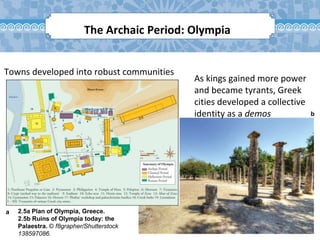
2.5a Plan of Olympia, Greece.
2.5b Ruins of Olympia today: the
Palaestra. © f8grapher/Shutterstock
138597086.
a
b
The Archaic Period: Olympia
Towns developed into robust communities
As kings gained more power
and became tyrants, Greek
cities developed a collective
identity as a demos
The Archaic Period and Panhellenism
• Hellenic identity developed during the Archaic Period
• Maintained by Panhellenic sanctuaries and festivals
• Oral performances of works by Homer and Hesiod developed a
shared understanding of gods and goddesses
• Led to a gradual homogenization of belief and worship
• Local variations on the traits and worship of gods remained
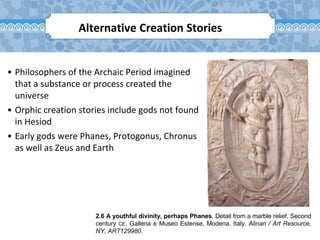
2.6 A youthful divinity, perhaps Phanes. Detail from a marble relief. Second
century CE. Galleria e Museo Estense, Modena, Italy. Alinari / Art Resource,
NY, ART129980.
Alternative Creation Stories
• Philosophers of the Archaic Period imagined
that a substance or process created the
universe
• Orphic creation stories include gods not found
in Hesiod
• Early gods were Phanes, Protogonus, Chronus
as well as Zeus and Earth
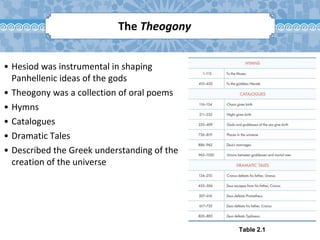
Table 2.1
The Theogony
• Hesiod was instrumental in shaping
Panhellenic ideas of the gods
• Theogony was a collection of oral poems
• Hymns
• Catalogues
• Dramatic Tales
• Described the Greek understanding of the
creation of the universe
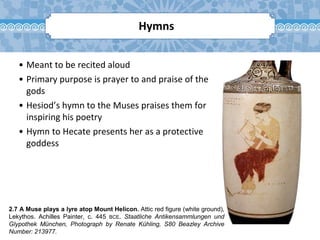
2.7 A Muse plays a lyre atop Mount Helicon. Attic red figure (white ground),
Lekythos. Achilles Painter, c. 445 BCE. Staatliche Antikensammlungen und
Glypothek München, Photograph by Renate Kühling, S80 Beazley Archive
Number: 213977.
Hymns
• Meant to be recited aloud
• Primary purpose is prayer to and praise of the
gods
• Hesiod’s hymn to the Muses praises them for
inspiring his poetry
• Hymn to Hecate presents her as a protective
goddess
2.8 Strife (Eris). Interior of a black figure cup.
Nikosthenes, c. 540–530 BCE. The J. Paul
Getty Museum, Villa Collection, Malibu,
California, 86.AE.169.
• Genealogies of the gods
• Designed to be recited aloud
• Describes creation as a genealogy
of the earliest gods
• Presents two methods of
procreation: spontaneous and
within marriage
Catalogues
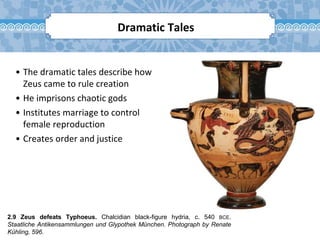
2.9 Zeus defeats Typhoeus. Chalcidian black-figure hydria, c. 540 BCE.
Staatliche Antikensammlungen und Glypothek München. Photograph by Renate
Kühling, 596.
Dramatic Tales
• The dramatic tales describe how
Zeus came to rule creation
• He imprisons chaotic gods
• Institutes marriage to control
female reproduction
• Creates order and justice
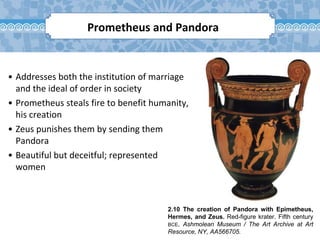
2.10 The creation of Pandora with Epimetheus,
Hermes, and Zeus. Red-figure krater. Fifth century
BCE. Ashmolean Museum / The Art Archive at Art
Resource, NY, AA566705.
Prometheus and Pandora
• Addresses both the institution of marriage
and the ideal of order in society
• Prometheus steals fire to benefit humanity,
his creation
• Zeus punishes them by sending them
Pandora
• Beautiful but deceitful; represented
women
THEORY
Creation
Classical Mythology in Context
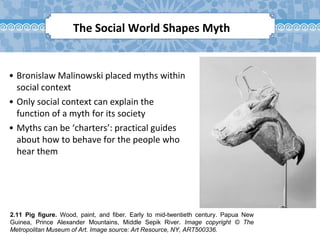
2.11 Pig figure. Wood, paint, and fiber. Early to mid-twentieth century. Papua New
Guinea, Prince Alexander Mountains, Middle Sepik River. Image copyright © The
Metropolitan Museum of Art. Image source: Art Resource, NY, ART500336.
• Bronislaw Malinowski placed myths within
social context
• Only social context can explain the
function of a myth for its society
• Myths can be ‘charters’: practical guides
about how to behave for the people who
hear them
The Social World Shapes Myth
COMPARISON
Creation
Classical Mythology in Context
Map 2.2 Creation Stories in the Ancient Near East
Ancient Greece, a
part of the
Mediterranean
world, was also
greatly influenced by
the Near East
Comparative
mythology studies
the similarities
between myths in
different societies;
or the ways in which
they move among
related societies
The Ancient Near East
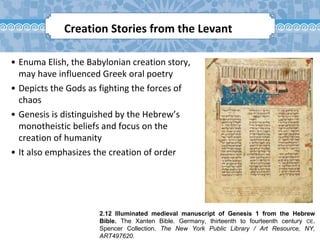
2.12 Illuminated medieval manuscript of Genesis 1 from the Hebrew
Bible. The Xanten Bible. Germany, thirteenth to fourteenth century CE.
Spencer Collection. The New York Public Library / Art Resource, NY,
ART497620.
Creation Stories from the Levant
• Enuma Elish, the Babylonian creation story,
may have influenced Greek oral poetry
• Depicts the Gods as fighting the forces of
chaos
• Genesis is distinguished by the Hebrew’s
monotheistic beliefs and focus on the
creation of humanity
• It also emphasizes the creation of order
RECEPTION
Creation
Classical Mythology in Context
2.13 Prometheus, the Light Bringer. Paul Manship, c. 1934. Rockefeller
Center, New York, USA. Melvyn Longhurst/Alamy, E6RE48.
Titans in Modern Art
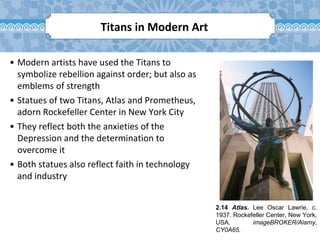
2.14 Atlas. Lee Oscar Lawrie, c.
1937. Rockefeller Center, New York,
USA. imageBROKER/Alamy,
CY0A65.
Titans in Modern Art
• Modern artists have used the Titans to
symbolize rebellion against order; but also as
emblems of strength
• Statues of two Titans, Atlas and Prometheus,
adorn Rockefeller Center in New York City
• They reflect both the anxieties of the
Depression and the determination to
overcome it
• Both statues also reflect faith in technology
and industry

Mythology in context chapter 2

  • 1.
  • 2.
  • 3.
    2.1 Prometheus (seated)molds human beings out of clay and water. Marble sarcophagus. Third century CE. Museum Capitoline, Rome, Italy. Erich Lessing / Art Resource, NY, ART74681. Creation Stories • Reflect understanding of how the world works • Set ethical, social, and religious patterns for a society • Provide explanations of the order of a society
  • 4.
    2.2 A lyreplayer performs in a musical competition. Detail from an Attic red-figure amphora. Andocides Painter, c. 525– 520 BCE. Louvre Museum, Paris, France. @RMN-Grand Palais/Art Resource, NY, ART154717. Hesiod’s Theogony • Began as oral history • Recorded sometime in the Archaic Period • Many scholars assume Hesiod is more fiction than fact • Not considered sacred by ancient Greeks • The work is not a single integrated poem but rather a collection of different types of oral poems: hymns (praise poems to the gods), catalogues (lists of places or events such as divine marriages and births), and dramatic tales (epic narratives with divine protagonists who take action). • Notice how all of these types are reflected in the long excerpt from Hesiod. Are they integrated into a coherent whole? How would the poem’s structure have aided the memory for oral presentation?
  • 5.
    2.3a Plan ofMycenae’s Citadel. 2.3b Ruins of Mycenae today. © Florin Stana/Shutterstock 194965928. a b The Late Bronze Age: Mycenae Mycenae was an important Bronze Age settlement in Greece It was a fortified settlement, probably the home of the king (wanax), located on a hilltop
  • 6.
    Map 2.1 Greecein the Mycenaean Age and the Archaic Period Ancient Greece
  • 7.
    2.4 A manwith a plow pulling oxen. Terracotta statue from Boeotia, Greece. Seventh to sixth century BCE. Louvre Museum, Paris, France. Gianni Dagli Orti/The Art Archive at Art Resource, NY, AA379724. • Communities had complex social and economic networks • Farmers and herders paid taxes in kind • All classes served in the army • Slavery was common • Bronze Age settlements disappear soon after 1200 BCE The Late Bronze Age: Mycenae
  • 8.
    The Iron Age:Ascra • The Iron Age is named after its use of iron for tools and weapons • Few records remain from this period • Hesiod’s Works and Days was composed at the end of this period • Takes place in Ascra, on Mount Helicon in Boetia • Hesiod’s description of Ascra is backed up by the archeological record • Kings have lost central authority • Most residents are small, independent farmers
  • 9.
    2.5a Plan ofOlympia, Greece. 2.5b Ruins of Olympia today: the Palaestra. © f8grapher/Shutterstock 138597086. a b The Archaic Period: Olympia Towns developed into robust communities As kings gained more power and became tyrants, Greek cities developed a collective identity as a demos
  • 10.
    The Archaic Periodand Panhellenism • Hellenic identity developed during the Archaic Period • Maintained by Panhellenic sanctuaries and festivals • Oral performances of works by Homer and Hesiod developed a shared understanding of gods and goddesses • Led to a gradual homogenization of belief and worship • Local variations on the traits and worship of gods remained
  • 11.
    2.6 A youthfuldivinity, perhaps Phanes. Detail from a marble relief. Second century CE. Galleria e Museo Estense, Modena, Italy. Alinari / Art Resource, NY, ART129980. Alternative Creation Stories • Philosophers of the Archaic Period imagined that a substance or process created the universe • Orphic creation stories include gods not found in Hesiod • Early gods were Phanes, Protogonus, Chronus as well as Zeus and Earth
  • 12.
    Table 2.1 The Theogony •Hesiod was instrumental in shaping Panhellenic ideas of the gods • Theogony was a collection of oral poems • Hymns • Catalogues • Dramatic Tales • Described the Greek understanding of the creation of the universe
  • 13.
    2.7 A Museplays a lyre atop Mount Helicon. Attic red figure (white ground), Lekythos. Achilles Painter, c. 445 BCE. Staatliche Antikensammlungen und Glypothek München, Photograph by Renate Kühling, S80 Beazley Archive Number: 213977. Hymns • Meant to be recited aloud • Primary purpose is prayer to and praise of the gods • Hesiod’s hymn to the Muses praises them for inspiring his poetry • Hymn to Hecate presents her as a protective goddess
  • 14.
    2.8 Strife (Eris).Interior of a black figure cup. Nikosthenes, c. 540–530 BCE. The J. Paul Getty Museum, Villa Collection, Malibu, California, 86.AE.169. • Genealogies of the gods • Designed to be recited aloud • Describes creation as a genealogy of the earliest gods • Presents two methods of procreation: spontaneous and within marriage Catalogues
  • 15.
    2.9 Zeus defeatsTyphoeus. Chalcidian black-figure hydria, c. 540 BCE. Staatliche Antikensammlungen und Glypothek München. Photograph by Renate Kühling, 596. Dramatic Tales • The dramatic tales describe how Zeus came to rule creation • He imprisons chaotic gods • Institutes marriage to control female reproduction • Creates order and justice
  • 16.
    2.10 The creationof Pandora with Epimetheus, Hermes, and Zeus. Red-figure krater. Fifth century BCE. Ashmolean Museum / The Art Archive at Art Resource, NY, AA566705. Prometheus and Pandora • Addresses both the institution of marriage and the ideal of order in society • Prometheus steals fire to benefit humanity, his creation • Zeus punishes them by sending them Pandora • Beautiful but deceitful; represented women
  • 17.
  • 18.
    2.11 Pig figure.Wood, paint, and fiber. Early to mid-twentieth century. Papua New Guinea, Prince Alexander Mountains, Middle Sepik River. Image copyright © The Metropolitan Museum of Art. Image source: Art Resource, NY, ART500336. • Bronislaw Malinowski placed myths within social context • Only social context can explain the function of a myth for its society • Myths can be ‘charters’: practical guides about how to behave for the people who hear them The Social World Shapes Myth
  • 19.
  • 20.
    Map 2.2 CreationStories in the Ancient Near East Ancient Greece, a part of the Mediterranean world, was also greatly influenced by the Near East Comparative mythology studies the similarities between myths in different societies; or the ways in which they move among related societies The Ancient Near East
  • 21.
    2.12 Illuminated medievalmanuscript of Genesis 1 from the Hebrew Bible. The Xanten Bible. Germany, thirteenth to fourteenth century CE. Spencer Collection. The New York Public Library / Art Resource, NY, ART497620. Creation Stories from the Levant • Enuma Elish, the Babylonian creation story, may have influenced Greek oral poetry • Depicts the Gods as fighting the forces of chaos • Genesis is distinguished by the Hebrew’s monotheistic beliefs and focus on the creation of humanity • It also emphasizes the creation of order
  • 22.
  • 23.
    2.13 Prometheus, theLight Bringer. Paul Manship, c. 1934. Rockefeller Center, New York, USA. Melvyn Longhurst/Alamy, E6RE48. Titans in Modern Art
  • 24.
    2.14 Atlas. LeeOscar Lawrie, c. 1937. Rockefeller Center, New York, USA. imageBROKER/Alamy, CY0A65. Titans in Modern Art • Modern artists have used the Titans to symbolize rebellion against order; but also as emblems of strength • Statues of two Titans, Atlas and Prometheus, adorn Rockefeller Center in New York City • They reflect both the anxieties of the Depression and the determination to overcome it • Both statues also reflect faith in technology and industry