FICTION
FICTION
⮚fiction is the a dream of the writer ,
made visible on the page . It may be the
writer’s lived experience or it may be
entirely imagined.
⮚It refers to literature created from the
imagination.
FICTION INCLUDES:
▪ Short Story
– brief fictional prose narrative that is
shorter than a novel and that usually deals
with only a few characters. The shorts story is
usually concerned with a single effect
conveyed in only one or a few significant
episodes or scenes
▪ Novels
- is an invented prose narrative of
considerable length and a certain complexity
that deals imaginatively with human experience,
usually through a connected sequence of events
involving a group of person in a specific setting.
▪ Myths
- used to describe a traditional story that
typically aims to explain a natural or social
phenomenon.
▪ Fairy Tales
- is a short story that belongs to the
folklore genre.
▪ Legend
- traditional story or group of stories told
about a particular person or place.
▪ Fables
-is a short , fictional story that aims to
convey a moral lesson. Fables often feature
animals, objects , or forces of nature as
characters
GENRE OF FICTION
▪ Historical Fiction
-is a genre of literature that
combines elements of history
with fictional narratives . It
involves creating stories that
are set in the past and often
revolve around real historical
events , period , or figures.
▪ Science Fiction
- is genre of fiction that
explores futuristic or
alternative worlds, often
involving advanced
technology, scientific
concepts ,or extraterrestrial.
▪ Realistic fiction
- realistic fiction is a genre
of literature that consists of stories
and characters that seem like
they could happen or exist in
real life. While they are not true
stories, they read like they could
be.
▪ Literary Fiction
-is a genre of fiction that
focuses primarily on
characterdevelopment ,
exploration of themes, and the
quality of writing. This genre
often delves into the human
experience , with stories that
reflect in various aspects of life,
society and relationships.
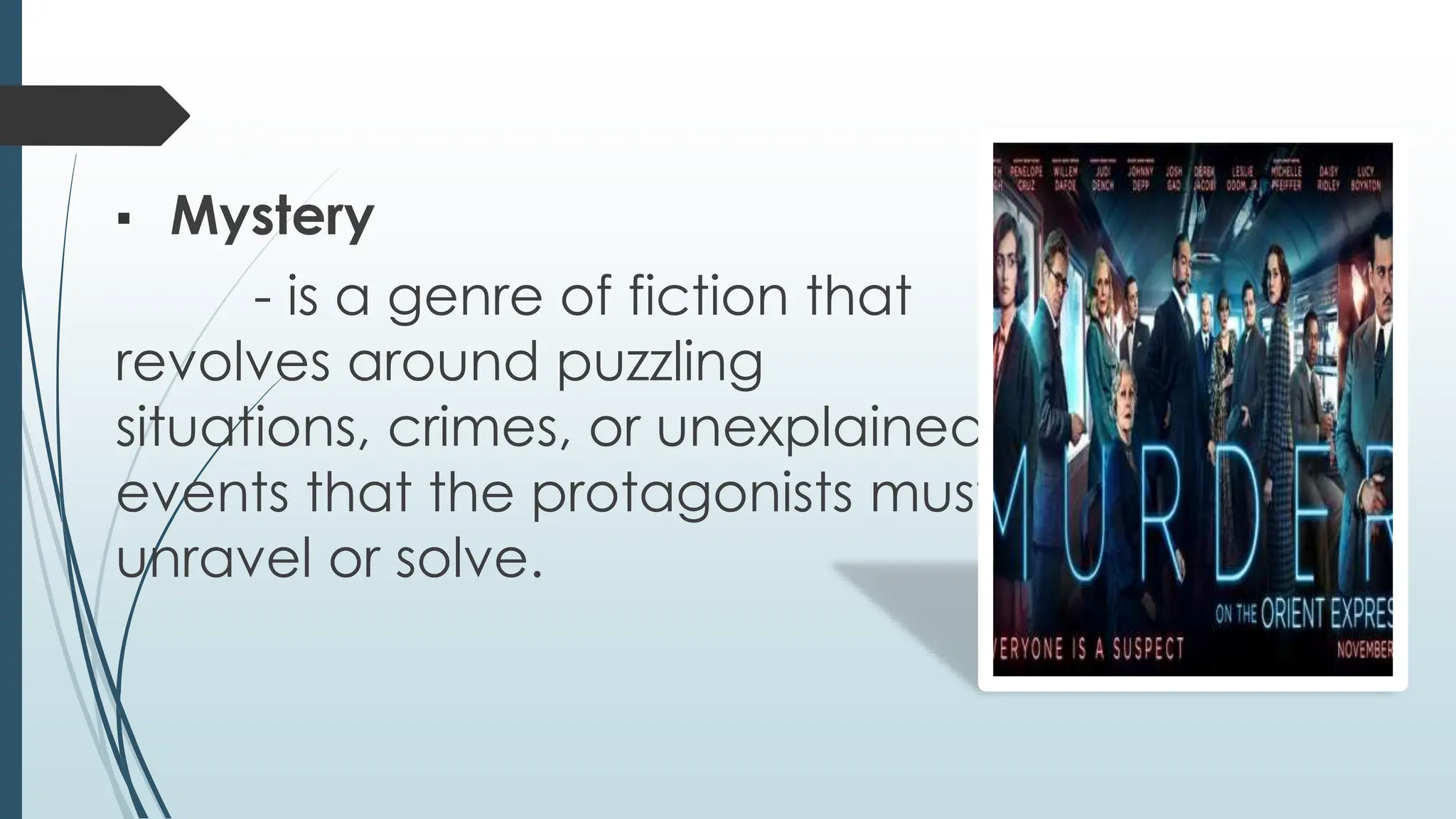
▪ Mystery
- is a genre of fiction that
revolves around puzzling
situations, crimes, or unexplained
events that the protagonists must
unravel or solve.
▪ Fantasy
- fantasy is a genre of fiction
that incorporates magical,
supernatural, or other fantastical
elements as central aspects of its
narrative, world-building, or
characters. This genre often
explores imaginative and
imaginary settings.
▪ Horror
- is a genre of fiction that
seeks to evoke feelings of
fear, dread, unease, or terror
in its audience. Horror can be
found in various forms of
media, including literature,
film, television, and video
games.
▪ Romance
- is a genre of fiction that
focuses on the romantic
relationships between
character, with an emphasis on
emotional connections,
personal growth, and the
development of love.
ELEMENTS OF FICTION
a. Character – a person or any entity
presented in a narrative or dramatic work.
Characters are the ones mainly involved in
the circumstances and action of a story. In
a story, characters can be classified as a
major or minor character depending on
their roles and importance in the
development of the story.
Types of Characters According to Involvement
Protagonist
- principal or lead character; commonly
referred to as the ‘hero’.
Antagonist
- known as the villain; the role is mainly to
oppose or to challenge the main character; it can
also be in other forms like death, defeat, illness
etc.
Types of Character According to
Development
Static/ Flat Character
- a character that does not change the
course of the story. The qualities and
characteristics of a certain character remain
as is.
Dynamic Character
- this character undergoes significant
changes in personality, behavior , perspective
etc. as the story develops.
Round Character
- known as complex and
multidimensional . A character that people
can relate the most. This also appears to be
lifelike.
b. Plot
- a causally related sequence of events ;
what happens as a result of the main
conflict is presented in a structure format ;
the sequence of events which involves the
character in conflict.(Beginning , Middle ,
Ending)
ELEMENTS OF PLOT
�Exposition- (beginning ) introduces the
time , setting and the main character.
� Rising Action - unfolds the problems and
struggles that would be encountered by
the main character leading to the crisis.
� Climax – (result of the crisis)part where
the problem or the conflict is the highest
peak of interest; also know as the crisis or
the point of no return.
� Falling action
– is the period of time in a story that follows
the climax and leads to resolution.
� Denouement or resolution
– contains the last statements about the
story.
c. Point of View
- it refers to the vantage point as to
how the story unfolds. Thus, it mainly
relates as to the way how the story is told
or narrated. This has several kinds like:
First Person – is a character perspective
that’s used to relay the thoughts and feelings
of a character or entity within a story. First
person is defined by the use of I, me, we, us,
etc.
Second person – belongs to the persons (or
people) being the addressed. This is a ‘you’
perspective.
d. Setting
– refers to where and when the action of
the study occurs. In the certain stories, the
environment can play a significant role. Knowing
where and when the story happening will help
readers to produce stronger more defensible
interpretation.
e. Conflict
- the struggle or complication
involving the characters, the opposition of
persons or forces upon which the action
depends in drama or fiction.
1.Internal Conflict
⮚occurs when the protagonist struggles
within himself or herself.
⮚ the protagonist is pulled by two
courses of action or by differing
emotions.
TYPES OF CONFLICT
2. Interpersonal Conflict
⮚pits the protagonist against someone else.
⮚ person – against –person.
3. External Conflict
⮚happens when the protagonist is in conflict
with the values of his or her society.
THANK YOU!

FICTION CREATIVE WRITING FICTION CREATIVE WRITING.pptx

  • 1.
  • 2.
    FICTION ⮚fiction is thea dream of the writer , made visible on the page . It may be the writer’s lived experience or it may be entirely imagined. ⮚It refers to literature created from the imagination.
  • 3.
    FICTION INCLUDES: ▪ ShortStory – brief fictional prose narrative that is shorter than a novel and that usually deals with only a few characters. The shorts story is usually concerned with a single effect conveyed in only one or a few significant episodes or scenes
  • 4.
    ▪ Novels - isan invented prose narrative of considerable length and a certain complexity that deals imaginatively with human experience, usually through a connected sequence of events involving a group of person in a specific setting. ▪ Myths - used to describe a traditional story that typically aims to explain a natural or social phenomenon.
  • 5.
    ▪ Fairy Tales -is a short story that belongs to the folklore genre. ▪ Legend - traditional story or group of stories told about a particular person or place. ▪ Fables -is a short , fictional story that aims to convey a moral lesson. Fables often feature animals, objects , or forces of nature as characters
  • 6.
    GENRE OF FICTION ▪Historical Fiction -is a genre of literature that combines elements of history with fictional narratives . It involves creating stories that are set in the past and often revolve around real historical events , period , or figures.
  • 7.
    ▪ Science Fiction -is genre of fiction that explores futuristic or alternative worlds, often involving advanced technology, scientific concepts ,or extraterrestrial.
  • 8.
    ▪ Realistic fiction -realistic fiction is a genre of literature that consists of stories and characters that seem like they could happen or exist in real life. While they are not true stories, they read like they could be.
  • 9.
    ▪ Literary Fiction -isa genre of fiction that focuses primarily on characterdevelopment , exploration of themes, and the quality of writing. This genre often delves into the human experience , with stories that reflect in various aspects of life, society and relationships.
  • 10.
    ▪ Mystery - isa genre of fiction that revolves around puzzling situations, crimes, or unexplained events that the protagonists must unravel or solve.
  • 11.
    ▪ Fantasy - fantasyis a genre of fiction that incorporates magical, supernatural, or other fantastical elements as central aspects of its narrative, world-building, or characters. This genre often explores imaginative and imaginary settings.
  • 12.
    ▪ Horror - isa genre of fiction that seeks to evoke feelings of fear, dread, unease, or terror in its audience. Horror can be found in various forms of media, including literature, film, television, and video games.
  • 13.
    ▪ Romance - isa genre of fiction that focuses on the romantic relationships between character, with an emphasis on emotional connections, personal growth, and the development of love.
  • 14.
    ELEMENTS OF FICTION a.Character – a person or any entity presented in a narrative or dramatic work. Characters are the ones mainly involved in the circumstances and action of a story. In a story, characters can be classified as a major or minor character depending on their roles and importance in the development of the story.
  • 15.
    Types of CharactersAccording to Involvement Protagonist - principal or lead character; commonly referred to as the ‘hero’. Antagonist - known as the villain; the role is mainly to oppose or to challenge the main character; it can also be in other forms like death, defeat, illness etc.
  • 16.
    Types of CharacterAccording to Development Static/ Flat Character - a character that does not change the course of the story. The qualities and characteristics of a certain character remain as is. Dynamic Character - this character undergoes significant changes in personality, behavior , perspective etc. as the story develops.
  • 17.
    Round Character - knownas complex and multidimensional . A character that people can relate the most. This also appears to be lifelike.
  • 18.
    b. Plot - acausally related sequence of events ; what happens as a result of the main conflict is presented in a structure format ; the sequence of events which involves the character in conflict.(Beginning , Middle , Ending)
  • 20.
    ELEMENTS OF PLOT �Exposition-(beginning ) introduces the time , setting and the main character. � Rising Action - unfolds the problems and struggles that would be encountered by the main character leading to the crisis. � Climax – (result of the crisis)part where the problem or the conflict is the highest peak of interest; also know as the crisis or the point of no return.
  • 21.
    � Falling action –is the period of time in a story that follows the climax and leads to resolution. � Denouement or resolution – contains the last statements about the story.
  • 22.
    c. Point ofView - it refers to the vantage point as to how the story unfolds. Thus, it mainly relates as to the way how the story is told or narrated. This has several kinds like:
  • 23.
    First Person –is a character perspective that’s used to relay the thoughts and feelings of a character or entity within a story. First person is defined by the use of I, me, we, us, etc. Second person – belongs to the persons (or people) being the addressed. This is a ‘you’ perspective.
  • 24.
    d. Setting – refersto where and when the action of the study occurs. In the certain stories, the environment can play a significant role. Knowing where and when the story happening will help readers to produce stronger more defensible interpretation.
  • 25.
    e. Conflict - thestruggle or complication involving the characters, the opposition of persons or forces upon which the action depends in drama or fiction.
  • 26.
    1.Internal Conflict ⮚occurs whenthe protagonist struggles within himself or herself. ⮚ the protagonist is pulled by two courses of action or by differing emotions. TYPES OF CONFLICT
  • 27.
    2. Interpersonal Conflict ⮚pitsthe protagonist against someone else. ⮚ person – against –person. 3. External Conflict ⮚happens when the protagonist is in conflict with the values of his or her society.
  • 28.