Basic Textual and Contextual Reading Approach in the Study and Appreciation of Literature.pptx
1.
Opening Prayer
Heavenly Father,
Wethank You for this new day.
Thank You for the gift of life, for our teachers, classmates, and
school.
Bless our minds and hearts so we may learn with wisdom and
joy.
Guide our teachers as they share their knowledge, and help us
to listen and understand.
May everything we do today bring honor to You.
This we ask through Christ our Lord. Amen.
2.
Basic Textual andContextual
Reading Approach in the Study
and Appreciation of Literature
3.
Archetype – atypical example of a character, symbol, or story pattern repeated across cultures and time.
Collective Unconscious – Carl Jung’s idea of shared human memories and symbols that shape
archetypes.
Protagonist – the main character or hero of a story.
Antagonist – the character who opposes the protagonist (the villain or enemy).
Confidant – a character whom the protagonist trusts and shares feelings with.
Foil – a character who contrasts with the protagonist to highlight their traits.
Tertiary Characters – minor characters in the story.
Hero – the brave, self-sacrificing main character who usually saves the day.
Villain – the evil or opposing character who creates conflict.
Companion – the loyal friend or sidekick of the hero.
Key Vocabulary Words
4.
Why do weoften see similar
characters in stories from
different cultures and time
periods?
For example, a brave hero, a
wise mentor, or a cruel villain.
5.
Archetype - arecurring character type, symbol, or pattern in stories
that represents universal human experiences.
Concept comes from Swiss psychologist, Carl Jung. His collective
unconscious shared human memories that make these patterns
→
recognizable across cultures.
Examples: Hero (Katniss), Mentor (Haymitch), Villain (President Snow),
Innocent (Rue).
6.
“Archetype Spotting”
Instructions: I’llbe showing short clips/images.
Identify: Which archetype is this? What traits prove it?
Example: Haymitch → Mentor (guides but also
flawed).Rue → Innocent (pure, hopeful, tragic).
7.
Role-Play Archetypes
Instructions: Dividethe class into small groups.
Each group picks 1 archetype (Hero, Villain,
Rebel, Mentor, Caregiver, etc.).
Create a 1-minute skit or dialogue showing that
archetype without naming it.
Class guesses: Which archetype you are
8.
Archetype Mix &Match Activity
Instructions:
1.You will receive one slip.
2.If you have an Archetype slip, find the
student with the matching Trait/Example
slip.
3.Once paired, introduce yourselves to
the class: “I am the [Archetype], and my
match is [Trait/Example].”
9.
Reflection Writing (5–7minutes)
1. What life lesson can we learn from (lead
role) as a hero/rebel? How does it connect to
our world today?
Write a short paragraph, then share with a
seatmate.
10.
Summarize:
• Archetypes makestories relatable
and universal.
• They reflect real human struggles
and values.
• Writers use archetypes to connect
deeply with readers across time
11.
Key Question toend:
If you were to write a story
today, which archetype would
you create, and how would you
modernize it?
12.
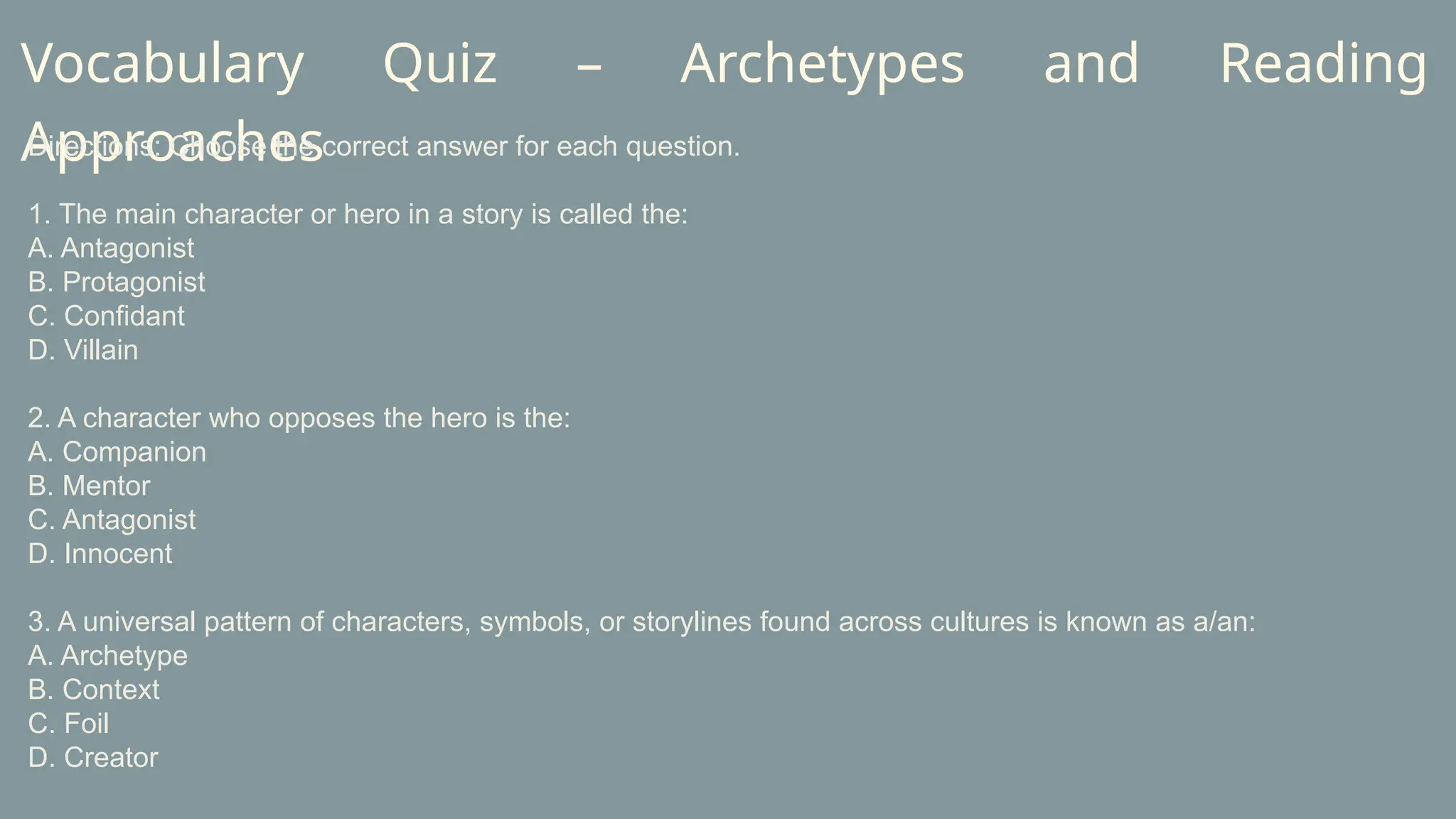
Vocabulary Quiz –Archetypes and Reading
Approaches
Directions: Choose the correct answer for each question.
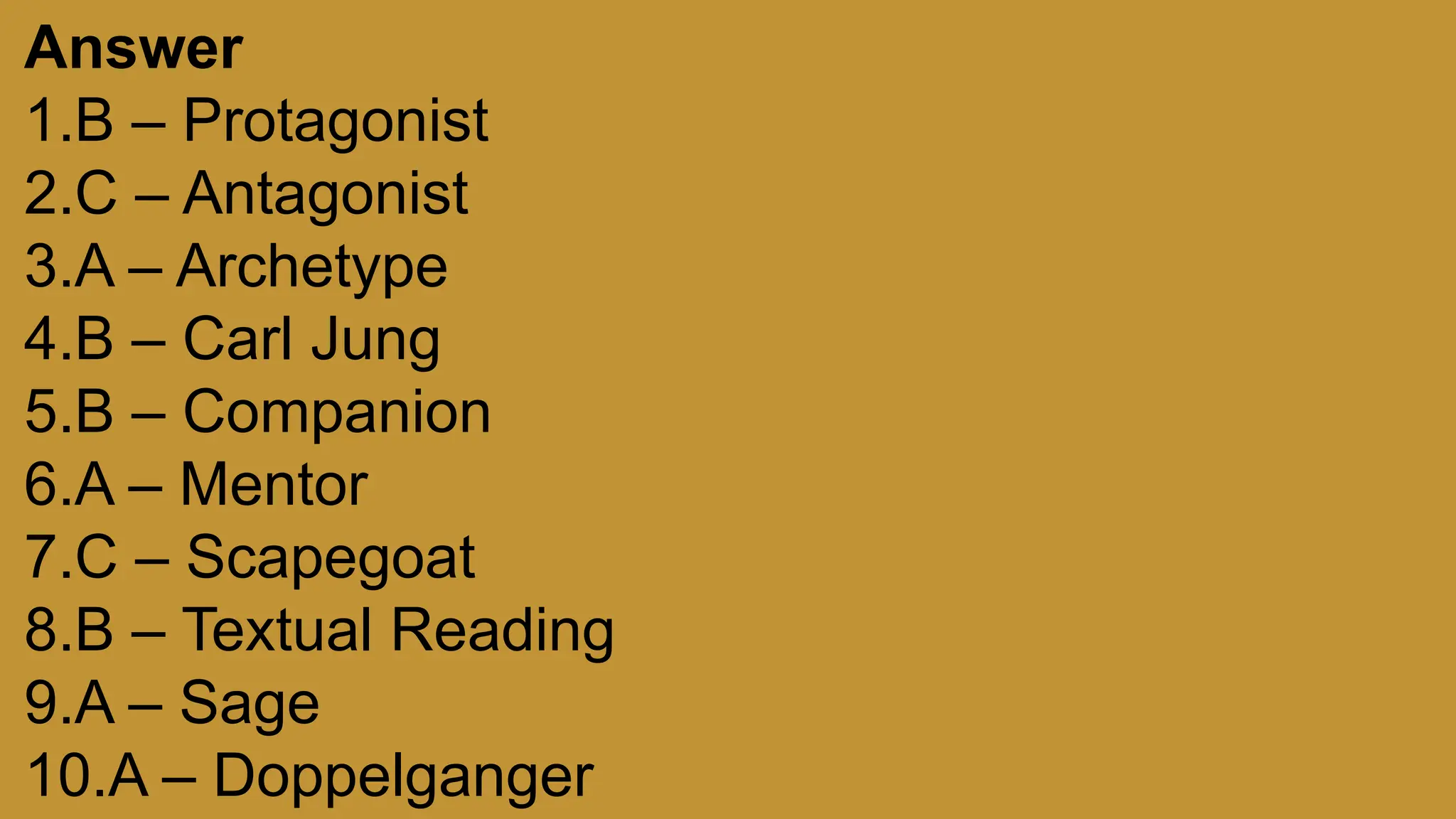
1. The main character or hero in a story is called the:
A. Antagonist
B. Protagonist
C. Confidant
D. Villain
2. A character who opposes the hero is the:
A. Companion
B. Mentor
C. Antagonist
D. Innocent
3. A universal pattern of characters, symbols, or storylines found across cultures is known as a/an:
A. Archetype
B. Context
C. Foil
D. Creator
13.
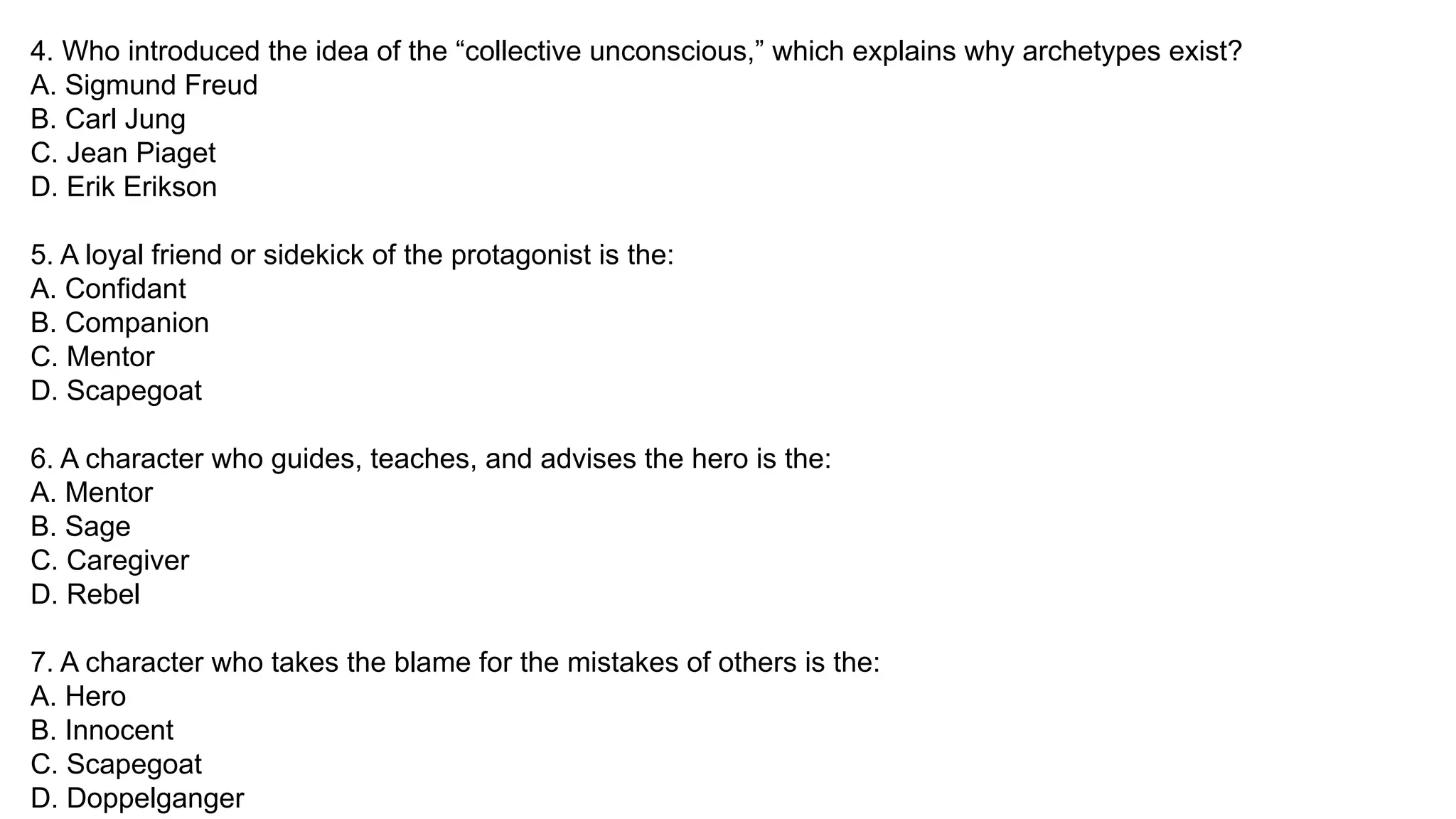
4. Who introducedthe idea of the “collective unconscious,” which explains why archetypes exist?
A. Sigmund Freud
B. Carl Jung
C. Jean Piaget
D. Erik Erikson
5. A loyal friend or sidekick of the protagonist is the:
A. Confidant
B. Companion
C. Mentor
D. Scapegoat
6. A character who guides, teaches, and advises the hero is the:
A. Mentor
B. Sage
C. Caregiver
D. Rebel
7. A character who takes the blame for the mistakes of others is the:
A. Hero
B. Innocent
C. Scapegoat
D. Doppelganger
14.
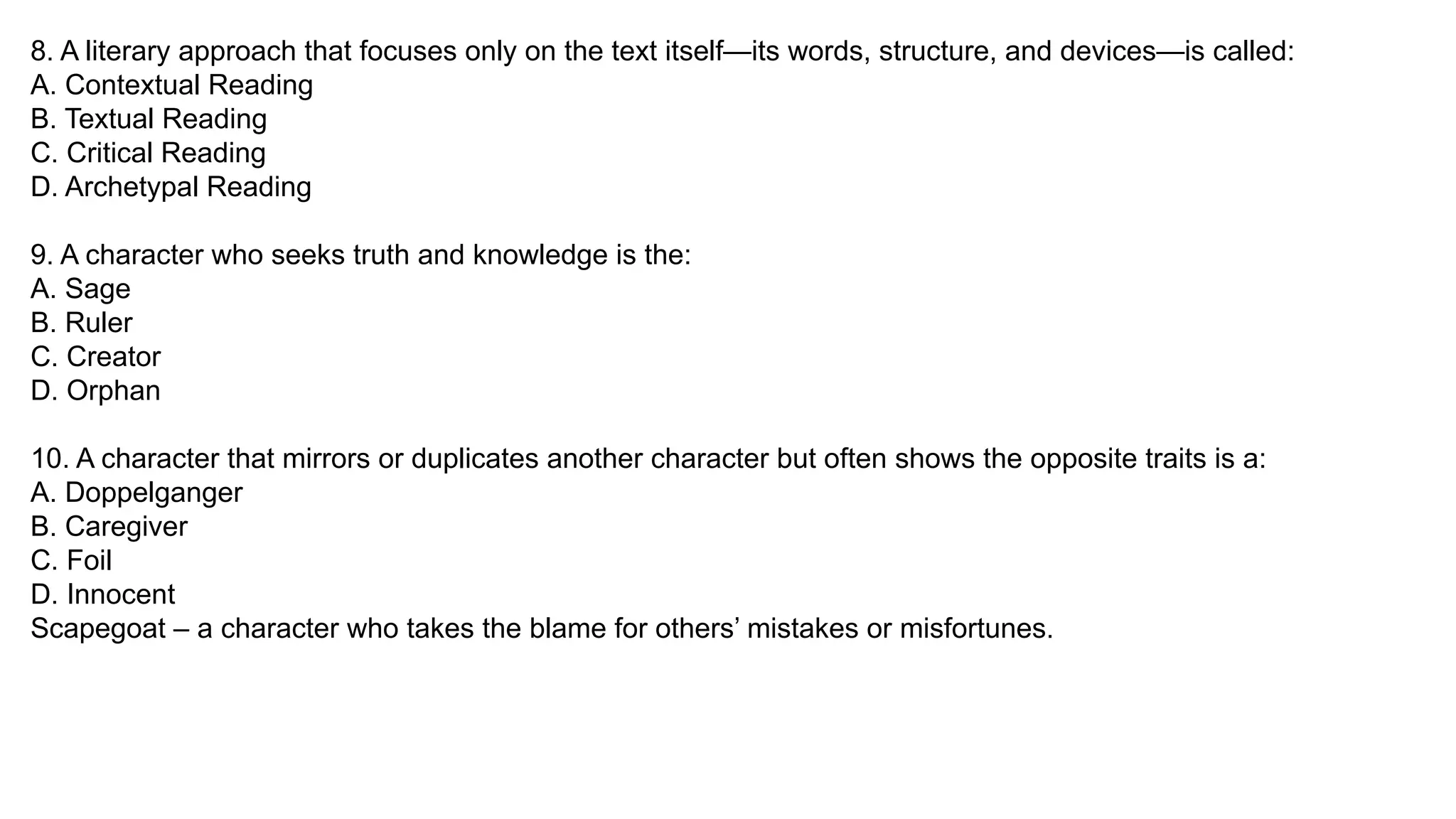
8. A literaryapproach that focuses only on the text itself—its words, structure, and devices—is called:
A. Contextual Reading
B. Textual Reading
C. Critical Reading
D. Archetypal Reading
9. A character who seeks truth and knowledge is the:
A. Sage
B. Ruler
C. Creator
D. Orphan
10. A character that mirrors or duplicates another character but often shows the opposite traits is a:
A. Doppelganger
B. Caregiver
C. Foil
D. Innocent
Scapegoat – a character who takes the blame for others’ mistakes or misfortunes.
Fonts Design Elements/ Icons
Colors
This presentation template
uses the following free fonts:
You can find these fonts online too.
Shadows Into Light Two
Quicksand
TITLES:
BODY TEXT:
#FFF8E2 #F9CF67 #C19336 #CFE185 #688B49
Use these in your presentation. Delete or hide this page before presenting.
Resource Page
19.
This presentation templateis free for everyone to use, thanks to the following:
for this presentation template for the photos, graphics, and elements
Happy designing!
Credits
Pexels, Pixabay,
Sketchify
![Archetype Mix & Match Activity
Instructions:
1.You will receive one slip.
2.If you have an Archetype slip, find the
student with the matching Trait/Example
slip.
3.Once paired, introduce yourselves to
the class: “I am the [Archetype], and my
match is [Trait/Example].”](https://image.slidesharecdn.com/basictextualandcontextualreadingapproachinthestudyandappreciationofliterature-251008010344-30389e42/75/Basic-Textual-and-Contextual-Reading-Approach-in-the-Study-and-Appreciation-of-Literature-pptx-8-2048.jpg)