Presented by: Maria Kesia Navarro
- Greek word for “origin” and
“model”
- refers to it as the first form for
whatever else comes after it
- It refers to a general character, trait
or structure commonly held in a
certain group or class ; it is an
embodiment or example , a model
with ideal features
- It may be figure, representation, or
symbol
- As a literary device, an
archetype is a reoccurring
symbol or motif throughout
literature that represents
universal patterns of human
nature.
- Narratology is the literary theory
that examines the ways that stories
are structured and what
characteristics stories have in
common and what makes them
different from one another.
- A form of Structuralism that focuses
on the structure of stories. Identifies 31
actions that a story can contain and
claims all stories pick from this list.
- Also focuses on the specific character
types that are repeated within all
stories—hero, villain, trickster,
orphan, mentor etc.
- Swiss psychologist, Carl Jung argued
that the root of an archetype is in the
“collective unconscious” of mankind.
- refers to experiences shared by a race
or culture
- includes love, religion, death, birth,
life, struggle, survival etc.
Joseph Campbell took Jung’s ideas and
applied them to world mythologies. In A
Hero with a Thousand Faces, among
other works, he refined the concept of
hero and the hero’s journey— George
Lucas used Campbell’s writings to
formulate the Star Wars saga.
Recognizing archetypal patterns in
literature brings patterns we all
unconsciously respond to in similar
ways to a conscious level.
- Birth
- Rebirth
- Death
- Power
- Magic
- Unity
- The hero
- The child
- God
- The demon
- The old
wise man
- The earth
mother
- The animal
Archetype can be applied to:
- image
- theme
- symbol
- idea
- character type
- plot pattern
Archetypes can be expressed in:
- myths
- dreams
- literature
- religions
- fantasies
- folklores
Aristotl
e
Aristotle’s poetics (c.330
BCE) are considered to be
the first surviving
philosophical exposition on
literary theory.
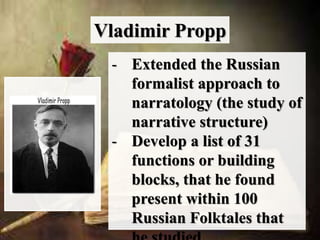
Vladimir Propp
Narratology began with the
Russian formalists
particularly Vladimir
Propp (Morphology of the
Folktale, (1978).
Vladimir Propp
- Extended the Russian
formalist approach to
narratology (the study of
narrative structure)
- Develop a list of 31
functions or building
blocks, that he found
present within 100
Russian Folktales that
Carl Jung
Carl Jung understood
archetypes as universal,
archaic patterns and
images that derive from
the collective unconscious
and are the psychic
counterpart of instinct.
Archetypal criticism is concerned with
the way cycles and reiterating patterns of
tradition, culture, inborn images, and
beliefs affect literary works. It operates
with the idea that certain symbols
represent the same ideas no matter the
time or place.
Authors focus on symbols to utilize in
literary works in order to strike readers’
unconscious. Such symbols recur often
enough in literature to be recognizable as
an element of one’s literary experience as
a whole it also deals with symbolism of
nature and the cosmos. There is
universality in literature, anthropology,
The use of archetypical characters and
situations gives a literary work a
universal acceptance, as readers identify
the characters and situations in their
social and cultural context. By using
common archetype, the writers attempt to
impart realism to their works, as the
situations and characters are drawn from
the experiences of the world.
Anthropological and psychological
studies of the late 19th and early 20th
century sparked the beginning of this
criticism. Information provided from
the findings of the past cultures
influences many prominent writers.
Also myths from the Greek and
Roman eras were thought of as
profound and as a result the desire to
incorporate such ideas in writing was
instigated. Archetypal Criticism came
into prominence in the 1930’s and
1940’s, continued to flourish in 1950’s
and 1960’s.
Archetypal criticism focuses on certain
symbols and their meanings. Almost all
literature is written to convey events
which mean something. Archetypal
criticism looks for these meanings, as well
as what the symbols in the story stand for.
It acts as a powerful tool in teaching and in
expressing universal feelings, beliefs, and
ideas. Very closely linked with
psychological theories and criticism.
Explains why literature touches deep inside
the heart of the reader.
Many critics are leery of the actual value of
the archetypal approach; they seem to
think it is reductionistic, formulaic. It
generally excludes other sources or
criticisms. Others believe that literary
individuality is ignored with so much
emphasis on cycles and patterns. Not all
literature contains symbolism; some is
simply written for enjoyment.
Some critics argue the theory is
unnecessary because archetypal
approaches to literature can also be
covered in psychology, anthropology,
comparative religion, and other fields.
Symbols can elicit multiple meanings; one
might interpret a literary work that is
entirely different from the author’s
intentions. This criticism has been used less
Hero: Martin Luther King Jr., Mahatma
Gandhi
Rebel: Che Guevara, William Wallace
Ruler: Napoleon, Genghis Khan
Healer: Florence Nightingale, Mother
Teresa
Adventurer: Christopher Columbus,
Marco Polo
Innocent: Anne Frank, Malala Musafzai
Genius: Albert Einstein, Leonardo da Vinci
Jester: Mark Twain, Charlie Chaplin
Outlaw: Jesse James, Butch Cassidy
 Situation
 Setting
 Symbolic
 Character
 Battle of Good and Evil - Good
ultimately triumphs
• Death and Rebirth - Shows the circle
of life
• Innate Wisdom vs. Educated Stupidity
- A character will have intuition and
knowledge that is better than those in
charge
• The Initiation - A character matures
and takes responsibility
• The Journey - The hero confronts
trials along the way
• The Magic Weapon - The hero has the
ability to use this to be successful in
the quest or to prove he or she is the
chosen one
• Nature vs. Mechanistic World - This
has nature as being good and
technology as bad
• The Quest - The search for someone or
something
• The Task - Something that must be
done
• The Garden - Symbolizes love and
fertility
• The Forest - Can be a wild place with
dangers and beasts. It can also be a
place to reconnect with nature.
• The River - Water symbolizes life and
the river can show life’s journey or
boundaries.
• The Sea - Can be both good and evil,
with dangers and treasures. It can also
show infinity.
• The Island - Symbolizes isolation
• The Mountain - Climbing up can
represent a spiritual journey.
• The Wasteland - A place for cleansing
and finding inner strength
• The Tower - Represents worship or
power
• The Small Town - This is where
everyone knows everyone and judges
them, so it represents intolerance.
• Light - Hope or renewal
• Dark - Despair or ignorance
• Water - Birth and life
• Haven - Safety
• Wilderness - Danger
• Fire - Knowledge, rebirth
• Ice - Death, ignorance
• Black - Evil, mystery
• Green - The earth, growth
• White - Purity, peace, innocence
• Three - Trinity; mind, body, spirit
• Four - Seasons, elements
• Square - Stability
• Circle - Heaven, perfection, eternity
• Spiral - Cosmic motion, growth
• Clouds - Mystery
• Crescent moon - Change
• Lightning - Inspiration
• Hourglass - Time passing
• Heart – Love
• The Bully - Intimidates others
• The Creature of Nightmare - Threatens
the hero’s life
• The Damsel in Distress - The hero rescues
her
• The Devil Figure - Tempts the hero
• Dreamer - Wants to be something else
• The Evil Genius - Seeks revenge and hates
all
• Friendly Beast - Assists the hero
• The Hero - Main character who may
fulfill a task or bring justice
• The Initiates - Need training to become
heroes
• Martyr - Willing to die for a cause
• Mentors - Train and counsel the
initiates
• The Outcast - Exiled for a crime and
becomes a wanderer
• The Star-Crossed Lovers - The pair
usually meet tragedy
• Survivor - Never gives up and always pulls
through
• The Temptress - A beautiful woman who
seduces the hero
• Tyrant - Wants to be in charge
• Wizard - Has special powers
- is one of two major ancient
Greek epic poems attributed
to Homer.
- It is, in part, a sequel to the
Iliad, the other work ascribed
to Homer.
In the excerpt from Homer’s epic The Odyssey,
the goddess Calypso addresses Odysseus as he’s
about to set off on his quest. There are many
thousands of stories based on the archetype of
the quest, or journey, and The Odyssey is one of
the most famous. Calypso foreshadows the
difficulties that are present in this archetypal
plot; the reader will know to expect the
challenges that Odysseus later faces both because
of this excerpt and because of the traditional
Othello is a tragedy by William
Shakespeare, believed to have
been written in 1603. It is based
on the story Un Capitano Moro by
Cinthio, a disciple of Boccaccio,
first published in 1565.
The play opens with Roderigo, a rich and
dissolute gentleman, complaining to Iago, an
ensign, that Iago has not told him about the
secret marriage between Desdemona, the
daughter of a Senator named Brabantio,
and Othello, a Moorish general in the
Venetian army.
Iago is one of the most famous villains in all
of literature, and here we can see a good
example of what makes him villainous. He
is Othello’s closest confidant, and yet he
acknowledges to Roderigo that he will only
“follow [Othello] to serve my turn upon
him.” The villain is often a manipulative
character who can’t be trusted, and here
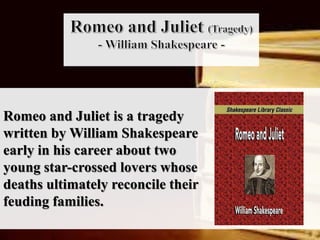
Romeo and Juliet is a tragedy
written by William Shakespeare
early in his career about two
young star-crossed lovers whose
deaths ultimately reconcile their
feuding families.
William Shakespeare created perhaps
the most famous archetypal lovers in
Romeo and Juliet. Their story is so
well known that the archetypal plot of
star-crossed lovers is named after this
prologue. However, Shakespeare was
certainly not the first person to write a
story about what we now call star-
Indeed, his play falls into the tradition of
tragic romances, and was based on a very
similar sixteenth century Italian story. Tragic
romances often concern lovers who are kept
or driven apart by obstacles outside of their
control.
The Catcher in the Rye is a 1951
novel by J. D. Salinger. A
controversial novel originally
published for adults, it has since
become popular with adolescent
readers for its themes of teenage
angst and alienation.
J.D. Salinger's The Catcher in the Rye, Holden
Caulfield recounts the days following his
expulsion from Pencey Prep, a private school.
After a fight with his roommate, Strad later,
Holden leaves school two days early to explore
New York before returning home, interacting
with teachers, prostitutes, nuns, an old girlfriend,
and his sister along the way. J.D. Salinger's
classic The Catcher in the Rye illustrates a
teenager's dramatic struggle against death and
Holden Caulfield, the protagonist of J.D.
Salinger’s The Catcher in the Rye, is noted for
being a rebel. Caulfield calls out “phonies” and
generally has contempt for many of what he
sees as society’s evils. Like Caulfield, rebel
characters often criticize problems in culture.
Some rebels attempt to change the culture, like
the real-life example of Che Guevara, while
others just reject it.
Almost all works of literature contain
examples of archetype. This is because
archetypes stem from cultural and
psychological myths that are universal or
nearly so. For example, the plot of a
character going on a quest is found in oral
storytelling traditions and works of literature
from around the world and from all time
Thus the “quest” plot is an archetype. Since
almost all types of plots and characters have
been codified into archetypes it is difficult, if
not impossible, to create a story without using
these long established symbols and patterns.
By trading in archetypes, authors help the
audience understand what the expectations
are for a certain type of story or character.
The author then doesn’t have to explain as
much, and when the author breaks from the
mold to some degree, that rupture will be all
the more intriguing to the reader.
Reference
Reine, M. (2015, May 8). Narratology/Archetypes by malory
reini on Prezi. Retrieved January 22, 2016, from
https://prezi.com/abjkll1agahk/narratologyarchetype
s/
Literary Devices. (2016). Archetype - Examples and
Definition of Archetype. Retrieved January 22, 2016,
from http://literarydevices.net/archetype/
Archetype Examples. (n.d.). Retrieved January 21st, 2016, from
http://examples.yourdictionary.com/archetype-
examples.html
LITERARY DEVICES. (2015). Archetype Examples and
Definition - Literary Devices. Retrieved January 22,
Narratology/Archetypes

Narratology/Archetypes

  • 1.
    Presented by: MariaKesia Navarro
  • 2.
    - Greek wordfor “origin” and “model” - refers to it as the first form for whatever else comes after it
  • 3.
    - It refersto a general character, trait or structure commonly held in a certain group or class ; it is an embodiment or example , a model with ideal features - It may be figure, representation, or symbol
  • 4.
    - As aliterary device, an archetype is a reoccurring symbol or motif throughout literature that represents universal patterns of human nature.
  • 5.
    - Narratology isthe literary theory that examines the ways that stories are structured and what characteristics stories have in common and what makes them different from one another.
  • 6.
    - A formof Structuralism that focuses on the structure of stories. Identifies 31 actions that a story can contain and claims all stories pick from this list. - Also focuses on the specific character types that are repeated within all stories—hero, villain, trickster, orphan, mentor etc.
  • 7.
    - Swiss psychologist,Carl Jung argued that the root of an archetype is in the “collective unconscious” of mankind.
  • 8.
    - refers toexperiences shared by a race or culture - includes love, religion, death, birth, life, struggle, survival etc.
  • 9.
    Joseph Campbell tookJung’s ideas and applied them to world mythologies. In A Hero with a Thousand Faces, among other works, he refined the concept of hero and the hero’s journey— George Lucas used Campbell’s writings to formulate the Star Wars saga.
  • 10.
    Recognizing archetypal patternsin literature brings patterns we all unconsciously respond to in similar ways to a conscious level.
  • 11.
    - Birth - Rebirth -Death - Power - Magic - Unity - The hero - The child - God - The demon - The old wise man - The earth mother - The animal
  • 12.
    Archetype can beapplied to: - image - theme - symbol - idea - character type - plot pattern
  • 13.
    Archetypes can beexpressed in: - myths - dreams - literature - religions - fantasies - folklores
  • 15.
    Aristotl e Aristotle’s poetics (c.330 BCE)are considered to be the first surviving philosophical exposition on literary theory.
  • 16.
    Vladimir Propp Narratology beganwith the Russian formalists particularly Vladimir Propp (Morphology of the Folktale, (1978).
  • 17.
    Vladimir Propp - Extendedthe Russian formalist approach to narratology (the study of narrative structure) - Develop a list of 31 functions or building blocks, that he found present within 100 Russian Folktales that
  • 18.
    Carl Jung Carl Jungunderstood archetypes as universal, archaic patterns and images that derive from the collective unconscious and are the psychic counterpart of instinct.
  • 19.
    Archetypal criticism isconcerned with the way cycles and reiterating patterns of tradition, culture, inborn images, and beliefs affect literary works. It operates with the idea that certain symbols represent the same ideas no matter the time or place.
  • 20.
    Authors focus onsymbols to utilize in literary works in order to strike readers’ unconscious. Such symbols recur often enough in literature to be recognizable as an element of one’s literary experience as a whole it also deals with symbolism of nature and the cosmos. There is universality in literature, anthropology,
  • 21.
    The use ofarchetypical characters and situations gives a literary work a universal acceptance, as readers identify the characters and situations in their social and cultural context. By using common archetype, the writers attempt to impart realism to their works, as the situations and characters are drawn from the experiences of the world.
  • 22.
    Anthropological and psychological studiesof the late 19th and early 20th century sparked the beginning of this criticism. Information provided from the findings of the past cultures influences many prominent writers.
  • 23.
    Also myths fromthe Greek and Roman eras were thought of as profound and as a result the desire to incorporate such ideas in writing was instigated. Archetypal Criticism came into prominence in the 1930’s and 1940’s, continued to flourish in 1950’s and 1960’s.
  • 24.
    Archetypal criticism focuseson certain symbols and their meanings. Almost all literature is written to convey events which mean something. Archetypal criticism looks for these meanings, as well as what the symbols in the story stand for.
  • 25.
    It acts asa powerful tool in teaching and in expressing universal feelings, beliefs, and ideas. Very closely linked with psychological theories and criticism. Explains why literature touches deep inside the heart of the reader.
  • 26.
    Many critics areleery of the actual value of the archetypal approach; they seem to think it is reductionistic, formulaic. It generally excludes other sources or criticisms. Others believe that literary individuality is ignored with so much emphasis on cycles and patterns. Not all literature contains symbolism; some is simply written for enjoyment.
  • 27.
    Some critics arguethe theory is unnecessary because archetypal approaches to literature can also be covered in psychology, anthropology, comparative religion, and other fields. Symbols can elicit multiple meanings; one might interpret a literary work that is entirely different from the author’s intentions. This criticism has been used less
  • 28.
    Hero: Martin LutherKing Jr., Mahatma Gandhi Rebel: Che Guevara, William Wallace Ruler: Napoleon, Genghis Khan Healer: Florence Nightingale, Mother Teresa
  • 29.
    Adventurer: Christopher Columbus, MarcoPolo Innocent: Anne Frank, Malala Musafzai Genius: Albert Einstein, Leonardo da Vinci Jester: Mark Twain, Charlie Chaplin Outlaw: Jesse James, Butch Cassidy
  • 30.
     Situation  Setting Symbolic  Character
  • 31.
     Battle ofGood and Evil - Good ultimately triumphs • Death and Rebirth - Shows the circle of life • Innate Wisdom vs. Educated Stupidity - A character will have intuition and knowledge that is better than those in charge
  • 32.
    • The Initiation- A character matures and takes responsibility • The Journey - The hero confronts trials along the way • The Magic Weapon - The hero has the ability to use this to be successful in the quest or to prove he or she is the chosen one
  • 33.
    • Nature vs.Mechanistic World - This has nature as being good and technology as bad • The Quest - The search for someone or something • The Task - Something that must be done
  • 34.
    • The Garden- Symbolizes love and fertility • The Forest - Can be a wild place with dangers and beasts. It can also be a place to reconnect with nature. • The River - Water symbolizes life and the river can show life’s journey or boundaries.
  • 35.
    • The Sea- Can be both good and evil, with dangers and treasures. It can also show infinity. • The Island - Symbolizes isolation • The Mountain - Climbing up can represent a spiritual journey.
  • 36.
    • The Wasteland- A place for cleansing and finding inner strength • The Tower - Represents worship or power • The Small Town - This is where everyone knows everyone and judges them, so it represents intolerance.
  • 37.
    • Light -Hope or renewal • Dark - Despair or ignorance • Water - Birth and life • Haven - Safety • Wilderness - Danger • Fire - Knowledge, rebirth • Ice - Death, ignorance • Black - Evil, mystery
  • 38.
    • Green -The earth, growth • White - Purity, peace, innocence • Three - Trinity; mind, body, spirit • Four - Seasons, elements • Square - Stability • Circle - Heaven, perfection, eternity
  • 39.
    • Spiral -Cosmic motion, growth • Clouds - Mystery • Crescent moon - Change • Lightning - Inspiration • Hourglass - Time passing • Heart – Love
  • 40.
    • The Bully- Intimidates others • The Creature of Nightmare - Threatens the hero’s life • The Damsel in Distress - The hero rescues her • The Devil Figure - Tempts the hero • Dreamer - Wants to be something else • The Evil Genius - Seeks revenge and hates all
  • 41.
    • Friendly Beast- Assists the hero • The Hero - Main character who may fulfill a task or bring justice • The Initiates - Need training to become heroes • Martyr - Willing to die for a cause • Mentors - Train and counsel the initiates
  • 42.
    • The Outcast- Exiled for a crime and becomes a wanderer • The Star-Crossed Lovers - The pair usually meet tragedy • Survivor - Never gives up and always pulls through • The Temptress - A beautiful woman who seduces the hero • Tyrant - Wants to be in charge • Wizard - Has special powers
  • 45.
    - is oneof two major ancient Greek epic poems attributed to Homer. - It is, in part, a sequel to the Iliad, the other work ascribed to Homer.
  • 47.
    In the excerptfrom Homer’s epic The Odyssey, the goddess Calypso addresses Odysseus as he’s about to set off on his quest. There are many thousands of stories based on the archetype of the quest, or journey, and The Odyssey is one of the most famous. Calypso foreshadows the difficulties that are present in this archetypal plot; the reader will know to expect the challenges that Odysseus later faces both because of this excerpt and because of the traditional
  • 49.
    Othello is atragedy by William Shakespeare, believed to have been written in 1603. It is based on the story Un Capitano Moro by Cinthio, a disciple of Boccaccio, first published in 1565.
  • 50.
    The play openswith Roderigo, a rich and dissolute gentleman, complaining to Iago, an ensign, that Iago has not told him about the secret marriage between Desdemona, the daughter of a Senator named Brabantio, and Othello, a Moorish general in the Venetian army.
  • 52.
    Iago is oneof the most famous villains in all of literature, and here we can see a good example of what makes him villainous. He is Othello’s closest confidant, and yet he acknowledges to Roderigo that he will only “follow [Othello] to serve my turn upon him.” The villain is often a manipulative character who can’t be trusted, and here
  • 54.
    Romeo and Julietis a tragedy written by William Shakespeare early in his career about two young star-crossed lovers whose deaths ultimately reconcile their feuding families.
  • 56.
    William Shakespeare createdperhaps the most famous archetypal lovers in Romeo and Juliet. Their story is so well known that the archetypal plot of star-crossed lovers is named after this prologue. However, Shakespeare was certainly not the first person to write a story about what we now call star-
  • 57.
    Indeed, his playfalls into the tradition of tragic romances, and was based on a very similar sixteenth century Italian story. Tragic romances often concern lovers who are kept or driven apart by obstacles outside of their control.
  • 59.
    The Catcher inthe Rye is a 1951 novel by J. D. Salinger. A controversial novel originally published for adults, it has since become popular with adolescent readers for its themes of teenage angst and alienation.
  • 60.
    J.D. Salinger's TheCatcher in the Rye, Holden Caulfield recounts the days following his expulsion from Pencey Prep, a private school. After a fight with his roommate, Strad later, Holden leaves school two days early to explore New York before returning home, interacting with teachers, prostitutes, nuns, an old girlfriend, and his sister along the way. J.D. Salinger's classic The Catcher in the Rye illustrates a teenager's dramatic struggle against death and
  • 62.
    Holden Caulfield, theprotagonist of J.D. Salinger’s The Catcher in the Rye, is noted for being a rebel. Caulfield calls out “phonies” and generally has contempt for many of what he sees as society’s evils. Like Caulfield, rebel characters often criticize problems in culture. Some rebels attempt to change the culture, like the real-life example of Che Guevara, while others just reject it.
  • 63.
    Almost all worksof literature contain examples of archetype. This is because archetypes stem from cultural and psychological myths that are universal or nearly so. For example, the plot of a character going on a quest is found in oral storytelling traditions and works of literature from around the world and from all time
  • 64.
    Thus the “quest”plot is an archetype. Since almost all types of plots and characters have been codified into archetypes it is difficult, if not impossible, to create a story without using these long established symbols and patterns.
  • 65.
    By trading inarchetypes, authors help the audience understand what the expectations are for a certain type of story or character. The author then doesn’t have to explain as much, and when the author breaks from the mold to some degree, that rupture will be all the more intriguing to the reader.
  • 66.
    Reference Reine, M. (2015,May 8). Narratology/Archetypes by malory reini on Prezi. Retrieved January 22, 2016, from https://prezi.com/abjkll1agahk/narratologyarchetype s/ Literary Devices. (2016). Archetype - Examples and Definition of Archetype. Retrieved January 22, 2016, from http://literarydevices.net/archetype/ Archetype Examples. (n.d.). Retrieved January 21st, 2016, from http://examples.yourdictionary.com/archetype- examples.html LITERARY DEVICES. (2015). Archetype Examples and Definition - Literary Devices. Retrieved January 22,