Chapter 6
HISTORY
Athena and Poseidon
Classical Mythology in Context
6.1 Head of Athena. Athena from Piraeus, detail of
a bronze statue. Classical Greek. Circa. 350 BCE.
Archaeological Museum, Piraeus, Greece. Marie
Mauzy / Art Resource, NY, ART392305.
Wisdom and War
• Athena’s favoritism towards men is
one of her defining traits
• She has traditional oversight of male
activities like farming, sailing, and
warfare
• Athena was born from Zeus’ skull,
and shares many of her traits with
him
• She is worshiped in cities, and has no
connection to nature or the natural
world
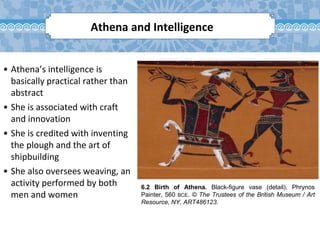
6.2 Birth of Athena. Black-figure vase (detail). Phrynos
Painter, 560 BCE. © The Trustees of the British Museum / Art
Resource, NY, ART486123.
Athena and Intelligence
• Athena’s intelligence is
basically practical rather than
abstract
• She is associated with craft
and innovation
• She is credited with inventing
the plough and the art of
shipbuilding
• She also oversees weaving, an
activity performed by both
men and women
Map 6.1 Athena in Greece
Athena
6.3 Athena studies the head of Medusa with Perseus. Detail from
an Apulian red-figure krater. Attributed to the Tarporley Painter, c.
400–385 BCE. Museum of Fine Arts, Boston, Massachusetts, USA /
Gift of Robert E. Hecht, Jr. / Bridgeman Images, BST 1121461.
Soldiers
• Athena was born wearing armor,
which presages her involvement in
war
• She oversees the martial arts-the
skills of warfare, as well a the
strategies of warfare
• She and Ares as associated with
completely different aspects of war
• She enables military success
through restraint, intelligence, and
craft
6.4 Athena constructing the Trojan Horse. Red-figured
Greek kylix (drinking cup). Sabouroff Painter, c. fifth
century BCE. Museo Archeologico, Florence, Italy. Scala /
Art Resource, NY, ART16611.
Heroes
• Athena is the patroness of
heroes, but Heracles and
Odysseus are her favorites
• Athena offers the practical
cleverness that allows heroes to
succeed at tasks where brute
strength is not enough
• She aids Odysseus in winning
the Trojan War, then in
returning safely to his home
6.5 Poseidon. Detail from an Attic red-figure
amphora from Etruria. Kleophrades Painter,
500–490 BCE. bpk, Berlin /
Antikensammlung, Staatliche Museen,
Berlin, Germany/Ingrid Geske- Heiden/ Art
Resource, NY, ART179889.
Poseidon
• Poseidon ruled the sea, the third of the earth
he won when he drew lots with his brothers
Zeus and Hades
• Poseidon is associated with horses as well, and
is sometimes credited with inventing the bridle
• He is most closely connected with elemental
forces like earthquakes and tidal waves
• Athena and Poseidon held a competition to
determine who would rule the city of Athens,
which highlights both their commonalities and
their differences
Map 6.2 Athena in Athens
The City of Athens
• Athena was worshiped in many
Greek cities, but her worship is
most developed in Athens
• She was represented in three
different forms on Athens’
Acropolis, and the Panathenaia
celebrated her and her victories
yearly
6.6 The preparation of wool and the weaving of cloth.
Black-figured lekythos (oil flask). Attributed to the Amasis
Painter, c. 550–530 BCE. Image copyright © The Metropolitan
Museum of Art. Image source: Art Resource, NY,
ART322634.
Weaving and the Women of Athens
• Greek women are typically associated with weaving,
one of their major tasks
• A peplos, a folded garment, was woven and
presented to Athena Polias at the Panathenaia
every year
• Women were recognized in the festival, but the
largest part of it celebrated the cunning and
intelligence that Athena offered men
6.7 Gaia (Ge) hands the baby Erichthonius/Erechtheus
Athena (standing). Red-figure kylix (drinking cup). Kod
Painter, c. 440–430 BCE. bpk, Berlin / Antikensammlung, Staatlic
Museen, Berlin, Germany/Johannes Laurentius/ Art Resource, N
ART300746.
The Origins of Athens
• In Athens’ myth of its
foundation, Athena gives birth
to a son, Erichthonius, who is
one of Athens’ first kings.
• Since he was born from the
earth, Athena remained a
virgin, and the role of women
in creation was obscured
• This emphasizes that men as
political beings are sufficient
without women’s participation
THEORY
Athena and Poseidon
Classical Mythology in Context
6.8 Pensive Athena. Marble votive
relief from the Acropolis. Circa 470–
450 BCE. Acropolis Museum,
Athens, Greece. Nimatallah / Art
Resource, NY, ART36206.
The Mind Structures Myths in Oppositions
• Greek myths share elements with dreams
• Psychologists have looked to myth to learn how the
human mind works and how experiences are
processed
• Sigmund Freud argued that myths express the fears
and wishes of a society
• Carl Jung argued that myths convey many messages,
not just hopes and fears
The Mind Structures Myths in Oppositions
• Claude Levi-Strauss, an anthropologist, was interested in how the human
mind structured experiences and then created similarly structured stories
and codes of behavior
• He argued that the human mind structures information in terms of
oppositions: night/day, male/female
• To understand myths one must look for the underlying opposition
• Breaking myths down into smaller units, mythemes, can aid in discovering
these oppositions and understanding the underlying social values of the
society which produced the myth
COMPARISON
Athena and Poseidon
Classical Mythology in Context
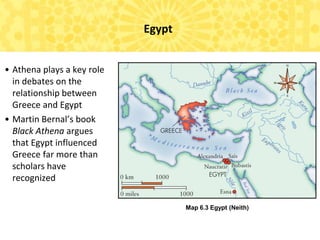
Map 6.3 Egypt (Neith)
Egypt
• Athena plays a key role
in debates on the
relationship between
Greece and Egypt
• Martin Bernal’s book
Black Athena argues
that Egypt influenced
Greece far more than
scholars have
recognized
6.9 Neith (left), wearing the
Red Crown. Wall painting,
Temple of Khnum, Esna, Egypt.
Jane Taylor / The Art Archive at
Art Resource, NY, AR9151364.
Athena and Neith
• In the Archaic Period, the Egyptian king
Psammetichus I employed Greek mercenaries to
reunify Upper and Lower Egypt
• He later settled them in Egypt in return for their
service
• Most interaction between Greece and Egypt revolved
around trade, and was centered in Naucratis, a Greek
colony in Lower Egypt
• The Egyptians seem to have closely regulated and
restricted contact between Egyptians and Greeks
• In the Histories, Herodotus describes the worship of
Neith and equates her to Athena
Athena and Neith
• Neith is depicted as the protector of Lower Egypt and its king
• She protects the king on his journey to the realm of the dead and is also
the protector of Osiris
• She also seems to have been associated with weaving, particularly
wrappings for the dead
• She is worshiped with a lamplight festival that celebrates her creation of
the world
• Herodotus treated the similarities between the two as evidence that they
were the same goddess
• Whether Neith had influence on the development of the attributes of
Athena is still questioned
RECEPTION
Athena and Poseidon
Classical Mythology in Context
6.10 Eugene Delacroix, Liberty Leading the
People (1830). Oil on canvas. Louvre Museum,
Paris, France. Erich Lessing / Art Resource, NY,
ART76327.
Athena as a Political Allegory
• Athena was a political, military, and
unifying goddess and a symbol for
the Athenian state
• Female figures modeled on her have
served similar roles for modern
nations
• Both Marianne in France and the
Statue of Liberty in America are
allegories for abstract political
values, and can be traced back to
Athena
• Since abstract concepts tend to be
female nouns, Athena is uniquely
suited to representing them
6.11 François-Charles Morice and
Léopold Morice, Statue of the
Republic (1879). Place de la
République, Paris, France. Agencja
Fotograficzna Caro/Alamy, CRFH69.
Athena as a Political Allegory
• Athena inspired two political allegories in
France: Liberte and Marianne
• Marianne was designed to represent the French
Republic, and stood for liberty
• Liberte, also a woman, is depicted as more
active and martial
• She is dressed as a commoner rather than in
Classical garb, and is more unrestrained and
fearless
6.12 Frédéric Bartholdi, Statue of Liberty (Liberty Enlightening the
World) (1876–1886). Liberty Island. New York, NY. © DeA Picture Library /
Art Resource, NY, ART341305.
• The Statue of Liberty recalls both Marianne and
Athena, representing both liberty and reason
• The statue’s meaning has shifted to a
celebration of the American experience as
‘mother of exiles’
• Her role as the virgin mother of immigrants
marks her similarity to the role Athena played
for Athens
Athena as a Political Allegory

Maurizio chapter 6 slides

  • 1.
  • 2.
  • 3.
    6.1 Head ofAthena. Athena from Piraeus, detail of a bronze statue. Classical Greek. Circa. 350 BCE. Archaeological Museum, Piraeus, Greece. Marie Mauzy / Art Resource, NY, ART392305. Wisdom and War • Athena’s favoritism towards men is one of her defining traits • She has traditional oversight of male activities like farming, sailing, and warfare • Athena was born from Zeus’ skull, and shares many of her traits with him • She is worshiped in cities, and has no connection to nature or the natural world
  • 4.
    6.2 Birth ofAthena. Black-figure vase (detail). Phrynos Painter, 560 BCE. © The Trustees of the British Museum / Art Resource, NY, ART486123. Athena and Intelligence • Athena’s intelligence is basically practical rather than abstract • She is associated with craft and innovation • She is credited with inventing the plough and the art of shipbuilding • She also oversees weaving, an activity performed by both men and women
  • 5.
    Map 6.1 Athenain Greece Athena
  • 6.
    6.3 Athena studiesthe head of Medusa with Perseus. Detail from an Apulian red-figure krater. Attributed to the Tarporley Painter, c. 400–385 BCE. Museum of Fine Arts, Boston, Massachusetts, USA / Gift of Robert E. Hecht, Jr. / Bridgeman Images, BST 1121461. Soldiers • Athena was born wearing armor, which presages her involvement in war • She oversees the martial arts-the skills of warfare, as well a the strategies of warfare • She and Ares as associated with completely different aspects of war • She enables military success through restraint, intelligence, and craft
  • 7.
    6.4 Athena constructingthe Trojan Horse. Red-figured Greek kylix (drinking cup). Sabouroff Painter, c. fifth century BCE. Museo Archeologico, Florence, Italy. Scala / Art Resource, NY, ART16611. Heroes • Athena is the patroness of heroes, but Heracles and Odysseus are her favorites • Athena offers the practical cleverness that allows heroes to succeed at tasks where brute strength is not enough • She aids Odysseus in winning the Trojan War, then in returning safely to his home
  • 8.
    6.5 Poseidon. Detailfrom an Attic red-figure amphora from Etruria. Kleophrades Painter, 500–490 BCE. bpk, Berlin / Antikensammlung, Staatliche Museen, Berlin, Germany/Ingrid Geske- Heiden/ Art Resource, NY, ART179889. Poseidon • Poseidon ruled the sea, the third of the earth he won when he drew lots with his brothers Zeus and Hades • Poseidon is associated with horses as well, and is sometimes credited with inventing the bridle • He is most closely connected with elemental forces like earthquakes and tidal waves • Athena and Poseidon held a competition to determine who would rule the city of Athens, which highlights both their commonalities and their differences
  • 9.
    Map 6.2 Athenain Athens The City of Athens • Athena was worshiped in many Greek cities, but her worship is most developed in Athens • She was represented in three different forms on Athens’ Acropolis, and the Panathenaia celebrated her and her victories yearly
  • 10.
    6.6 The preparationof wool and the weaving of cloth. Black-figured lekythos (oil flask). Attributed to the Amasis Painter, c. 550–530 BCE. Image copyright © The Metropolitan Museum of Art. Image source: Art Resource, NY, ART322634. Weaving and the Women of Athens • Greek women are typically associated with weaving, one of their major tasks • A peplos, a folded garment, was woven and presented to Athena Polias at the Panathenaia every year • Women were recognized in the festival, but the largest part of it celebrated the cunning and intelligence that Athena offered men
  • 11.
    6.7 Gaia (Ge)hands the baby Erichthonius/Erechtheus Athena (standing). Red-figure kylix (drinking cup). Kod Painter, c. 440–430 BCE. bpk, Berlin / Antikensammlung, Staatlic Museen, Berlin, Germany/Johannes Laurentius/ Art Resource, N ART300746. The Origins of Athens • In Athens’ myth of its foundation, Athena gives birth to a son, Erichthonius, who is one of Athens’ first kings. • Since he was born from the earth, Athena remained a virgin, and the role of women in creation was obscured • This emphasizes that men as political beings are sufficient without women’s participation
  • 12.
  • 13.
    6.8 Pensive Athena.Marble votive relief from the Acropolis. Circa 470– 450 BCE. Acropolis Museum, Athens, Greece. Nimatallah / Art Resource, NY, ART36206. The Mind Structures Myths in Oppositions • Greek myths share elements with dreams • Psychologists have looked to myth to learn how the human mind works and how experiences are processed • Sigmund Freud argued that myths express the fears and wishes of a society • Carl Jung argued that myths convey many messages, not just hopes and fears
  • 14.
    The Mind StructuresMyths in Oppositions • Claude Levi-Strauss, an anthropologist, was interested in how the human mind structured experiences and then created similarly structured stories and codes of behavior • He argued that the human mind structures information in terms of oppositions: night/day, male/female • To understand myths one must look for the underlying opposition • Breaking myths down into smaller units, mythemes, can aid in discovering these oppositions and understanding the underlying social values of the society which produced the myth
  • 15.
  • 16.
    Map 6.3 Egypt(Neith) Egypt • Athena plays a key role in debates on the relationship between Greece and Egypt • Martin Bernal’s book Black Athena argues that Egypt influenced Greece far more than scholars have recognized
  • 17.
    6.9 Neith (left),wearing the Red Crown. Wall painting, Temple of Khnum, Esna, Egypt. Jane Taylor / The Art Archive at Art Resource, NY, AR9151364. Athena and Neith • In the Archaic Period, the Egyptian king Psammetichus I employed Greek mercenaries to reunify Upper and Lower Egypt • He later settled them in Egypt in return for their service • Most interaction between Greece and Egypt revolved around trade, and was centered in Naucratis, a Greek colony in Lower Egypt • The Egyptians seem to have closely regulated and restricted contact between Egyptians and Greeks • In the Histories, Herodotus describes the worship of Neith and equates her to Athena
  • 18.
    Athena and Neith •Neith is depicted as the protector of Lower Egypt and its king • She protects the king on his journey to the realm of the dead and is also the protector of Osiris • She also seems to have been associated with weaving, particularly wrappings for the dead • She is worshiped with a lamplight festival that celebrates her creation of the world • Herodotus treated the similarities between the two as evidence that they were the same goddess • Whether Neith had influence on the development of the attributes of Athena is still questioned
  • 19.
  • 20.
    6.10 Eugene Delacroix,Liberty Leading the People (1830). Oil on canvas. Louvre Museum, Paris, France. Erich Lessing / Art Resource, NY, ART76327. Athena as a Political Allegory • Athena was a political, military, and unifying goddess and a symbol for the Athenian state • Female figures modeled on her have served similar roles for modern nations • Both Marianne in France and the Statue of Liberty in America are allegories for abstract political values, and can be traced back to Athena • Since abstract concepts tend to be female nouns, Athena is uniquely suited to representing them
  • 21.
    6.11 François-Charles Moriceand Léopold Morice, Statue of the Republic (1879). Place de la République, Paris, France. Agencja Fotograficzna Caro/Alamy, CRFH69. Athena as a Political Allegory • Athena inspired two political allegories in France: Liberte and Marianne • Marianne was designed to represent the French Republic, and stood for liberty • Liberte, also a woman, is depicted as more active and martial • She is dressed as a commoner rather than in Classical garb, and is more unrestrained and fearless
  • 22.
    6.12 Frédéric Bartholdi,Statue of Liberty (Liberty Enlightening the World) (1876–1886). Liberty Island. New York, NY. © DeA Picture Library / Art Resource, NY, ART341305. • The Statue of Liberty recalls both Marianne and Athena, representing both liberty and reason • The statue’s meaning has shifted to a celebration of the American experience as ‘mother of exiles’ • Her role as the virgin mother of immigrants marks her similarity to the role Athena played for Athens Athena as a Political Allegory