Chapter 7
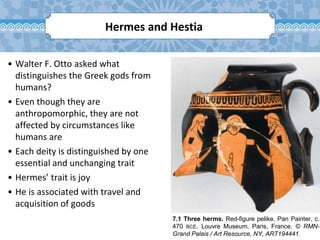
7.1 Three herms. Red-figure pelike. Pan Painter, c.
470 BCE. Louvre Museum, Paris, France. © RMN-
Grand Palais / Art Resource, NY, ART194441.
Hermes and Hestia
• Walter F. Otto asked what
distinguishes the Greek gods from
humans?
• Even though they are
anthropomorphic, they are not
affected by circumstances like
humans are
• Each deity is distinguished by one
essential and unchanging trait
• Hermes’ trait is joy
• He is associated with travel and
acquisition of goods
HISTORY
Hermes and Hestia
Classical Mythology in Context
7.2 Hermes with winged sandals, cap, and wand.
Red-figured lekythos (oil flask). Attributed to the
Tithonus Painter, c. 480–470 BCE. Image copyright
© The Metropolitan Museum of Art. Image source:
Art Resource, NY, ART414543.
For Herms to Hermes
• Hermes was sometimes represented as a fully human man,
but also as a statue
• The Herms were square stone pillars featuring a bearded head
and a phallus
• They were thought to derive from piles of rocks called
‘Hermes’s hills’
• Hermes was honored by the Greeks for making roads safe for
travelers
• Hermes is also frequently depicted as the messenger of the
gods
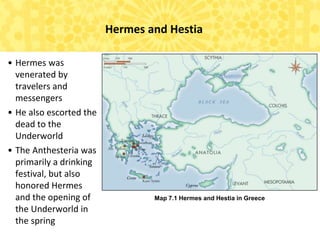
Map 7.1 Hermes and Hestia in Greece
Hermes and Hestia
• Hermes was
venerated by
travelers and
messengers
• He also escorted the
dead to the
Underworld
• The Anthesteria was
primarily a drinking
festival, but also
honored Hermes
and the opening of
the Underworld in
the spring
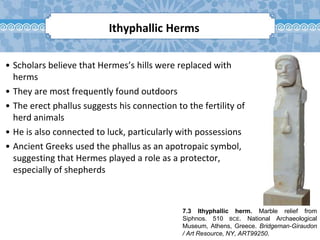
7.3 Ithyphallic herm. Marble relief from
Siphnos. 510 BCE. National Archaeological
Museum, Athens, Greece. Bridgeman-Giraudon
/ Art Resource, NY, ART99250.
Ithyphallic Herms
• Scholars believe that Hermes’s hills were replaced with
herms
• They are most frequently found outdoors
• The erect phallus suggests his connection to the fertility of
herd animals
• He is also connected to luck, particularly with possessions
• Ancient Greeks used the phallus as an apotropaic symbol,
suggesting that Hermes played a role as a protector,
especially of shepherds
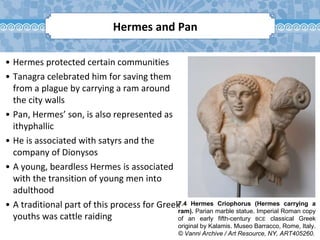
7.4 Hermes Criophorus (Hermes carrying a
ram). Parian marble statue. Imperial Roman copy
of an early fifth-century BCE classical Greek
original by Kalamis. Museo Barracco, Rome, Italy.
© Vanni Archive / Art Resource, NY, ART405260.
Hermes and Pan
• Hermes protected certain communities
• Tanagra celebrated him for saving them
from a plague by carrying a ram around
the city walls
• Pan, Hermes’ son, is also represented as
ithyphallic
• He is associated with satyrs and the
company of Dionysos
• A young, beardless Hermes is associated
with the transition of young men into
adulthood
• A traditional part of this process for Greek
youths was cattle raiding
7.5 Hestia, Greek goddess of the
hearth. Detail from a red-figure kylix.
Circa sixth century BCE. Archaeological
Museum, Tarquinia, Italy. Gianni Dagli
Orti / The Art Archive at Art Resource,
NY, AA389250.
Hestia
• In many ways, Hestia was Hermes’s opposite
• She was the firstborn child of Cronus and Rhea,
but has almost no temples, rituals, or cult
shrines in her honor
• She is an eternal virgin, associated with the
hearth and fire, and therefore worshiped in the
home
• Her name means hearth
• She represented the fixed center of home and
family, in opposition to Hermes’s constant
traveling
THEORY
Hermes and Hestia
Classical Mythology in Context
7.6 Hermes Trismegistus. Detail of a
marble pavement. Giovanni di Stefano
da Siena, 1488. Duomo, Sienna, Italy.
Scala / Art Resource, NY, ART22288.
The Mind Structures Myths in Archetypes
• ‘Trickster’ is a designation for a certain kind of
character found in myths and folktales
• It is linked to Carl Jung’s concept of archetypes,
which, he argued, were generated by a
“collective unconscious”-shared mental models
that all people use to make meaning out of
their experiences
• The shadow has socially unacceptable
responses to social demands, and often has
characteristics that society does not value
• The shadow can either be frightening, or it can
be a benign figure who expresses antisocial
behavior with humor
The Mind Structures Myths in Archetypes
• Most scholars no longer accept Jung’s idea of the collective unconscious
• When they study archetypes, they catalogue the traits they exhibit
• Traits of trickster figures include:
• Mockery of social, religious, or political laws or institutions
• They disrupt situations, sometimes for their benefit but sometimes to
their detriment
• They have the ability to change form
• They exhibit creativity and boundless energy
• They are often cultural heroes to humans
• Because of their role in questioning social customs and laws, they are often
also the heroes of marginalized or powerless groups within society
COMPARISON
Hermes and Hestia
Classical Mythology in Context
Thoth and Hermes Trismegistus
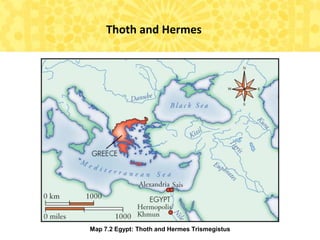
• The Greeks liked to draw connections between their deities and those of
their neighbors, as with Athena and Neith
• Hermes was frequently identified with the Egyptian god Thoth
• Over time, they fused the two and developed a new deity, Hermes
Trismegistus (Thrice-Blessed)
• Hermes Trismegistus became a vehicle through which pagans articulated
abstract, philosophical arguments about the nature of divinity
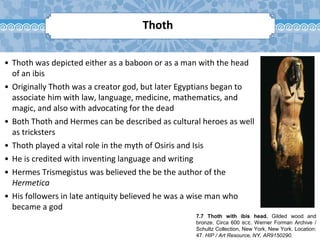
7.7 Thoth with ibis head. Gilded wood and
bronze. Circa 600 BCE. Werner Forman Archive /
Schultz Collection, New York, New York. Location:
47. HIP / Art Resource, NY, AR9150290.
Thoth
• Thoth was depicted either as a baboon or as a man with the head
of an ibis
• Originally Thoth was a creator god, but later Egyptians began to
associate him with law, language, medicine, mathematics, and
magic, and also with advocating for the dead
• Both Thoth and Hermes can be described as cultural heroes as well
as tricksters
• Thoth played a vital role in the myth of Osiris and Isis
• He is credited with inventing language and writing
• Hermes Trismegistus was believed the be the author of the
Hermetica
• His followers in late antiquity believed he was a wise man who
became a god
Map 7.2 Egypt: Thoth and Hermes Trismegistus
Thoth and Hermes
RECEPTION
Hermes and Hestia
Classical Mythology in Context
7.8 Sleeping Hermaphroditus. Marble. Roman copy of a
Greek original, second half of the second century BCE.
Louvre Museum, Paris, France. © RMN-Grand Palais / Art
Resource, NY, ART434602.
Hermaphroditus in Pre-Raphaelite Art
• Hermaphroditus, the son of Hermes and
Aphrodite, was also a trickster figure
• He was both male and female
• Associated with fertility and sexual
abundance
• In Ovid’s Metamorphosis he is described
as having merged with the nymph
Salmacis, and therefore has both male
and female sexual organs
• Poet Charles Algernon Swinburne uses a fascination with the Sleeping
Hermaphroditus to question normal ideas of sexual difference and identity
• The Pre-Raphaelites were a group of artists in Victorian England who questioned exis
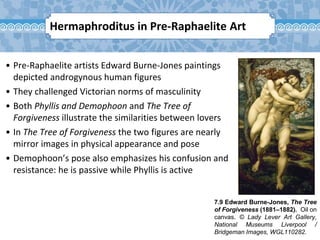
7.9 Edward Burne-Jones, The Tree
of Forgiveness (1881–1882). Oil on
canvas. © Lady Lever Art Gallery,
National Museums Liverpool /
Bridgeman Images, WGL110282.
• Pre-Raphaelite artists Edward Burne-Jones paintings
depicted androgynous human figures
• They challenged Victorian norms of masculinity
• Both Phyllis and Demophoon and The Tree of
Forgiveness illustrate the similarities between lovers
• In The Tree of Forgiveness the two figures are nearly
mirror images in physical appearance and pose
• Demophoon’s pose also emphasizes his confusion and
resistance: he is passive while Phyllis is active
Hermaphroditus in Pre-Raphaelite Art
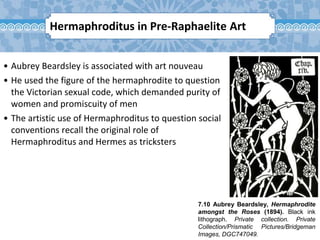
7.10 Aubrey Beardsley, Hermaphrodite
amongst the Roses (1894). Black ink
lithograph. Private collection. Private
Collection/Prismatic Pictures/Bridgeman
Images, DGC747049.
• Aubrey Beardsley is associated with art nouveau
• He used the figure of the hermaphrodite to question
the Victorian sexual code, which demanded purity of
women and promiscuity of men
• The artistic use of Hermaphroditus to question social
conventions recall the original role of
Hermaphroditus and Hermes as tricksters
Hermaphroditus in Pre-Raphaelite Art

Maurizio chapter 7 slides

  • 1.
  • 2.
    7.1 Three herms.Red-figure pelike. Pan Painter, c. 470 BCE. Louvre Museum, Paris, France. © RMN- Grand Palais / Art Resource, NY, ART194441. Hermes and Hestia • Walter F. Otto asked what distinguishes the Greek gods from humans? • Even though they are anthropomorphic, they are not affected by circumstances like humans are • Each deity is distinguished by one essential and unchanging trait • Hermes’ trait is joy • He is associated with travel and acquisition of goods
  • 3.
  • 4.
    7.2 Hermes withwinged sandals, cap, and wand. Red-figured lekythos (oil flask). Attributed to the Tithonus Painter, c. 480–470 BCE. Image copyright © The Metropolitan Museum of Art. Image source: Art Resource, NY, ART414543. For Herms to Hermes • Hermes was sometimes represented as a fully human man, but also as a statue • The Herms were square stone pillars featuring a bearded head and a phallus • They were thought to derive from piles of rocks called ‘Hermes’s hills’ • Hermes was honored by the Greeks for making roads safe for travelers • Hermes is also frequently depicted as the messenger of the gods
  • 5.
    Map 7.1 Hermesand Hestia in Greece Hermes and Hestia • Hermes was venerated by travelers and messengers • He also escorted the dead to the Underworld • The Anthesteria was primarily a drinking festival, but also honored Hermes and the opening of the Underworld in the spring
  • 6.
    7.3 Ithyphallic herm.Marble relief from Siphnos. 510 BCE. National Archaeological Museum, Athens, Greece. Bridgeman-Giraudon / Art Resource, NY, ART99250. Ithyphallic Herms • Scholars believe that Hermes’s hills were replaced with herms • They are most frequently found outdoors • The erect phallus suggests his connection to the fertility of herd animals • He is also connected to luck, particularly with possessions • Ancient Greeks used the phallus as an apotropaic symbol, suggesting that Hermes played a role as a protector, especially of shepherds
  • 7.
    7.4 Hermes Criophorus(Hermes carrying a ram). Parian marble statue. Imperial Roman copy of an early fifth-century BCE classical Greek original by Kalamis. Museo Barracco, Rome, Italy. © Vanni Archive / Art Resource, NY, ART405260. Hermes and Pan • Hermes protected certain communities • Tanagra celebrated him for saving them from a plague by carrying a ram around the city walls • Pan, Hermes’ son, is also represented as ithyphallic • He is associated with satyrs and the company of Dionysos • A young, beardless Hermes is associated with the transition of young men into adulthood • A traditional part of this process for Greek youths was cattle raiding
  • 8.
    7.5 Hestia, Greekgoddess of the hearth. Detail from a red-figure kylix. Circa sixth century BCE. Archaeological Museum, Tarquinia, Italy. Gianni Dagli Orti / The Art Archive at Art Resource, NY, AA389250. Hestia • In many ways, Hestia was Hermes’s opposite • She was the firstborn child of Cronus and Rhea, but has almost no temples, rituals, or cult shrines in her honor • She is an eternal virgin, associated with the hearth and fire, and therefore worshiped in the home • Her name means hearth • She represented the fixed center of home and family, in opposition to Hermes’s constant traveling
  • 9.
  • 10.
    7.6 Hermes Trismegistus.Detail of a marble pavement. Giovanni di Stefano da Siena, 1488. Duomo, Sienna, Italy. Scala / Art Resource, NY, ART22288. The Mind Structures Myths in Archetypes • ‘Trickster’ is a designation for a certain kind of character found in myths and folktales • It is linked to Carl Jung’s concept of archetypes, which, he argued, were generated by a “collective unconscious”-shared mental models that all people use to make meaning out of their experiences • The shadow has socially unacceptable responses to social demands, and often has characteristics that society does not value • The shadow can either be frightening, or it can be a benign figure who expresses antisocial behavior with humor
  • 11.
    The Mind StructuresMyths in Archetypes • Most scholars no longer accept Jung’s idea of the collective unconscious • When they study archetypes, they catalogue the traits they exhibit • Traits of trickster figures include: • Mockery of social, religious, or political laws or institutions • They disrupt situations, sometimes for their benefit but sometimes to their detriment • They have the ability to change form • They exhibit creativity and boundless energy • They are often cultural heroes to humans • Because of their role in questioning social customs and laws, they are often also the heroes of marginalized or powerless groups within society
  • 12.
  • 13.
    Thoth and HermesTrismegistus • The Greeks liked to draw connections between their deities and those of their neighbors, as with Athena and Neith • Hermes was frequently identified with the Egyptian god Thoth • Over time, they fused the two and developed a new deity, Hermes Trismegistus (Thrice-Blessed) • Hermes Trismegistus became a vehicle through which pagans articulated abstract, philosophical arguments about the nature of divinity
  • 14.
    7.7 Thoth withibis head. Gilded wood and bronze. Circa 600 BCE. Werner Forman Archive / Schultz Collection, New York, New York. Location: 47. HIP / Art Resource, NY, AR9150290. Thoth • Thoth was depicted either as a baboon or as a man with the head of an ibis • Originally Thoth was a creator god, but later Egyptians began to associate him with law, language, medicine, mathematics, and magic, and also with advocating for the dead • Both Thoth and Hermes can be described as cultural heroes as well as tricksters • Thoth played a vital role in the myth of Osiris and Isis • He is credited with inventing language and writing • Hermes Trismegistus was believed the be the author of the Hermetica • His followers in late antiquity believed he was a wise man who became a god
  • 15.
    Map 7.2 Egypt:Thoth and Hermes Trismegistus Thoth and Hermes
  • 16.
  • 17.
    7.8 Sleeping Hermaphroditus.Marble. Roman copy of a Greek original, second half of the second century BCE. Louvre Museum, Paris, France. © RMN-Grand Palais / Art Resource, NY, ART434602. Hermaphroditus in Pre-Raphaelite Art • Hermaphroditus, the son of Hermes and Aphrodite, was also a trickster figure • He was both male and female • Associated with fertility and sexual abundance • In Ovid’s Metamorphosis he is described as having merged with the nymph Salmacis, and therefore has both male and female sexual organs • Poet Charles Algernon Swinburne uses a fascination with the Sleeping Hermaphroditus to question normal ideas of sexual difference and identity • The Pre-Raphaelites were a group of artists in Victorian England who questioned exis
  • 18.
    7.9 Edward Burne-Jones,The Tree of Forgiveness (1881–1882). Oil on canvas. © Lady Lever Art Gallery, National Museums Liverpool / Bridgeman Images, WGL110282. • Pre-Raphaelite artists Edward Burne-Jones paintings depicted androgynous human figures • They challenged Victorian norms of masculinity • Both Phyllis and Demophoon and The Tree of Forgiveness illustrate the similarities between lovers • In The Tree of Forgiveness the two figures are nearly mirror images in physical appearance and pose • Demophoon’s pose also emphasizes his confusion and resistance: he is passive while Phyllis is active Hermaphroditus in Pre-Raphaelite Art
  • 19.
    7.10 Aubrey Beardsley,Hermaphrodite amongst the Roses (1894). Black ink lithograph. Private collection. Private Collection/Prismatic Pictures/Bridgeman Images, DGC747049. • Aubrey Beardsley is associated with art nouveau • He used the figure of the hermaphrodite to question the Victorian sexual code, which demanded purity of women and promiscuity of men • The artistic use of Hermaphroditus to question social conventions recall the original role of Hermaphroditus and Hermes as tricksters Hermaphroditus in Pre-Raphaelite Art