Name: Drashti P. Nagla
Roll No. : 9
Paper no : 7 Literary theory and Criticism
Presentation topic:
Describe the characters and
situation/symbols in Archetypal criticism
Enrolment no: 2069108420170021
M.A English semester – 2
Beach year : 2016-18
Submitted to –
Department of English
Maharaja Krishnakumarsinhji
Bhavnagar University
“ In literary criticism the term
Archetypal denotes recurrent
narrative Designs, patterns of
action, character- types,
themes, and images which are
identifiable in a wide variety of
works of literature, as well as in
myths, dreams, and even social
rituals.”
Northrop Frye
What is Archetypal Criticism?
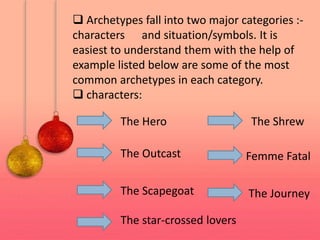
 Archetypes fall into two major categories :-
characters and situation/symbols. It is
easiest to understand them with the help of
example listed below are some of the most
common archetypes in each category.
 characters:
The Hero
The Outcast
The Scapegoat
The star-crossed lovers
The Shrew
Femme Fatal
The Journey
 The Hero:
The Courageous figure, the one who’s always
running in and saving the day. Ex. Dartognon from Alexander
Dumas’s “The three Musketeers” (Hamlet, Macbeth, Tom
Jones, Moll Flanders).
 The Outcast:
The outcast is just that. He or she has been cast
and of society or has left it on a voluntary basis. The outcast
figure can of ten times also be considered as a Christ figure.
Ex. Simon from William Golding’s “The lord of the Flies”
(pandavs-ram-sita-laxman- sugreve, Duke,Orlando,Rosalind in
“ AS You Like It”, Tramps in Godot)
 The scapegoat:
The scapegoat figure is the one who gets
blamed for everything, regardless of wether he or she is
actually fault. Ex. Snowball from George Orwell’s “Animal
Farm.”
 The star-crossed lovers:
this is the young couple joined by love
but unexpectedly parted by fate. Ex. Romeo and Juliet from
William Shakespeare.
 The shrew:
This is that nagging, bothersome wife always
battering her husband with verbal abuse. Ex. Zeena from
Edith wharton’s “ Ethan Frome”
 Femme Fatale:
A female character type who brings upon
catastrophic and disastrous events. Eve from the story of
Genesis or Pandord from Greek mytholigy are two such
figures. Sita, Draupadi and Surparnakha.
` The Journey:
A narrative archetype where the protagonist
must overcome a series of obstacles before reaching his or
her goal. The quintessential journey archetype in western
culture is arguably. Ex. Homer’s Odyssey.
 Archetypal symbols very more than Archetype
narrative or character types, but any symbol with deep
roots in a culture’s mythology, such as the forbidden fruit
in Genesis or even the poison apple in Snow White, is an
example of a symbol that resonates to Archetypal critics.
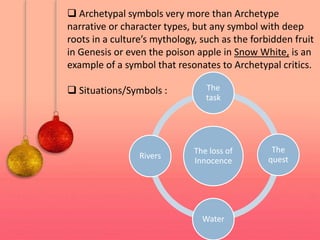
 Situations/Symbols :
The loss of
Innocence
The
task
The
quest
Water
Rivers
• The Task:
A situation in which a character, or group of
characters, is driven to complete some duty of
monstrous proposition. Ex. Frodo's task to keep
the ring safe in J. R. R. Tolkien's “ The lord of the
rings” trilogy .Kurukshetra’s battle for Arjun.
• The Quest:
Here, the characters are searching for
something, weather consciously or unconsciously.
Their actions, thoughts, and feelings center
around the goal of completing this quest. Ex.
Christian's quest for salvation in John Bunyan’s “
The Pilgrim’s Progress”. ( also a search for sita, Nal
– Damyanti, savitri for satyakam’s life, Shakuntala
in Kalidas).
o Water:
Water is a symbol of life , cleansing, and rebirth. It is a
strong life force , and is often depicted as a living, reasoning
force. Birth – death – resurrection , creation, purification and
redemption, fertility and growth. Sea/ocean: the mother of all
life, spiritual mystery, death and/or rebirth, timelessness and
eternity.
o River:
Death and rebirth (baptism): the flowing of time into
eternity, transitional phases of the life cycle. Ex. Edna learns to
swim in Kate Chopin’s “ The Awakening”. { Water movie and
novel by Bapsi Sidhawa, death by water, polluted river in waste
land. }
o The loss of Innocence:
This is, as the name implies, a loss of innocence
through sexual experience, violence, or any other means.
Ex. Moll, Tom, Tess, these are characters who loss their
innocence through sexual experience.
Archetypal Criticism

Archetypal Criticism

  • 2.
    Name: Drashti P.Nagla Roll No. : 9 Paper no : 7 Literary theory and Criticism Presentation topic: Describe the characters and situation/symbols in Archetypal criticism Enrolment no: 2069108420170021 M.A English semester – 2 Beach year : 2016-18 Submitted to – Department of English Maharaja Krishnakumarsinhji Bhavnagar University
  • 3.
    “ In literarycriticism the term Archetypal denotes recurrent narrative Designs, patterns of action, character- types, themes, and images which are identifiable in a wide variety of works of literature, as well as in myths, dreams, and even social rituals.” Northrop Frye What is Archetypal Criticism?
  • 4.
     Archetypes fallinto two major categories :- characters and situation/symbols. It is easiest to understand them with the help of example listed below are some of the most common archetypes in each category.  characters: The Hero The Outcast The Scapegoat The star-crossed lovers The Shrew Femme Fatal The Journey
  • 5.
     The Hero: TheCourageous figure, the one who’s always running in and saving the day. Ex. Dartognon from Alexander Dumas’s “The three Musketeers” (Hamlet, Macbeth, Tom Jones, Moll Flanders).  The Outcast: The outcast is just that. He or she has been cast and of society or has left it on a voluntary basis. The outcast figure can of ten times also be considered as a Christ figure. Ex. Simon from William Golding’s “The lord of the Flies” (pandavs-ram-sita-laxman- sugreve, Duke,Orlando,Rosalind in “ AS You Like It”, Tramps in Godot)  The scapegoat: The scapegoat figure is the one who gets blamed for everything, regardless of wether he or she is actually fault. Ex. Snowball from George Orwell’s “Animal Farm.”
  • 6.
     The star-crossedlovers: this is the young couple joined by love but unexpectedly parted by fate. Ex. Romeo and Juliet from William Shakespeare.  The shrew: This is that nagging, bothersome wife always battering her husband with verbal abuse. Ex. Zeena from Edith wharton’s “ Ethan Frome”  Femme Fatale: A female character type who brings upon catastrophic and disastrous events. Eve from the story of Genesis or Pandord from Greek mytholigy are two such figures. Sita, Draupadi and Surparnakha. ` The Journey: A narrative archetype where the protagonist must overcome a series of obstacles before reaching his or her goal. The quintessential journey archetype in western culture is arguably. Ex. Homer’s Odyssey.
  • 7.
     Archetypal symbolsvery more than Archetype narrative or character types, but any symbol with deep roots in a culture’s mythology, such as the forbidden fruit in Genesis or even the poison apple in Snow White, is an example of a symbol that resonates to Archetypal critics.  Situations/Symbols : The loss of Innocence The task The quest Water Rivers
  • 8.
    • The Task: Asituation in which a character, or group of characters, is driven to complete some duty of monstrous proposition. Ex. Frodo's task to keep the ring safe in J. R. R. Tolkien's “ The lord of the rings” trilogy .Kurukshetra’s battle for Arjun. • The Quest: Here, the characters are searching for something, weather consciously or unconsciously. Their actions, thoughts, and feelings center around the goal of completing this quest. Ex. Christian's quest for salvation in John Bunyan’s “ The Pilgrim’s Progress”. ( also a search for sita, Nal – Damyanti, savitri for satyakam’s life, Shakuntala in Kalidas).
  • 9.
    o Water: Water isa symbol of life , cleansing, and rebirth. It is a strong life force , and is often depicted as a living, reasoning force. Birth – death – resurrection , creation, purification and redemption, fertility and growth. Sea/ocean: the mother of all life, spiritual mystery, death and/or rebirth, timelessness and eternity. o River: Death and rebirth (baptism): the flowing of time into eternity, transitional phases of the life cycle. Ex. Edna learns to swim in Kate Chopin’s “ The Awakening”. { Water movie and novel by Bapsi Sidhawa, death by water, polluted river in waste land. } o The loss of Innocence: This is, as the name implies, a loss of innocence through sexual experience, violence, or any other means. Ex. Moll, Tom, Tess, these are characters who loss their innocence through sexual experience.