Symbolism in Literature English 12 Fall 2009 Ms. Ross
Images from: wikipedia.org/ www.jorymon.com www.stepheniemeyer.com/
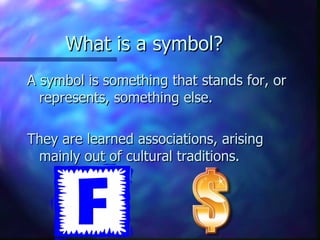
What is a symbol? A symbol is something that stands for, or represents, something else. They are learned associations, arising mainly out of cultural traditions.
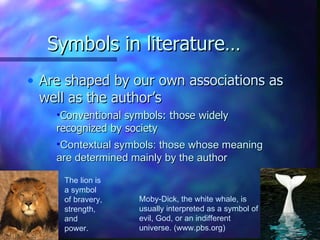
Symbols in literature… Are shaped by our own associations as well as the author’s Moby-Dick, the white whale, is usually interpreted as a symbol of evil, God, or an indifferent universe. (www.pbs.org) The lion is a symbol of bravery, strength, and power. Conventional symbols: those widely recognized by society Contextual symbols: those whose meaning are determined mainly by the author
Are related to the culture they come from. The ones here come mainly from a western/Eurocentric tradition Can be recognized by the frequency an object or character is mentioned in a piece of literature--if it is mentioned often, it is probably important. Or, look at how much detail is used in describing an object.  (“How to Understand Symbolism in Literature”, www.ehow.com) Symbols in literature…
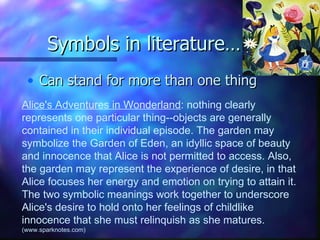
Can stand for more than one thing Symbols in literature… Alice's Adventures in Wonderland : nothing clearly represents one particular thing--objects are generally contained in their individual episode. The garden may symbolize the Garden of Eden, an idyllic space of beauty and innocence that Alice is not permitted to access. Also, the garden may represent the experience of desire, in that Alice focuses her energy and emotion on trying to attain it. The two symbolic meanings work together to underscore Alice's desire to hold onto her feelings of childlike innocence that she must relinquish as she matures.   (www.sparknotes.com)
Motifs & Allegories Motif: recurring thematic symbols, images, ideas or items. These point in the direction of the overall theme Allegory: a story whose characters, setting, events, etc. are meant to represent general truths about human existence. The entire story is a collection of symbols
Common Conventional Symbols in Literature
Sun & Light Father principle (i.e. male) Consciousness: thinking,  enlightenment, wisdom,  spiritual vision, awareness Passage of time and life Rising sun: birth, creation,  enlightenment Setting sun: endings, death Creative energy Sun: Law in nature
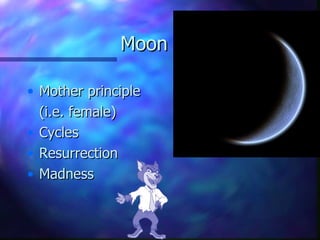
Moon Mother principle  (i.e. female) Cycles Resurrection Madness
Night & Dark The mysterious The unknown (e.g. to be “in the dark”) Death Evil, shadiness of quality (i.e. the darker the night, the purer the evil) Darkness can also be calming,  restful, serene—much like still  being in the womb Image from: www.stepheniemeyer.com
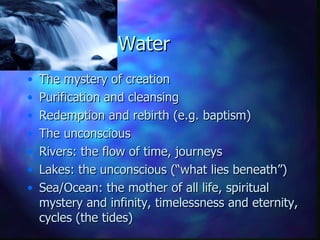
Water The mystery of creation Purification and cleansing Redemption and rebirth (e.g. baptism) The unconscious Rivers: the flow of time, journeys Lakes: the unconscious (“what lies beneath”) Sea/Ocean: the mother of all life, spiritual mystery and infinity, timelessness and eternity, cycles (the tides)
Fire & Lightning Fire: associated with the sun  and light Purification Destruction Power Passionate emotions: love, hate, rage, anger Sexuality Lightning: dramatic, instantaneous divine retribution and destruction
Flowers: The Rose Traditionally (since the Victorian era, anyway), the colour of the rose determines the kind of love: Red = romance, beauty Yellow = friendship Deep pink = gratitude and appreciation Light pink = sympathy and admiration White = reverence, purity, innocence, remembrance (and, therefore, also death) Orange = passion, excitement Lavender = enchantment, love at first sight
Flowers: A Few More Calla lily = beauty Daffodil = regard Daisy = innocence Narcissus = egotism Red poppy = consolation, death
Noteworthy Plants Bamboo = longevity, strength, grace Laurel = glory Oak = wisdom, strength Acorn = potential, strength Tree = fertility, life, growth, immortality or long life Garden = paradise and unspoiled beauty, innocence, fertility
Circle / Sphere Wholeness, completeness Unity Having no weak point The feminine spirit
Triangle The masculine spirit (positive or negative) The sky, the earth and the living creatures  The union of two that creates the third  (such as parents and child) The perfect union when two become one  In Christianity: The father, the mother and the son  The Father, the Son and the Holy Spirit  The power of the One to become All ( www.wiki.answers.com ) NB: Nazis used triangle markings in concentration camps to categorize prisoners
Numbers: One & Two One: the original, the creator Two: duality Male and female Good and evil Night and day; hot and cold; etc. Two-facedness (e.g. Janus:  Roman god of gates, doors,  doorways, beginnings and  endings) Yin and yang: female and male  opposites
Numbers: Three Spiritual awareness Completeness and unity Phases of life: past, present and future; maiden, mother, and crone; etc. Triads Christianity: The Holy Trinity Buddhism: Buddha, Dhamma, and Sangha Family: mother, father, child The three Fates; three Sirens; three Witches; three Furies; three Graces
Numbers: Four The earth (associated also with the square) Cycles, because of the seasons Four elements: air, water, fire, earth Four directions: north, south, east, west Ovid’s Four Ages of the World: Gold, Silver, Bronze, Iron Four rivers of Hades
Numbers: Seven The union of three (spirituality) and four (earth) Eternal life: human life linked with divine life Completion of a cycle; perfect order (week, music scale, rainbow, etc.) Wisdom Christianity: creation in seven days Judaism: Passover and the menorah branches
Numbers: Twelve & Forty Twelve: completion (of a cycle) Year, zodiac Twelve gods of Mount Olympus,  twelve labors of Hercules Forty: negative associations, usually religious “ Quarantine” was originally 40 days of isolation in the Roman port Examples of 40s in the Old Testament: 40 days Hebrews wandered in the desert, 40 days and nights of the great flood
Cross Associated with the number four, for the quadrants it creates Christianity: suffering, death and resurrection, Jesus, the faith itself and its followers Red cross: medical care and assistance Ankh: Egyptian symbol of life and fertility Saltire (diagonally crossed lines): skull and crossbones represent danger, poison, pirates
Sphinx & Crown Sphinx: part human (usually female) or ram, part lion, part bird Knowledge and wisdom The sun (and its associated meanings) Power and might Crown Monarchy, royalty or head of state Power and wealth Often associated with the number two (double crown) or three (triple crown) and their meanings
Animals: Serpent / Snake Energy and pure force Evil and corruption Sensuality Destruction Mystery Wisdom The unconscious Primitiveness and origins Includes worms, because of their resemblance
Animals: Eagle, Dove, Phoenix Eagle Bravery, leadership United States of America Dove Peace, hope for peace  Phoenix Resurrection
Animals: Cat & Dog Cat Independence Meditation, mystery, and watchfulness Cleverness and wisdom Black cats = bad luck (superstition) Dog Loyalty  Guardianship (e.g.  Cerberus)
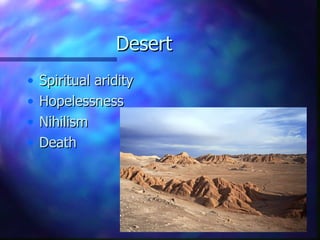
Desert Spiritual aridity Hopelessness Nihilism Death
Colours Possibly the most pervasive of literary symbols Shade is important—can show the potency of the symbolic meaning Consider combinations of colours (separate or blended) As many colours can be seen positively or negatively, their effects and contexts must be taken into account
Red Blood; life and death Energy Violence, disorder, sacrifice, rage, danger Warmth and heat Passion Lust
Green Fertility, growth, and the abundance of nature Hope Renewal Envy Na ï vet é Rottenness, decay, and death
Blue Closely associated with water Also associated with the sky Spirituality and religious beliefs Peace, calm, stability and order Intelligence Sadness and depression
Black Closely associated with darkness and night Darkness, chaos, and emptiness Mystery and the unknown Primal wisdom The unconscious Evil Melancholy
White Associated with light Purity, innocence, and virginity Timelessness Blinding truth Death and the supernatural Mirrors = reflection
Yellow Cheerfulness, happiness, warmth, and joy Hope (e.g. yellow ribbons) Hazard and danger (e.g. road signs) The sun (and its meanings) Gold = sovereignty and wealth Cowardice and deceit
Orange Red’s intensity and aggressiveness, tempered by yellow’s cheer Vibrancy, warmth and joy Courage and strength The sun (and its meanings) Light orange = summer Dark orange = autumn
Purple Royalty, nobility, and authority Mystery Spirituality
Brown Wholesomeness and earthiness Dependability, simplicity, and friendliness Health Permanence Dullness

Symbolism

  • 1.
    Symbolism in LiteratureEnglish 12 Fall 2009 Ms. Ross
  • 2.
    Images from: wikipedia.org/www.jorymon.com www.stepheniemeyer.com/
  • 3.
    What is asymbol? A symbol is something that stands for, or represents, something else. They are learned associations, arising mainly out of cultural traditions.
  • 4.
    Symbols in literature…Are shaped by our own associations as well as the author’s Moby-Dick, the white whale, is usually interpreted as a symbol of evil, God, or an indifferent universe. (www.pbs.org) The lion is a symbol of bravery, strength, and power. Conventional symbols: those widely recognized by society Contextual symbols: those whose meaning are determined mainly by the author
  • 5.
    Are related tothe culture they come from. The ones here come mainly from a western/Eurocentric tradition Can be recognized by the frequency an object or character is mentioned in a piece of literature--if it is mentioned often, it is probably important. Or, look at how much detail is used in describing an object. (“How to Understand Symbolism in Literature”, www.ehow.com) Symbols in literature…
  • 6.
    Can stand formore than one thing Symbols in literature… Alice's Adventures in Wonderland : nothing clearly represents one particular thing--objects are generally contained in their individual episode. The garden may symbolize the Garden of Eden, an idyllic space of beauty and innocence that Alice is not permitted to access. Also, the garden may represent the experience of desire, in that Alice focuses her energy and emotion on trying to attain it. The two symbolic meanings work together to underscore Alice's desire to hold onto her feelings of childlike innocence that she must relinquish as she matures. (www.sparknotes.com)
  • 7.
    Motifs & AllegoriesMotif: recurring thematic symbols, images, ideas or items. These point in the direction of the overall theme Allegory: a story whose characters, setting, events, etc. are meant to represent general truths about human existence. The entire story is a collection of symbols
  • 8.
  • 9.
    Sun & LightFather principle (i.e. male) Consciousness: thinking, enlightenment, wisdom, spiritual vision, awareness Passage of time and life Rising sun: birth, creation, enlightenment Setting sun: endings, death Creative energy Sun: Law in nature
  • 10.
    Moon Mother principle (i.e. female) Cycles Resurrection Madness
  • 11.
    Night & DarkThe mysterious The unknown (e.g. to be “in the dark”) Death Evil, shadiness of quality (i.e. the darker the night, the purer the evil) Darkness can also be calming, restful, serene—much like still being in the womb Image from: www.stepheniemeyer.com
  • 12.
    Water The mysteryof creation Purification and cleansing Redemption and rebirth (e.g. baptism) The unconscious Rivers: the flow of time, journeys Lakes: the unconscious (“what lies beneath”) Sea/Ocean: the mother of all life, spiritual mystery and infinity, timelessness and eternity, cycles (the tides)
  • 13.
    Fire & LightningFire: associated with the sun and light Purification Destruction Power Passionate emotions: love, hate, rage, anger Sexuality Lightning: dramatic, instantaneous divine retribution and destruction
  • 14.
    Flowers: The RoseTraditionally (since the Victorian era, anyway), the colour of the rose determines the kind of love: Red = romance, beauty Yellow = friendship Deep pink = gratitude and appreciation Light pink = sympathy and admiration White = reverence, purity, innocence, remembrance (and, therefore, also death) Orange = passion, excitement Lavender = enchantment, love at first sight
  • 15.
    Flowers: A FewMore Calla lily = beauty Daffodil = regard Daisy = innocence Narcissus = egotism Red poppy = consolation, death
  • 16.
    Noteworthy Plants Bamboo= longevity, strength, grace Laurel = glory Oak = wisdom, strength Acorn = potential, strength Tree = fertility, life, growth, immortality or long life Garden = paradise and unspoiled beauty, innocence, fertility
  • 17.
    Circle / SphereWholeness, completeness Unity Having no weak point The feminine spirit
  • 18.
    Triangle The masculinespirit (positive or negative) The sky, the earth and the living creatures The union of two that creates the third (such as parents and child) The perfect union when two become one In Christianity: The father, the mother and the son The Father, the Son and the Holy Spirit The power of the One to become All ( www.wiki.answers.com ) NB: Nazis used triangle markings in concentration camps to categorize prisoners
  • 19.
    Numbers: One &Two One: the original, the creator Two: duality Male and female Good and evil Night and day; hot and cold; etc. Two-facedness (e.g. Janus: Roman god of gates, doors, doorways, beginnings and endings) Yin and yang: female and male opposites
  • 20.
    Numbers: Three Spiritualawareness Completeness and unity Phases of life: past, present and future; maiden, mother, and crone; etc. Triads Christianity: The Holy Trinity Buddhism: Buddha, Dhamma, and Sangha Family: mother, father, child The three Fates; three Sirens; three Witches; three Furies; three Graces
  • 21.
    Numbers: Four Theearth (associated also with the square) Cycles, because of the seasons Four elements: air, water, fire, earth Four directions: north, south, east, west Ovid’s Four Ages of the World: Gold, Silver, Bronze, Iron Four rivers of Hades
  • 22.
    Numbers: Seven Theunion of three (spirituality) and four (earth) Eternal life: human life linked with divine life Completion of a cycle; perfect order (week, music scale, rainbow, etc.) Wisdom Christianity: creation in seven days Judaism: Passover and the menorah branches
  • 23.
    Numbers: Twelve &Forty Twelve: completion (of a cycle) Year, zodiac Twelve gods of Mount Olympus, twelve labors of Hercules Forty: negative associations, usually religious “ Quarantine” was originally 40 days of isolation in the Roman port Examples of 40s in the Old Testament: 40 days Hebrews wandered in the desert, 40 days and nights of the great flood
  • 24.
    Cross Associated withthe number four, for the quadrants it creates Christianity: suffering, death and resurrection, Jesus, the faith itself and its followers Red cross: medical care and assistance Ankh: Egyptian symbol of life and fertility Saltire (diagonally crossed lines): skull and crossbones represent danger, poison, pirates
  • 25.
    Sphinx & CrownSphinx: part human (usually female) or ram, part lion, part bird Knowledge and wisdom The sun (and its associated meanings) Power and might Crown Monarchy, royalty or head of state Power and wealth Often associated with the number two (double crown) or three (triple crown) and their meanings
  • 26.
    Animals: Serpent /Snake Energy and pure force Evil and corruption Sensuality Destruction Mystery Wisdom The unconscious Primitiveness and origins Includes worms, because of their resemblance
  • 27.
    Animals: Eagle, Dove,Phoenix Eagle Bravery, leadership United States of America Dove Peace, hope for peace Phoenix Resurrection
  • 28.
    Animals: Cat &Dog Cat Independence Meditation, mystery, and watchfulness Cleverness and wisdom Black cats = bad luck (superstition) Dog Loyalty Guardianship (e.g. Cerberus)
  • 29.
    Desert Spiritual aridityHopelessness Nihilism Death
  • 30.
    Colours Possibly themost pervasive of literary symbols Shade is important—can show the potency of the symbolic meaning Consider combinations of colours (separate or blended) As many colours can be seen positively or negatively, their effects and contexts must be taken into account
  • 31.
    Red Blood; lifeand death Energy Violence, disorder, sacrifice, rage, danger Warmth and heat Passion Lust
  • 32.
    Green Fertility, growth,and the abundance of nature Hope Renewal Envy Na ï vet é Rottenness, decay, and death
  • 33.
    Blue Closely associatedwith water Also associated with the sky Spirituality and religious beliefs Peace, calm, stability and order Intelligence Sadness and depression
  • 34.
    Black Closely associatedwith darkness and night Darkness, chaos, and emptiness Mystery and the unknown Primal wisdom The unconscious Evil Melancholy
  • 35.
    White Associated withlight Purity, innocence, and virginity Timelessness Blinding truth Death and the supernatural Mirrors = reflection
  • 36.
    Yellow Cheerfulness, happiness,warmth, and joy Hope (e.g. yellow ribbons) Hazard and danger (e.g. road signs) The sun (and its meanings) Gold = sovereignty and wealth Cowardice and deceit
  • 37.
    Orange Red’s intensityand aggressiveness, tempered by yellow’s cheer Vibrancy, warmth and joy Courage and strength The sun (and its meanings) Light orange = summer Dark orange = autumn
  • 38.
    Purple Royalty, nobility,and authority Mystery Spirituality
  • 39.
    Brown Wholesomeness andearthiness Dependability, simplicity, and friendliness Health Permanence Dullness