Top-Down Network Design
Chapter Eleven
Selecting Technologies and Devices for Enterprise Networks
Copyright 2010 Cisco Press & Priscilla Oppenheimer
Enterprise Technologies and
Devices
• Remote access networks
• Wide area networks (WANs)
• Devices
– End user remote access devices
– Central site remote access devices
– VPN concentrators
– Routers
Selection Criteria
• Business requirements and constraints
• Cost
• Technical goals
• Bandwidth requirements
• QoS requirements
• Network topology
• Traffic flow and load
• Etc.
Remote Access Technologies
• The Point-to-Point Protocol (PPP)
• Integrated Services Digital Network (ISDN)
• Cable modems
• Digital Subscriber Line (DSL)
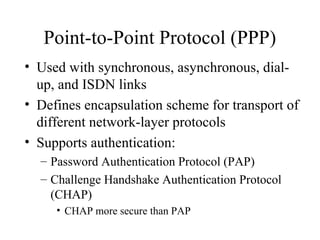
Point-to-Point Protocol (PPP)
• Used with synchronous, asynchronous, dial-
up, and ISDN links
• Defines encapsulation scheme for transport of
different network-layer protocols
• Supports authentication:
– Password Authentication Protocol (PAP)
– Challenge Handshake Authentication Protocol
(CHAP)
• CHAP more secure than PAP
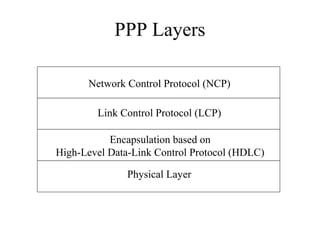
PPP Layers
Network Control Protocol (NCP)
Link Control Protocol (LCP)
Encapsulation based on
High-Level Data-Link Control Protocol (HDLC)
Physical Layer
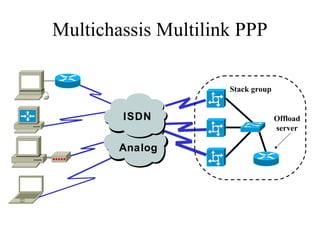
Multichassis Multilink PPP
Stack group
ISDN
Analog
Offload
server
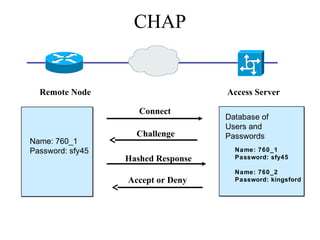
CHAP
Name: 760_1
Password: sfy45
Remote Node Access Server
Connect
Challenge
Hashed Response
Accept or Deny
Database of
Users and
Passwords
Name: 760_1
Password: sfy45
Name: 760_2
Password: kingsford
ISDN
• Digital data-transport service offered by
regional telephone carriers (telcos)
• Circuit-switched service that carries voice
and data
• Cost-effective remote-access solution for
telecommuters and remote offices
– Cost of an ISDN circuit is usually based on a
monthly fee plus usage time
• Good choice as a backup link for another
type of link, for example, Frame Relay
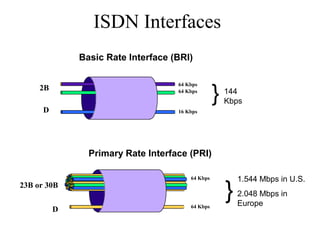
ISDN Interfaces
23B or 30B
D
1.544 Mbps in U.S.
2.048 Mbps in
Europe
Primary Rate Interface (PRI)
64 Kbps
64 Kbps
}
64 Kbps
64 Kbps
16 Kbps
144
Kbps
2B
D
}
Basic Rate Interface (BRI)
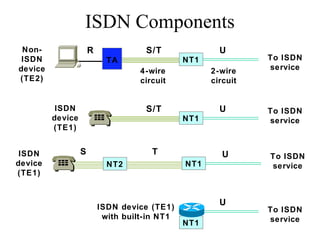
ISDN Components
ISDN device (TE1)
with built-in NT1
To ISDN
service
U
NT1
ISDN
device
(TE1)
S/T U
NT1
To ISDN
service
Non-
ISDN
device
(TE2)
S/T U
TA NT1
R
4-wire
circuit
2-wire
circuit
To ISDN
service
ISDN
device
(TE1)
T U
NT1
To ISDN
serviceNT2
S
Cable Modem Service
• Operates over the coax cable used by cable TV
• Much faster than analog modems, and usually
much faster than ISDN (depending on how
many users share the cable)
– 25 to 50 Mbps downstream from the head end
– 2 to 3 Mbps upstream from end users
• Standard = Data Over Cable Service Interface
Specification (DOCSIS)
DSL
• High-speed digital data traffic over ordinary
telephone wires
• Sophisticated modulation schemes mean
higher speeds than ISDN
– Speeds range from 1.544 to 9 Mbps
• Actual bandwidth depends on type of DSL
service, DSL modem, and many physical-
layer factors
• Asymmetric DSL (ADSL) very popular
– Downstream faster than upstream
WAN Technologies
• Leased lines
• Synchronous Optical Network (SONET)
• Frame Relay
• Asynchronous Transfer Mode (ATM)
Leased Lines
• Dedicated digital, copper circuits that a
customer leases from a carrier for a
predetermined amount of time, usually for
months or years
• Speeds range from 64 Kbps to 45 Mbps
• Enterprises use leased lines for both voice
and data traffic
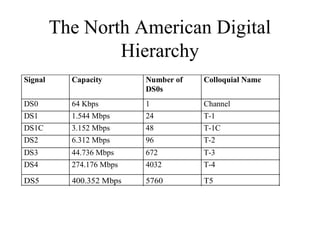
The North American Digital
Hierarchy
Synchronous Optical Network
(SONET)
• Physical-layer specification for high-speed
synchronous transmission of packets or
cells over fiber-optic cabling
• Service providers and carriers make wide
use of SONET in their internal networks
• Gaining popularity within private networks
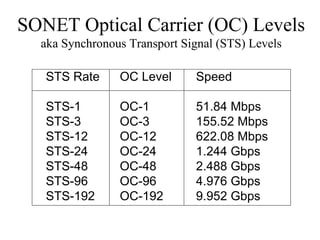
SONET Optical Carrier (OC) Levels
aka Synchronous Transport Signal (STS) Levels
STS Rate OC Level Speed
STS-1 OC-1 51.84 Mbps
STS-3 OC-3 155.52 Mbps
STS-12 OC-12 622.08 Mbps
STS-24 OC-24 1.244 Gbps
STS-48 OC-48 2.488 Gbps
STS-96 OC-96 4.976 Gbps
STS-192 OC-192 9.952 Gbps
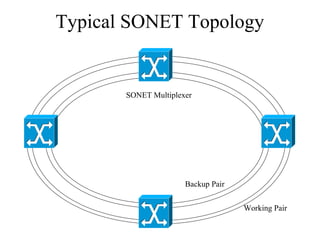
Working Pair
Backup Pair
Typical SONET Topology
SONET Multiplexer
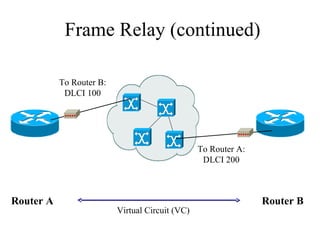
Frame Relay
• Industry-standard data-link-layer protocol
for transporting traffic across wide-area
virtual circuits
• Optimized for efficiency on circuits with
low error rates
• Attractively-priced in most parts of the
world
• Carriers agree to forward traffic at a
Committed Information Rate (CIR)
Frame Relay (continued)
Router A Router B
To Router B:
DLCI 100
To Router A:
DLCI 200
Virtual Circuit (VC)
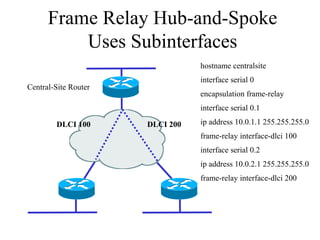
Frame Relay Hub-and-Spoke
Uses Subinterfaces
Central-Site Router
hostname centralsite
interface serial 0
encapsulation frame-relay
interface serial 0.1
ip address 10.0.1.1 255.255.255.0
frame-relay interface-dlci 100
interface serial 0.2
ip address 10.0.2.1 255.255.255.0
frame-relay interface-dlci 200
DLCI 100 DLCI 200
Asynchronous Transfer Mode
(ATM)
• Used in service provider internal networks
• Gaining popularity within private networks,
both WANs and sometimes LANs
• Supports very high bandwidth requirements
– Copper cabling: 45 Mbps or more
– Fiber-optic cabling: OC-192 (9.952 Gbps) and
beyond, especially if technologies such as
wave-division multiplexing (WDM) are used
ATM (continued)
• Provides efficient sharing of bandwidth
among applications with various Quality of
Service (QoS) requirements
– Cell-based system inherently better for QoS
than frames
• Application can specify upon connection
establishment the QoS it requires
• Peak and minimum cell rates, cell-loss ratio,
and cell-transfer delay
Ethernet over ATM
• ATM router interfaces are expensive
• Some providers allow a customer to use an
Ethernet interface to access the provider’s
ATM WAN
• May require a converter
• Expected to gain popularity because it has
the advantages of both worlds
– Easy-to-use LAN
– QoS-aware WAN
Selection Criteria for Remote
Access Devices
• Support for VPN features
• Support for NAT
• Reliability
• Cost
• Ease of configuration and management
• Support for one or more high-speed
Ethernet interfaces
• If desired, wireless support
• Etc.
Selection Criteria for VPN
Concentrators
• Support for:
– Tunneling protocols such as IPSec, PPTP, and L2TP
– Encryption algorithms such as 168-bit Triple DES,
Microsoft Encryption (MPPE), RC4, AES
– Authentication algorithms, including MD5, SHA-1, HMAC
– Network system protocols, such as DNS, RADIUS,
Kerberos, LDAP
– Routing protocols
– Certificate authorities
– Network management using SSH or HTTP with SSL
– Etc.
Selection Criteria for Enterprise
Routers
• Number of ports
• Processing speed
• Media and technologies supported
• MTTR and MTBF
• Throughput
• Optimization features
• Etc
Selection Criteria for a WAN
Service Provider
• Extent of services and technologies
• Geographical areas covered
• Reliability and performance characteristics
of the provider’s internal network
• The level of security offered by the provider
• The level of technical support offered by
the provider
• The likelihood that the provider will
continue to stay in business
Selecting a Provider (continued)
• The provider’s willingness to work with you
to meet your needs
• The physical routing of network links
• Redundancy within the network
• The extent to which the provider relies on
other providers for redundancy
• The level of oversubscription on the network
• QoS support
• Etc.
Summary
• A major task during the physical design phase
is selecting technologies and devices for
enterprise networks
– Remote access networks
– WANs
– Service providers
– Devices
• End user remote access devices
• Central site remote access devices
• VPN concentrators
• Routers
Review Questions
• Compare and contrast technologies for
supporting remote users.
• Compare and contrast WAN technologies.
• What selection criteria can you use when
purchasing internetworking devices for
enterprise network customers?
• What criteria can you use when selecting a
WAN service provider?

Chapter11

  • 1.
    Top-Down Network Design ChapterEleven Selecting Technologies and Devices for Enterprise Networks Copyright 2010 Cisco Press & Priscilla Oppenheimer
  • 2.
    Enterprise Technologies and Devices •Remote access networks • Wide area networks (WANs) • Devices – End user remote access devices – Central site remote access devices – VPN concentrators – Routers
  • 3.
    Selection Criteria • Businessrequirements and constraints • Cost • Technical goals • Bandwidth requirements • QoS requirements • Network topology • Traffic flow and load • Etc.
  • 4.
    Remote Access Technologies •The Point-to-Point Protocol (PPP) • Integrated Services Digital Network (ISDN) • Cable modems • Digital Subscriber Line (DSL)
  • 5.
    Point-to-Point Protocol (PPP) •Used with synchronous, asynchronous, dial- up, and ISDN links • Defines encapsulation scheme for transport of different network-layer protocols • Supports authentication: – Password Authentication Protocol (PAP) – Challenge Handshake Authentication Protocol (CHAP) • CHAP more secure than PAP
  • 6.
    PPP Layers Network ControlProtocol (NCP) Link Control Protocol (LCP) Encapsulation based on High-Level Data-Link Control Protocol (HDLC) Physical Layer
  • 7.
    Multichassis Multilink PPP Stackgroup ISDN Analog Offload server
  • 8.
    CHAP Name: 760_1 Password: sfy45 RemoteNode Access Server Connect Challenge Hashed Response Accept or Deny Database of Users and Passwords Name: 760_1 Password: sfy45 Name: 760_2 Password: kingsford
  • 9.
    ISDN • Digital data-transportservice offered by regional telephone carriers (telcos) • Circuit-switched service that carries voice and data • Cost-effective remote-access solution for telecommuters and remote offices – Cost of an ISDN circuit is usually based on a monthly fee plus usage time • Good choice as a backup link for another type of link, for example, Frame Relay
  • 10.
    ISDN Interfaces 23B or30B D 1.544 Mbps in U.S. 2.048 Mbps in Europe Primary Rate Interface (PRI) 64 Kbps 64 Kbps } 64 Kbps 64 Kbps 16 Kbps 144 Kbps 2B D } Basic Rate Interface (BRI)
  • 11.
    ISDN Components ISDN device(TE1) with built-in NT1 To ISDN service U NT1 ISDN device (TE1) S/T U NT1 To ISDN service Non- ISDN device (TE2) S/T U TA NT1 R 4-wire circuit 2-wire circuit To ISDN service ISDN device (TE1) T U NT1 To ISDN serviceNT2 S
  • 12.
    Cable Modem Service •Operates over the coax cable used by cable TV • Much faster than analog modems, and usually much faster than ISDN (depending on how many users share the cable) – 25 to 50 Mbps downstream from the head end – 2 to 3 Mbps upstream from end users • Standard = Data Over Cable Service Interface Specification (DOCSIS)
  • 13.
    DSL • High-speed digitaldata traffic over ordinary telephone wires • Sophisticated modulation schemes mean higher speeds than ISDN – Speeds range from 1.544 to 9 Mbps • Actual bandwidth depends on type of DSL service, DSL modem, and many physical- layer factors • Asymmetric DSL (ADSL) very popular – Downstream faster than upstream
  • 14.
    WAN Technologies • Leasedlines • Synchronous Optical Network (SONET) • Frame Relay • Asynchronous Transfer Mode (ATM)
  • 15.
    Leased Lines • Dedicateddigital, copper circuits that a customer leases from a carrier for a predetermined amount of time, usually for months or years • Speeds range from 64 Kbps to 45 Mbps • Enterprises use leased lines for both voice and data traffic
  • 16.
    The North AmericanDigital Hierarchy
  • 17.
    Synchronous Optical Network (SONET) •Physical-layer specification for high-speed synchronous transmission of packets or cells over fiber-optic cabling • Service providers and carriers make wide use of SONET in their internal networks • Gaining popularity within private networks
  • 18.
    SONET Optical Carrier(OC) Levels aka Synchronous Transport Signal (STS) Levels STS Rate OC Level Speed STS-1 OC-1 51.84 Mbps STS-3 OC-3 155.52 Mbps STS-12 OC-12 622.08 Mbps STS-24 OC-24 1.244 Gbps STS-48 OC-48 2.488 Gbps STS-96 OC-96 4.976 Gbps STS-192 OC-192 9.952 Gbps
  • 19.
    Working Pair Backup Pair TypicalSONET Topology SONET Multiplexer
  • 20.
    Frame Relay • Industry-standarddata-link-layer protocol for transporting traffic across wide-area virtual circuits • Optimized for efficiency on circuits with low error rates • Attractively-priced in most parts of the world • Carriers agree to forward traffic at a Committed Information Rate (CIR)
  • 21.
    Frame Relay (continued) RouterA Router B To Router B: DLCI 100 To Router A: DLCI 200 Virtual Circuit (VC)
  • 22.
    Frame Relay Hub-and-Spoke UsesSubinterfaces Central-Site Router hostname centralsite interface serial 0 encapsulation frame-relay interface serial 0.1 ip address 10.0.1.1 255.255.255.0 frame-relay interface-dlci 100 interface serial 0.2 ip address 10.0.2.1 255.255.255.0 frame-relay interface-dlci 200 DLCI 100 DLCI 200
  • 23.
    Asynchronous Transfer Mode (ATM) •Used in service provider internal networks • Gaining popularity within private networks, both WANs and sometimes LANs • Supports very high bandwidth requirements – Copper cabling: 45 Mbps or more – Fiber-optic cabling: OC-192 (9.952 Gbps) and beyond, especially if technologies such as wave-division multiplexing (WDM) are used
  • 24.
    ATM (continued) • Providesefficient sharing of bandwidth among applications with various Quality of Service (QoS) requirements – Cell-based system inherently better for QoS than frames • Application can specify upon connection establishment the QoS it requires • Peak and minimum cell rates, cell-loss ratio, and cell-transfer delay
  • 25.
    Ethernet over ATM •ATM router interfaces are expensive • Some providers allow a customer to use an Ethernet interface to access the provider’s ATM WAN • May require a converter • Expected to gain popularity because it has the advantages of both worlds – Easy-to-use LAN – QoS-aware WAN
  • 26.
    Selection Criteria forRemote Access Devices • Support for VPN features • Support for NAT • Reliability • Cost • Ease of configuration and management • Support for one or more high-speed Ethernet interfaces • If desired, wireless support • Etc.
  • 27.
    Selection Criteria forVPN Concentrators • Support for: – Tunneling protocols such as IPSec, PPTP, and L2TP – Encryption algorithms such as 168-bit Triple DES, Microsoft Encryption (MPPE), RC4, AES – Authentication algorithms, including MD5, SHA-1, HMAC – Network system protocols, such as DNS, RADIUS, Kerberos, LDAP – Routing protocols – Certificate authorities – Network management using SSH or HTTP with SSL – Etc.
  • 28.
    Selection Criteria forEnterprise Routers • Number of ports • Processing speed • Media and technologies supported • MTTR and MTBF • Throughput • Optimization features • Etc
  • 29.
    Selection Criteria fora WAN Service Provider • Extent of services and technologies • Geographical areas covered • Reliability and performance characteristics of the provider’s internal network • The level of security offered by the provider • The level of technical support offered by the provider • The likelihood that the provider will continue to stay in business
  • 30.
    Selecting a Provider(continued) • The provider’s willingness to work with you to meet your needs • The physical routing of network links • Redundancy within the network • The extent to which the provider relies on other providers for redundancy • The level of oversubscription on the network • QoS support • Etc.
  • 31.
    Summary • A majortask during the physical design phase is selecting technologies and devices for enterprise networks – Remote access networks – WANs – Service providers – Devices • End user remote access devices • Central site remote access devices • VPN concentrators • Routers
  • 32.
    Review Questions • Compareand contrast technologies for supporting remote users. • Compare and contrast WAN technologies. • What selection criteria can you use when purchasing internetworking devices for enterprise network customers? • What criteria can you use when selecting a WAN service provider?

Editor's Notes

  • #10 ISDN is becoming obsolete, though it is still used some places.