SOFTWARE DEFINED NETWORK 
Ravi
Agenda 
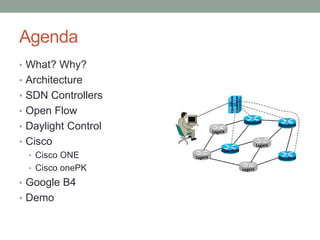
• What? Why? 
• Architecture 
• SDN Controllers 
• Open Flow 
• Daylight Control 
• Cisco 
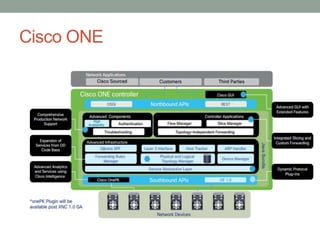
• Cisco ONE 
• Cisco onePK 
• Google B4 
• Demo
What is SDN? 
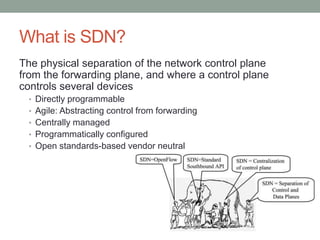
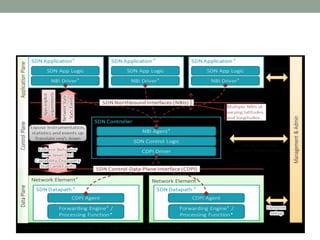
The physical separation of the network control plane 
from the forwarding plane, and where a control plane 
controls several devices 
• Directly programmable 
• Agile: Abstracting control from forwarding 
• Centrally managed 
• Programmatically configured 
• Open standards-based vendor neutral
SDN Operation - Control/Data Plan 
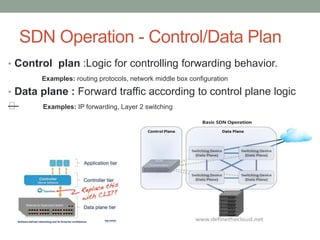
• Control plan :Logic for controlling forwarding behavior. 
Examples: routing protocols, network middle box configuration 
• Data plane : Forward traffic according to control plane logic 
— Examples: IP forwarding, Layer 2 switching
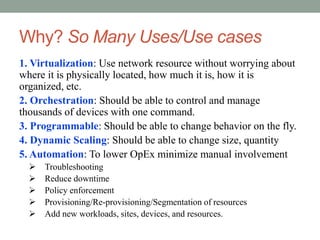
Why? So Many Uses/Use cases 
1. Virtualization: Use network resource without worrying about 
where it is physically located, how much it is, how it is 
organized, etc. 
2. Orchestration: Should be able to control and manage 
thousands of devices with one command. 
3. Programmable: Should be able to change behavior on the fly. 
4. Dynamic Scaling: Should be able to change size, quantity 
5. Automation: To lower OpEx minimize manual involvement 
 Troubleshooting 
 Reduce downtime 
 Policy enforcement 
 Provisioning/Re-provisioning/Segmentation of resources 
 Add new workloads, sites, devices, and resources.
Why? So Many Uses/Use cases 
6. Visibility: Monitor resources, connectivity 
7. Performance: Optimize network device utilization 
 Traffic engineering/Bandwidth management 
 Capacity optimization 
 Load balancing 
 High utilization 
 Fast failure handling 
8. Multi-tenancy: Tenants need complete control over their 
addresses, topology, and routing, security 
9. Service Integration: Load balancers, firewalls, Intrusion 
Detection Systems (IDS), provisioned on demand and placed 
appropriately on the traffic path
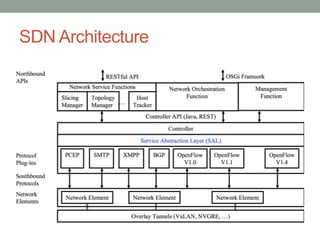
SDN Architecture
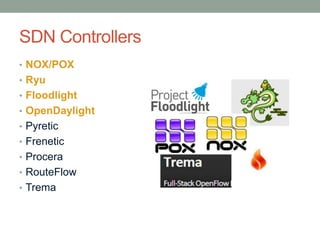
SDN Controllers 
Many Different SDN Controllers 
• NOX/POX 
• Ryu 
• Floodlight 
• OpenDaylight 
• Pyretic 
• Frenetic 
• Procera 
• RouteFlow 
• Trema 
! NOX/POX 
! Ryu 
! Floodlight 
! OpenDaylight 
! Pyretic 
! Frenetic 
! Procera 
! RouteFlow 
! Trema 
3
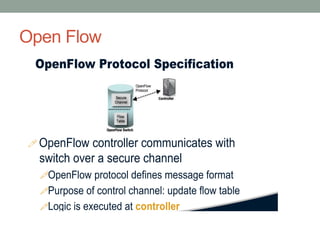
Open Flow 
OpenFlow Protocol Specification 
! OpenFlow controller communicates with 
switch over a secure channel 
" OpenFlow protocol defines message format 
" Purpose of control channel: update flow table 
" Logic is executed at controller
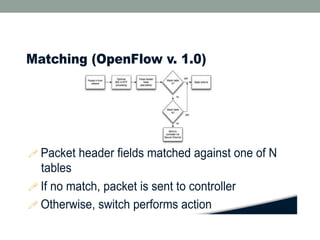
Matching (OpenFlow v. 1.0) 
! Packet header fields matched against one of N 
tables 
! If no match, packet is sent to controller 
! Otherwise, switch performs action 
5
Open Day Light
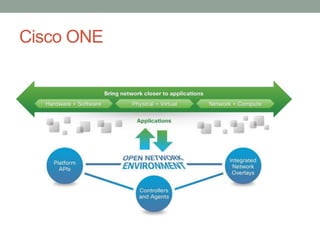
Cisco ONE
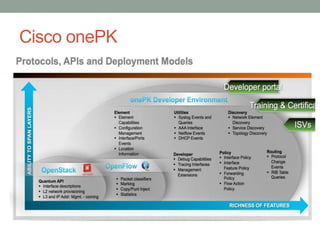
Cisco onePK
Cisco Controller
Cisco Application Centric Infrastructure
Google B4 Architecture 
-Software-defined WAN 
• Logically centralized traffic-engineering controller, which allows applications to manipulate bandwidth 
across data centers through WAN networks. 
• Automation - separate monitoring, management and operation from individual boxes
Amazon VP Cloud 
Dynamic Scaling of Resources: 
Amazon Virtual Private Cloud 
! Connect logically 
isolated VM 
instances to existing 
network 
! Connection to 
existing 
infrastructure via 
VPN 
hDp://aws.typepad.com/aws/2009/08/introducingHamazonHvirtualHprivateH 
cloudHvpc.html)
ADDITIONAL SLIDES
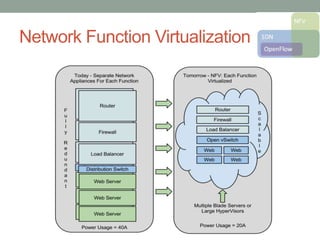
Network Function Virtualization
Cisco ONE
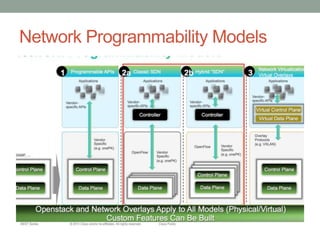
Network Programmability Models
Active Networks 
• Networks where switches perform custom 
computations on packets 
• ž Examples (and motivation) 
• —Trace program running at each router 
• —Middleboxes: firewalls, proxies, application services
Network Virtualization 
• What is Network Virtualization? 
• ž Representation of one or more logical network 
topologies on the same infrastructure. 
• ž Many different instantiations 
—Virtual LANs (VLANs) 
—Various technologies and network testbeds —Today: 
VMWare, Nicira, etc.

Software Defined Network - SDN

  • 1.
  • 2.
    Agenda • What?Why? • Architecture • SDN Controllers • Open Flow • Daylight Control • Cisco • Cisco ONE • Cisco onePK • Google B4 • Demo
  • 3.
    What is SDN? The physical separation of the network control plane from the forwarding plane, and where a control plane controls several devices • Directly programmable • Agile: Abstracting control from forwarding • Centrally managed • Programmatically configured • Open standards-based vendor neutral
  • 4.
    SDN Operation -Control/Data Plan • Control plan :Logic for controlling forwarding behavior. Examples: routing protocols, network middle box configuration • Data plane : Forward traffic according to control plane logic — Examples: IP forwarding, Layer 2 switching
  • 5.
    Why? So ManyUses/Use cases 1. Virtualization: Use network resource without worrying about where it is physically located, how much it is, how it is organized, etc. 2. Orchestration: Should be able to control and manage thousands of devices with one command. 3. Programmable: Should be able to change behavior on the fly. 4. Dynamic Scaling: Should be able to change size, quantity 5. Automation: To lower OpEx minimize manual involvement  Troubleshooting  Reduce downtime  Policy enforcement  Provisioning/Re-provisioning/Segmentation of resources  Add new workloads, sites, devices, and resources.
  • 6.
    Why? So ManyUses/Use cases 6. Visibility: Monitor resources, connectivity 7. Performance: Optimize network device utilization  Traffic engineering/Bandwidth management  Capacity optimization  Load balancing  High utilization  Fast failure handling 8. Multi-tenancy: Tenants need complete control over their addresses, topology, and routing, security 9. Service Integration: Load balancers, firewalls, Intrusion Detection Systems (IDS), provisioned on demand and placed appropriately on the traffic path
  • 7.
  • 8.
    SDN Controllers ManyDifferent SDN Controllers • NOX/POX • Ryu • Floodlight • OpenDaylight • Pyretic • Frenetic • Procera • RouteFlow • Trema ! NOX/POX ! Ryu ! Floodlight ! OpenDaylight ! Pyretic ! Frenetic ! Procera ! RouteFlow ! Trema 3
  • 9.
    Open Flow OpenFlowProtocol Specification ! OpenFlow controller communicates with switch over a secure channel " OpenFlow protocol defines message format " Purpose of control channel: update flow table " Logic is executed at controller
  • 10.
    Matching (OpenFlow v.1.0) ! Packet header fields matched against one of N tables ! If no match, packet is sent to controller ! Otherwise, switch performs action 5
  • 11.
  • 12.
  • 13.
  • 14.
  • 15.
  • 16.
    Google B4 Architecture -Software-defined WAN • Logically centralized traffic-engineering controller, which allows applications to manipulate bandwidth across data centers through WAN networks. • Automation - separate monitoring, management and operation from individual boxes
  • 17.
    Amazon VP Cloud Dynamic Scaling of Resources: Amazon Virtual Private Cloud ! Connect logically isolated VM instances to existing network ! Connection to existing infrastructure via VPN hDp://aws.typepad.com/aws/2009/08/introducingHamazonHvirtualHprivateH cloudHvpc.html)
  • 18.
  • 19.
  • 20.
  • 22.
  • 25.
    Active Networks •Networks where switches perform custom computations on packets • ž Examples (and motivation) • —Trace program running at each router • —Middleboxes: firewalls, proxies, application services
  • 26.
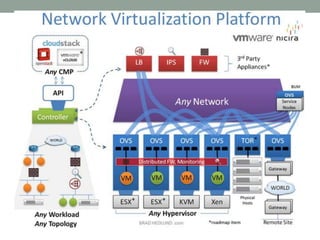
    Network Virtualization •What is Network Virtualization? • ž Representation of one or more logical network topologies on the same infrastructure. • ž Many different instantiations —Virtual LANs (VLANs) —Various technologies and network testbeds —Today: VMWare, Nicira, etc.

Editor's Notes

  • #4 Software Defined Networking (SDN): A new networking paradigm whereby the behavior of a network is controlled by a single high-level software program.  The general term for network architectures whereby the control plane (software that controls network behavior) and the data plane (the devices that forward traffic) are separate from one another. Control plane: The functions in the network that control the behavior of the network (e.g., network paths, forwarding behavior).  Typically, the control plane is instantiated as a single, high-level software controller. Data plane: The functions in the network that are responsible for forwarding (or not forwarding) traffic.  Typically, the data plane is instantiated as forwarding tables in routers, switches, firewalls, and middleboxes. Network virtualization: The notion of instantiating many distinct logical networks on top of a single, shared physical network infrastructure.
  • #5 SDN is the framework to automatically manage and control a large number of network devices and services in a multi-tenant environment
  • #8 OpenFlow originated SDN but now many different southbound and northbound APIs, intermediate services and tools are being discussed and implemented by the industry, e.g., XMPP, ForCES, PCE, ALTO The OpenFlow protocol is a foundational element for building SDN solutions. The SDN architecture is: Directly programmable: Network control is directly programmable because it is decoupled from forwarding functions. Agile: Abstracting control from forwarding lets administrators dynamically adjust network-wide traffic flow to meet changing needs. Centrally managed: Network intelligence is (logically) centralized in software-based SDN controllers that maintain a global view of the network, which appears to applications and policy engines as a single, logical switch. Programmatically configured: SDN lets network managers configure, manage, secure, and optimize network resources very quickly via dynamic, automated SDN programs, which they can write themselves because the programs do not depend on proprietary software. Open standards-based and vendor-neutral: When implemented through open standards, SDN simplifies network design and operation because instructions are provided by SDN controllers instead of multiple, vendor-specific devices and protocols.
  • #12 OpenDaylight SDN Controller platform is the leading open source SDN controller project under Linux Foundation Multi-company collaboration under Linux foundation Many projects including OpenDaylight Controller NO-OpenFlow (Not Only OpenFlow): Supports multiple southbound protocols via plug-ins including OpenFlow Dynamically linked in to a Service Abstraction Layer (SAL) Abstraction  SAL figures out how to fulfill the service requested by higher layers irrespective of the southbound protocol Modular design using OSGI framework A rich set of North-bound APIs via RESTful services for loosely coupled applications and OSGI services for co-located applications using the same address space
  • #17 http://www.networkcomputing.com/networking/inside-googles-software-defined-network/a/d-id/1234201?
  • #18 Allows customers to define their own network, address space, etc. ž Extend existing enterprise data center — VPN between Amazon VPC and data center ž Applications/Benefits — Dynamic scaling — Disaster recovery — Manageability
  • #20 Network Functions Virtualization (NFV) is a network architecture concept that proposes using IT virtualization related technologies, to virtualize entire classes of network node functions into building blocks that may be connected, or chained, together to create communication services.