Wide Area Network
Claisse Neriel L. Martinez
Introduction
Wide Area Network
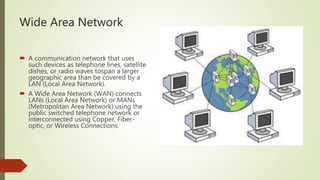
 A communication network that uses
such devices as telephone lines, satellite
dishes, or radio waves tospan a larger
geographic area than be covered by a
LAN (Local Area Network).
 A Wide Area Network (WAN) connects
LANs (Local Area Network) or MANs
(Metropolitan Area Network) using the
public switched telephone network or
interconnected using Copper, Fiber-
optic, or Wireless Connections.
Characteristics of
Wide Area
Network
Wide Area network can cover a very large geographical area – even
span the world.
They usually communicate at slow speeds or low bandwidth
compared to LANs (Local Area Networks).
Access to the Wide Area Network is limited – a Local Area Network
usually has only one WAN link that is shared by all devices.
They use devices such as routers, modems, and WAN switches.
Characteristics of
Wide Area
Network
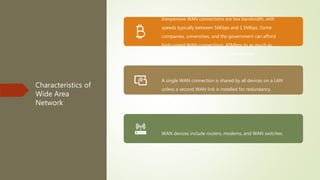
Inexpensive WAN connections are low bandwidth, with
speeds typically between 56Kbps and 1.5Mbps. Some
companies, universities, and the government can afford
high-speed WAN connections, 45Mbps to as much as
1Gbps, but at a significantly greater expense.
A single WAN connection is shared by all devices on a LAN
unless a second WAN link is installed for redundancy.
WAN devices include routers, modems, and WAN switches.
Function of
Wide Area
Network
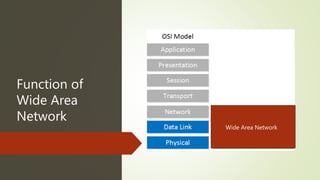
Wide Area Network
Types of Wide Area Network
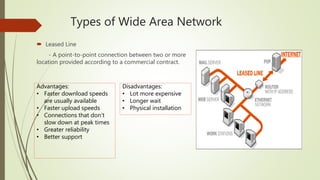
 Leased Line
- A point-to-point connection between two or more
location provided according to a commercial contract.
Advantages:
• Faster download speeds
are usually available
• Faster upload speeds
• Connections that don’t
slow down at peak times
• Greater reliability
• Better support
Disadvantages:
• Lot more expensive
• Longer wait
• Physical installation
Types of Wide Area
Network
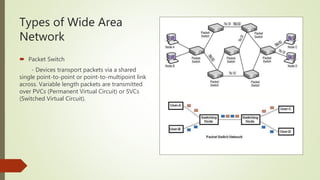
 Packet Switch
- Devices transport packets via a shared
single point-to-point or point-to-multipoint link
across. Variable length packets are transmitted
over PVCs (Permanent Virtual Circuit) or SVCs
(Switched Virtual Circuit).
Types of Wide Area
Network
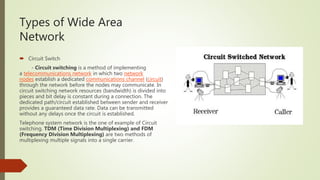
 Circuit Switch
- Circuit switching is a method of implementing
a telecommunications network in which two network
nodes establish a dedicated communications channel (circuit)
through the network before the nodes may communicate. In
circuit switching network resources (bandwidth) is divided into
pieces and bit delay is constant during a connection. The
dedicated path/circuit established between sender and receiver
provides a guaranteed data rate. Data can be transmitted
without any delays once the circuit is established.
Telephone system network is the one of example of Circuit
switching. TDM (Time Division Multiplexing) and FDM
(Frequency Division Multiplexing) are two methods of
multiplexing multiple signals into a single carrier.
Types of Wide Area Network
 Packet Switch vs Circuit Switch
Advantages:
• More efficient in terms of bandwidth, since the
concept of reserving circuit is not there.
• Minimal transmission latency.
• More reliable as destination can detect the
missing packet.
• More fault tolerant because packets may
follow different path in case any link is down,
Unlike Circuit Switching.
• Cost effective and comparatively cheaper to
implement.
Disadvantages:
• Packet Switching don’t give packets in order,
whereas Circuit Switching provides ordered
delivery of packets because all the packets
follow the same path.
• Since the packets are unordered, we need to
provide sequence numbers to each packet.
• Complexity is more at each node because of
the facility to follow multiple path.
• Transmission delay is more because of
rerouting.
• Packet Switching is beneficial only for small
messages, but for bursty data (large
messages) Circuit Switching is better.
WAN Technologies
 Point-to-Point Protocol (PPP)
A point-to-point connection consists of a dedicated logical connection between
two points over a leased line. PPP supports nearly all network protocol types and is
most frequently found in dial-up connections.
Advantages:
• It’s well tested and implemented.
• It offers excellent throughput.
• It supports most network protocol.
• It’s simple to implement.
Disadvantages:
• It’s less flexible for expanding to
multiple sites.
• It’s expensive, depending on
bandwidth and the provider.
• It requires dedicated leased lines.
WAN Technologies
 Digital Subscriber Line (DSL)
Digital Subscriber Line is a broadband technology based on Asynchronous Transfer Mode (ATM). DSL
runs on existing telephone lines, but the service requires an infrastructure upgrade at the CO.
DSL comes in two flavors: Asymmetrical DSL (ADSL) service offers a higher download transfer rate than
upload rate (ex: 384Kbps/ 144Kbps). Symmetrical DSL (SDSL) transfers at the same rate in both direction.
Advantages:
• It’s very affordable, depending on
service.
• Currently, it supports speeds of up to
6Mbps for downloading and 1.5Mbps
for uploading.
• It runs over normal telephone lines.
• Data and phone calls can exist on the
same line simultaneously.
Disadvantages:
• Availability and quality of service
depends on the condition of the
line and the distance from the
office building to the CO. This
distance is usually less than 1500
ft.
• DSL service is not available
everywhere.
WAN Technologies
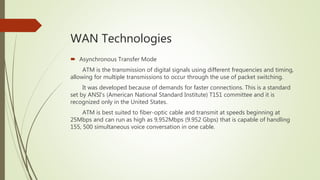
 Asynchronous Transfer Mode
ATM is the transmission of digital signals using different frequencies and timing,
allowing for multiple transmissions to occur through the use of packet switching.
It was developed because of demands for faster connections. This is a standard
set by ANSI’s (American National Standard Institute) T1S1 committee and it is
recognized only in the United States.
ATM is best suited to fiber-optic cable and transmit at speeds beginning at
25Mbps and can run as high as 9,952Mbps (9.952 Gbps) that is capable of handling
155, 500 simultaneous voice conversation in one cable.
WAN Technologies
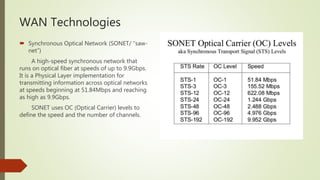
 Synchronous Optical Network (SONET/ “saw-
net”)
A high-speed synchronous network that
runs on optical fiber at speeds of up to 9.9Gbps.
It is a Physical Layer implementation for
transmitting information across optical networks
at speeds beginning at 51.84Mbps and reaching
as high as 9.9Gbps.
SONET uses OC (Optical Carrier) levels to
define the speed and the number of channels.
WAN Technologies
 Cable Internet
The data-over-cable technology is based on the ITU-T J. 112 standard, Data Over Cable System
Interface Specification (DOCSIS). Cable modems allow users to use the existing television cable coming
from the street for high-bandwidth data transmission in addition to television.
Cable technology is usually limited to residential buildings. If you have a home office or
telecommute, cable will definitely be the lowest-cost solution.
Advantages:
• It can provide high-bandwidth
Internet access at 10Mbps.
• You can maintain your cable television
over the same cable.
• It’s extremely affordable in most
metropolitan areas.
• Future uses will probably include
telephone access on the same cable.
Disadvantages:
• It’s not readily available in all
areas.
• The technology is a shared
medium, meaning that if there’s a
lot of traffic on your cable
segment, you may be receiving at
speeds much less than 10Mbps.
WAN Technologies
 Frame Relay
Frame Relay was introduced in 1992, and has since grown as a popular alternative
to PPP, ISDN, X.25, and other WAN Technologies. Frame Relay assumes a high-speed
link and is able to transmit faster than its predecessor X.25 because it does not have
error correction.
Advantages:
• It’s widely adopted in the U.S. and
internationally.
• Its high-capacity switched core offers
scalability.
• It’s a flexible technology that allows
for expansion and growth.
Disadvantages:
• It provides minimal error
correction.
• Connection-oriented service can
cause latency on slower links.
WAN Technologies
 Integrated Service Digital Network (ISDN)
Integrated Services Digital Network (ISDN) is a set of communication standards
for simultaneous digital transmission of voice, video, data, and other network services
over the traditional circuits of the public switched telephone network.
Types:
• Basic Rate Interface (BRI) – Supports up to 128Kbps on two Bearer Channel of 64Kbps
each and a 16Kbps Data Channel.
• Primary Rate Interface (PRI) – has 23 B channel and one 64Kbps D channel.
Wide Area Network Security
 Border Firewall at each site.
 Wide area network security is best maintained by requiring all users who are
connecting to your WAN to connect via Virtual Private Network (VPN). A VPN
creates a secure tunnel that protects your data and allows all traffic, voice or data
to pass through a public WAN as if it was on a private circuit or LAN.
 Antivirus filtering.

Wide Area Network (WAN)

  • 1.
    Wide Area Network ClaisseNeriel L. Martinez
  • 2.
  • 3.
    Wide Area Network A communication network that uses such devices as telephone lines, satellite dishes, or radio waves tospan a larger geographic area than be covered by a LAN (Local Area Network).  A Wide Area Network (WAN) connects LANs (Local Area Network) or MANs (Metropolitan Area Network) using the public switched telephone network or interconnected using Copper, Fiber- optic, or Wireless Connections.
  • 4.
    Characteristics of Wide Area Network WideArea network can cover a very large geographical area – even span the world. They usually communicate at slow speeds or low bandwidth compared to LANs (Local Area Networks). Access to the Wide Area Network is limited – a Local Area Network usually has only one WAN link that is shared by all devices. They use devices such as routers, modems, and WAN switches.
  • 5.
    Characteristics of Wide Area Network InexpensiveWAN connections are low bandwidth, with speeds typically between 56Kbps and 1.5Mbps. Some companies, universities, and the government can afford high-speed WAN connections, 45Mbps to as much as 1Gbps, but at a significantly greater expense. A single WAN connection is shared by all devices on a LAN unless a second WAN link is installed for redundancy. WAN devices include routers, modems, and WAN switches.
  • 6.
  • 7.
    Types of WideArea Network  Leased Line - A point-to-point connection between two or more location provided according to a commercial contract. Advantages: • Faster download speeds are usually available • Faster upload speeds • Connections that don’t slow down at peak times • Greater reliability • Better support Disadvantages: • Lot more expensive • Longer wait • Physical installation
  • 8.
    Types of WideArea Network  Packet Switch - Devices transport packets via a shared single point-to-point or point-to-multipoint link across. Variable length packets are transmitted over PVCs (Permanent Virtual Circuit) or SVCs (Switched Virtual Circuit).
  • 9.
    Types of WideArea Network  Circuit Switch - Circuit switching is a method of implementing a telecommunications network in which two network nodes establish a dedicated communications channel (circuit) through the network before the nodes may communicate. In circuit switching network resources (bandwidth) is divided into pieces and bit delay is constant during a connection. The dedicated path/circuit established between sender and receiver provides a guaranteed data rate. Data can be transmitted without any delays once the circuit is established. Telephone system network is the one of example of Circuit switching. TDM (Time Division Multiplexing) and FDM (Frequency Division Multiplexing) are two methods of multiplexing multiple signals into a single carrier.
  • 10.
    Types of WideArea Network  Packet Switch vs Circuit Switch Advantages: • More efficient in terms of bandwidth, since the concept of reserving circuit is not there. • Minimal transmission latency. • More reliable as destination can detect the missing packet. • More fault tolerant because packets may follow different path in case any link is down, Unlike Circuit Switching. • Cost effective and comparatively cheaper to implement. Disadvantages: • Packet Switching don’t give packets in order, whereas Circuit Switching provides ordered delivery of packets because all the packets follow the same path. • Since the packets are unordered, we need to provide sequence numbers to each packet. • Complexity is more at each node because of the facility to follow multiple path. • Transmission delay is more because of rerouting. • Packet Switching is beneficial only for small messages, but for bursty data (large messages) Circuit Switching is better.
  • 11.
    WAN Technologies  Point-to-PointProtocol (PPP) A point-to-point connection consists of a dedicated logical connection between two points over a leased line. PPP supports nearly all network protocol types and is most frequently found in dial-up connections. Advantages: • It’s well tested and implemented. • It offers excellent throughput. • It supports most network protocol. • It’s simple to implement. Disadvantages: • It’s less flexible for expanding to multiple sites. • It’s expensive, depending on bandwidth and the provider. • It requires dedicated leased lines.
  • 12.
    WAN Technologies  DigitalSubscriber Line (DSL) Digital Subscriber Line is a broadband technology based on Asynchronous Transfer Mode (ATM). DSL runs on existing telephone lines, but the service requires an infrastructure upgrade at the CO. DSL comes in two flavors: Asymmetrical DSL (ADSL) service offers a higher download transfer rate than upload rate (ex: 384Kbps/ 144Kbps). Symmetrical DSL (SDSL) transfers at the same rate in both direction. Advantages: • It’s very affordable, depending on service. • Currently, it supports speeds of up to 6Mbps for downloading and 1.5Mbps for uploading. • It runs over normal telephone lines. • Data and phone calls can exist on the same line simultaneously. Disadvantages: • Availability and quality of service depends on the condition of the line and the distance from the office building to the CO. This distance is usually less than 1500 ft. • DSL service is not available everywhere.
  • 13.
    WAN Technologies  AsynchronousTransfer Mode ATM is the transmission of digital signals using different frequencies and timing, allowing for multiple transmissions to occur through the use of packet switching. It was developed because of demands for faster connections. This is a standard set by ANSI’s (American National Standard Institute) T1S1 committee and it is recognized only in the United States. ATM is best suited to fiber-optic cable and transmit at speeds beginning at 25Mbps and can run as high as 9,952Mbps (9.952 Gbps) that is capable of handling 155, 500 simultaneous voice conversation in one cable.
  • 14.
    WAN Technologies  SynchronousOptical Network (SONET/ “saw- net”) A high-speed synchronous network that runs on optical fiber at speeds of up to 9.9Gbps. It is a Physical Layer implementation for transmitting information across optical networks at speeds beginning at 51.84Mbps and reaching as high as 9.9Gbps. SONET uses OC (Optical Carrier) levels to define the speed and the number of channels.
  • 15.
    WAN Technologies  CableInternet The data-over-cable technology is based on the ITU-T J. 112 standard, Data Over Cable System Interface Specification (DOCSIS). Cable modems allow users to use the existing television cable coming from the street for high-bandwidth data transmission in addition to television. Cable technology is usually limited to residential buildings. If you have a home office or telecommute, cable will definitely be the lowest-cost solution. Advantages: • It can provide high-bandwidth Internet access at 10Mbps. • You can maintain your cable television over the same cable. • It’s extremely affordable in most metropolitan areas. • Future uses will probably include telephone access on the same cable. Disadvantages: • It’s not readily available in all areas. • The technology is a shared medium, meaning that if there’s a lot of traffic on your cable segment, you may be receiving at speeds much less than 10Mbps.
  • 16.
    WAN Technologies  FrameRelay Frame Relay was introduced in 1992, and has since grown as a popular alternative to PPP, ISDN, X.25, and other WAN Technologies. Frame Relay assumes a high-speed link and is able to transmit faster than its predecessor X.25 because it does not have error correction. Advantages: • It’s widely adopted in the U.S. and internationally. • Its high-capacity switched core offers scalability. • It’s a flexible technology that allows for expansion and growth. Disadvantages: • It provides minimal error correction. • Connection-oriented service can cause latency on slower links.
  • 17.
    WAN Technologies  IntegratedService Digital Network (ISDN) Integrated Services Digital Network (ISDN) is a set of communication standards for simultaneous digital transmission of voice, video, data, and other network services over the traditional circuits of the public switched telephone network. Types: • Basic Rate Interface (BRI) – Supports up to 128Kbps on two Bearer Channel of 64Kbps each and a 16Kbps Data Channel. • Primary Rate Interface (PRI) – has 23 B channel and one 64Kbps D channel.
  • 18.
    Wide Area NetworkSecurity  Border Firewall at each site.  Wide area network security is best maintained by requiring all users who are connecting to your WAN to connect via Virtual Private Network (VPN). A VPN creates a secure tunnel that protects your data and allows all traffic, voice or data to pass through a public WAN as if it was on a private circuit or LAN.  Antivirus filtering.