TDMA
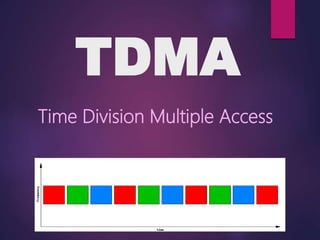
Time Division Multiple Access
Outline
 What is TDMA
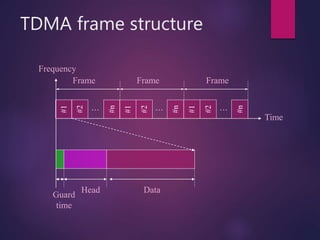
 TDMA frame structure
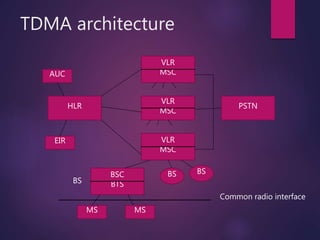
 TDMA architecture
 Advantage of TDMA
 Disadvantage of TDMA
What is TDMA?
 Time Division Multiple Access
 Digital wireless telephone transmission technique
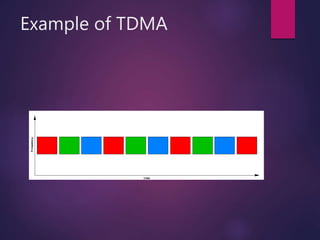
 Allocates the given bandwidth for different users in
different time slots
 Each user is allowed to transmit only within specified
time intervals (Time Slots).
 When users transmit, they occupy the whole
frequency bandwidth
Example of TDMA
TDMA frame structure
…
Time
Frequency
#1
#2
#n
#1
#2
#n
… …
#1
#2
#n
Frame Frame
Frame
Head Data
Guard
time
TDMA architecture
AUC
HLR
EIR
VLR
MSC
PSTN
VLR
MSC
VLR
MSC
BS BS
BSC
BTS
MS MS
BS
Common radio interface
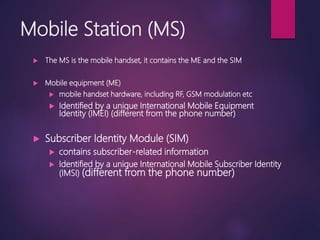
Mobile Station (MS)
 The MS is the mobile handset, it contains the ME and the SIM
 Mobile equipment (ME)
 mobile handset hardware, including RF, GSM modulation etc
 Identified by a unique International Mobile Equipment
Identity (IMEI) (different from the phone number)
 Subscriber Identity Module (SIM)
 contains subscriber-related information
 Identified by a unique International Mobile Subscriber Identity
(IMSI) (different from the phone number)
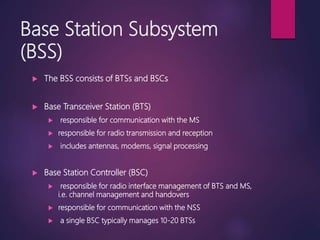
Base Station Subsystem
(BSS)
 The BSS consists of BTSs and BSCs
 Base Transceiver Station (BTS)
 responsible for communication with the MS
 responsible for radio transmission and reception
 includes antennas, modems, signal processing
 Base Station Controller (BSC)
 responsible for radio interface management of BTS and MS,
i.e. channel management and handovers
 responsible for communication with the NSS
 a single BSC typically manages 10-20 BTSs
Network and Switching
Subsystem (NSS)
 NSS contains the switching functions of
TDMA, as well as databases for mobility
management
 NSS contains
 Mobile Switching Centre (MSC)
 Home Location Register (HLR)
 Visitor Location Register (VLR)
NSS cont’d...
 Mobile Switching Centre (MSC)
 coordinates setup of calls to and from GSM users
 controls several BSCs
 Home Location Register (HLR)
 contains information about subscribers, e.g. subscriber profiles, also
information on their current location
 IMSI, user phone number, address of current VLR etc
 Visitor Location Register (VLR)
 temporarily stores subscription data for subscribers currently in the
(G)MSC area
 contains more precise location data than does the HLR
 linked to one or more MSCs
Advantage of TDMA
 A single channel can be used by multiple user
 TDMA can be used instead of analog duplex
filter with time switch
 The number of radio transceiver can be
reduced and the cell size can be much
smaller
 TDMA is most cost effective technology to
convert analog system to digital
Disadvantage of TDMA
 TDMA require the accurate clock
 Inaccurate clock for transmitter and receiver results in
time jittering
 It causes multipath distortion
Thank you…

TDMA Time Division Multiple Access

  • 1.
  • 2.
    Outline  What isTDMA  TDMA frame structure  TDMA architecture  Advantage of TDMA  Disadvantage of TDMA
  • 3.
    What is TDMA? Time Division Multiple Access  Digital wireless telephone transmission technique  Allocates the given bandwidth for different users in different time slots  Each user is allowed to transmit only within specified time intervals (Time Slots).  When users transmit, they occupy the whole frequency bandwidth
  • 4.
  • 5.
    TDMA frame structure … Time Frequency #1 #2 #n #1 #2 #n …… #1 #2 #n Frame Frame Frame Head Data Guard time
  • 6.
  • 7.
    Mobile Station (MS) The MS is the mobile handset, it contains the ME and the SIM  Mobile equipment (ME)  mobile handset hardware, including RF, GSM modulation etc  Identified by a unique International Mobile Equipment Identity (IMEI) (different from the phone number)  Subscriber Identity Module (SIM)  contains subscriber-related information  Identified by a unique International Mobile Subscriber Identity (IMSI) (different from the phone number)
  • 8.
    Base Station Subsystem (BSS) The BSS consists of BTSs and BSCs  Base Transceiver Station (BTS)  responsible for communication with the MS  responsible for radio transmission and reception  includes antennas, modems, signal processing  Base Station Controller (BSC)  responsible for radio interface management of BTS and MS, i.e. channel management and handovers  responsible for communication with the NSS  a single BSC typically manages 10-20 BTSs
  • 9.
    Network and Switching Subsystem(NSS)  NSS contains the switching functions of TDMA, as well as databases for mobility management  NSS contains  Mobile Switching Centre (MSC)  Home Location Register (HLR)  Visitor Location Register (VLR)
  • 10.
    NSS cont’d...  MobileSwitching Centre (MSC)  coordinates setup of calls to and from GSM users  controls several BSCs  Home Location Register (HLR)  contains information about subscribers, e.g. subscriber profiles, also information on their current location  IMSI, user phone number, address of current VLR etc  Visitor Location Register (VLR)  temporarily stores subscription data for subscribers currently in the (G)MSC area  contains more precise location data than does the HLR  linked to one or more MSCs
  • 11.
    Advantage of TDMA A single channel can be used by multiple user  TDMA can be used instead of analog duplex filter with time switch  The number of radio transceiver can be reduced and the cell size can be much smaller  TDMA is most cost effective technology to convert analog system to digital
  • 12.
    Disadvantage of TDMA TDMA require the accurate clock  Inaccurate clock for transmitter and receiver results in time jittering  It causes multipath distortion
  • 13.