NETWORK TRAFFIC
MANAGEMENT
BY PUNEET BAWA
INTRODUCTION
• The traffic is basically a flow of packets or data in the network
• The regulation of traffic into the point of networks to improve the
service that network provides
• The traffic management aims of having fair or equitable allocation of
network resources for adaptive applications
• For performance guarantee of non adaptive applications, the traffic
management can be achieved by using certain algorithms
• Leaky Bucket
• Token Algorithms
QOS(QUALITY OF SERVICE)
• Create an appropriate environment for the traffic
• QoS controls and manages network resources by setting
priorities for specific types of data on the network.
• For many organizations, QoS is included in the service-level
agreement (SLA) with their network service provider to
guarantee a certain level of performance.
QOS PARAMETERS
• Packet Loss: happens when network links become congested and routers and
switches start dropping packets. Eg –voice/video call drop
• Jitter: Variation of delays in the call as a result of network congestion, time
drifting and route changes. Eg- Quality of Video Call
• Latency: The time taken by packet to travel from source to destination. Eg- high
latency leads to echo and overlapping voice/video call
• Bandwidth: The capacity of network to transmit the maximum amount of data
from source to destination in a given amount of time. Eg- Setting Priorities on
increased requirements
• Mean Opinion Score(MOS): The metric to rate voice quality ranging from 0 to 5.
Rating 5 being the best one.
TECHNIQUES TO IMPROVE QOS
• Also referred to as ‘Scheduling Techniques’
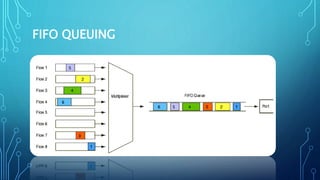
• FIFO Queuing:
• First In First Out
• The packet waits in a buffer or a queue until the node is ready to process them
• If the queue is full, the incoming packets are discarded
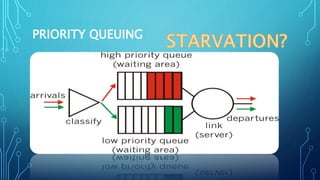
• Priority Queuing
• Weighted Fair Queuing: It is similar to priority queue but some weights are
assigned based on the priority of queue. The process uses rotating switch
in order to justify fair selection of the packets
FIFO QUEUING
PRIORITY QUEUING
WEIGHTED FAIR QUEUE

Basics of Network Traffic Management

  • 1.
  • 2.
    INTRODUCTION • The trafficis basically a flow of packets or data in the network • The regulation of traffic into the point of networks to improve the service that network provides • The traffic management aims of having fair or equitable allocation of network resources for adaptive applications • For performance guarantee of non adaptive applications, the traffic management can be achieved by using certain algorithms • Leaky Bucket • Token Algorithms
  • 3.
    QOS(QUALITY OF SERVICE) •Create an appropriate environment for the traffic • QoS controls and manages network resources by setting priorities for specific types of data on the network. • For many organizations, QoS is included in the service-level agreement (SLA) with their network service provider to guarantee a certain level of performance.
  • 4.
    QOS PARAMETERS • PacketLoss: happens when network links become congested and routers and switches start dropping packets. Eg –voice/video call drop • Jitter: Variation of delays in the call as a result of network congestion, time drifting and route changes. Eg- Quality of Video Call • Latency: The time taken by packet to travel from source to destination. Eg- high latency leads to echo and overlapping voice/video call • Bandwidth: The capacity of network to transmit the maximum amount of data from source to destination in a given amount of time. Eg- Setting Priorities on increased requirements • Mean Opinion Score(MOS): The metric to rate voice quality ranging from 0 to 5. Rating 5 being the best one.
  • 5.
    TECHNIQUES TO IMPROVEQOS • Also referred to as ‘Scheduling Techniques’ • FIFO Queuing: • First In First Out • The packet waits in a buffer or a queue until the node is ready to process them • If the queue is full, the incoming packets are discarded • Priority Queuing • Weighted Fair Queuing: It is similar to priority queue but some weights are assigned based on the priority of queue. The process uses rotating switch in order to justify fair selection of the packets
  • 6.
  • 7.
  • 8.