Top-Down Network Design
Chapter Seven
Selecting Switching and Routing Protocols
Copyright 2010 Cisco Press & Priscilla Oppenheimer
Switching and Routing Choices
• Switching
– Layer 2 transparent bridging (switching)
– Multilayer switching
– Spanning Tree Protocol enhancements
– VLAN technologies
• Routing
– Static or dynamic
– Distance-vector and link-state protocols
– Interior and exterior
– Etc.
Selection Criteria for Switching
and Routing Protocols
• Network traffic characteristics
• Bandwidth, memory, and CPU usage
• The number of peers supported
• The capability to adapt to changes quickly
• Support for authentication
Making Decisions
• Goals must be established
• Many options should be explored
• The consequences of the decision should be
investigated
• Contingency plans should be made
• A decision table can be used
Example Decision Table
Transparent Bridging (Switching)
Tasks
• Forward frames transparently
• Learn which port to use for each MAC
address
• Flood frames when the destination
unicast address hasn’t been learned yet
• Filter frames from going out ports that
don’t include the destination address
• Flood broadcasts and multicasts
Switching Table on a Bridge or
Switch
MAC Address Port
1
2
3
08-00-07-06-41-B9
00-00-0C-60-7C-01
00-80-24-07-8C-02
Cisco Spanning Tree Protocol
Enhancements
• PortFast
• UplinkFast and Backbone Fast
• Unidirectional link detection
• Loop Guard
Redundant Uplinks
Access
Layer
Distribution
Layer
Core
Layer
Switch A
Switch B Switch C
Primary
Uplink
Secondary
UplinkX
X
X = blocked by STP
• If a link fails, how long will STP take to recover?
• Use UplinkFast to speed convergence
Protocols for Transporting
VLAN Information
• Inter-Switch Link (ISL)
– Tagging protocol
– Cisco proprietary
• IEEE 802.1Q
– Tagging protocol
– IEEE standard
• VLAN Trunk Protocol (VTP)
– VLAN management protocol
Selecting Routing Protocols
• They all have the same general goal:
– To share network reachability information
among routers
• They differ in many ways:
– Interior versus exterior
– Metrics supported
– Dynamic versus static and default
– Distance-vector versus link-sate
– Classful versus classless
– Scalability
Interior Versus Exterior Routing
Protocols
• Interior routing protocols are used within an
autonomous system
• Exterior routing protocols are used between
autonomous systems
Autonomous system (two definitions that are often used):
“A set of routers that presents a common routing policy to the
internetwork”
“A network or set of networks that are under the administrative control of
a single entity”
Routing Protocol Metrics
• Metric: the determining factor used by a routing
algorithm to decide which route to a network is
better than another
• Examples of metrics:
– Bandwidth - capacity
– Delay - time
– Load - amount of network traffic
– Reliability - error rate
– Hop count - number of routers that a packet must
travel through before reaching the destination network
– Cost - arbitrary value defined by the protocol or
administrator
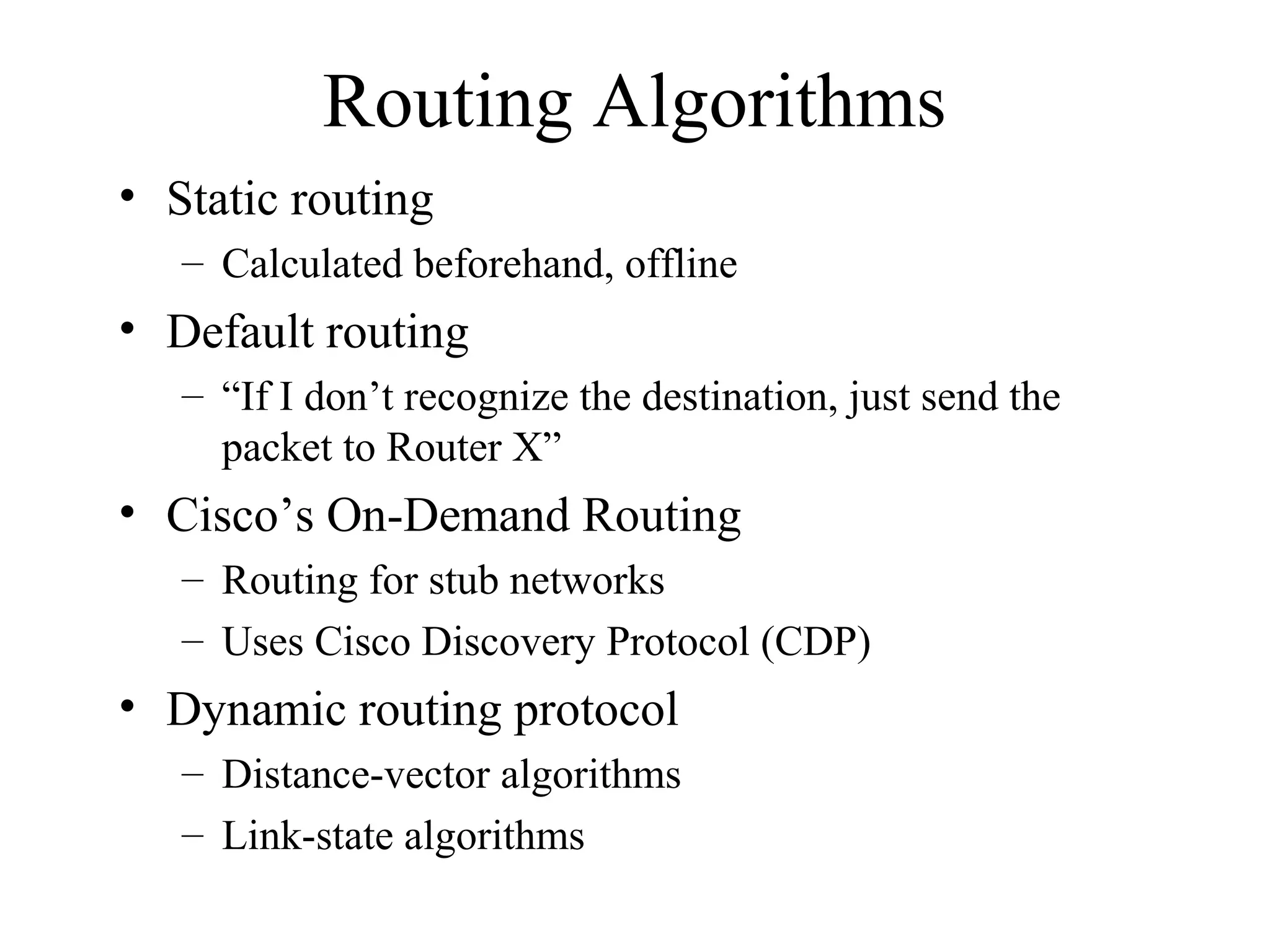
Routing Algorithms
• Static routing
– Calculated beforehand, offline
• Default routing
– “If I don’t recognize the destination, just send the
packet to Router X”
• Cisco’s On-Demand Routing
– Routing for stub networks
– Uses Cisco Discovery Protocol (CDP)
• Dynamic routing protocol
– Distance-vector algorithms
– Link-state algorithms
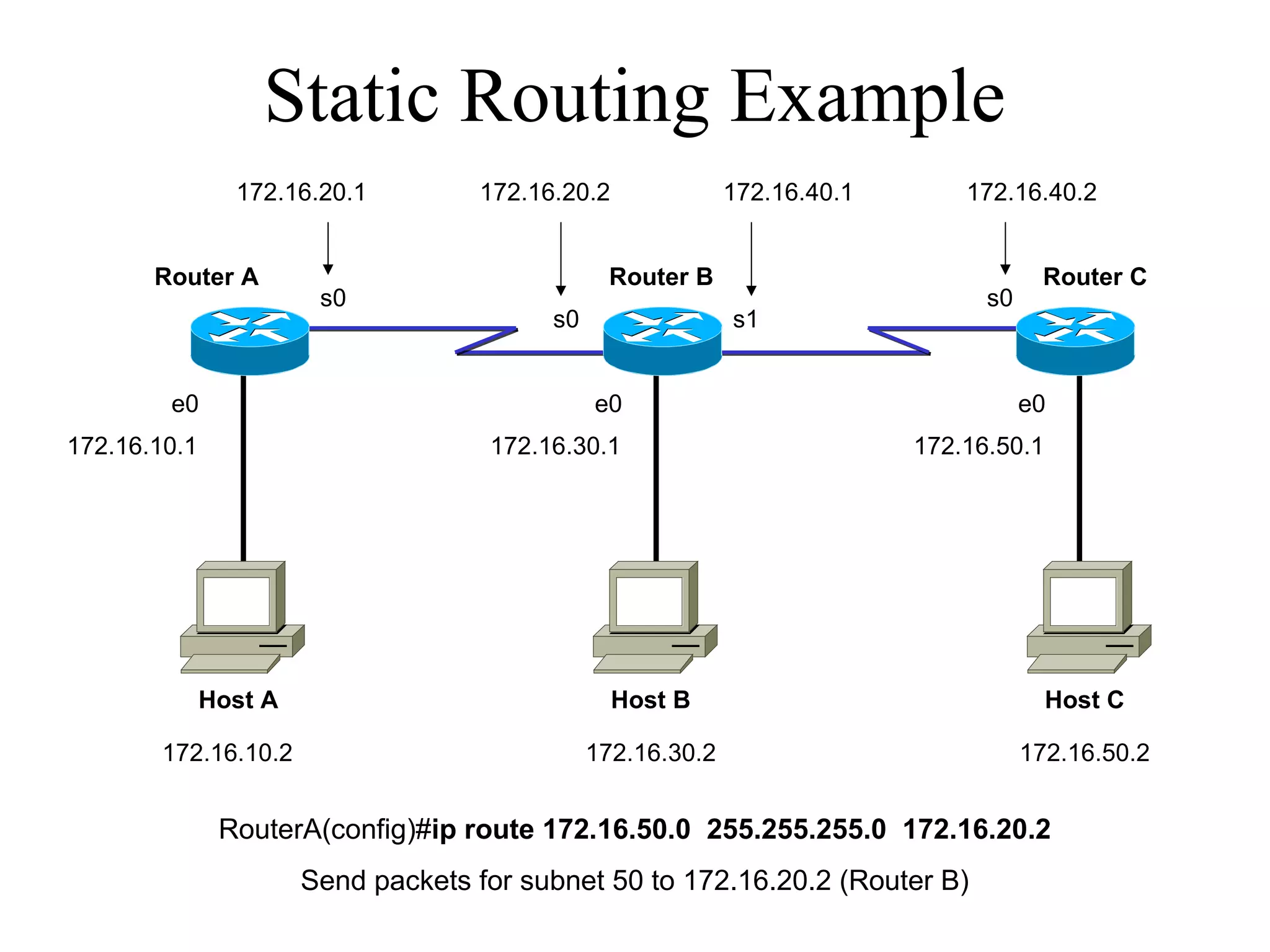
Static Routing Example
RouterA(config)#ip route 172.16.50.0 255.255.255.0 172.16.20.2
Send packets for subnet 50 to 172.16.20.2 (Router B)
e0 e0e0
s0 s1
s0 s0
Router A Router B Router C
Host A Host CHost B
172.16.10.2 172.16.30.2 172.16.50.2
172.16.20.1 172.16.40.1
172.16.10.1 172.16.30.1 172.16.50.1
172.16.20.2 172.16.40.2
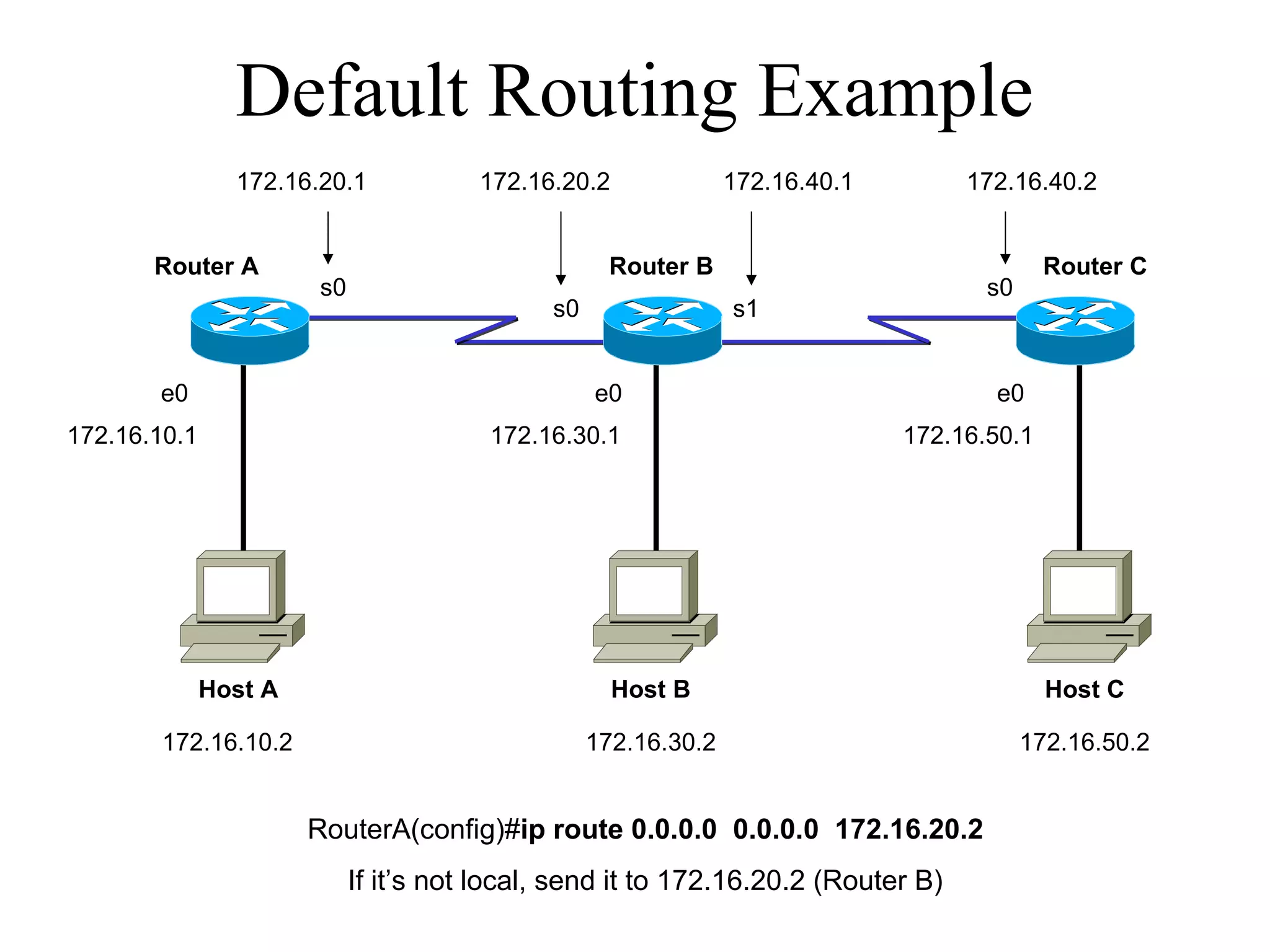
Default Routing Example
RouterA(config)#ip route 0.0.0.0 0.0.0.0 172.16.20.2
If it’s not local, send it to 172.16.20.2 (Router B)
e0 e0e0
s0 s1
s0 s0
Router A Router B Router C
Host A Host CHost B
172.16.10.2 172.16.30.2 172.16.50.2
172.16.20.1 172.16.40.1
172.16.10.1 172.16.30.1 172.16.50.1
172.16.20.2 172.16.40.2
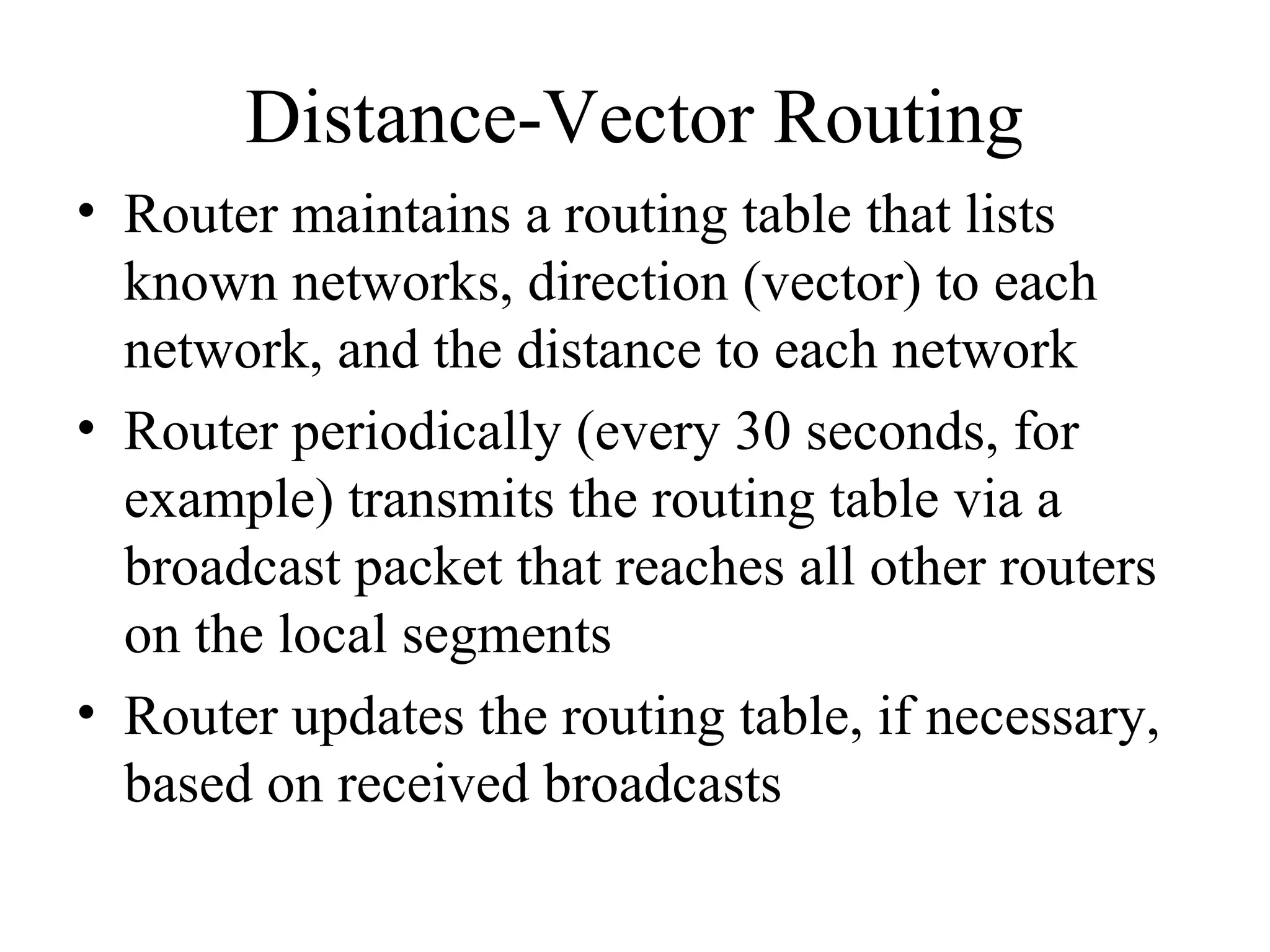
Distance-Vector Routing
• Router maintains a routing table that lists
known networks, direction (vector) to each
network, and the distance to each network
• Router periodically (every 30 seconds, for
example) transmits the routing table via a
broadcast packet that reaches all other routers
on the local segments
• Router updates the routing table, if necessary,
based on received broadcasts
Distance-Vector Routing Tables
Router A Router B
172.16.0.0 192.168.2.0
Network Distance Send To
172.16.0.0 0 Port 1
192.168.2.0 1 Router B
Network Distance Send To
192.168.2.0 0 Port 1
172.16.0.0 1 Router A
Router A’s Routing Table Router B’s Routing Table
Link-State Routing
• Routers send updates only when there’s a
change
• Router that detects change creates a link-state
advertisement (LSA) and sends it to neighbors
• Neighbors propagate the change to their
neighbors
• Routers update their topological database if
necessary
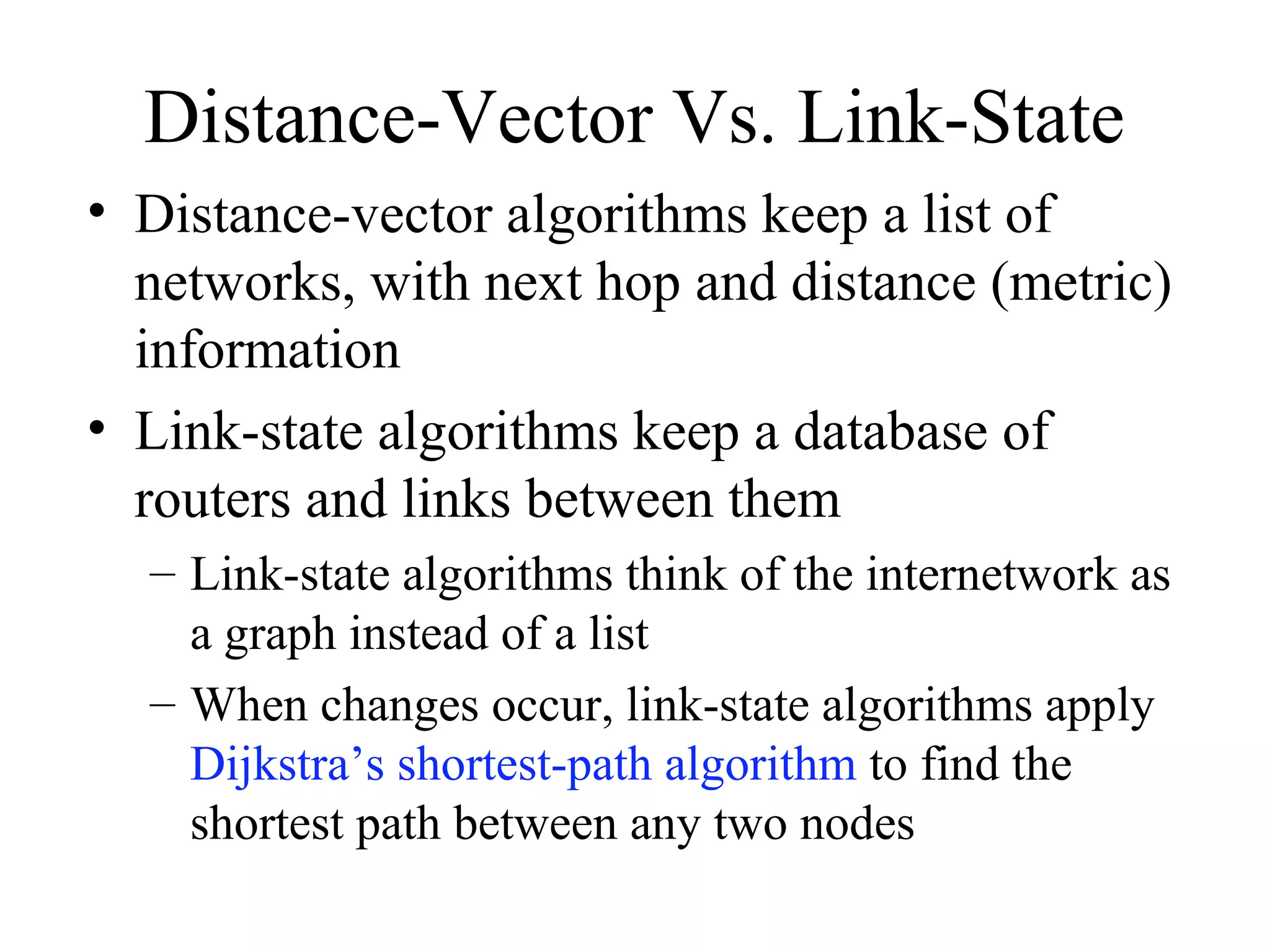
Distance-Vector Vs. Link-State
• Distance-vector algorithms keep a list of
networks, with next hop and distance (metric)
information
• Link-state algorithms keep a database of
routers and links between them
– Link-state algorithms think of the internetwork as
a graph instead of a list
– When changes occur, link-state algorithms apply
Dijkstra’s shortest-path algorithm to find the
shortest path between any two nodes
Choosing Between Distance-
Vector and Link-State
Choose Distance-Vector
• Simple, flat topology
• Hub-and-spoke topology
• Junior network administrators
• Convergence time not a big
concern
Choose Link-State
• Hierarchical topology
• More senior network
administrators
• Fast convergence is critical
Dynamic IP Routing Protocols
Distance-Vector
• Routing Information Protocol
(RIP) Version 1 and 2
• Interior Gateway Routing
Protocol (IGRP)
• Enhanced IGRP
• Border Gateway Protocol
(BGP)
Link-State
• Open Shortest Path First
(OSPF)
• Intermediate System-to-
Intermediate System (IS-IS)
Routing Information Protocol (RIP)
• First standard routing protocol developed for TCP/IP
environments
– RIP Version 1 is documented in RFC 1058 (1988)
– RIP Version 2 is documented in RFC 2453 (1998)
• Easy to configure and troubleshoot
• Broadcasts its routing table every 30 seconds; 25 routes per
packet
• Uses a single routing metric (hop count) to measure the
distance to a destination network; max hop count is 15
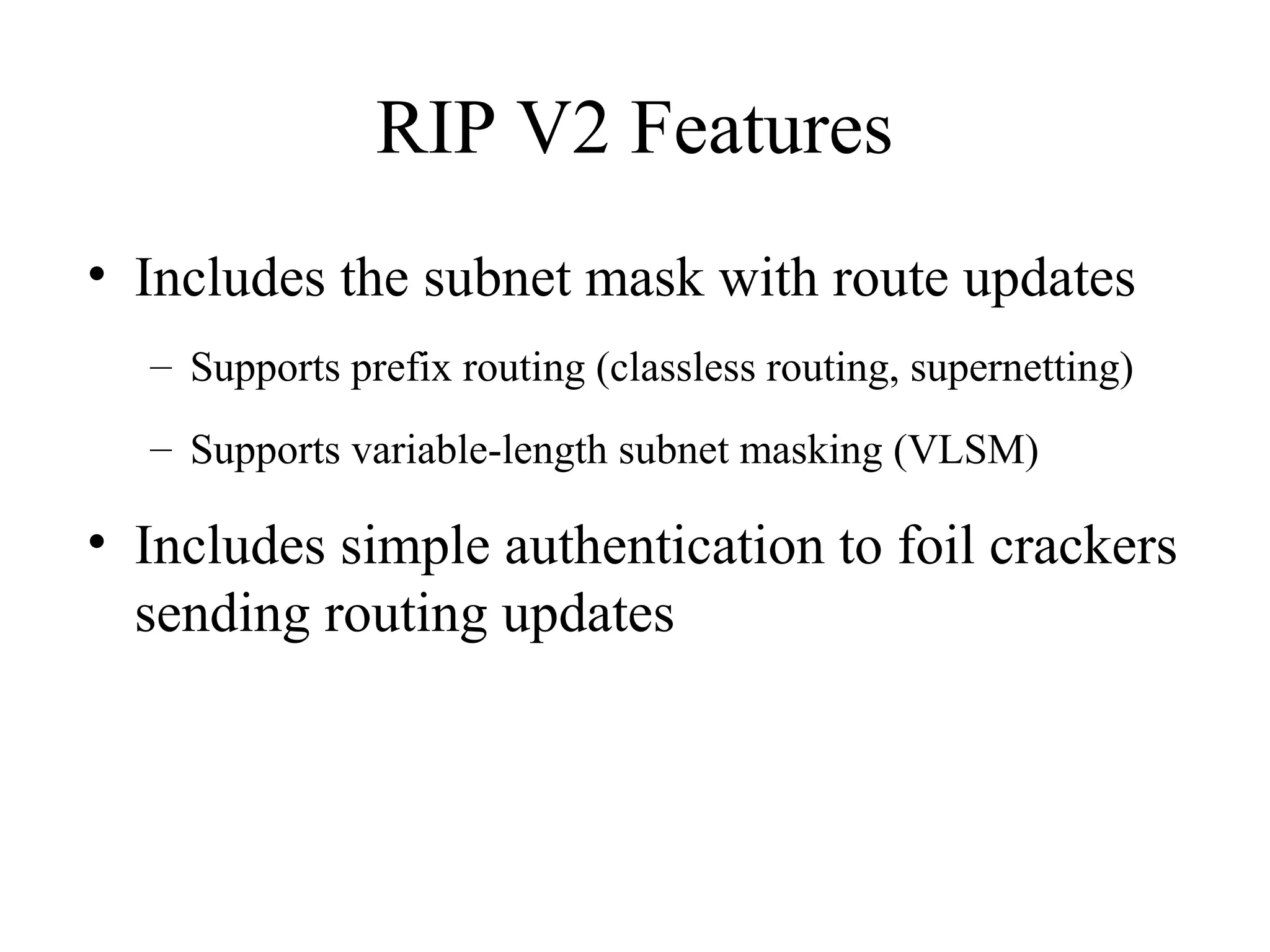
RIP V2 Features
• Includes the subnet mask with route updates
– Supports prefix routing (classless routing, supernetting)
– Supports variable-length subnet masking (VLSM)
• Includes simple authentication to foil crackers
sending routing updates
IGRP Solved Problems with RIP
• 15-hop limitation in RIP
– IGRP supports 255 hops
• Reliance on just one metric (hop count)
– IGRP uses bandwidth, delay, reliability, load
– (By default just uses bandwidth and delay)
• RIP's 30-second update timer
– IGRP uses 90 seconds
EIGRP
• Adjusts to changes in internetwork very
quickly
• Incremental updates contain only changes,
not full routing table
• Updates are delivered reliably
• Router keeps track of neighbors’ routing
tables and uses them as feasible successor
• Same metric as IGRP, but more granularity
(32 bits instead of 24 bits)
Open Shortest Path First (OSPF)
• Open standard, defined in RFC 2328
• Adjusts to changes quickly
• Supports very large internetworks
• Does not use a lot of bandwidth
• Authenticates protocol exchanges to
meet security goals
OSPF Metric
• A single dimensionless value called cost. A
network administrator assigns an OSPF cost
to each router interface on the path to a
network. The lower the cost, the more likely
the interface is to be used to forward data
traffic.
• On a Cisco router, the cost of an interface
defaults to 100,000,000 divided by the
bandwidth for the interface. For example, a
100-Mbps Ethernet interface has a cost of 1.
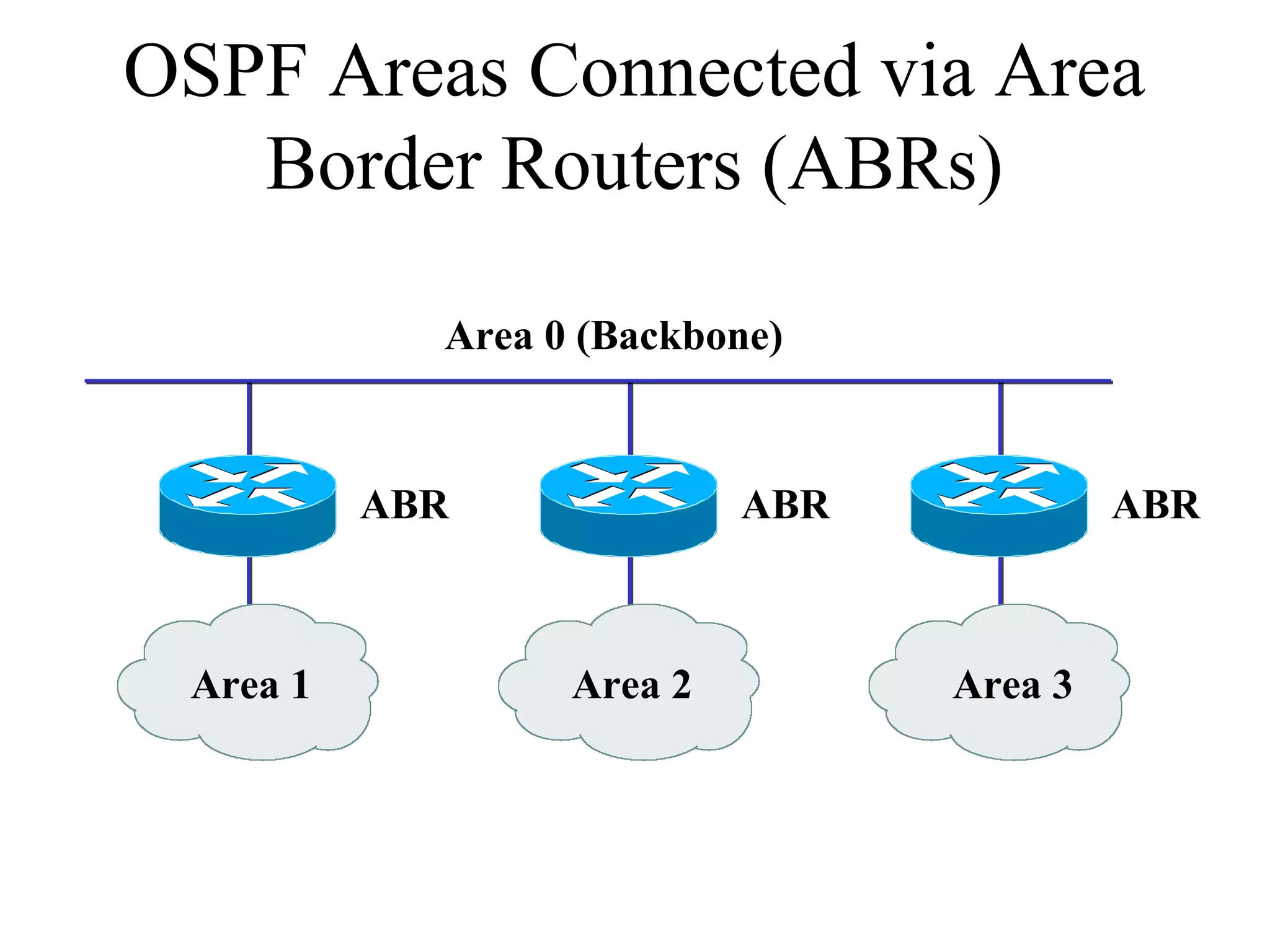
OSPF Areas Connected via Area
Border Routers (ABRs)
Area 1 Area 3Area 2
Area 0 (Backbone)
ABR ABRABR
IS-IS
• Intermediate System-to-Intermediate
System
• Link-state routing protocol
• Designed by the ISO for the OSI protocols
• Integrated IS-IS handles IP also
Border Gateway Protocol (BGP)
• Allows routers in different autonomous
systems to exchange routing information
– Exterior routing protocol
– Used on the Internet among large ISPs and major
companies
• Supports route aggregation
• Main metric is the length of the list of
autonomous system numbers, but BGP also
supports routing based on policies
Summary
• The selection of switching and routing
protocols should be based on an analysis of
– Goals
– Scalability and performance characteristics of the
protocols
• Transparent bridging is used on modern
switches
– But other choices involve enhancements to STP
and protocols for transporting VLAN information
• There are many types of routing protocols and
many choices within each type
Review Questions
• What are some options for enhancing the
Spanning Tree Protocol?
• What factors will help you decide whether
distance-vector or link-state routing is best for
your design customer?
• What factors will help you select a specific
routing protocol?
• Why do static and default routing still play a
role in many modern network designs?

Chapter07

  • 1.
    Top-Down Network Design ChapterSeven Selecting Switching and Routing Protocols Copyright 2010 Cisco Press & Priscilla Oppenheimer
  • 2.
    Switching and RoutingChoices • Switching – Layer 2 transparent bridging (switching) – Multilayer switching – Spanning Tree Protocol enhancements – VLAN technologies • Routing – Static or dynamic – Distance-vector and link-state protocols – Interior and exterior – Etc.
  • 3.
    Selection Criteria forSwitching and Routing Protocols • Network traffic characteristics • Bandwidth, memory, and CPU usage • The number of peers supported • The capability to adapt to changes quickly • Support for authentication
  • 4.
    Making Decisions • Goalsmust be established • Many options should be explored • The consequences of the decision should be investigated • Contingency plans should be made • A decision table can be used
  • 5.
  • 6.
    Transparent Bridging (Switching) Tasks •Forward frames transparently • Learn which port to use for each MAC address • Flood frames when the destination unicast address hasn’t been learned yet • Filter frames from going out ports that don’t include the destination address • Flood broadcasts and multicasts
  • 7.
    Switching Table ona Bridge or Switch MAC Address Port 1 2 3 08-00-07-06-41-B9 00-00-0C-60-7C-01 00-80-24-07-8C-02
  • 8.
    Cisco Spanning TreeProtocol Enhancements • PortFast • UplinkFast and Backbone Fast • Unidirectional link detection • Loop Guard
  • 9.
    Redundant Uplinks Access Layer Distribution Layer Core Layer Switch A SwitchB Switch C Primary Uplink Secondary UplinkX X X = blocked by STP • If a link fails, how long will STP take to recover? • Use UplinkFast to speed convergence
  • 10.
    Protocols for Transporting VLANInformation • Inter-Switch Link (ISL) – Tagging protocol – Cisco proprietary • IEEE 802.1Q – Tagging protocol – IEEE standard • VLAN Trunk Protocol (VTP) – VLAN management protocol
  • 11.
    Selecting Routing Protocols •They all have the same general goal: – To share network reachability information among routers • They differ in many ways: – Interior versus exterior – Metrics supported – Dynamic versus static and default – Distance-vector versus link-sate – Classful versus classless – Scalability
  • 12.
    Interior Versus ExteriorRouting Protocols • Interior routing protocols are used within an autonomous system • Exterior routing protocols are used between autonomous systems Autonomous system (two definitions that are often used): “A set of routers that presents a common routing policy to the internetwork” “A network or set of networks that are under the administrative control of a single entity”
  • 13.
    Routing Protocol Metrics •Metric: the determining factor used by a routing algorithm to decide which route to a network is better than another • Examples of metrics: – Bandwidth - capacity – Delay - time – Load - amount of network traffic – Reliability - error rate – Hop count - number of routers that a packet must travel through before reaching the destination network – Cost - arbitrary value defined by the protocol or administrator
  • 14.
    Routing Algorithms • Staticrouting – Calculated beforehand, offline • Default routing – “If I don’t recognize the destination, just send the packet to Router X” • Cisco’s On-Demand Routing – Routing for stub networks – Uses Cisco Discovery Protocol (CDP) • Dynamic routing protocol – Distance-vector algorithms – Link-state algorithms
  • 15.
    Static Routing Example RouterA(config)#iproute 172.16.50.0 255.255.255.0 172.16.20.2 Send packets for subnet 50 to 172.16.20.2 (Router B) e0 e0e0 s0 s1 s0 s0 Router A Router B Router C Host A Host CHost B 172.16.10.2 172.16.30.2 172.16.50.2 172.16.20.1 172.16.40.1 172.16.10.1 172.16.30.1 172.16.50.1 172.16.20.2 172.16.40.2
  • 16.
    Default Routing Example RouterA(config)#iproute 0.0.0.0 0.0.0.0 172.16.20.2 If it’s not local, send it to 172.16.20.2 (Router B) e0 e0e0 s0 s1 s0 s0 Router A Router B Router C Host A Host CHost B 172.16.10.2 172.16.30.2 172.16.50.2 172.16.20.1 172.16.40.1 172.16.10.1 172.16.30.1 172.16.50.1 172.16.20.2 172.16.40.2
  • 17.
    Distance-Vector Routing • Routermaintains a routing table that lists known networks, direction (vector) to each network, and the distance to each network • Router periodically (every 30 seconds, for example) transmits the routing table via a broadcast packet that reaches all other routers on the local segments • Router updates the routing table, if necessary, based on received broadcasts
  • 18.
    Distance-Vector Routing Tables RouterA Router B 172.16.0.0 192.168.2.0 Network Distance Send To 172.16.0.0 0 Port 1 192.168.2.0 1 Router B Network Distance Send To 192.168.2.0 0 Port 1 172.16.0.0 1 Router A Router A’s Routing Table Router B’s Routing Table
  • 19.
    Link-State Routing • Routerssend updates only when there’s a change • Router that detects change creates a link-state advertisement (LSA) and sends it to neighbors • Neighbors propagate the change to their neighbors • Routers update their topological database if necessary
  • 20.
    Distance-Vector Vs. Link-State •Distance-vector algorithms keep a list of networks, with next hop and distance (metric) information • Link-state algorithms keep a database of routers and links between them – Link-state algorithms think of the internetwork as a graph instead of a list – When changes occur, link-state algorithms apply Dijkstra’s shortest-path algorithm to find the shortest path between any two nodes
  • 21.
    Choosing Between Distance- Vectorand Link-State Choose Distance-Vector • Simple, flat topology • Hub-and-spoke topology • Junior network administrators • Convergence time not a big concern Choose Link-State • Hierarchical topology • More senior network administrators • Fast convergence is critical
  • 22.
    Dynamic IP RoutingProtocols Distance-Vector • Routing Information Protocol (RIP) Version 1 and 2 • Interior Gateway Routing Protocol (IGRP) • Enhanced IGRP • Border Gateway Protocol (BGP) Link-State • Open Shortest Path First (OSPF) • Intermediate System-to- Intermediate System (IS-IS)
  • 23.
    Routing Information Protocol(RIP) • First standard routing protocol developed for TCP/IP environments – RIP Version 1 is documented in RFC 1058 (1988) – RIP Version 2 is documented in RFC 2453 (1998) • Easy to configure and troubleshoot • Broadcasts its routing table every 30 seconds; 25 routes per packet • Uses a single routing metric (hop count) to measure the distance to a destination network; max hop count is 15
  • 24.
    RIP V2 Features •Includes the subnet mask with route updates – Supports prefix routing (classless routing, supernetting) – Supports variable-length subnet masking (VLSM) • Includes simple authentication to foil crackers sending routing updates
  • 25.
    IGRP Solved Problemswith RIP • 15-hop limitation in RIP – IGRP supports 255 hops • Reliance on just one metric (hop count) – IGRP uses bandwidth, delay, reliability, load – (By default just uses bandwidth and delay) • RIP's 30-second update timer – IGRP uses 90 seconds
  • 26.
    EIGRP • Adjusts tochanges in internetwork very quickly • Incremental updates contain only changes, not full routing table • Updates are delivered reliably • Router keeps track of neighbors’ routing tables and uses them as feasible successor • Same metric as IGRP, but more granularity (32 bits instead of 24 bits)
  • 27.
    Open Shortest PathFirst (OSPF) • Open standard, defined in RFC 2328 • Adjusts to changes quickly • Supports very large internetworks • Does not use a lot of bandwidth • Authenticates protocol exchanges to meet security goals
  • 28.
    OSPF Metric • Asingle dimensionless value called cost. A network administrator assigns an OSPF cost to each router interface on the path to a network. The lower the cost, the more likely the interface is to be used to forward data traffic. • On a Cisco router, the cost of an interface defaults to 100,000,000 divided by the bandwidth for the interface. For example, a 100-Mbps Ethernet interface has a cost of 1.
  • 29.
    OSPF Areas Connectedvia Area Border Routers (ABRs) Area 1 Area 3Area 2 Area 0 (Backbone) ABR ABRABR
  • 30.
    IS-IS • Intermediate System-to-Intermediate System •Link-state routing protocol • Designed by the ISO for the OSI protocols • Integrated IS-IS handles IP also
  • 31.
    Border Gateway Protocol(BGP) • Allows routers in different autonomous systems to exchange routing information – Exterior routing protocol – Used on the Internet among large ISPs and major companies • Supports route aggregation • Main metric is the length of the list of autonomous system numbers, but BGP also supports routing based on policies
  • 32.
    Summary • The selectionof switching and routing protocols should be based on an analysis of – Goals – Scalability and performance characteristics of the protocols • Transparent bridging is used on modern switches – But other choices involve enhancements to STP and protocols for transporting VLAN information • There are many types of routing protocols and many choices within each type
  • 33.
    Review Questions • Whatare some options for enhancing the Spanning Tree Protocol? • What factors will help you decide whether distance-vector or link-state routing is best for your design customer? • What factors will help you select a specific routing protocol? • Why do static and default routing still play a role in many modern network designs?