1
Network Design and Management
By Thomas Lerell
2
Network Design and Management
Introduction
Properly designing a computer network is a difficult task. It
requires planning and analysis, feasibility studies, capacity
planning, and baseline creation skills.
Performing network management is difficult too. A network

manager must possess computer and people skills, management
skills, financial skills, and be able to keep up with changing
technology.
3
Network Design and Management
Systems Development Life Cycle (SDLC)
Every business has a number of goals.
System planners and management personnel within a company
try to generate a set of questions, or problems, to help the
company achieve those goals.
To properly understand a problem, analyze all possible
solutions, select the best solution, and implement and maintain
the solution, you need to follow a well-defined plan.
SDLC is a methodology, or plan, for a structured approach to
the development of a business system.
4
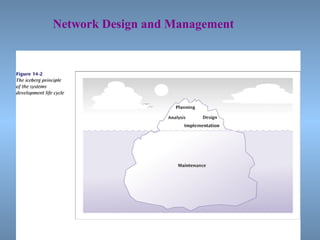
Systems Development Life Cycle
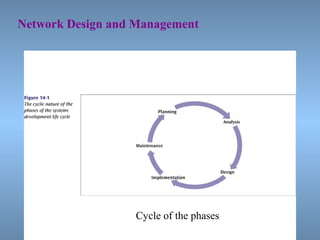
SDLC involves several phases. These phases are often:
• Planning
• Analysis
• Design
• Implementation
• Maintenance
These phases are cyclical and usually never ending.
5
Network Design and Management
Cycle of the phases
6
Network Design and Management
Systems Development Life Cycle
A systems analyst is typically responsible for managing a
project and following the SDLC phases.
Anyone, however, may be called upon to assist a systems
analyst.
Or anyone may have to assume some of the duties of a systems
analyst.
Individuals that are called upon to support a computer network
should understand the basic phases of SDLC.
7
Network Design and Management
Systems Development Life Cycle
Planning Phase - Identify problems, opportunities, and
objectives.
Analysis Phase - Determine information requirements.
Information requirements can be gathered by sampling and
collecting hard data, interviewing, questionnaires, observing
environments, and prototyping.
Design Phase - Design the system that was recommended and
approved at the end of the analysis phase.
8
Network Design and Management
Systems Development Life Cycle
Implementation Phase - The system is installed and preparations
are made to move from the old system to the new.
Maintenance Phase - The longest phase, involves the ongoing
maintenance of the project.
Maintenance may require personnel to return to an earlier phase
to perform an update.
9
Network Design and Management
10
Network Design and Management
Network Modeling
When updating or creating a new computer system, the analyst
will create a set of models for both the existing system (if there
is one) and the proposed system.
Network models can either demonstrate the current state of the
network or can model the desired computer network.
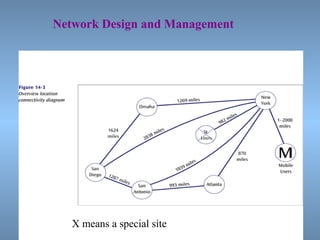
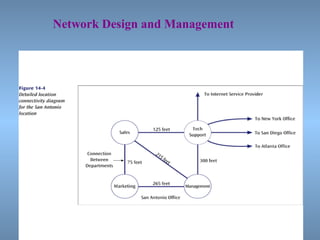
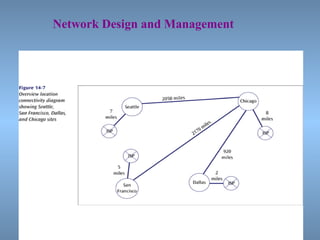
A location connectivity diagram is a network modeling tool that
depicts the various locations involved in a a network and the
interconnections between those locations.
11
Network Design and Management
Network Modeling
An overview location connectivity diagram shows the big
picture of geographic locations of network facilities.
External users and mobile users can be identified, as well as the
locations primary to a business.
A detailed location connectivity diagram is a close-up model of
a single location and the networks that reside at the location.
Working groups and the distances between those groups can be
identified with a detailed diagram.
12
Network Design and Management
X means a special site
13
Network Design and Management
14
Feasibility Studies
There are a number of ways to determine if a proposed system
is going to be feasible.
Technically feasible means the proposed system can be created
and implemented using currently existing technology.
It can be done.
Financially feasible means the proposed system can be built
given the company’s current financial ability.
We can afford it.
Operationally feasible means the system operates as designed
and implemented.
It’ll work after we build it and it will be used.
15
Feasibility Studies
Time feasible means the system can be constructed in an agreed
upon time frame.
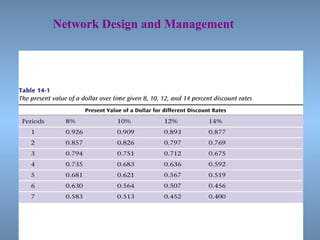
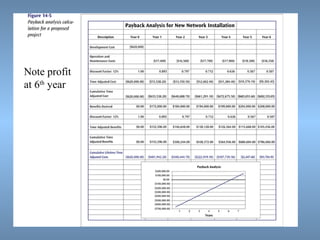
Payback analysis ascertains costs and benefits of proposed
system usually on an annual basis.
Payback analysis is a good technique to use to determine
financial feasibility.
To calculate payback analysis, you must know all the expenses
that will be incurred to create and maintain the system, as well
as all possible income derived from the system.
You must also be aware of the time value of money (a dollar
today is worth more than one dollar promised a year from now
because the dollar can be invested).
16
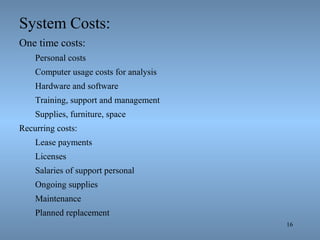
System Costs:
One time costs:
Personal costs
Computer usage costs for analysis
Hardware and software
Training, support and management
Supplies, furniture, space
Recurring costs:
Lease payments
Licenses
Salaries of support personal
Ongoing supplies
Maintenance
Planned replacement
17
Network Design and Management
18
Note profit
at 6th
year
19
Network Design and Management
Capacity Planning
Capacity planning involves trying to determine the amount of
network bandwidth necessary to support an application or a set
of applications.
A number of techniques exist for performing capacity planning,
including linear projection, computer simulation, benchmarking,
and analytical modeling.
Linear projection involves predicting one or more network
capacities based on the current network parameters and
multiplying by some constant.
20
Network Design and Management
Capacity Planning
A computer simulation involves modeling an existing system or
proposed system using a computer-based simulation tool.
Benchmarking involves generating system statistics under a
controlled environment and then comparing those statistics
against known measurements.
Analytical modeling involves the creation of mathematical
equations to calculate various network values.
21
Network Design and Management
Creating a Baseline
Involves the measurement and recording of a network’s state of
operation over a given period of time.
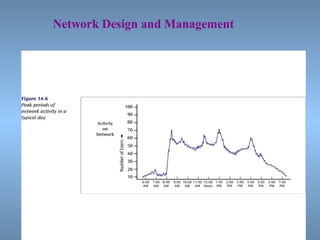
A baseline can be used to determine current network
performance and to help determine future network needs.
Baseline studies should be ongoing projects, and not something
started and stopped every so many years.
22
Network Design and Management
Creating a Baseline
To perform a baseline study, you should:
• Collect information on number and type of system nodes,
including workstations, routers, bridges, switches, hubs, and
servers.
• Create an up-to-date roadmap of all nodes along with model
numbers, serial numbers and any address information such as IP
or Ethernet addresses.
• Collect information on operational protocols used throughout
the system.
23
Network Design and Management
Creating a Baseline
To perform a baseline study, you should:
• List all network applications, including the number, type and
utilization level.
• Create a fairly extensive list of statistics to help meet your
goals. These statistics can include average network utilization,
peak network utilization, average frame size, peak frame size,
average frames per second, peak frames per second, total
network collisions, network collisions per second, total runts,
total jabbers, total CRC errors, and nodes with highest
percentage of utilization.
24
Network Design and Management
25
Network Design and Management
Network Manager Skills
A good network manager will possess many skills:
• Computer skills
• People skills
• Management skills
• Financial planning skills
• Knowledge of statistics
• Speaking and writing skills
26
Generating Useable Statistics
Statistics, properly generated, can be an invaluable aid to
demonstrating current system demands and predicting future
needs.
Mean time between failures (MTBF)
Mean time to repair (MTTR)
Availability is the probability that a particular component or
system will be available during a fixed time period
Reliability is the probability that over a period of time the
particular component or device will be available
27
Generating Useable Statistics
Mean time between failures (MTBF) is the average time a
device or system will operate before it fails.
(from the manufacturer!)
Large or small?
Mean time to repair (MTTR) is the average time necessary to
repair a failure within the computer system.
Includes swap time, time to bring the system back up, replacement time,
etc.
Large or small?
28
Generating Useable Statistics
Availability is the probability that a particular component or
system will be available during a fixed time period.
A(t) = a/(a+b) + b/(a+b) x e-(a+b)t
A = 1 means the system is nearly always operational
in which: a = 1/MTTR
b = 1/MTBF
e = natural log function
t = the time interval
29
Generating Useable Statistics
Suppose we want to calculate the availability of a modem that has a
MTBF of 3000 hours and a MTTR of 1 hour. The availability of
this modem for an 8-hour period is:
a = 1/1
b = 1/3000 = 0.00033
A(8 hours) =1/(1 + 0.00033) + 0.00033/(1 + 0.00033) x e-(1 + 0.00033)8
= 0.9997 + 0.00033 x 0.000335
= 0.9997
Not available 3 out of 10,000 times you want it.
30
Network Design and Management
Generating Useable Statistics
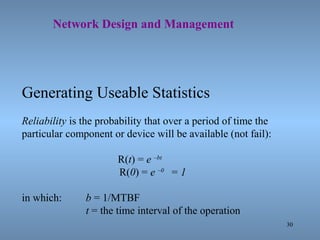
Reliability is the probability that over a period of time the
particular component or device will be available (not fail):
R(t) = e –bt
R(0) = e –0
= 1
in which: b = 1/MTBF
t = the time interval of the operation
31
Network Design and Management
Generating Useable Statistics
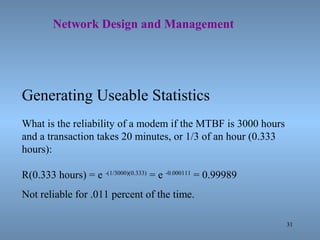
What is the reliability of a modem if the MTBF is 3000 hours
and a transaction takes 20 minutes, or 1/3 of an hour (0.333
hours):
R(0.333 hours) = e -(1/3000)(0.333)
= e -0.000111
= 0.99989
Not reliable for .011 percent of the time.
32
Network Design and Management
Generating Useable Statistics
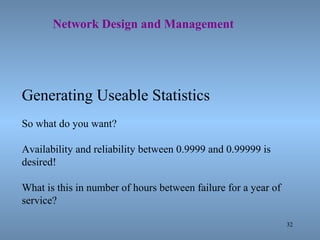
So what do you want?
Availability and reliability between 0.9999 and 0.99999 is
desired!
What is this in number of hours between failure for a year of
service?
33
Network Design and Management
Managing Operations
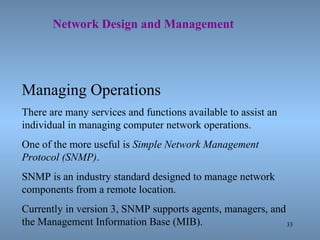
There are many services and functions available to assist an
individual in managing computer network operations.
One of the more useful is Simple Network Management
Protocol (SNMP).
SNMP is an industry standard designed to manage network
components from a remote location.
Currently in version 3, SNMP supports agents, managers, and
the Management Information Base (MIB).
34
Network Design and Management
Managing Operations
A managed element has management software, called an agent,
running in it.
A second object, the SNMP manager, controls the operations of
a managed element and maintains a database of information
about all managed elements.
A manager can query an agent to return current operating
values, or can instruct an agent to perform a particular action.
The Management Information Base (MIB) is a collection of
information that is organized hierarchically and describes the
operating parameters of all managed agents.
35
Network Design and Management
Managing Operations
SNMP operates on a network between the application layer and
the UDP/IP layer (not TCP/IP) – the transport layer.
36
Network Design and Management
Network Diagnostic Tools
To assist a network support person, a number of diagnostic tools
are available:
• Electrical testers (voltage, etc.)
• Cable testers (open circuits, etc.)
• Network testers (view the entire network0
• Protocol analyzers (monitors packets)
37
Network Design and Management
Capacity Planning and Network Design In
Action: BringBring Corporation
Returning to BringBring Corporation from an earlier chapter,
let’s complete our design, including e-mail and Internet access
for each of the four sites.
A linear projection can be used to estimate the amount of
Internet traffic at each site.
An overview location connectivity diagram gives us a big
picture of the network interconnections.
38
Network Design and Management
39
Network Design and Management
Capacity Planning and Network Design In
Action: BringBring Corporation
A second linear projection can be used to determine the amount
of local area network traffic within each site.

Network Design and Management

  • 1.
    1 Network Design andManagement By Thomas Lerell
  • 2.
    2 Network Design andManagement Introduction Properly designing a computer network is a difficult task. It requires planning and analysis, feasibility studies, capacity planning, and baseline creation skills. Performing network management is difficult too. A network manager must possess computer and people skills, management skills, financial skills, and be able to keep up with changing technology.
  • 3.
    3 Network Design andManagement Systems Development Life Cycle (SDLC) Every business has a number of goals. System planners and management personnel within a company try to generate a set of questions, or problems, to help the company achieve those goals. To properly understand a problem, analyze all possible solutions, select the best solution, and implement and maintain the solution, you need to follow a well-defined plan. SDLC is a methodology, or plan, for a structured approach to the development of a business system.
  • 4.
    4 Systems Development LifeCycle SDLC involves several phases. These phases are often: • Planning • Analysis • Design • Implementation • Maintenance These phases are cyclical and usually never ending.
  • 5.
    5 Network Design andManagement Cycle of the phases
  • 6.
    6 Network Design andManagement Systems Development Life Cycle A systems analyst is typically responsible for managing a project and following the SDLC phases. Anyone, however, may be called upon to assist a systems analyst. Or anyone may have to assume some of the duties of a systems analyst. Individuals that are called upon to support a computer network should understand the basic phases of SDLC.
  • 7.
    7 Network Design andManagement Systems Development Life Cycle Planning Phase - Identify problems, opportunities, and objectives. Analysis Phase - Determine information requirements. Information requirements can be gathered by sampling and collecting hard data, interviewing, questionnaires, observing environments, and prototyping. Design Phase - Design the system that was recommended and approved at the end of the analysis phase.
  • 8.
    8 Network Design andManagement Systems Development Life Cycle Implementation Phase - The system is installed and preparations are made to move from the old system to the new. Maintenance Phase - The longest phase, involves the ongoing maintenance of the project. Maintenance may require personnel to return to an earlier phase to perform an update.
  • 9.
  • 10.
    10 Network Design andManagement Network Modeling When updating or creating a new computer system, the analyst will create a set of models for both the existing system (if there is one) and the proposed system. Network models can either demonstrate the current state of the network or can model the desired computer network. A location connectivity diagram is a network modeling tool that depicts the various locations involved in a a network and the interconnections between those locations.
  • 11.
    11 Network Design andManagement Network Modeling An overview location connectivity diagram shows the big picture of geographic locations of network facilities. External users and mobile users can be identified, as well as the locations primary to a business. A detailed location connectivity diagram is a close-up model of a single location and the networks that reside at the location. Working groups and the distances between those groups can be identified with a detailed diagram.
  • 12.
    12 Network Design andManagement X means a special site
  • 13.
  • 14.
    14 Feasibility Studies There area number of ways to determine if a proposed system is going to be feasible. Technically feasible means the proposed system can be created and implemented using currently existing technology. It can be done. Financially feasible means the proposed system can be built given the company’s current financial ability. We can afford it. Operationally feasible means the system operates as designed and implemented. It’ll work after we build it and it will be used.
  • 15.
    15 Feasibility Studies Time feasiblemeans the system can be constructed in an agreed upon time frame. Payback analysis ascertains costs and benefits of proposed system usually on an annual basis. Payback analysis is a good technique to use to determine financial feasibility. To calculate payback analysis, you must know all the expenses that will be incurred to create and maintain the system, as well as all possible income derived from the system. You must also be aware of the time value of money (a dollar today is worth more than one dollar promised a year from now because the dollar can be invested).
  • 16.
    16 System Costs: One timecosts: Personal costs Computer usage costs for analysis Hardware and software Training, support and management Supplies, furniture, space Recurring costs: Lease payments Licenses Salaries of support personal Ongoing supplies Maintenance Planned replacement
  • 17.
  • 18.
  • 19.
    19 Network Design andManagement Capacity Planning Capacity planning involves trying to determine the amount of network bandwidth necessary to support an application or a set of applications. A number of techniques exist for performing capacity planning, including linear projection, computer simulation, benchmarking, and analytical modeling. Linear projection involves predicting one or more network capacities based on the current network parameters and multiplying by some constant.
  • 20.
    20 Network Design andManagement Capacity Planning A computer simulation involves modeling an existing system or proposed system using a computer-based simulation tool. Benchmarking involves generating system statistics under a controlled environment and then comparing those statistics against known measurements. Analytical modeling involves the creation of mathematical equations to calculate various network values.
  • 21.
    21 Network Design andManagement Creating a Baseline Involves the measurement and recording of a network’s state of operation over a given period of time. A baseline can be used to determine current network performance and to help determine future network needs. Baseline studies should be ongoing projects, and not something started and stopped every so many years.
  • 22.
    22 Network Design andManagement Creating a Baseline To perform a baseline study, you should: • Collect information on number and type of system nodes, including workstations, routers, bridges, switches, hubs, and servers. • Create an up-to-date roadmap of all nodes along with model numbers, serial numbers and any address information such as IP or Ethernet addresses. • Collect information on operational protocols used throughout the system.
  • 23.
    23 Network Design andManagement Creating a Baseline To perform a baseline study, you should: • List all network applications, including the number, type and utilization level. • Create a fairly extensive list of statistics to help meet your goals. These statistics can include average network utilization, peak network utilization, average frame size, peak frame size, average frames per second, peak frames per second, total network collisions, network collisions per second, total runts, total jabbers, total CRC errors, and nodes with highest percentage of utilization.
  • 24.
  • 25.
    25 Network Design andManagement Network Manager Skills A good network manager will possess many skills: • Computer skills • People skills • Management skills • Financial planning skills • Knowledge of statistics • Speaking and writing skills
  • 26.
    26 Generating Useable Statistics Statistics,properly generated, can be an invaluable aid to demonstrating current system demands and predicting future needs. Mean time between failures (MTBF) Mean time to repair (MTTR) Availability is the probability that a particular component or system will be available during a fixed time period Reliability is the probability that over a period of time the particular component or device will be available
  • 27.
    27 Generating Useable Statistics Meantime between failures (MTBF) is the average time a device or system will operate before it fails. (from the manufacturer!) Large or small? Mean time to repair (MTTR) is the average time necessary to repair a failure within the computer system. Includes swap time, time to bring the system back up, replacement time, etc. Large or small?
  • 28.
    28 Generating Useable Statistics Availabilityis the probability that a particular component or system will be available during a fixed time period. A(t) = a/(a+b) + b/(a+b) x e-(a+b)t A = 1 means the system is nearly always operational in which: a = 1/MTTR b = 1/MTBF e = natural log function t = the time interval
  • 29.
    29 Generating Useable Statistics Supposewe want to calculate the availability of a modem that has a MTBF of 3000 hours and a MTTR of 1 hour. The availability of this modem for an 8-hour period is: a = 1/1 b = 1/3000 = 0.00033 A(8 hours) =1/(1 + 0.00033) + 0.00033/(1 + 0.00033) x e-(1 + 0.00033)8 = 0.9997 + 0.00033 x 0.000335 = 0.9997 Not available 3 out of 10,000 times you want it.
  • 30.
    30 Network Design andManagement Generating Useable Statistics Reliability is the probability that over a period of time the particular component or device will be available (not fail): R(t) = e –bt R(0) = e –0 = 1 in which: b = 1/MTBF t = the time interval of the operation
  • 31.
    31 Network Design andManagement Generating Useable Statistics What is the reliability of a modem if the MTBF is 3000 hours and a transaction takes 20 minutes, or 1/3 of an hour (0.333 hours): R(0.333 hours) = e -(1/3000)(0.333) = e -0.000111 = 0.99989 Not reliable for .011 percent of the time.
  • 32.
    32 Network Design andManagement Generating Useable Statistics So what do you want? Availability and reliability between 0.9999 and 0.99999 is desired! What is this in number of hours between failure for a year of service?
  • 33.
    33 Network Design andManagement Managing Operations There are many services and functions available to assist an individual in managing computer network operations. One of the more useful is Simple Network Management Protocol (SNMP). SNMP is an industry standard designed to manage network components from a remote location. Currently in version 3, SNMP supports agents, managers, and the Management Information Base (MIB).
  • 34.
    34 Network Design andManagement Managing Operations A managed element has management software, called an agent, running in it. A second object, the SNMP manager, controls the operations of a managed element and maintains a database of information about all managed elements. A manager can query an agent to return current operating values, or can instruct an agent to perform a particular action. The Management Information Base (MIB) is a collection of information that is organized hierarchically and describes the operating parameters of all managed agents.
  • 35.
    35 Network Design andManagement Managing Operations SNMP operates on a network between the application layer and the UDP/IP layer (not TCP/IP) – the transport layer.
  • 36.
    36 Network Design andManagement Network Diagnostic Tools To assist a network support person, a number of diagnostic tools are available: • Electrical testers (voltage, etc.) • Cable testers (open circuits, etc.) • Network testers (view the entire network0 • Protocol analyzers (monitors packets)
  • 37.
    37 Network Design andManagement Capacity Planning and Network Design In Action: BringBring Corporation Returning to BringBring Corporation from an earlier chapter, let’s complete our design, including e-mail and Internet access for each of the four sites. A linear projection can be used to estimate the amount of Internet traffic at each site. An overview location connectivity diagram gives us a big picture of the network interconnections.
  • 38.
  • 39.
    39 Network Design andManagement Capacity Planning and Network Design In Action: BringBring Corporation A second linear projection can be used to determine the amount of local area network traffic within each site.