Computer Graphics
Surface Models
• A surface of an object is more complete and less
ambiguous representation than its wire frame model; it is
an extension of a wire frame model with additional
information.
• A wire frame model can be extracted from a surface model
by deleting all surface entities (not the wireframe entities –
point, lines, or curves!). Databases of surface models are
centralized and associative, manipulation of surface
entities in one view is automatically reflected in the other
views. Surface models can be shaded and represented with
hidden lines.
Computer Graphics
Types of Surfaces
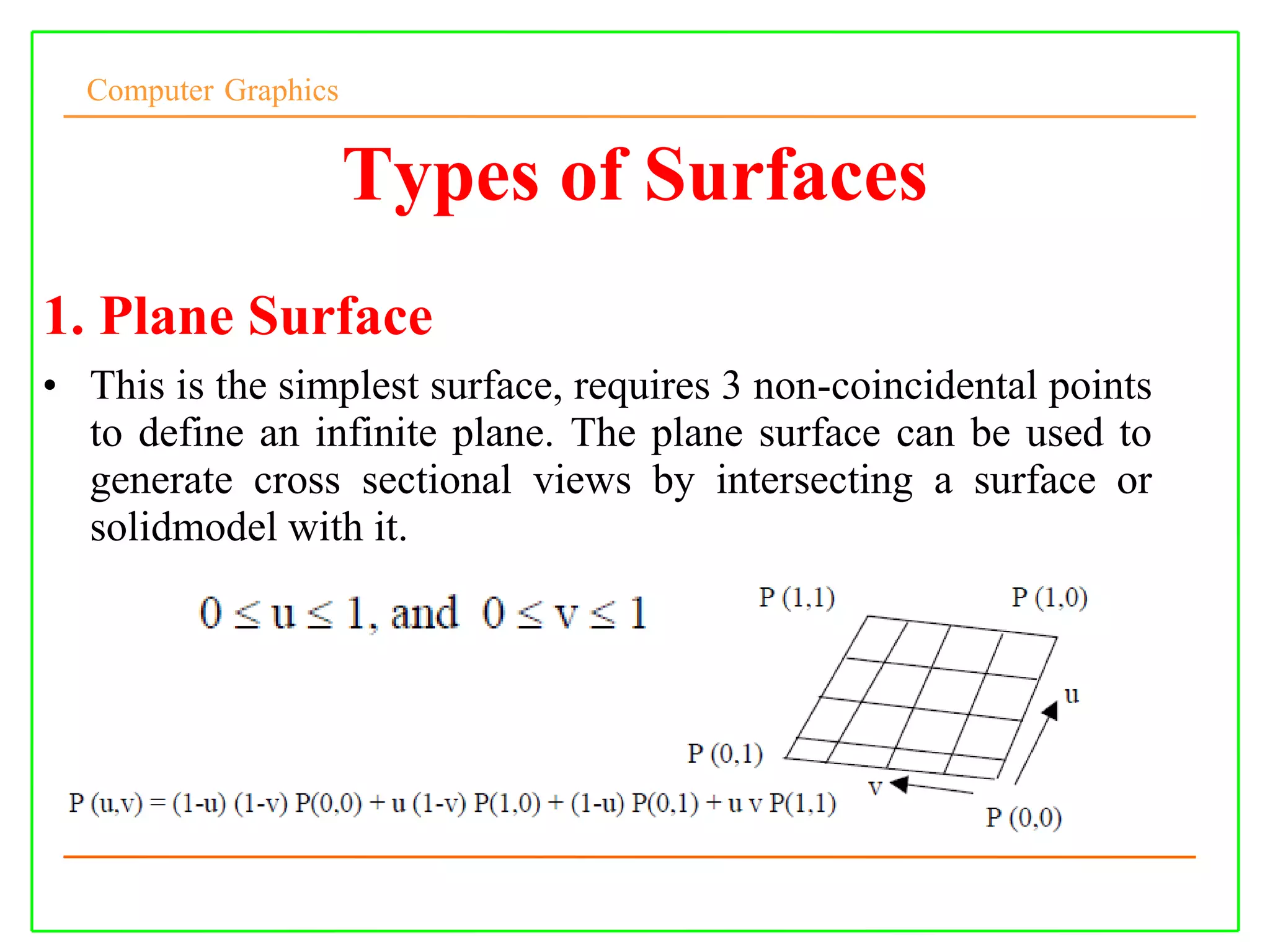
1. Plane Surface
• This is the simplest surface, requires 3 non-coincidental points
to define an infinite plane. The plane surface can be used to
generate cross sectional views by intersecting a surface or
solidmodel with it.
Computer Graphics
2. Ruled (lofted) Surface
This is a linear surface. It interpolates linearly between
two boundary curves that define the surface.
Boundary curves can be any wire frame entity. The
surface is ideal to represent surfaces that do not have
any twists or kinks.
Computer Graphics
3.Surface of Revolution
• This is an axisymmetric surface that can model
axisymmetric objects. It is generated by rotating a
planar wire frame entity in space about the axis of
symmetry of a given angle.
Computer Graphics
4.Tabulated Surface
This is a surface generated by translating a
planar curve a given distance along a
specified direction. The plane of the curve
is perpendicular to the axis of the generated
cylinder.
Computer Graphics
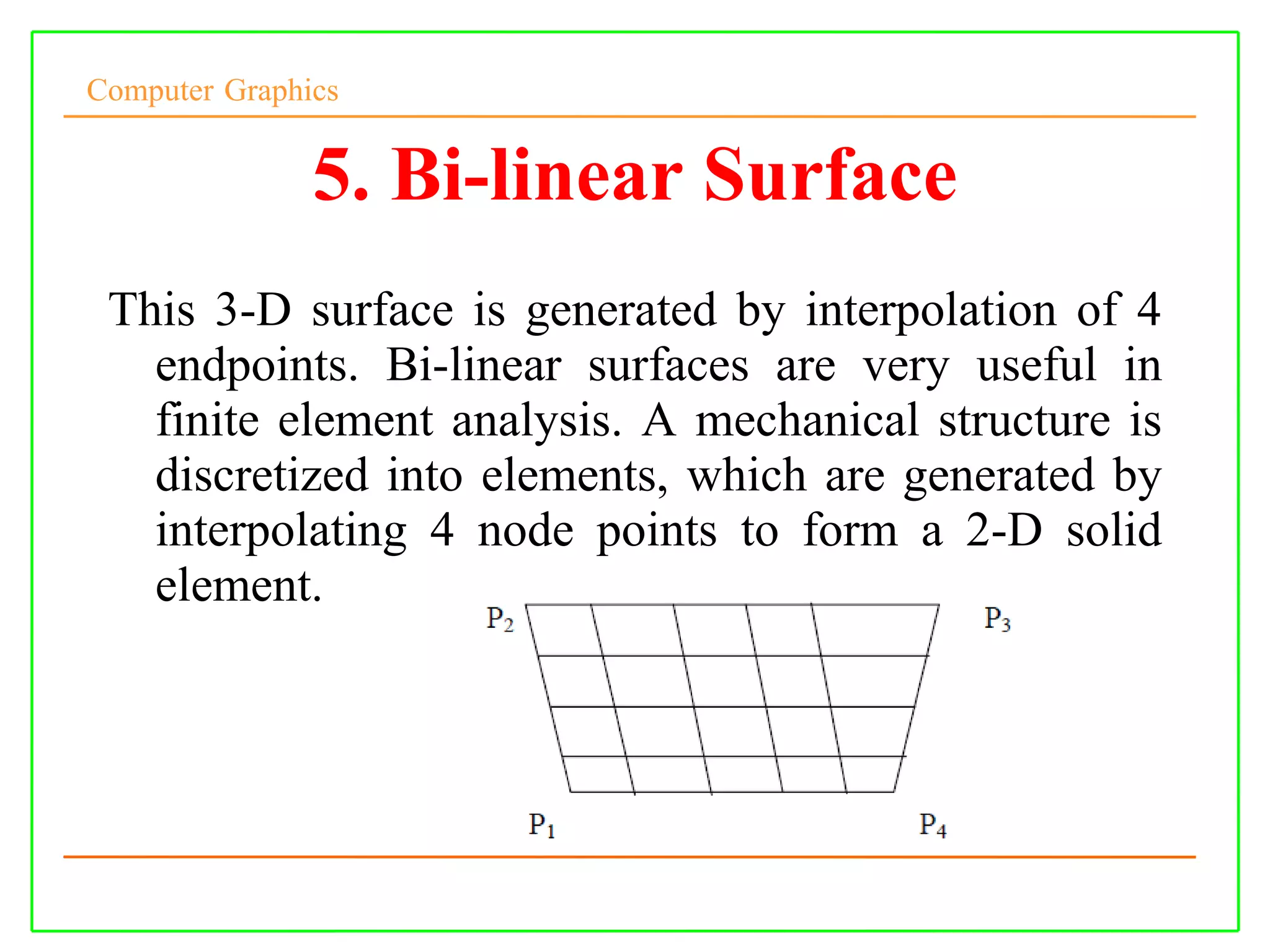
5. Bi-linear Surface
This 3-D surface is generated by interpolation of 4
endpoints. Bi-linear surfaces are very useful in
finite element analysis. A mechanical structure is
discretized into elements, which are generated by
interpolating 4 node points to form a 2-D solid
element.
Computer Graphics
6.Coons Patch
• Coons patch or surface is generated by the
interpolation of 4 edge curves as shown.
Computer Graphics
Bi-cubic patches (Surfaces)
• The concept of parametric curves can be
extended to surfaces
• The cubic parametric curve is in the form of
Q(t)=tTM q where q=(q1,q2,q3,q4) : qi control
points, M is the basis matrix (Hermite or
Bezier,…), tT=(t3, t2, t, 1)
Computer Graphics
• Now we assume qi to vary along a parameter s,
• Qi(s,t)=tTM [q1(s),q2(s),q3(s),q4(s)]
• qi(s) are themselves cubic curves, we can write
them in the form …
Computer Graphics
Bicubic patches
s
M
M
t
M
s
M
s
M
t
t
s
Q
T
T
T
T
T
.
.
.
.
])
[
.
.
],...,
[
.
.
.(
.
)
,
( 4
4
4
41
1
1
1
1
q
q
,
q
,
q
,
q
q
,
q
,
q
,
q 4
3
2
4
3
2
1


where q is a 4x4 matrix
Each column contains the control points of
q1(s),…,q4(s)
x,y,z computed by












44
34
24
14
43
33
23
13
42
32
22
12
41
31
21
11
q
q
q
q
q
q
q
q
q
q
q
q
q
q
q
q
s
M
M
t
t
s
z
s
M
M
t
t
s
y
s
M
M
t
t
s
x
T
z
T
T
y
T
T
x
T
.
.
.
.
)
,
(
.
.
.
.
)
,
(
.
.
.
.
)
,
(
q
q
q



Computer Graphics
14/10/2008 Lecture 6 11
Bézier example
• We compute (x,y,z) by
coords
z
of
array
is
q
s
M
q
M
t
t
s
z
coords
y
of
array
is
q
s
M
q
M
t
t
s
y
coords
x
of
array
is
q
s
M
q
M
t
t
s
x
z
T
B
z
B
T
y
T
B
y
B
T
x
T
B
x
B
T
4
4
.
.
.
.
)
,
(
4
4
.
.
.
.
)
,
(
4
4
.
.
.
.
)
,
(






Computer Graphics
14/10/2008 Lecture 6 12
Continuity of Bicubic patches.
• Hermite and Bézier patches
– C0 continuity by sharing 4
control points between
patches.
– C1 continuity when both sets
of control points either side of
the edge are collinear with the
edge.

Surface models

  • 1.
    Computer Graphics Surface Models •A surface of an object is more complete and less ambiguous representation than its wire frame model; it is an extension of a wire frame model with additional information. • A wire frame model can be extracted from a surface model by deleting all surface entities (not the wireframe entities – point, lines, or curves!). Databases of surface models are centralized and associative, manipulation of surface entities in one view is automatically reflected in the other views. Surface models can be shaded and represented with hidden lines.
  • 2.
    Computer Graphics Types ofSurfaces 1. Plane Surface • This is the simplest surface, requires 3 non-coincidental points to define an infinite plane. The plane surface can be used to generate cross sectional views by intersecting a surface or solidmodel with it.
  • 3.
    Computer Graphics 2. Ruled(lofted) Surface This is a linear surface. It interpolates linearly between two boundary curves that define the surface. Boundary curves can be any wire frame entity. The surface is ideal to represent surfaces that do not have any twists or kinks.
  • 4.
    Computer Graphics 3.Surface ofRevolution • This is an axisymmetric surface that can model axisymmetric objects. It is generated by rotating a planar wire frame entity in space about the axis of symmetry of a given angle.
  • 5.
    Computer Graphics 4.Tabulated Surface Thisis a surface generated by translating a planar curve a given distance along a specified direction. The plane of the curve is perpendicular to the axis of the generated cylinder.
  • 6.
    Computer Graphics 5. Bi-linearSurface This 3-D surface is generated by interpolation of 4 endpoints. Bi-linear surfaces are very useful in finite element analysis. A mechanical structure is discretized into elements, which are generated by interpolating 4 node points to form a 2-D solid element.
  • 7.
    Computer Graphics 6.Coons Patch •Coons patch or surface is generated by the interpolation of 4 edge curves as shown.
  • 8.
    Computer Graphics Bi-cubic patches(Surfaces) • The concept of parametric curves can be extended to surfaces • The cubic parametric curve is in the form of Q(t)=tTM q where q=(q1,q2,q3,q4) : qi control points, M is the basis matrix (Hermite or Bezier,…), tT=(t3, t2, t, 1)
  • 9.
    Computer Graphics • Nowwe assume qi to vary along a parameter s, • Qi(s,t)=tTM [q1(s),q2(s),q3(s),q4(s)] • qi(s) are themselves cubic curves, we can write them in the form …
  • 10.
    Computer Graphics Bicubic patches s M M t M s M s M t t s Q T T T T T . . . . ]) [ . . ],..., [ . . .( . ) , (4 4 4 41 1 1 1 1 q q , q , q , q q , q , q , q 4 3 2 4 3 2 1   where q is a 4x4 matrix Each column contains the control points of q1(s),…,q4(s) x,y,z computed by             44 34 24 14 43 33 23 13 42 32 22 12 41 31 21 11 q q q q q q q q q q q q q q q q s M M t t s z s M M t t s y s M M t t s x T z T T y T T x T . . . . ) , ( . . . . ) , ( . . . . ) , ( q q q   
  • 11.
    Computer Graphics 14/10/2008 Lecture6 11 Bézier example • We compute (x,y,z) by coords z of array is q s M q M t t s z coords y of array is q s M q M t t s y coords x of array is q s M q M t t s x z T B z B T y T B y B T x T B x B T 4 4 . . . . ) , ( 4 4 . . . . ) , ( 4 4 . . . . ) , (      
  • 12.
    Computer Graphics 14/10/2008 Lecture6 12 Continuity of Bicubic patches. • Hermite and Bézier patches – C0 continuity by sharing 4 control points between patches. – C1 continuity when both sets of control points either side of the edge are collinear with the edge.