Chapter 9 Cellular Respiration: Harvesting Chemical Energy
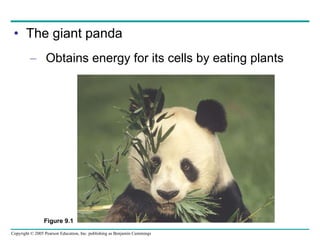
The giant panda Obtains energy for its cells by eating plants Figure 9.1
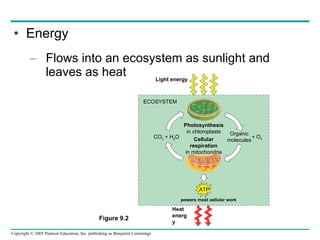
Energy Flows into an ecosystem as sunlight and leaves as heat Light energy ECOSYSTEM CO 2  + H 2 O Photosynthesis in chloroplasts Cellular respiration in mitochondria Organic molecules + O 2 ATP powers most cellular work  Heat energy Figure 9.2
Concept 9.1: Catabolic pathways yield energy by oxidizing organic fuels The breakdown of organic molecules is exergonic One catabolic process, fermentation Is a partial degradation of sugars that occurs without oxygen
Cellular respiration Is the most prevalent and efficient catabolic pathway Consumes oxygen and organic molecules such as glucose Yields ATP
Redox Reactions: Oxidation and Reduction Catabolic pathways yield energy Due to the transfer of electrons Redox reactions Transfer electrons from one reactant to another by oxidation and reduction
In oxidation A substance loses electrons, or is oxidized In reduction A substance gains electrons, or is reduced
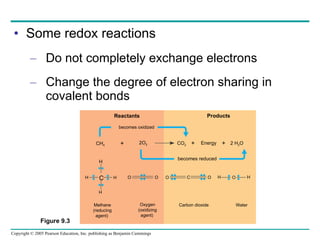
Some redox reactions Do not completely exchange electrons Change the degree of electron sharing in covalent bonds CH 4 H H H H C O O O O O C H H Methane (reducing agent)  Oxygen (oxidizing agent)  Carbon dioxide  Water + 2O 2 CO 2 + Energy + 2 H 2 O becomes oxidized becomes reduced Reactants Products Figure 9.3
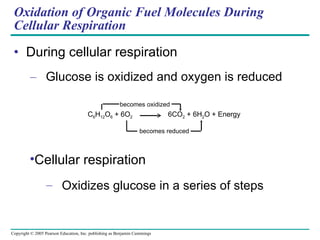
Oxidation of Organic Fuel Molecules During Cellular Respiration During cellular respiration Glucose is oxidized and oxygen is reduced Cellular respiration Oxidizes glucose in a series of steps C 6 H 12 O 6  + 6O 2   6CO 2  + 6H 2 O + Energy becomes oxidized becomes reduced
Electrons from organic compounds Are usually first transferred to NAD + , a coenzyme NAD + H O O O O – O O O – O O O P P CH 2 CH 2 HO OH H H HO OH HO H H N + C NH 2 H N H NH 2 N N Nicotinamide (oxidized form) NH 2 + 2[H] (from food) Dehydrogenase Reduction of NAD + Oxidation of NADH 2 e –  + 2 H + 2 e –  + H + NADH O H H N C + Nicotinamide (reduced form) N Figure 9.4
NADH, the reduced form of NAD + Passes the electrons to the electron transport chain
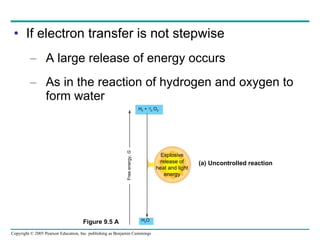
If electron transfer is not stepwise A large release of energy occurs As in the reaction of hydrogen and oxygen to form water (a) Uncontrolled reaction Free energy,  G H 2 O Explosive release of heat and light energy Figure 9.5 A H 2  +  1 / 2  O 2
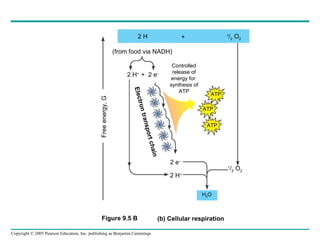
The electron transport chain Passes electrons in a series of steps instead of in one explosive reaction Uses the energy from the electron transfer to form ATP
2 H 1 / 2  O 2 (from food via NADH) 2 H +  +  2 e – 2 H + 2 e – H 2 O 1 / 2  O 2 Controlled release of energy for  synthesis of ATP ATP ATP ATP Electron transport chain  Free energy, G (b) Cellular respiration + Figure 9.5 B
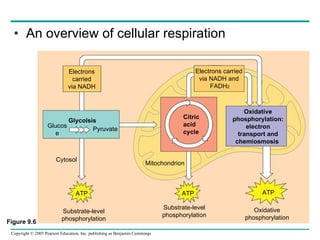
The Stages of Cellular Respiration:  A Preview Respiration is a cumulative function of three metabolic stages Glycolysis The citric acid cycle Oxidative phosphorylation
Glycolysis Breaks down glucose into two molecules of pyruvate The citric acid cycle Completes the breakdown of glucose Oxidative phosphorylation Is driven by the electron transport chain Generates ATP
An overview of cellular respiration Figure 9.6 Electrons carried via NADH Glycolsis Glucose Pyruvate ATP Substrate-level phosphorylation Electrons carried  via NADH and  FADH 2 Citric acid cycle Oxidative phosphorylation: electron transport and chemiosmosis  ATP ATP Substrate-level phosphorylation Oxidative phosphorylation Mitochondrion Cytosol
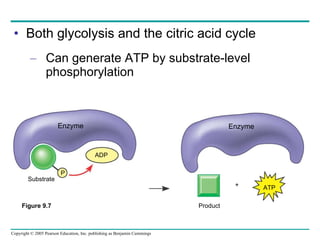
Both glycolysis and the citric acid cycle Can generate ATP by substrate-level phosphorylation Figure 9.7 Enzyme Enzyme ATP ADP Product Substrate P +
Concept 9.2: Glycolysis harvests energy by oxidizing glucose to pyruvate Glycolysis Means “splitting of sugar” Breaks down glucose into pyruvate Occurs in the cytoplasm of the cell
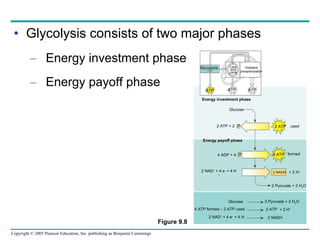
Glycolysis consists of two major phases Energy investment phase Energy payoff phase Glycolysis Citric acid cycle Oxidative phosphorylation ATP ATP ATP 2 ATP 4 ATP used formed Glucose 2 ATP + 2  P 4 ADP + 4 P 2 NAD +  + 4 e -  + 4 H  + 2 NADH + 2 H + 2 Pyruvate + 2 H 2 O Energy investment phase Energy payoff phase Glucose 2 Pyruvate + 2 H 2 O 4 ATP formed – 2 ATP used 2 ATP 2 NAD +  + 4 e –  + 4 H  + 2 NADH + 2 H + Figure 9.8
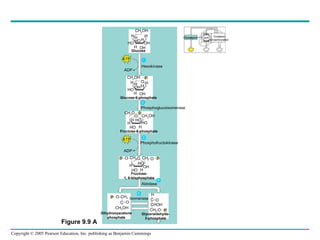
A closer look at the energy investment phase
Dihydroxyacetone phosphate Glyceraldehyde- 3-phosphate H H H H H OH OH HO HO CH 2 OH H H H H O H OH HO OH P CH 2 O P H O H HO HO H HO CH 2 OH P O CH 2 O CH 2 O P HO H HO H OH O P CH 2 C O CH 2 OH H C CHOH CH 2 O O P ATP ADP Hexokinase Glucose Glucose-6-phosphate Fructose-6-phosphate ATP ADP Phosphoglucoisomerase Phosphofructokinase Fructose- 1, 6-bisphosphate Aldolase Isomerase Glycolysis 1 2 3 4 5 CH 2 OH Oxidative phosphorylation Citric acid cycle Figure 9.9 A
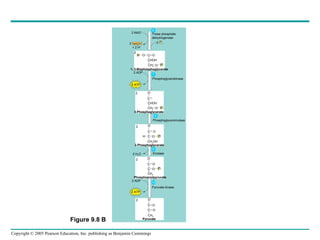
A closer look at the energy payoff phase
2 NAD + NADH 2 + 2 H + Triose phosphate dehydrogenase 2 P  i 2 P C CHOH O P O CH 2 O 2 O – 1, 3-Bisphosphoglycerate 2 ADP 2 ATP Phosphoglycerokinase CH 2 O P 2 C CHOH 3-Phosphoglycerate Phosphoglyceromutase O – C C CH 2 OH H O P 2-Phosphoglycerate 2 H 2 O 2 O – Enolase C C O P O CH 2 Phosphoenolpyruvate 2 ADP 2 ATP Pyruvate kinase O – C C O O CH 3 2 6 8 7 9 10 Pyruvate O Figure 9.8 B
Concept 9.3: The citric acid cycle completes the energy-yielding oxidation of organic molecules The citric acid cycle Takes place in the matrix of the mitochondrion
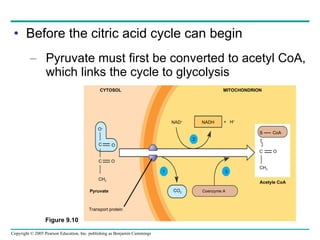
Before the citric acid cycle can begin Pyruvate must first be converted to acetyl CoA, which links the cycle to glycolysis CYTOSOL MITOCHONDRION NADH +  H + NAD + 2 3 1 CO 2 Coenzyme A Pyruvate Acetyle CoA S CoA C CH 3 O Transport protein O – O O C C CH 3 Figure 9.10
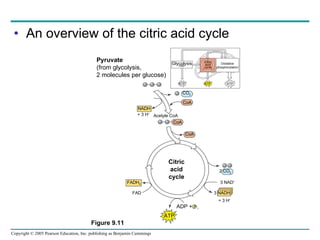
An overview of the citric acid cycle ATP 2 CO 2 3 NAD + 3 NADH + 3 H + ADP +  P   i FAD FADH 2 Citric acid cycle CoA CoA Acetyle CoA NADH + 3 H + CoA CO 2 Pyruvate (from glycolysis, 2 molecules per glucose) ATP ATP ATP Glycolysis Citric acid cycle Oxidative phosphorylation Figure 9.11
A closer look at the citric acid cycle
Concept 9.4: During oxidative phosphorylation, chemiosmosis couples electron transport to ATP synthesis NADH and FADH 2 Donate electrons to the electron transport chain, which powers ATP synthesis via oxidative phosphorylation
The Pathway of Electron Transport In the electron transport chain Electrons from NADH and FADH 2  lose energy in several steps
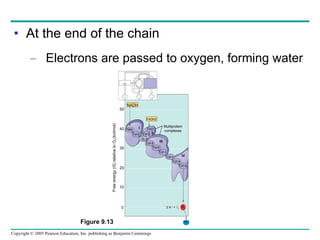
At the end of the chain Electrons are passed to oxygen, forming water H 2 O O 2 NADH FADH2 FMN Fe•S Fe•S Fe•S O FAD Cyt  b Cyt  c 1 Cyt  c Cyt  a Cyt  a 3 2 H  +  +  1  2 I II III IV Multiprotein complexes 0 10 20 30 40 50 Free energy ( G ) relative to O 2  (kcl/mol) Figure 9.13
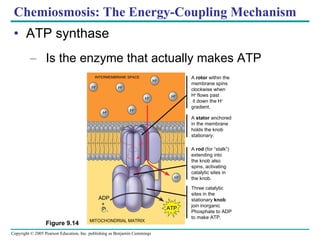
Chemiosmosis: The Energy-Coupling Mechanism ATP synthase Is the enzyme that actually makes ATP INTERMEMBRANE SPACE H + H + H + H + H + H + H + H + P  i + ADP ATP A  rotor  within the  membrane spins  clockwise when H +  flows past  it down the H +  gradient. A  stator  anchored in the membrane holds the knob stationary. A  rod  (for “stalk”) extending into  the knob also spins, activating catalytic sites in the knob. Three catalytic  sites in the  stationary  knob join inorganic  Phosphate to ADP to make ATP.   MITOCHONDRIAL MATRIX Figure 9.14
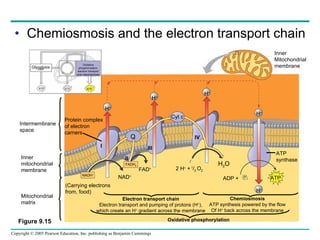
At certain steps along the electron transport chain Electron transfer causes protein complexes to pump H +  from the mitochondrial matrix to the intermembrane space
The resulting H +  gradient Stores energy Drives chemiosmosis in ATP synthase Is referred to as a proton-motive force Chemiosmosis Is an energy-coupling mechanism that uses energy in the form of a H +  gradient across a membrane to drive cellular work
Chemiosmosis and the electron transport chain Oxidative phosphorylation. electron transport and chemiosmosis Glycolysis ATP ATP ATP Inner Mitochondrial membrane H + H + H + H + H + ATP P  i Protein complex of electron  carners Cyt  c I II III IV (Carrying electrons from, food) NADH + FADH 2 NAD + FAD + 2 H +  +  1 / 2  O 2 H 2 O ADP + Electron transport chain Electron transport and pumping of protons (H + ), which create an H +  gradient across the membrane Chemiosmosis ATP synthesis powered by the flow Of H +  back across the membrane ATP synthase Q Oxidative phosphorylation Intermembrane space Inner mitochondrial membrane Mitochondrial matrix Figure 9.15
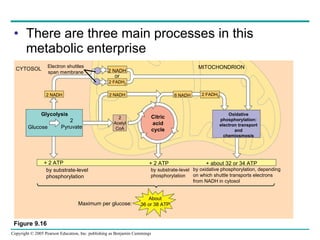
An Accounting of ATP Production by Cellular Respiration During respiration, most energy flows in this sequence Glucose to NADH to electron transport chain to proton-motive force to ATP
There are three main processes in this metabolic enterprise Electron shuttles span membrane CYTOSOL 2 NADH 2 FADH 2 2 NADH 6 NADH  2 FADH 2 2 NADH Glycolysis Glucose 2 Pyruvate 2 Acetyl CoA Citric acid cycle Oxidative phosphorylation: electron transport and chemiosmosis MITOCHONDRION by substrate-level phosphorylation by substrate-level phosphorylation by oxidative phosphorylation, depending on which shuttle transports electrons from NADH in cytosol  Maximum per glucose: About 36 or 38 ATP + 2 ATP + 2 ATP + about 32 or 34 ATP or Figure 9.16
About 40% of the energy in a glucose molecule Is transferred to ATP during cellular respiration, making approximately 38 ATP
Concept 9.5: Fermentation enables some cells to produce ATP without the use of oxygen Cellular respiration Relies on oxygen to produce ATP In the absence of oxygen Cells can still produce ATP through fermentation
Glycolysis Can produce ATP with or without oxygen, in aerobic or anaerobic conditions Couples with fermentation to produce ATP Fermentation consists of Glycolysis plus reactions that regenerate NAD + , which can be reused by glycolysis
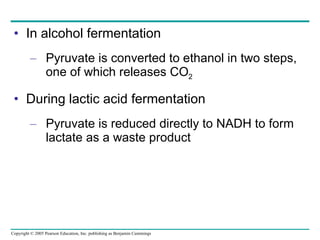
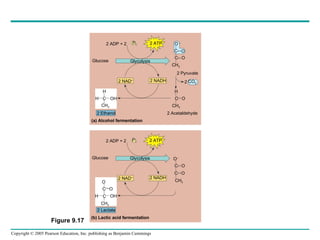
In alcohol fermentation Pyruvate is converted to ethanol in two steps, one of which releases CO 2 During lactic acid fermentation Pyruvate is reduced directly to NADH to form lactate as a waste product
2 ADP + 2 P 1 2 ATP Glycolysis Glucose 2 NAD + 2 NADH 2 Pyruvate 2 Acetaldehyde 2 Ethanol (a) Alcohol fermentation 2 ADP + 2 P 1 2 ATP Glycolysis Glucose 2 NAD + 2 NADH 2 Lactate (b) Lactic acid fermentation H H OH CH 3 C O  – O C C O CH 3 H C O CH 3 O – C O C O CH 3 O C O C OH H CH 3 CO 2 2 Figure 9.17
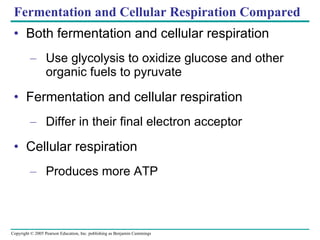
Fermentation and Cellular Respiration Compared Both fermentation and cellular respiration Use glycolysis to oxidize glucose and other organic fuels to pyruvate Fermentation and cellular respiration Differ in their final electron acceptor Cellular respiration Produces more ATP
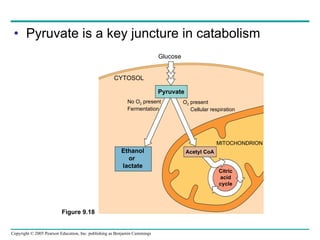
Pyruvate is a key juncture in catabolism Glucose CYTOSOL Pyruvate No O 2  present Fermentation O 2  present Cellular respiration Ethanol or  lactate Acetyl CoA MITOCHONDRION Citric acid cycle Figure 9.18
The Evolutionary Significance of Glycolysis Glycolysis Occurs in nearly all organisms Probably evolved in ancient prokaryotes before there was oxygen in the atmosphere Concept 9.6: Glycolysis and the citric acid cycle connect to many other metabolic pathways
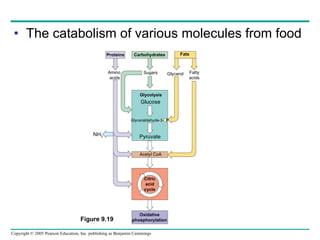
The Versatility of Catabolism Catabolic pathways Funnel electrons from many kinds of organic molecules into cellular respiration
The catabolism of various molecules from food Amino  acids Sugars Glycerol Fatty acids Glycolysis Glucose Glyceraldehyde-3-  P Pyruvate Acetyl CoA NH 3 Citric acid cycle Oxidative phosphorylation Fats Proteins Carbohydrates Figure 9.19
Biosynthesis (Anabolic Pathways) The body Uses small molecules to build other substances These small molecules May come directly from food or through glycolysis or the citric acid cycle
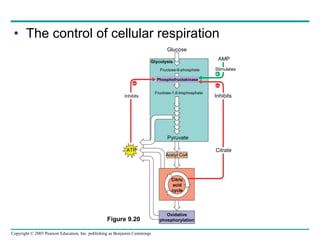
Regulation of Cellular Respiration via Feedback Mechanisms Cellular respiration Is controlled by allosteric enzymes at key points in glycolysis and the citric acid cycle
The control of cellular respiration Glucose Glycolysis Fructose-6-phosphate Phosphofructokinase Fructose-1,6-bisphosphate Inhibits Inhibits Pyruvate ATP Acetyl CoA Citric acid cycle Citrate Oxidative phosphorylation Stimulates AMP + – – Figure 9.20

forjeffpark

  • 1.
    Chapter 9 CellularRespiration: Harvesting Chemical Energy
  • 2.
    The giant pandaObtains energy for its cells by eating plants Figure 9.1
  • 3.
    Energy Flows intoan ecosystem as sunlight and leaves as heat Light energy ECOSYSTEM CO 2 + H 2 O Photosynthesis in chloroplasts Cellular respiration in mitochondria Organic molecules + O 2 ATP powers most cellular work Heat energy Figure 9.2
  • 4.
    Concept 9.1: Catabolicpathways yield energy by oxidizing organic fuels The breakdown of organic molecules is exergonic One catabolic process, fermentation Is a partial degradation of sugars that occurs without oxygen
  • 5.
    Cellular respiration Isthe most prevalent and efficient catabolic pathway Consumes oxygen and organic molecules such as glucose Yields ATP
  • 6.
    Redox Reactions: Oxidationand Reduction Catabolic pathways yield energy Due to the transfer of electrons Redox reactions Transfer electrons from one reactant to another by oxidation and reduction
  • 7.
    In oxidation Asubstance loses electrons, or is oxidized In reduction A substance gains electrons, or is reduced
  • 8.
    Some redox reactionsDo not completely exchange electrons Change the degree of electron sharing in covalent bonds CH 4 H H H H C O O O O O C H H Methane (reducing agent) Oxygen (oxidizing agent) Carbon dioxide Water + 2O 2 CO 2 + Energy + 2 H 2 O becomes oxidized becomes reduced Reactants Products Figure 9.3
  • 9.
    Oxidation of OrganicFuel Molecules During Cellular Respiration During cellular respiration Glucose is oxidized and oxygen is reduced Cellular respiration Oxidizes glucose in a series of steps C 6 H 12 O 6 + 6O 2 6CO 2 + 6H 2 O + Energy becomes oxidized becomes reduced
  • 10.
    Electrons from organiccompounds Are usually first transferred to NAD + , a coenzyme NAD + H O O O O – O O O – O O O P P CH 2 CH 2 HO OH H H HO OH HO H H N + C NH 2 H N H NH 2 N N Nicotinamide (oxidized form) NH 2 + 2[H] (from food) Dehydrogenase Reduction of NAD + Oxidation of NADH 2 e – + 2 H + 2 e – + H + NADH O H H N C + Nicotinamide (reduced form) N Figure 9.4
  • 11.
    NADH, the reducedform of NAD + Passes the electrons to the electron transport chain
  • 12.
    If electron transferis not stepwise A large release of energy occurs As in the reaction of hydrogen and oxygen to form water (a) Uncontrolled reaction Free energy, G H 2 O Explosive release of heat and light energy Figure 9.5 A H 2 + 1 / 2 O 2
  • 13.
    The electron transportchain Passes electrons in a series of steps instead of in one explosive reaction Uses the energy from the electron transfer to form ATP
  • 14.
    2 H 1/ 2 O 2 (from food via NADH) 2 H + + 2 e – 2 H + 2 e – H 2 O 1 / 2 O 2 Controlled release of energy for synthesis of ATP ATP ATP ATP Electron transport chain Free energy, G (b) Cellular respiration + Figure 9.5 B
  • 15.
    The Stages ofCellular Respiration: A Preview Respiration is a cumulative function of three metabolic stages Glycolysis The citric acid cycle Oxidative phosphorylation
  • 16.
    Glycolysis Breaks downglucose into two molecules of pyruvate The citric acid cycle Completes the breakdown of glucose Oxidative phosphorylation Is driven by the electron transport chain Generates ATP
  • 17.
    An overview ofcellular respiration Figure 9.6 Electrons carried via NADH Glycolsis Glucose Pyruvate ATP Substrate-level phosphorylation Electrons carried via NADH and FADH 2 Citric acid cycle Oxidative phosphorylation: electron transport and chemiosmosis ATP ATP Substrate-level phosphorylation Oxidative phosphorylation Mitochondrion Cytosol
  • 18.
    Both glycolysis andthe citric acid cycle Can generate ATP by substrate-level phosphorylation Figure 9.7 Enzyme Enzyme ATP ADP Product Substrate P +
  • 19.
    Concept 9.2: Glycolysisharvests energy by oxidizing glucose to pyruvate Glycolysis Means “splitting of sugar” Breaks down glucose into pyruvate Occurs in the cytoplasm of the cell
  • 20.
    Glycolysis consists oftwo major phases Energy investment phase Energy payoff phase Glycolysis Citric acid cycle Oxidative phosphorylation ATP ATP ATP 2 ATP 4 ATP used formed Glucose 2 ATP + 2 P 4 ADP + 4 P 2 NAD + + 4 e - + 4 H + 2 NADH + 2 H + 2 Pyruvate + 2 H 2 O Energy investment phase Energy payoff phase Glucose 2 Pyruvate + 2 H 2 O 4 ATP formed – 2 ATP used 2 ATP 2 NAD + + 4 e – + 4 H + 2 NADH + 2 H + Figure 9.8
  • 21.
    A closer lookat the energy investment phase
  • 22.
    Dihydroxyacetone phosphate Glyceraldehyde-3-phosphate H H H H H OH OH HO HO CH 2 OH H H H H O H OH HO OH P CH 2 O P H O H HO HO H HO CH 2 OH P O CH 2 O CH 2 O P HO H HO H OH O P CH 2 C O CH 2 OH H C CHOH CH 2 O O P ATP ADP Hexokinase Glucose Glucose-6-phosphate Fructose-6-phosphate ATP ADP Phosphoglucoisomerase Phosphofructokinase Fructose- 1, 6-bisphosphate Aldolase Isomerase Glycolysis 1 2 3 4 5 CH 2 OH Oxidative phosphorylation Citric acid cycle Figure 9.9 A
  • 23.
    A closer lookat the energy payoff phase
  • 24.
    2 NAD +NADH 2 + 2 H + Triose phosphate dehydrogenase 2 P i 2 P C CHOH O P O CH 2 O 2 O – 1, 3-Bisphosphoglycerate 2 ADP 2 ATP Phosphoglycerokinase CH 2 O P 2 C CHOH 3-Phosphoglycerate Phosphoglyceromutase O – C C CH 2 OH H O P 2-Phosphoglycerate 2 H 2 O 2 O – Enolase C C O P O CH 2 Phosphoenolpyruvate 2 ADP 2 ATP Pyruvate kinase O – C C O O CH 3 2 6 8 7 9 10 Pyruvate O Figure 9.8 B
  • 25.
    Concept 9.3: Thecitric acid cycle completes the energy-yielding oxidation of organic molecules The citric acid cycle Takes place in the matrix of the mitochondrion
  • 26.
    Before the citricacid cycle can begin Pyruvate must first be converted to acetyl CoA, which links the cycle to glycolysis CYTOSOL MITOCHONDRION NADH + H + NAD + 2 3 1 CO 2 Coenzyme A Pyruvate Acetyle CoA S CoA C CH 3 O Transport protein O – O O C C CH 3 Figure 9.10
  • 27.
    An overview ofthe citric acid cycle ATP 2 CO 2 3 NAD + 3 NADH + 3 H + ADP + P i FAD FADH 2 Citric acid cycle CoA CoA Acetyle CoA NADH + 3 H + CoA CO 2 Pyruvate (from glycolysis, 2 molecules per glucose) ATP ATP ATP Glycolysis Citric acid cycle Oxidative phosphorylation Figure 9.11
  • 28.
    A closer lookat the citric acid cycle
  • 29.
    Concept 9.4: Duringoxidative phosphorylation, chemiosmosis couples electron transport to ATP synthesis NADH and FADH 2 Donate electrons to the electron transport chain, which powers ATP synthesis via oxidative phosphorylation
  • 30.
    The Pathway ofElectron Transport In the electron transport chain Electrons from NADH and FADH 2 lose energy in several steps
  • 31.
    At the endof the chain Electrons are passed to oxygen, forming water H 2 O O 2 NADH FADH2 FMN Fe•S Fe•S Fe•S O FAD Cyt b Cyt c 1 Cyt c Cyt a Cyt a 3 2 H + + 1  2 I II III IV Multiprotein complexes 0 10 20 30 40 50 Free energy ( G ) relative to O 2 (kcl/mol) Figure 9.13
  • 32.
    Chemiosmosis: The Energy-CouplingMechanism ATP synthase Is the enzyme that actually makes ATP INTERMEMBRANE SPACE H + H + H + H + H + H + H + H + P i + ADP ATP A rotor within the membrane spins clockwise when H + flows past it down the H + gradient. A stator anchored in the membrane holds the knob stationary. A rod (for “stalk”) extending into the knob also spins, activating catalytic sites in the knob. Three catalytic sites in the stationary knob join inorganic Phosphate to ADP to make ATP. MITOCHONDRIAL MATRIX Figure 9.14
  • 33.
    At certain stepsalong the electron transport chain Electron transfer causes protein complexes to pump H + from the mitochondrial matrix to the intermembrane space
  • 34.
    The resulting H+ gradient Stores energy Drives chemiosmosis in ATP synthase Is referred to as a proton-motive force Chemiosmosis Is an energy-coupling mechanism that uses energy in the form of a H + gradient across a membrane to drive cellular work
  • 35.
    Chemiosmosis and theelectron transport chain Oxidative phosphorylation. electron transport and chemiosmosis Glycolysis ATP ATP ATP Inner Mitochondrial membrane H + H + H + H + H + ATP P i Protein complex of electron carners Cyt c I II III IV (Carrying electrons from, food) NADH + FADH 2 NAD + FAD + 2 H + + 1 / 2 O 2 H 2 O ADP + Electron transport chain Electron transport and pumping of protons (H + ), which create an H + gradient across the membrane Chemiosmosis ATP synthesis powered by the flow Of H + back across the membrane ATP synthase Q Oxidative phosphorylation Intermembrane space Inner mitochondrial membrane Mitochondrial matrix Figure 9.15
  • 36.
    An Accounting ofATP Production by Cellular Respiration During respiration, most energy flows in this sequence Glucose to NADH to electron transport chain to proton-motive force to ATP
  • 37.
    There are threemain processes in this metabolic enterprise Electron shuttles span membrane CYTOSOL 2 NADH 2 FADH 2 2 NADH 6 NADH 2 FADH 2 2 NADH Glycolysis Glucose 2 Pyruvate 2 Acetyl CoA Citric acid cycle Oxidative phosphorylation: electron transport and chemiosmosis MITOCHONDRION by substrate-level phosphorylation by substrate-level phosphorylation by oxidative phosphorylation, depending on which shuttle transports electrons from NADH in cytosol Maximum per glucose: About 36 or 38 ATP + 2 ATP + 2 ATP + about 32 or 34 ATP or Figure 9.16
  • 38.
    About 40% ofthe energy in a glucose molecule Is transferred to ATP during cellular respiration, making approximately 38 ATP
  • 39.
    Concept 9.5: Fermentationenables some cells to produce ATP without the use of oxygen Cellular respiration Relies on oxygen to produce ATP In the absence of oxygen Cells can still produce ATP through fermentation
  • 40.
    Glycolysis Can produceATP with or without oxygen, in aerobic or anaerobic conditions Couples with fermentation to produce ATP Fermentation consists of Glycolysis plus reactions that regenerate NAD + , which can be reused by glycolysis
  • 41.
    In alcohol fermentationPyruvate is converted to ethanol in two steps, one of which releases CO 2 During lactic acid fermentation Pyruvate is reduced directly to NADH to form lactate as a waste product
  • 42.
    2 ADP +2 P 1 2 ATP Glycolysis Glucose 2 NAD + 2 NADH 2 Pyruvate 2 Acetaldehyde 2 Ethanol (a) Alcohol fermentation 2 ADP + 2 P 1 2 ATP Glycolysis Glucose 2 NAD + 2 NADH 2 Lactate (b) Lactic acid fermentation H H OH CH 3 C O – O C C O CH 3 H C O CH 3 O – C O C O CH 3 O C O C OH H CH 3 CO 2 2 Figure 9.17
  • 43.
    Fermentation and CellularRespiration Compared Both fermentation and cellular respiration Use glycolysis to oxidize glucose and other organic fuels to pyruvate Fermentation and cellular respiration Differ in their final electron acceptor Cellular respiration Produces more ATP
  • 44.
    Pyruvate is akey juncture in catabolism Glucose CYTOSOL Pyruvate No O 2 present Fermentation O 2 present Cellular respiration Ethanol or lactate Acetyl CoA MITOCHONDRION Citric acid cycle Figure 9.18
  • 45.
    The Evolutionary Significanceof Glycolysis Glycolysis Occurs in nearly all organisms Probably evolved in ancient prokaryotes before there was oxygen in the atmosphere Concept 9.6: Glycolysis and the citric acid cycle connect to many other metabolic pathways
  • 46.
    The Versatility ofCatabolism Catabolic pathways Funnel electrons from many kinds of organic molecules into cellular respiration
  • 47.
    The catabolism ofvarious molecules from food Amino acids Sugars Glycerol Fatty acids Glycolysis Glucose Glyceraldehyde-3- P Pyruvate Acetyl CoA NH 3 Citric acid cycle Oxidative phosphorylation Fats Proteins Carbohydrates Figure 9.19
  • 48.
    Biosynthesis (Anabolic Pathways)The body Uses small molecules to build other substances These small molecules May come directly from food or through glycolysis or the citric acid cycle
  • 49.
    Regulation of CellularRespiration via Feedback Mechanisms Cellular respiration Is controlled by allosteric enzymes at key points in glycolysis and the citric acid cycle
  • 50.
    The control ofcellular respiration Glucose Glycolysis Fructose-6-phosphate Phosphofructokinase Fructose-1,6-bisphosphate Inhibits Inhibits Pyruvate ATP Acetyl CoA Citric acid cycle Citrate Oxidative phosphorylation Stimulates AMP + – – Figure 9.20